
A Croatian feed mill selected a DCS-50P*2 mixed feed packing scale for controlled 20–40 kg filling of pellets, crumbles and selected mash feeds.
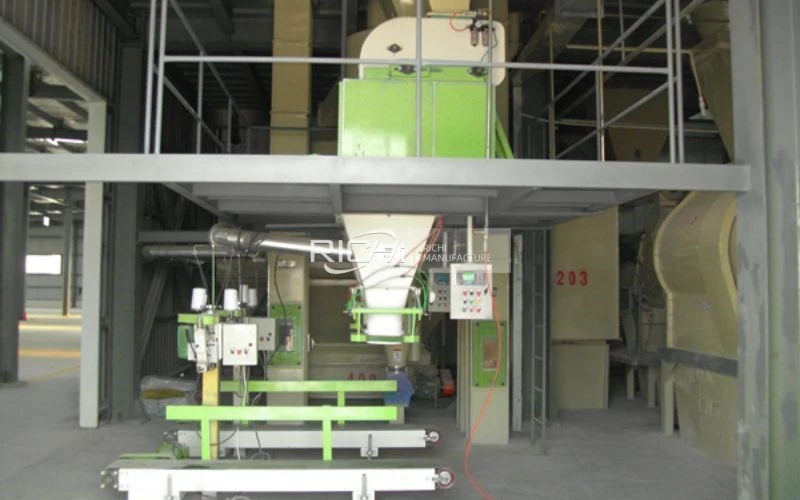
A feed manufacturer in Osijek-Baranja County selected a DCS-50P*2 Mixed Feed Packing Scale in Croatia to improve weighing and bag filling across several finished-feed categories. The mill produces pig feed pellets, poultry pellets and crumbles, selected mash products and smaller-diameter specialty feed, with 20 kg, 25 kg and 40 kg bags used according to product and customer requirement.
The customer retained its finished-product bins, downstream conveyor and bag-closing equipment and concentrated the investment on the weighing and filling stage. The DCS-50P*2 uses belt feeding and provides a reference speed of 10–12 bags per minute, giving the approximately 35,000 T/A feed operation sufficient packing margin when smaller bags and different feed forms are scheduled through the same section.
Name:
animal feed weighing and packing scale
Country:
Croatia
Date:
2026
Capacity:
10–12 bags/min
Model:
DCS-50P*2
Power:
1.5×2 + 0.55 + 0.37 kW
Feeding Method:
Belt feeding
Bag Sizes:
20 kg, 25 kg and 40 kg
The feed mill did not package one product with one permanent bulk density.
Pig pellets normally flow freely from a finished-product bin. Poultry crumbles contain more small particles. Mash feed behaves differently again, while coated specialty pellets can become less free-flowing when surface oil increases.
A packing system configured only around one easy-flowing pellet would therefore create operating problems when production moved to another feed category.
The customer needed a weighing system that could meter different dry compound feeds while maintaining controlled filling near the target bag weight.
| Project Parameter | Configuration |
|---|---|
| Equipment | Mixed animal feed weighing and packing scale |
| Model | DCS-50P*2 |
| Feeding Method | Belt feeding |
| Suitable Materials | Feed pellets, crumbles, mash and other qualified feed materials |
| Packaging Speed | 10–12 bags/min under suitable operating conditions |
| Installed Power | 1.5×2 + 0.55 + 0.37 kW |
| Static Weighing Accuracy | ±0.1% |
| Dynamic Weighing Accuracy | ±0.2% |
| Compressed Air Requirement | 0.4–0.6 MPa, approximately 1.5 m³/h |
| Packaging Range | 10–50 kg/bag |
| Main Project Bag Sizes | 20 kg, 25 kg and 40 kg |
| Bag Closing | Sewing, thermoplastic sealing or combined closing according to bag structure |
| Installation Type | Standalone packing-scale retrofit in an operating feed mill |
The stated speed and accuracy are machine reference values. Actual performance depends on feed flowability, bulk density, target bag weight, belt settings, scale calibration, installation vibration and downstream bag handling.
Gravity filling is effective for clean, free-flowing pellets, but this customer also packages products that do not always discharge from a hopper at the same rate.
Belt feeding gives the packing scale more control over material delivery into the weighing section. The feed stream can be reduced as the target weight approaches instead of depending entirely on the natural flow of the product.
This is useful when the same packing station handles pellets, crumbles and selected mash feeds.
The belt arrangement also avoids using an auger as the normal metering device for fragile finished pellets. An auger is appropriate for many powders, but repeated mechanical contact can be undesirable when the principal product is already formed feed.
The main reason for choosing the DCS-50P*2 rather than the DCS-50P is packaging rate.
The single-belt DCS-50P is rated at 6–8 bags per minute, while the DCS-50P*2 provides a reference range of 10–12 bags per minute.
This difference becomes more important with 20 kg bags.
At 10 bags per minute, 20 kg bags represent approximately 12 T/H during continuous filling. At 12 bags per minute, the theoretical figure reaches approximately 14 T/H.
With 25 kg bags, the corresponding theoretical filling range is approximately 15–18 T/H.
These calculations do not mean the complete feed factory operates continuously at those tonnages. They show why the packing machine has enough filling reserve for an upstream feed section operating at a lower practical rate.
The plant produces approximately 35,000 tonnes of feed annually, but annual mill tonnage alone is not enough to size a packing machine.
Some product can move in different packaging formats, and daily feed production is divided between different formulas and bag sizes.
A more useful sizing calculation considers the tonnes actually entering the bagging section during the busiest production period.
The customer therefore evaluates peak hourly finished-feed flow, bag size and required bags per minute together.
This avoids choosing a packing scale merely by dividing annual plant output by working days.
The DCS-50P*2 has a specified static weighing accuracy of ±0.1% and dynamic accuracy of ±0.2%.
For practical production, dynamic accuracy is especially relevant because feed is moving through the weighing system during the filling cycle.
At a 20 kg target, ±0.2% corresponds mathematically to approximately ±40 g. At 25 kg it corresponds to approximately ±50 g, while at 40 kg it corresponds to approximately ±80 g.
These figures explain the equipment specification. They should not be presented as a guarantee that every bag will always fall exactly within those values regardless of material or calibration.
The customer therefore verifies finished bags through routine check weighing.
The Croatian mill supplies both domestic customers and buyers elsewhere in the European market.
Some commercial contracts establish their own permitted bag-weight tolerances. Those contractual requirements should be checked separately from the packing scale specification.
A machine rated at ±0.2% dynamic accuracy provides a useful technical basis for controlled filling, but compliance still depends on calibration, production checks, the applicable weighing procedure and the actual product being packaged.
The feed mill therefore uses recorded check weights for export batches rather than relying only on the value shown on the machine specification sheet.
If a 25 kg bag repeatedly receives more feed than its target, the excess product leaves the mill without corresponding sales revenue.
If bags are consistently under target, the problem moves in the opposite direction and can lead to customer complaints or contract issues.
The objective is not to deliberately set the scale above nominal weight to avoid every underweight bag.
Instead, the plant aims for a controlled distribution around its production target while monitoring the actual filled weight.
This is one reason a modern weighing scale can provide more value than manual filling followed by occasional platform-scale adjustment.
The Mixed Feed Packing Scale in Croatia receives products that have already completed their manufacturing process and are ready for commercial packaging.
These products can share one packing station, but they should not automatically share one feeder speed and one weighing profile.
Dry, durable pig feed pellets generally provide relatively stable flow through the finished-product hopper and onto the belt feeder.
The main controls are feed rate, bag weight and the condition of the pellets arriving from the storage bin.
Excessive fines still affect flow behavior. If a large proportion of broken pellets reaches the packing scale, the material may behave differently from clean pellets even when nominal pellet diameter has not changed.
The customer therefore keeps upstream cooling and screening performance separate from the weighing function.
The packing scale cannot repair damaged pellets.
Crumbled feed contains a wider particle-size distribution than a conventional intact pellet.
Fine material can settle differently inside bins and can accumulate around transfer points during long production campaigns.
The belt feeder gives the operator controlled material movement, but the weighing system still depends on reasonably uniform feed supply from above.
If segregation develops inside a large finished-product bin, a highly accurate scale cannot make the physical feed composition uniform again.
Product handling before the packing machine therefore remains important.
Mash introduces another operating condition.
Fine particles are easily displaced by air as the bag fills, especially when the product falls rapidly into an empty bag.
The packing area therefore needs suitable containment and aspiration around the filling position where required.
Dust extraction should control escaping fines without creating excessive suction that removes saleable product or interferes with stable weighing.
Belt surfaces also need regular inspection because accumulated mash can alter material flow if it is allowed to build up.
The customer also produces selected small-diameter aquaculture feeds.
Products with a significant surface-oil coating can behave differently from ordinary dry livestock pellets. Higher oil addition can reduce free flow and leave residue on belts, chutes and other contact surfaces.
Belt feeding is useful for controlled handling, but the machine should not be described as immune to bridging or buildup simply because it has two feeders.
The plant checks actual product flow, belt cleanliness and cut-off behavior before establishing its routine settings for an oily pellet.
Where coating level or bulk density changes substantially, the packaging profile is checked again.
A 2 mm pellet is not automatically harder to package than a 4 mm pellet.
Bulk density, pellet length, surface oil, fines, moisture and durability can matter more than nominal diameter.
Two products with the same weight can also occupy very different bag volumes.
This means the customer evaluates both kilograms per bag and the physical volume required to hold those kilograms.
Bag dimensions have to provide enough usable volume without becoming excessively large and unstable during conveying or palletizing.
Moving from poultry feed to pig feed or from oily pellets to a dry product involves more than selecting another bag weight on the control system.
The plant checks the finished-product outlet, belts, weighing hopper, filling spout and nearby transfer surfaces for residual material.
This becomes particularly important after an oily specialty product because residue can capture fines from the next feed campaign.
Cleaning frequency is therefore determined by material behavior and feed-safety procedures rather than one fixed number of operating hours.
The customer also plans production sequence so compatible products can be grouped where practical.
The customer's compound feeds use combinations of cereals, protein meals, oils, minerals and micro-ingredients, but these materials have already been processed before the finished product reaches packaging.
The automatic packing machine does not control formula nutrient levels or pellet quality.
Its responsibility begins with qualified finished feed entering the weighing and filling section.
This distinction prevents problems created earlier in production from being attributed to the bagging machine.
Eastern Croatia is well suited to this customer profile because the national agricultural sector produces substantial quantities of maize, wheat, soybean and sunflower crops.
The feed mill can therefore combine domestic cereals and oilseed-derived ingredients with purchased materials according to formula economics and quality requirements.
Ingredient availability does not mean every material is locally supplied in every batch, and the customer does not use one permanent country-of-origin statement for its formulas.
The packing section remains independent of those purchasing changes as long as the physical properties of the finished feed stay within the machine's operating range.
Smaller bags require more filling cycles to package the same number of tonnes.
For example, one tonne requires 50 bags at 20 kg but only 25 bags at 40 kg.
A feed mill selling a large proportion of its output in 20 kg bags therefore needs substantially more bag cycles than another mill with the same tonnage using mainly 40 kg packages.
This is one of the strongest reasons for choosing the 10–12 bags/min DCS-50P*2 for this project.
The decision comes from bag-cycle demand rather than annual tonnage alone.
Heavier bags increase the mass represented by each filling cycle, but operator handling and downstream conveying become more important.
The packing machine may be mechanically capable of rapid weighing while the person presenting bags, the conveyor or the sewing station requires more time to handle a larger package.
The plant therefore confirms practical line output with the real bag rather than multiplying the maximum cycle rate by 40 kg and treating the result as guaranteed throughput.
This is particularly important in a semi-automatic retrofit where operators remain part of the packaging cycle.
The project does not require a fully robotic bagging line.
An operator presents the empty bag to the filling position, while the weighing system controls material dosing. The filled bag then moves into the customer's downstream closing and handling arrangement.
This provides an appropriate automation level for a medium-scale feed mill that already has trained packaging staff.
It also avoids adding an automatic bag placer, palletizer and wrapping system when those functions are not the current production bottleneck.
The DCS packaging system can be configured around sewing, thermoplastic sealing or a combined closing arrangement.
The correct choice depends on bag material rather than feed type alone.
Woven or paper feed bags can use a sewn closure where that meets the customer's distribution requirement. Bags containing a suitable thermoplastic liner can incorporate heat sealing when additional moisture protection is required.
For this retrofit, the customer can continue using serviceable downstream closing equipment instead of replacing it solely because the weighing scale has been upgraded.
Pig pellets, poultry crumbles and mash do not necessarily require identical belt and cut-off settings.
The operator therefore establishes suitable parameters using actual product trials.
During commissioning, filled bags are independently check-weighed while feeder behavior is adjusted until the scale operates consistently around the required target.
When bulk density or flow behavior changes materially, the relevant product setting is checked again.
This is more reliable than using one permanent configuration for every feed manufactured by the mill.
Accurate weighing requires a stable installation.
A scale mounted where a large conveyor, hammer mill or other vibrating machine transfers substantial movement into the support structure may not perform as consistently as the same scale on a stable frame.
The installation therefore considers structural support as well as available floor area.
Flexible connections around the weighing section should also avoid creating mechanical forces that interfere with the load measurement.
Equipment accuracy and installation quality have to be considered together.
The DCS-50P*2 requires a compressed-air supply in the range of 0.4–0.6 MPa, with reference consumption around 1.5 m³/h.
The customer's air system therefore needs sufficient pressure, appropriate filtration and moisture control.
Unstable pneumatic pressure can interfere with bag clamping and other actuated functions even when the weighing electronics are operating correctly.
Utility preparation is checked before installation rather than after the packing machine is already positioned.
The DCS-50P*2 power configuration is 1.5×2 + 0.55 + 0.37 kW.
This is small compared with major feed-mill equipment such as hammer mills and pellet mills, but the electrical connection still needs correct voltage, frequency, protection and grounding.
The customer also has to include the downstream conveyor and bag-closing equipment when reviewing the complete packaging-section electrical load.
Machine electrical data are therefore confirmed against the actual Croatian site before shipment.
Retrofit projects often fail at interfaces rather than at machine capacity.
Before installation, the customer needs to confirm the finished-product bin outlet, vertical clearance, packing-scale inlet position and the working height of the filled-bag conveyor.
The DCS-50P*2 also requires enough horizontal space for its belt-feeding arrangement and access for cleaning and maintenance.
A dimensioned site sketch is more useful than simply stating the total packaging-room floor area.
A 10–12 bags/min scale can only use its available speed when filled bags leave the machine without creating another bottleneck.
The conveyor, sewing or sealing station and manual stacking area therefore have to support the actual bag cycle.
If downstream handling clears only six bags per minute, operating the weighing machine at twelve bags per minute would simply create an accumulation of filled bags.
The customer therefore evaluates the complete packaging rhythm instead of treating scale speed as an isolated performance target.
The DCS-50P*2 is prepared for sea transport from Qingdao to Rijeka before inland movement to the feed mill in eastern Croatia.
Rijeka provides Croatia with a major Adriatic cargo gateway and onward road and rail connections toward the interior.
Before dispatch, the customer can prepare the packing area using machine dimensions, inlet and outlet elevations, electrical information, compressed-air requirements and maintenance-clearance data.
Ocean schedules, terminal handling and inland transport are coordinated from the confirmed shipment arrangement rather than presented as fixed delivery times.
If feed output increases, the customer should first identify which part of the finished-product section reaches its practical limit.
The DCS-50P*2 may still have available weighing capacity while bag presentation, sealing, pallet handling or finished-product storage becomes restrictive.
In that situation, adding another scale would not increase useful production.
A parallel packing position becomes relevant only when sufficient finished feed is available and the surrounding equipment can support the additional bag flow.
A Mixed Feed Packing Scale in Croatia should be selected from product flowability, bag size and required bag cycles rather than annual feed production alone. A mill packaging clean 25 kg pellets has a different requirement from one switching between 20 kg crumbles, 40 kg mash and coated specialty pellets.
For another Croatian feed producer, RICHI Machinery would first review finished-feed types, bulk density, pellet or crumble size, fines level, surface oil, target bag weights, required bags per minute, contract tolerance, finished-product bin arrangement, conveyor height, bag-closing method, compressed-air supply, electrical conditions and available installation space.
Those details determine whether the DCS-50P*2 provides the right capacity margin or whether a single-belt, gravity-fed or auger-fed packing model would be a better fit for the actual production mix.
Having the right mix of reliable, high-quality pellet machine and pelletizing systems and expert support is essential to your success. Watch how our end-to-end feed pellet plant solutions have helped our customers optimize their performance.
Our customized and future-proofed turnkey pellet plant solutions is designed with you at the core. From vision to reality and beyond, our team stays connected with yours. Giving you peace-of-mind with an expert at your side.
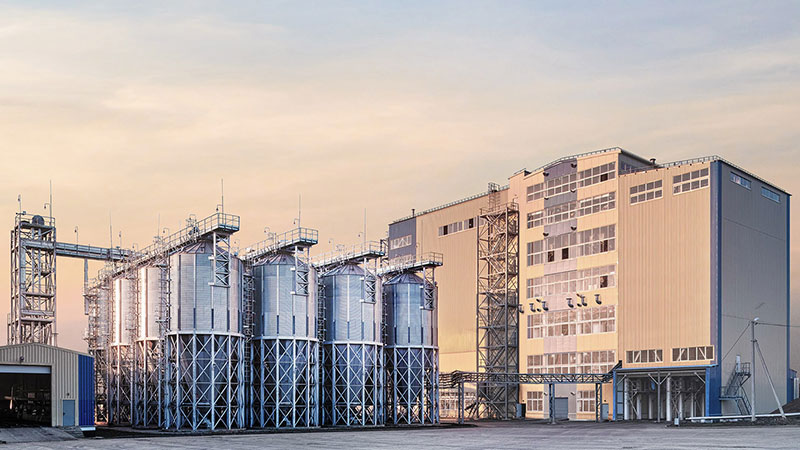
At RICHI, we go beyond project completion. With RICHI Servicee, we’re your dedicated partners in success. Count on us for expert guidance, minimal downtime, and optimized productivity. Choose RICHI for unmatched service and support.
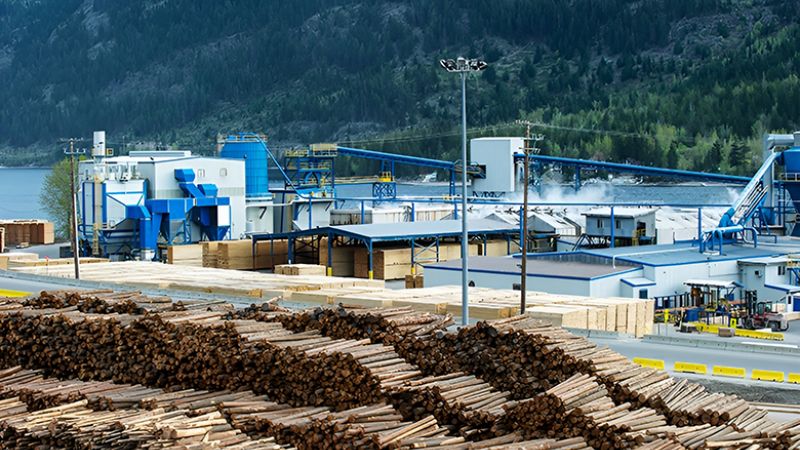


Meet global product demands and quality standards with industry-leading pellet plant design, engineering, equipment, and construction services for pellet processors.


Your Partner Beyond Project Completion
2000+ cases
RICHI is the leading designer, manufacturer and builder of pellet plants in the world, completing over 2000 projects in 140 countries across 6 continents.
Read More
Increase plant productivity, profitability, and safety by integrating high quality equipment into your pellet production line. Over the years, RICHI has become China's top pellet equipment manufacturer. At the same time, RICHI has established valuable partnerships with the world's leading component and raw material manufacturers to bring you the best there is in technology, automation, and efficiency in pelleting plant machinery.

For nearly 30 years, RICHI has been providing best-in-class pellet plant equipment and services to clients across a variety of industries, sizes, and needs. We pride ourselves on the knowledge and skill that each team member possesses – from our technical sales team to our process design engineers. You can count on RICHI Machinery to take your operation to the next level of innovation, quality, and success.
Need help with your pellet manufacturing plant project? Contact us today.
ANIMAL FEED
BIOMASS
WOOD
ORGANIC FERTILIZER
AQUA FEED
CAT LITTER
MUNICIPAL WASTE RECYCLING
SPECIAL PELLET PRODUCTION
RICHI Machinery continues to deliver world class pellet mill equipment, pellet plant engineering and project solutions that add value to our customers in the animal feed, wood waste, agriculture waste, organic fertilizer, cat litter and special pellet products industries. Throughout the years, we RICHI Machinery have built strong brand, becoming industry-leading pellet machine manufacturer. We value integrity, promise quality, and prioritize your success.
Learn MoreWith our expert team, we precisely implement your process engineering requirements in pellet mill and pelletizing plant systems. No matter which industry you’re in – we understand your needs and deliver solutions that meet the highest standards.
At RICHI, quality comes first. Our pellet making machine and related pellet line equipment undergo rigorous quality controls to ensure they meet the highest standards. Rely on products that are durable, safe, and efficient.
With decades of experience in pellet machine and pellet production line production, we have earned a reputation as a trusted partner in various industries. Our expertise allows us to cover a wide range of applications.
Not only do we offer premium pelleting equipment, but we are also experts at designing, building, installing, and maintaining facilities from the ground up. Our expertise is within pellt plant process design, discovering the most efficient, productive, and profitable way to handle your materials in an end-to-end cycle.
○ RICHI MACHINERY
Keeping in touch with us is an effective way to solve all your problems. If you have any needs or questions, please leave your contact information, then RICHI technical consultants will send design, quotation, videos to your mailbox. You can also contact us directly via WhatsApp: +86 13838389622
Copyright©2015-2026 by HENAN RICHI MACHINERY CO., LTD. All rights reserved.