
A horse feed manufacturer in County Kildare, Ireland, needed to improve the cooling stage for premium pelleted feeds supplied to thoroughbred breeding farms, sport-horse yards, and other equine customers. The mill was producing approximately 6 T/H of 6 mm pellets, including formulations containing molasses, and its existing cooler was no longer providing sufficiently uniform cooling before storage and bagging.
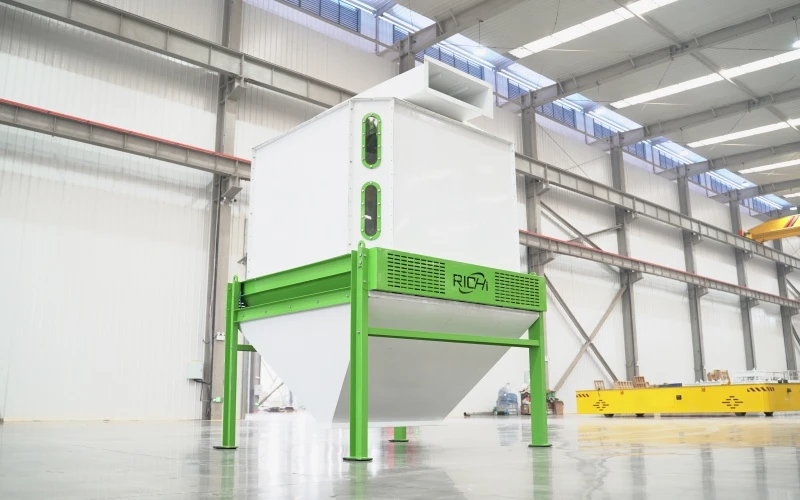
A horse feed manufacturer in County Kildare, Ireland, needed to improve the cooling stage for premium pelleted feeds supplied to thoroughbred breeding farms, sport-horse yards, and other equine customers. The mill was producing approximately 6 T/H of 6 mm pellets, including formulations containing molasses, and its existing cooler was no longer providing sufficiently uniform cooling before storage and bagging.
The customer therefore purchased a standalone SKLF17×17 horse feed pellet cooler in Ireland to replace the existing cooling unit while retaining the rest of the feed production system. Rather than treating the cooler simply as a machine for lowering pellet temperature, the project focused on controlling temperature and moisture consistently, avoiding condensation after packaging, limiting pellet breakage, and improving storage stability under Ireland’s relatively humid climate.
Name:
Feed Pellet Cooler
Country:
Ireland
Date:
2025
Capacity:
6 T/H
Model:
SKLF17×17
Main Motor Power:
1.5 KW
Application:
Pelleted horse feed
Pellet diameter:
6 mm
County Kildare is well suited to this application because of its concentration of thoroughbred breeding, racing, training, and equine businesses. The customer operates as a commercial feed manufacturer rather than an individual horse farm, producing several pelleted feeds for horses at different life and performance stages.
The existing pelleting section could produce approximately 6 T/H, but the old cooling equipment created an increasingly obvious bottleneck. Pellets were not leaving the cooler at a sufficiently uniform temperature, particularly during periods of warmer or more humid weather.
That matters because hot pellets should not be sent directly into bags or bulk storage. If the pellet temperature remains substantially above ambient conditions, heat retained inside the product can contribute to condensation as the feed cools after packaging. Uneven moisture distribution and warm pockets can further reduce storage stability.
The customer therefore wanted a cooler that could match the existing 6 T/H pelleting capacity and provide more controlled counterflow cooling.
The mill manufactures premium compound horse feed using ingredients selected according to the nutritional specification of each product. Typical formulations include cereals such as oats and barley, protein ingredients, fibre sources, minerals, vitamins, oils, and molasses.
Molasses is used in some formulations to improve palatability, provide energy, reduce dust, and support pellet characteristics. Its inclusion level varies by recipe rather than remaining fixed across every product.
This distinction is important when specifying a horse feed pellet cooler. A dry, relatively low-molasses formula does not necessarily behave in exactly the same way as a richer formulation containing more molasses or oil.
The customer mainly produces 6 mm pellets for adult horses. Pellet length and hardness are adjusted according to formulation and product positioning rather than using one fixed specification for every feed.
Based on the existing pelleting capacity, available installation space, pellet characteristics, and required cooling load, the SKLF17×17 was selected for the retrofit.
| Project Parameter | Configuration |
|---|---|
| Equipment | SKLF17×17 counterflow pellet cooler |
| Application | Pelleted horse feed |
| Existing Pellet Line Output | Approximately 6 T/H |
| Typical Pellet Diameter | 6 mm |
| Cooling Principle | Counterflow air cooling |
| Discharge | Controlled mechanical discharge system |
| Project Type | Single-machine replacement / retrofit |
The selected cooler was sized with sufficient operating margin around the customer’s normal 6 T/H output instead of matching the pellet mill at its absolute nominal production figure. This gives the cooling section room to accommodate fluctuations in pellet temperature, formulation, bulk density, ambient air conditions, and feed rate.
The principle of a counterflow cooler is straightforward: hot pellets enter the cooling chamber while ambient air is drawn through the pellet bed in the opposite direction to product movement.
The incoming cooling air first contacts the cooler pellets near the lower part of the chamber and progressively encounters warmer product higher in the bed. This temperature relationship provides efficient heat exchange while avoiding an unnecessarily severe thermal shock to freshly formed pellets.
For this horse feed application, the objective is not to make pellets “as cold as possible.” The practical target is to bring the finished feed reasonably close to ambient temperature while achieving stable moisture conditions before subsequent handling and packaging.
A commonly used operational reference is an outlet pellet temperature only several degrees Celsius above ambient conditions. The actual achievable value changes with ambient temperature, relative humidity, airflow, residence time, pellet size, bed depth, and incoming pellet conditions.
One of the reasons the customer wanted a more controllable cooler was the variation between horse feed recipes.
Molasses-containing pellets can behave differently during cooling because formulation affects surface characteristics, moisture migration, pellet durability, and airflow through the pellet bed. Higher-fat formulations can introduce another set of cooling characteristics.
Instead of applying a fixed 14-minute cooling time to every batch, operators adjust the cooler according to actual product conditions.
The important variables include incoming pellet temperature, incoming moisture, molasses and oil inclusion, pellet diameter, pellet length, bulk density, ambient temperature, ambient relative humidity, airflow, bed depth, and discharge frequency.
During commissioning, several operating combinations were evaluated so the customer could establish suitable settings for its principal horse feed formulations.
This distinction is particularly important in feed production.
A counterflow pellet cooler can remove some moisture as hot pellets release sensible heat and part of their moisture into the cooling air. However, it should not automatically be treated as equipment guaranteed to reduce every product from 14–15% moisture to 11–12%.
The actual moisture reduction depends heavily on ambient air conditions and the condition of the pellets entering the cooler. Ireland’s humid weather makes this especially relevant.
If pellets consistently leave the pellet mill with excessive moisture, the appropriate response is to examine conditioning parameters, steam quality, formulation, pellet mill operation, airflow, and the overall process rather than simply increasing cooler residence time indefinitely.
The SKLF17×17 was therefore selected primarily for controlled pellet cooling with associated moisture equilibration, not as a replacement for a dedicated drying process.
Ambient-air cooling performance cannot be separated from local weather conditions.
In cool, relatively dry conditions, ambient air can provide strong cooling performance. During humid conditions, however, the air has less capacity to accept additional moisture from the pellets.
For an Irish feed mill, this means operators should monitor both temperature and relative humidity rather than relying on one cooler setting throughout the year.
The control strategy developed for this project allows the mill to adjust airflow and product residence according to seasonal conditions and the formulation being produced.
This is more reliable than specifying one universal outlet moisture value that the cooler is expected to achieve regardless of weather.
One of the most important improvements sought by the customer was eliminating the practice of packaging pellets while they were still excessively warm.
Hot feed can continue releasing heat and moisture after entering the bag. Depending on the packaging material and storage environment, this can create localized condensation and moisture migration.
The new operating procedure therefore uses outlet temperature as an important release criterion before pellets proceed to the packaging section.
The mill also monitors finished-feed moisture according to its quality-control program. Where storage stability is particularly important, moisture measurements can be supplemented by water-activity testing and appropriate microbiological or mycotoxin controls.
This is a much more reliable approach to mould management than assuming that one moisture percentage alone guarantees product safety.
The cooler contributes to storage stability, but it cannot prevent every mould or mycotoxin problem by itself.
Mould risk can originate much earlier in the process. Cereals, forage ingredients, protein meals, and other raw materials may already have experienced unsuitable moisture or storage conditions before entering the feed mill.
For this reason, the customer’s control program covers incoming ingredient inspection, moisture management, storage conditions, cleaning, process control, finished-feed testing, and warehouse management in addition to pellet cooling.
The horse feed pellet cooler therefore performs a clearly defined function: preventing inadequate post-pelleting cooling from becoming another source of storage instability.
Cooling performance was not the customer’s only concern.
Premium horse feed pellets also need to retain acceptable physical quality during discharge. Excessive breakage generates fines, increases dust, reduces saleable yield, and can affect customer perception of the feed.
The SKLF cooler uses controlled discharge rather than aggressively conveying or grinding the product inside the cooling chamber.
The discharge frequency is coordinated with the pellet bed level so that material remains in the cooler long enough for heat exchange while maintaining continuous production.
This approach is particularly useful when processing formulations whose pellet hardness changes with fibre, oil, molasses, starch, and conditioning conditions.
This was not a complete feed mill project. The customer already had the principal processing equipment and only needed to replace the inadequate cooler.
The new horse feed pellet cooler was installed downstream of the existing pellet mill and upstream of the final screening and packaging stages.
The retrofit required more than simply positioning the cooler in the space previously occupied by the old unit. RICHI reviewed inlet height, discharge height, supporting structure, access for maintenance, air duct routing, cyclone or dust-control connection, fan arrangement, downstream conveying, and the interface with the packaging system.
Counterflow pellet coolers require sufficient vertical installation space, so building height and platform design were particularly important considerations.
The cooling fan and exhaust system are essential parts of the cooling process.
Too little airflow can leave pellets warm and produce an uneven temperature profile. Excessive airflow is not automatically better because it can increase energy consumption, entrain more fines, and disturb the desired cooling conditions.
The airflow therefore has to be matched to pellet-bed resistance and actual production conditions.
Dust and fines carried by the exhaust air also need appropriate separation. The customer’s retrofit design incorporated the cooler into the existing plant dust-management arrangement rather than exhausting dusty air directly into the production building.
The first commissioning runs were performed with the customer’s normal 6 mm horse feed rather than using an unrelated standard test material.
Operators monitored inlet temperature, outlet temperature, product moisture, ambient conditions, airflow, cooler bed level, discharge frequency, and pellet physical quality.
Several recipes were tested because a lower-molasses maintenance feed and a higher-energy performance feed do not necessarily require identical cooler settings.
The resulting operating data gave the production team reference settings for each principal product family. These settings serve as starting points rather than permanent values; operators can make corrections when raw-material or ambient conditions change.
Horse feed containing molasses and other liquid ingredients can leave deposits if the production and cooling equipment is not cleaned appropriately.
The customer therefore paid particular attention to accessibility during equipment selection and installation.
Inspection points allow operators to check the chamber and discharge area for accumulated fines or adhering material. The plant incorporates cooler inspection and cleaning into its preventive-maintenance and sanitation schedule rather than waiting for deposits to interfere with airflow or discharge.
Materials and surface treatment in relevant contact areas can also be selected according to the formulation, sanitation requirements, and expected exposure conditions. Stainless steel can be specified for selected contact components where the customer’s process requires it, but it is not assumed that the entire cooler must be manufactured from stainless steel simply because molasses is present.
The SKLF17×17 horse feed pellet cooler was dispatched from Qingdao Port, China, with Dublin used as the destination port for the Irish project.
Before shipment, RICHI provided the customer with the installation drawings and interface information required to prepare the retrofit area. This allowed structural preparation and modification of the surrounding conveying system to begin before the cooler arrived.
Because the customer was replacing an operating machine rather than building a new plant, reducing shutdown time was a major consideration. Much of the supporting work could therefore be prepared in advance and connected during the planned installation window.
Training concentrated on process control rather than simply teaching operators how to start and stop the machine.
The production team learned how to evaluate cooling performance using inlet and outlet conditions, how changes in ambient humidity affect the process, how to adjust discharge and airflow, how to recognize uneven cooling, and how to inspect the equipment for accumulated fines or material deposits.
The customer was also advised not to respond to every moisture problem by increasing cooling time. If incoming pellets are unusually wet, the cause should be traced upstream to conditioning, steam addition, formulation, or other process conditions.
This troubleshooting logic is especially valuable in a multi-formula horse feed mill.
“The main difference is that cooling is now a controlled part of production rather than something we simply assumed was happening. We check the pellet temperature against ambient conditions and adjust the cooler when the formulation or weather changes. That has given us much more confidence before the feed goes into bags, especially with our richer molassed horse feeds.”
The customer also found that the new cooler removed the previous capacity restriction at the cooling stage. The pellet mill can operate around its normal 6 T/H production rate without the downstream cooler forcing unnecessary interruptions.
Equally important, the mill now has measurable cooling criteria for finished pellets rather than relying on operators touching a bag or pellet sample and deciding whether it “feels cool enough.”
For racehorse, breeding, and sport-horse feeds, the value of a cooler is not created by one dramatic performance number. Its value comes from producing more repeatable conditions before screening, storage, and packaging.
A correctly sized counterflow cooler helps the mill control several interconnected issues:
A feed producer should not select a cooler only from the nominal T/H capacity of the pellet mill. Pellet diameter, incoming temperature, formulation, moisture, bulk density, ambient climate, building height, available airflow, exhaust arrangement, and downstream handling all affect cooler sizing.
For this project, the existing line produced approximately 6 T/H of 6 mm horse feed pellets, making the SKLF17×17 an appropriate retrofit solution with operating margin for normal production fluctuations.
A substantially larger horse feed plant would require the next suitable cooler size to be evaluated against its actual process conditions rather than automatically selecting a larger model from capacity alone.
This horse feed pellet cooler in Ireland project involved replacing an underperforming cooling stage in an existing commercial feed mill. The County Kildare manufacturer already had its grinding, mixing, conditioning, pelleting, conveying, and packaging equipment.
The SKLF17×17 counterflow cooler was selected around the plant’s approximately 6 T/H production requirement and 6 mm horse feed pellets. Its role is to provide controlled, uniform cooling before screening and packaging while accommodating the different processing characteristics of maintenance, breeding, and performance horse feeds.
For horse feed manufacturers processing molasses-containing pellets, cooler selection should be based on actual production data rather than a fixed assumption such as “14 minutes always removes 3% moisture.” Ambient humidity, formulation, incoming moisture, pellet dimensions, airflow, and residence time all affect the result. The SKLF17×17 is configured as a 6–8 T/H counterflow cooler intended to bring pellets close to ambient temperature.
RICHI Machinery can configure a horse feed pellet cooler according to pellet output, pellet diameter, inlet temperature, formulation characteristics, molasses or oil addition, plant layout, local climate, available installation height, and existing upstream and downstream equipment. For an operating feed mill, this allows the cooling section to be upgraded without unnecessarily replacing the rest of a production system that is already working effectively.
Having the right mix of reliable, high-quality pellet machine and pelletizing systems and expert support is essential to your success. Watch how our end-to-end feed pellet plant solutions have helped our customers optimize their performance.
Our customized and future-proofed turnkey pellet plant solutions is designed with you at the core. From vision to reality and beyond, our team stays connected with yours. Giving you peace-of-mind with an expert at your side.
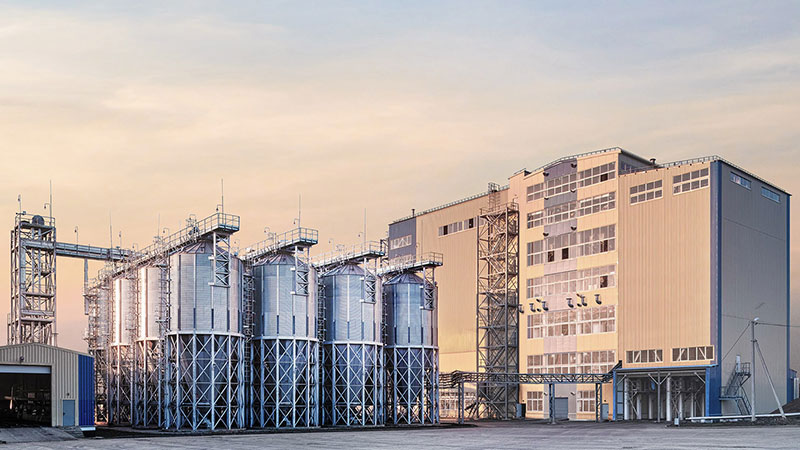
At RICHI, we go beyond project completion. With RICHI Servicee, we’re your dedicated partners in success. Count on us for expert guidance, minimal downtime, and optimized productivity. Choose RICHI for unmatched service and support.
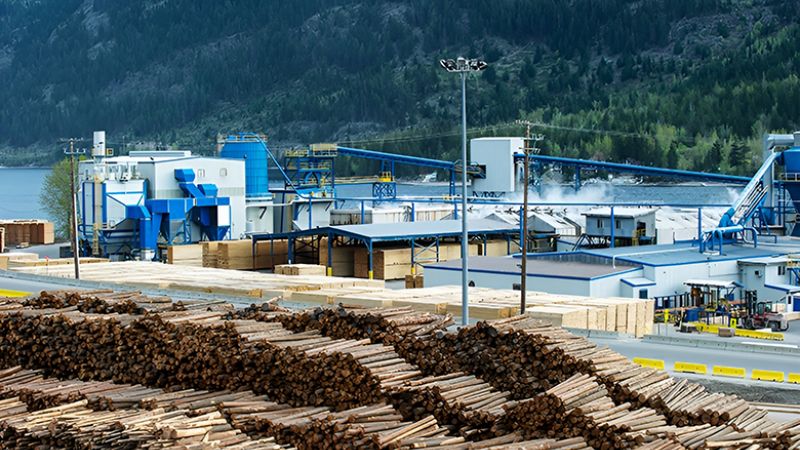


Meet global product demands and quality standards with industry-leading pellet plant design, engineering, equipment, and construction services for pellet processors.


Your Partner Beyond Project Completion
2000+ cases
RICHI is the leading designer, manufacturer and builder of pellet plants in the world, completing over 2000 projects in 140 countries across 6 continents.
Read More
Increase plant productivity, profitability, and safety by integrating high quality equipment into your pellet production line. Over the years, RICHI has become China's top pellet equipment manufacturer. At the same time, RICHI has established valuable partnerships with the world's leading component and raw material manufacturers to bring you the best there is in technology, automation, and efficiency in pelleting plant machinery.

For nearly 30 years, RICHI has been providing best-in-class pellet plant equipment and services to clients across a variety of industries, sizes, and needs. We pride ourselves on the knowledge and skill that each team member possesses – from our technical sales team to our process design engineers. You can count on RICHI Machinery to take your operation to the next level of innovation, quality, and success.
Need help with your pellet manufacturing plant project? Contact us today.
ANIMAL FEED
BIOMASS
WOOD
ORGANIC FERTILIZER
AQUA FEED
CAT LITTER
MUNICIPAL WASTE RECYCLING
SPECIAL PELLET PRODUCTION
RICHI Machinery continues to deliver world class pellet mill equipment, pellet plant engineering and project solutions that add value to our customers in the animal feed, wood waste, agriculture waste, organic fertilizer, cat litter and special pellet products industries. Throughout the years, we RICHI Machinery have built strong brand, becoming industry-leading pellet machine manufacturer. We value integrity, promise quality, and prioritize your success.
Learn MoreWith our expert team, we precisely implement your process engineering requirements in pellet mill and pelletizing plant systems. No matter which industry you’re in – we understand your needs and deliver solutions that meet the highest standards.
At RICHI, quality comes first. Our pellet making machine and related pellet line equipment undergo rigorous quality controls to ensure they meet the highest standards. Rely on products that are durable, safe, and efficient.
With decades of experience in pellet machine and pellet production line production, we have earned a reputation as a trusted partner in various industries. Our expertise allows us to cover a wide range of applications.
Not only do we offer premium pelleting equipment, but we are also experts at designing, building, installing, and maintaining facilities from the ground up. Our expertise is within pellt plant process design, discovering the most efficient, productive, and profitable way to handle your materials in an end-to-end cycle.
○ RICHI MACHINERY
Keeping in touch with us is an effective way to solve all your problems. If you have any needs or questions, please leave your contact information, then RICHI technical consultants will send design, quotation, videos to your mailbox. You can also contact us directly via WhatsApp: +86 13838389622
Copyright©2015-2026 by HENAN RICHI MACHINERY CO., LTD. All rights reserved.