
A Hemp Cat Litter Pellet Machine in Poland project was developed for an agricultural processing company that already handled industrial hemp and wanted to turn its low-value hemp residues into a commercial pet litter product.
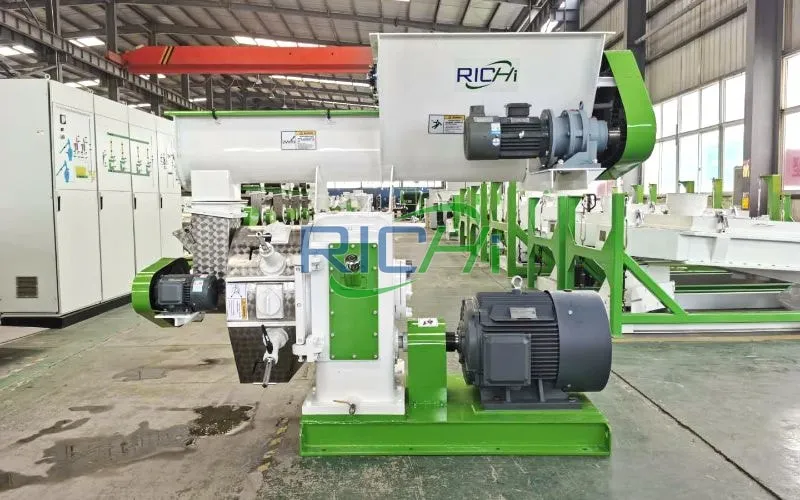
A Hemp Cat Litter Pellet Machine in Poland project was developed for an agricultural processing company that already handled industrial hemp and wanted to turn its low-value hemp residues into a commercial pet litter product. The customer had access to hemp hurds and fine hemp particles from fiber processing, but these materials were previously sold mainly as loose bedding or low-value biomass.
Instead of building a completely new cat litter factory, the customer purchased two MZLH420 hemp cat litter pellet machines and integrated them with equipment already available at the plant. This gave the company a practical way to test the plant-based cat litter market while keeping the initial project focused on the missing process: converting prepared hemp fiber into uniform, easy-to-package pellets.
Name:
Hemp Cat Litter Pelletizer
Country:
Poland
Date:
2025
Capacity:
1.0–1.2 T/H
Model:
MZLH420
Main Motor Power:
90 kW
Raw Materials:
hemp hurds, finer hemp fractions
Pellet diameter:
5–6 mm
The customer is an agricultural processor in eastern Poland with experience in industrial hemp processing. Its existing business generates different fractions after hemp stalks are processed and fibers are separated.
One of these fractions is hemp hurd, the woody inner part of the stalk. Fine particles and dust are also generated during crushing, separation and material handling.
These materials already had outlets, but mostly as relatively low-value bulk products. The company wanted to find an application that would make better use of the absorbent characteristics of hemp while creating a standardized consumer product.
Pet litter became one of the options under evaluation.
The customer was particularly interested in plant-fiber litter because it could use a raw material already generated inside its own business. This meant the project was not dependent on establishing a completely new feedstock supply chain.
The Hemp Cat Litter Pellet Machine in Poland therefore became the central equipment for converting an existing agricultural byproduct into a different product category.
This was not a greenfield cat litter production line.
The hemp processing facility already had crushing, separation, dust collection, material storage and basic drying capabilities. The customer's technical team could also use existing conveying and material preparation equipment after suitable adjustments.
What the plant could not do was densify prepared hemp material into consistent pellets.
Loose hemp hurd is relatively bulky, and fine fractions generated during processing are difficult to package as a standardized retail litter product. The customer therefore decided to add pelletizing first rather than replace equipment that could still be used.
Two machines were selected because the company wanted commercial production capacity while retaining flexibility. Both units can produce the same litter specification when demand is high, while production can also be organized around maintenance or different formulation trials.
For customers already operating hemp processing facilities, this is an important point. Purchasing a Hemp Cat Litter Pellet Machine in Poland does not automatically mean that an entirely new plant is required. The correct scope depends on what crushing, drying, mixing, conveying, cooling and packaging equipment is already available.
The primary raw materials in this project are hemp hurds and finer hemp fractions recovered from the customer's existing fiber processing operation.
Hemp hurd provides the main fibrous structure. Fine hemp material can also be incorporated after screening and preparation, reducing the amount of usable material that would otherwise remain as a low-value residue.
The original project concept used one fixed formula with exact percentages of hemp hurd, hemp dust, starch and mineral additives. In actual cat litter production, however, formulation should be established through material testing rather than treated as a universal recipe.
Particle size, incoming moisture, bulk density, natural binding behavior and the required absorbency all influence the formulation and pelletizing conditions. If a binder or functional additive is required, its type and dosage should be determined according to the target litter performance and applicable product requirements.
RICHI therefore focused first on whether the customer's prepared hemp material could form durable pellets under suitable compression conditions.
The customer selected two MZLH420 ring die pellet mills without conditioners. This configuration is suitable for the customer's fiber-based pelletizing application and avoids adding a conditioning process that was not required for this particular product.
| Project Item | Specification |
|---|---|
| Equipment | Hemp cat litter pellet machine |
| Model | MZLH420 |
| Quantity | 2 units |
| Main Motor Power | 90 kW per unit |
| Arch Breaker Feeder Power | 3 kW |
| Forced Feeder Power | 1.5 kW |
| Ring Die Inner Diameter | 420 mm |
| Available Pellet Diameter | 4–12 mm |
| Project Pellet Diameter | Approximately 5–6 mm |
| Capacity | 1.0–1.2 T/H per unit |
| Combined Capacity | Approximately 2.0–2.4 T/H under suitable material conditions |
The selected capacity matched the customer's available hemp residues and gradual market-entry strategy. The company did not need a much larger MZLH model simply because larger equipment was available.
For this Hemp Cat Litter Pellet Machine in Poland project, capacity matching was based on the amount of prepared raw material that could actually be supplied continuously to the two pellet mills.
Hemp residues cannot simply be fed into a pellet machine directly from fiber separation.
The raw material first needs a suitable particle-size distribution and reasonably controlled moisture. Oversized hurd pieces can interfere with stable feeding and pellet formation, while excessive fine dust can change material behavior inside the ring die.
Bulk density is another consideration. Lightweight fibrous material can bridge in conventional feeding systems, resulting in unstable mill load. This is one reason the MZLH420 used for this project includes an arch-breaking feeder and forced feeding arrangement.
The prepared material is delivered continuously into the pelletizing chamber, where rollers force it through the ring die openings. Compression and friction form the material into cylindrical pellets.
Die specification is important here. RICHI evaluates the raw material, pellet diameter and required product strength before determining an appropriate ring die configuration rather than applying a wood-pellet die directly to hemp cat litter production.
The customer's existing hemp processing equipment significantly reduced the scope of the new investment.
After fiber separation, the usable hurd and fine fractions are collected and prepared to the required size. Material condition is checked before formulation and mixing. The prepared mixture is then conveyed to the two MZLH420 machines.
Fresh pellets leaving a ring die pellet mill are warm and need appropriate downstream handling before packaging. Cooling allows the pellets to stabilize, while screening can separate loose fines from acceptable finished product.
The resulting process is therefore based on material preparation, formulation and mixing, pelletizing, cooling, screening and packaging.
The two hemp cat litter pellet machines form the core densification stage, but RICHI also evaluated whether the equipment around them could provide stable feeding and handle the finished output.
The customer initially evaluated several pellet dimensions rather than assuming that one size would work automatically.
For this project, approximately 5–6 mm diameter pellets provided a practical balance between product handling, pellet strength and the intended non-clumping absorbent litter format. Pellet length can be controlled through the cutting arrangement and operating conditions according to the customer's packaging and product requirements.
Diameter is only one aspect of cat litter quality.
A customer investing in a hemp cat litter pelletizer also needs to consider absorbency, bulk density, fines after handling, pellet durability, odor-control strategy and how easily the product can be packaged and poured.
This is why RICHI recommends raw-material testing when customers are developing a new litter formulation. Two customers may both use hemp hurd but obtain different pelletizing results because their particle size, moisture and fine-material content are different.
The main improvement was product standardization.
Before this investment, the hemp residues were loose materials whose density and particle distribution varied considerably. That may be acceptable for some bulk agricultural applications, but it creates problems when developing a packaged pet product.
Pelletizing gives the material a more controlled physical form. The customer can screen the finished product, remove excessive fines and package litter according to a defined specification.
Densification also makes material handling more convenient. Compared with loose hurd, pellets occupy a more compact and predictable volume, which helps with storage, packaging and transport planning.
For the customer, these improvements were more important than simply increasing tonnage. The Hemp Cat Litter Pellet Machine in Poland allowed an existing residue to become a repeatable finished product rather than another loose biomass material.
The project fits a broader interest in litter products made from renewable plant materials. Hemp, wood fiber, paper, tofu residues and other biomass materials can be considered for different litter formulations when their physical characteristics and product performance are suitable.
However, the customer did not invest based on the assumption that hemp litter would automatically replace mineral litter or command a guaranteed premium.
The commercial advantage was more specific: the company already controlled hemp raw material and already understood how to process it. Developing a pet litter product offered an opportunity to move farther downstream instead of selling all hemp residues at the lowest processing level.
The two-machine approach also limits the risk of entering a new market. If demand expands, additional pelletizing or downstream packaging capacity can be considered later.
The two MZLH420 hemp cat litter pellet machines were shipped by sea from Qingdao Port in China to the Port of Gdańsk in Poland.
Before shipment, RICHI supplied the customer with equipment dimensions, installation requirements and interface information so that preparation of the existing workshop could proceed before the machines arrived.
Because this was an integration project rather than a complete new production line, communication about inlet and outlet positions, electrical requirements and surrounding conveying equipment was particularly important.
The customer's technical team handled local installation with technical guidance from RICHI. Spare and wear parts required for future operation were also discussed before shipment so that the plant could prepare for routine maintenance.
The customer's main concern during supplier selection was not whether a machine could make ordinary biomass pellets. The question was whether it could process lightweight hemp material into a product suitable for the customer's cat litter concept.
RICHI therefore discussed the customer's raw material before finalizing the MZLH420 configuration. Attention was given to feeding behavior, particle preparation, moisture, ring die selection and expected pellet diameter.
The ability to purchase only the equipment actually missing from the plant was another factor. RICHI could work around the customer's existing hemp processing system instead of requiring the company to purchase a complete standardized line.
This reduced unnecessary capital expenditure and gave the customer a clearer expansion route. If future production requires additional crushing, drying, mixing, cooling, screening or automated packaging, those sections can be evaluated according to actual demand.
During the initial production period, the customer's operators found that stable raw-material preparation had a greater effect on pellet quality than they originally expected. When the proportion of very fine hemp dust changed significantly, feeding behavior and pellet formation also changed.
After tightening control over screening, mixing and moisture adjustment, operation became more consistent.
The customer also found the interchangeable ring die concept useful for product development. The current commercial specification is based around 5–6 mm pellets, but the company is not locked permanently into one diameter if future buyers require another product format within the machine's applicable range.
Most importantly, the customer achieved its original goal: adding a new processing step without rebuilding the existing hemp facility.
This Hemp Cat Litter Pellet Machine in Poland project is particularly relevant to hemp processors, agricultural residue companies and pet litter manufacturers that already have access to hemp hurd or similar plant fibers and want to evaluate a higher-value pelletized product.
But equipment selection should not begin with the model number alone.
If a customer already has crushing, dryer and mixing equipment, the project may require only a standalone hemp pellet machine plus suitable feeding and downstream handling. If the raw material comes directly from hemp stalk processing and has not been prepared, additional crushing, screening, drying or mixing may be necessary before pelletizing.
For RICHI to evaluate a similar project, the most useful starting information is straightforward: what hemp material is available, its current particle size and moisture, how many tons are available per hour or per year, the required litter pellet diameter, and whether crushing, drying, mixing, cooling and packaging equipment already exists at the plant.
With those details, RICHI Machinery can determine whether an MZLH420 like the two units used in this Hemp Cat Litter Pellet Machine in Poland project is appropriate, or whether a different model and supporting configuration would provide a better match. For businesses already generating hemp residues, that assessment can be the first practical step toward determining whether the material can move from a low-value byproduct into a standardized plant-based cat litter product.
Having the right mix of reliable, high-quality pellet machine and pelletizing systems and expert support is essential to your success. Watch how our end-to-end feed pellet plant solutions have helped our customers optimize their performance.
Our customized and future-proofed turnkey pellet plant solutions is designed with you at the core. From vision to reality and beyond, our team stays connected with yours. Giving you peace-of-mind with an expert at your side.
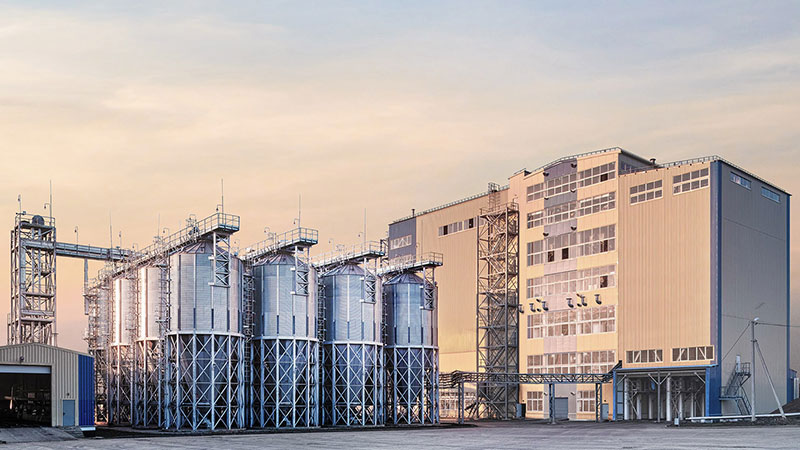
At RICHI, we go beyond project completion. With RICHI Servicee, we’re your dedicated partners in success. Count on us for expert guidance, minimal downtime, and optimized productivity. Choose RICHI for unmatched service and support.
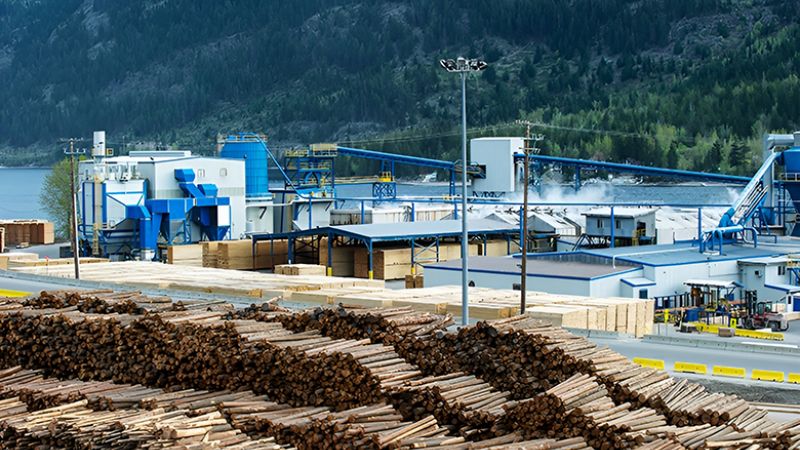


Meet global product demands and quality standards with industry-leading pellet plant design, engineering, equipment, and construction services for pellet processors.

Your Partner Beyond Project Completion
2000+ cases
RICHI is the leading designer, manufacturer and builder of pellet plants in the world, completing over 2000 projects in 140 countries across 6 continents.
Read More
Increase plant productivity, profitability, and safety by integrating high quality equipment into your pellet production line. Over the years, RICHI has become China's top pellet equipment manufacturer. At the same time, RICHI has established valuable partnerships with the world's leading component and raw material manufacturers to bring you the best there is in technology, automation, and efficiency in pelleting plant machinery.

For nearly 30 years, RICHI has been providing best-in-class pellet plant equipment and services to clients across a variety of industries, sizes, and needs. We pride ourselves on the knowledge and skill that each team member possesses – from our technical sales team to our process design engineers. You can count on RICHI Machinery to take your operation to the next level of innovation, quality, and success.
Need help with your pellet manufacturing plant project? Contact us today.
ANIMAL FEED
BIOMASS
WOOD
ORGANIC FERTILIZER
AQUA FEED
CAT LITTER
MUNICIPAL WASTE RECYCLING
SPECIAL PELLET PRODUCTION
RICHI Machinery continues to deliver world class pellet mill equipment, pellet plant engineering and project solutions that add value to our customers in the animal feed, wood waste, agriculture waste, organic fertilizer, cat litter and special pellet products industries. Throughout the years, we RICHI Machinery have built strong brand, becoming industry-leading pellet machine manufacturer. We value integrity, promise quality, and prioritize your success.
Learn MoreWith our expert team, we precisely implement your process engineering requirements in pellet mill and pelletizing plant systems. No matter which industry you’re in – we understand your needs and deliver solutions that meet the highest standards.
At RICHI, quality comes first. Our pellet making machine and related pellet line equipment undergo rigorous quality controls to ensure they meet the highest standards. Rely on products that are durable, safe, and efficient.
With decades of experience in pellet machine and pellet production line production, we have earned a reputation as a trusted partner in various industries. Our expertise allows us to cover a wide range of applications.
Not only do we offer premium pelleting equipment, but we are also experts at designing, building, installing, and maintaining facilities from the ground up. Our expertise is within pellt plant process design, discovering the most efficient, productive, and profitable way to handle your materials in an end-to-end cycle.
○ RICHI MACHINERY
Keeping in touch with us is an effective way to solve all your problems. If you have any needs or questions, please leave your contact information, then RICHI technical consultants will send design, quotation, videos to your mailbox. You can also contact us directly via WhatsApp: +86 13838389622
Copyright©2015-2026 by HENAN RICHI MACHINERY CO., LTD. All rights reserved.