
The South African customer did not purchase a larger hammer mill simply because the cattle operation wanted “finer hay.” The real problem appeared after the farm began producing part of its own supplemental cattle feed. Opened hay bales still contained long stems, compressed knots and uneven fibre that could not move consistently through the existing mixer and pelletizing section.
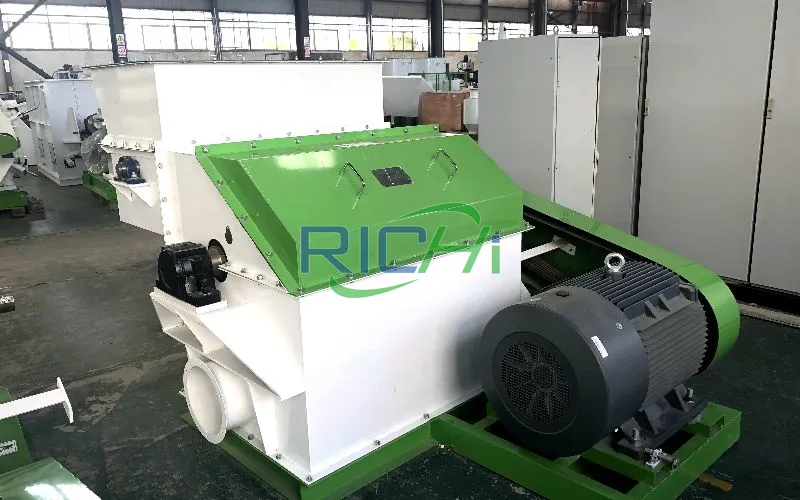
The South African customer did not purchase a larger hammer mill simply because the cattle operation wanted “finer hay.” The real problem appeared after the farm began producing part of its own supplemental cattle feed. Opened hay bales still contained long stems, compressed knots and uneven fibre that could not move consistently through the existing mixer and pelletizing section.
A commercial beef operation in South Africa’s Northern Cape therefore installed one SFSP66×80 hay hammer mill as a standalone addition to its existing feed-preparation system.
The grass crusher machine receives loose forage after bale opening and primary shredding, reduces the selected material to a controlled particle distribution and supplies a more uniform fibrous ingredient for the farm’s cattle feed pellet production. Long forage for rumen-effective fibre continues to be supplied separately rather than forcing the entire cattle ration through the hammer mill.
Name:
Hay Hammer Mill
Country:
South Africa
Date:
2025
Capacity:
2.0–2.5 T/H
Model:
SFSP66×80
Main Motor Power:
75 kW
Main Materials:
Teff hay, lucerne hay
Final product size:
4mm
The cattle operation already had bale handling, ingredient storage, mixing and pelletizing equipment.
Its weak point was between bale opening and mixing.
The bale breaker could tear apart compressed hay and reduce large bale sections, but the discharge still contained fibres that were too long and inconsistent for controlled pellet-feed production.
Instead of replacing functioning equipment, the customer added one forage grinding machine at that specific point.
The SFSP66×80 does not need to operate continuously throughout the day.
A 500-head herd can consume several tonnes of dry matter daily depending on cattle weight, production stage and ration design, but only part of that feed is processed through this hammer mill.
The farm batches the fibrous ingredients required for its supplemental pellets during scheduled feed-preparation periods.
At approximately 2.0–2.5 T/H reference forage capacity, several hours of grinding can prepare the day’s or several days’ required milled hay without making the machine unrealistically large for the herd.
The province is dry, but it is also one of South Africa’s most important commercial hay-producing regions where irrigation is available.
Lucerne is particularly significant.
Recent South African industry research reports that the Northern Cape produces more than 90% of the country’s officially graded lucerne hay, much of it from irrigated production systems.
This makes a Northern Cape cattle business using baled lucerne a realistic customer profile for forage grinding equipment.
Teff is established in South African forage production and is commonly conserved as hay.
South African forage guidance lists teff alongside lucerne and other crops specifically for hay production, and local livestock literature describes both teff and lucerne as familiar supplementary forage resources.
The customer buys teff hay when its price and quality fit the ration, particularly for fibre supply in the pellet formulation.
Maize stalks, leaves and other post-harvest residues are available in South African cattle systems, but maize stover is not nutritionally equivalent to lucerne or good teff hay.
It is generally more fibrous and lower in feed value.
South African research comparing fibre sources has reported substantially higher NDF in maize stover than in lucerne, illustrating why these materials should not be substituted kilogram-for-kilogram without reformulation.
The farm therefore uses maize stover selectively as a lower-cost fibre source rather than treating all three forages as one interchangeable raw material.
| Project Parameter | Specification |
|---|---|
| Equipment | Hay hammer mill |
| Model | SFSP66×80 |
| Quantity | 1 unit |
| Rotor Diameter | 660 mm |
| Grinding Chamber Width | 800 mm |
| Main Motor | 75 kW |
| Hammer Tip Speed | Approximately 103 m/s |
| Reference Forage Capacity | Approximately 2.0–2.5 T/H |
| Main Materials | Teff hay, lucerne hay and prepared maize stover |
| Downstream Use | Fibrous ingredient for cattle feed pellet production |
A hammer mill performs best when its feed is reasonably continuous and already reduced to a manageable form.
A compressed round or square hay bale creates a very different loading condition from loose chopped forage.
Feeding intact bales would cause irregular load, bridging and sudden surges of fibre.
The existing bale breaker therefore remains an essential upstream machine.
The bale breaker opens compressed forage and breaks apart large bale sections.
The SFSP66×80 then performs secondary size reduction.
Keeping those functions separate improves feeding stability and prevents the hammer mill from being forced to act simultaneously as a bale opener and fine grinder.
Baled forage can contain baling twine, wire fragments, stones, soil or other contaminants.
These should be removed before material reaches the high-speed rotor.
Magnetic protection can be included for ferrous contamination, but visual and mechanical cleaning remain important.
Plastic baling twine does not become a useful feed ingredient simply because it passes through a crusher.
Long strands can also wrap around shafts or contaminate finished feed.
Operators therefore remove strings and wrapping during bale opening instead of expecting the hammer mill to process them.
A hammer-mill screen controls the upper tendency of particle size, but the discharge is still a distribution of fibres and particles rather than perfectly identical 4 mm pieces.
Different forage materials fracture differently.
Fine teff stems, leafy lucerne and dry maize stalks will not produce identical particle distributions through the same screen.
The relatively fine ground forage produced by this machine is intended for mixing and subsequent ring-die pelleting.
The farm does not grind all long-stem roughage this finely and then use it as the only fibre source in a total mixed ration.
Cattle still receive appropriately structured roughage outside the pelletized supplement.
Ruminants require more than a laboratory fibre percentage.
The physical structure of forage influences chewing, rumination and rumen function.
Reducing every forage ingredient to very short particles simply to make mixing easier can undermine that function.
The customer therefore uses the hay hammer mill only on the forage portion intended for pellet production.
A relatively fine screen may be suitable where the pellet mill requires a more uniform fibrous mash.
A coarser screen can be selected when the formulation tolerates longer fibre and excessive grinding would only consume extra power.
The final choice depends on forage type, downstream die specification and desired pellet quality.
Teff hay is relatively fine-stemmed.
After bale breaking, much of the material may already be near the required size.
The farm therefore avoids unnecessary over-grinding simply to make a screen specification look consistent.
Lucerne bales contain relatively fragile leaves and stronger stems.
Aggressive grinding can generate excessive leaf fines while stems are still being reduced.
The customer adjusts screen and feed rate to obtain a usable overall particle distribution rather than pulverizing the most nutritious leafy fraction.
Dry stalk sections are generally tougher and more heterogeneous than fine hay.
Primary chopping becomes particularly important before maize residue enters the SFSP66×80.
Actual throughput can therefore be lower on a difficult maize-stover campaign than on well-prepared teff hay.
The quoted range should be understood under suitable forage preparation conditions.
Moisture, screen opening, fibre length, material density, hammer condition and feed rate all affect output.
A customer requesting extremely fine grinding should not expect the same capacity as one using a relatively open forage screen.
Dry hay fractures more readily than damp fibrous material.
Material with excessive moisture can become more difficult to pass through the screen and may reduce capacity.
The farm therefore monitors stored hay condition instead of feeding weather-damaged or very wet bales indiscriminately.
If hay has absorbed excessive moisture in storage, grinding it more aggressively will not solve the storage problem.
Wet forage must be managed appropriately before fine processing.
The customer separates moisture management from particle-size reduction.
Long light forage has much lower bulk density than grain.
A large volume entering the grinder does not necessarily represent a large mass flow.
The feeding system therefore has to maintain a steady material layer so the rotor does not alternate between empty running and sudden overload.
The customer watches motor current together with throughput.
A rapidly increasing load can indicate an excessive feed rate, a restrictive screen, high material moisture or worn grinding components.
Operators address those causes rather than treating motor overload as a normal production method.
As hammer edges wear, grinding efficiency and particle-size distribution can change.
The farm therefore rotates or replaces hammers according to actual wear condition.
Waiting until capacity collapses can increase energy consumption and reduce consistency upstream of the mixer.
Damaged screens can allow oversized fibre to escape or create uneven discharge.
Blocked open area reduces effective grinding capacity.
Inspection of hammers and screens is therefore treated as one maintenance routine.
The customer wanted flexibility for teff, lucerne and crop-residue campaigns.
RICHI therefore provided multiple screen options rather than configuring the machine permanently around one material.
The screen is changed when the product requirement changes, not simply according to the calendar.
The hammer mill does not have to operate at exactly the same instantaneous rate as the mixer or pellet mill.
A small buffer allows the farm to grind forage in scheduled batches and then draw material into formulation as needed.
This is another reason a 2.0–2.5 T/H machine can fit a 500-head operation without running continuously.
The nutritional composition changes according to cattle stage and the quality of available forage.
Ground hay provides fibre, while cereal ingredients, protein sources, minerals and other components are included according to ration formulation.
Good lucerne hay generally contains considerably more crude protein than maize stover.
South African cattle-feed analyses have reported lucerne hay near 18.6% crude protein in one dataset, while maize stover is primarily a fibrous feed resource.
The nutritionist therefore cannot replace lucerne with maize residue purely on a cost-per-tonne basis.
Harvest maturity has a strong effect on hay quality.
Late-cut fibrous teff should not be assigned the same nutritional value as well-made leafy hay.
The farm purchases and formulates on actual forage quality where analysis is available.
The SFSP66×80 hay crusher machine changes particle size.
It does not add protein, energy or minerals to poor-quality forage.
Its role is to prepare the fibrous ingredient to the physical condition required for downstream mixing and pelletizing.
Long fibres can separate from fine grain meals inside handling equipment.
Controlled grinding brings the physical dimensions closer together and helps the mixer distribute fibrous ingredients through the pellet mash.
This improves physical preparation and mixing consistency before pelletizing.
Once the balanced mash enters the customer’s existing pellet mill, the major ingredients are compressed into one physical feed unit.
This can reduce separation of the pelletized supplement during handling and feeding.
The farm still supplies long roughage separately, so the pellet does not have to perform every nutritional function in the cattle ration.
The hay hammer mill was installed for one purpose: preparing fibrous raw material for the farm’s cattle feed pellet section.
The grinding parameters, screen selection and operating schedule are therefore configured around this specific production requirement.
A bale breaker solves material opening and metering.
Its discharge can still contain fibres much longer than a pellet-feed mixer or ring die prefers.
The SFSP66×80 performs the second reduction step required for a controlled pellet mash.
Without bale opening, large compressed blocks would enter the grinder irregularly.
The two machines therefore complement one another rather than compete.
For a customer starting with loose pre-chopped hay instead of bales, the bale breaker might not be necessary.
Because lucerne production is strongly concentrated in the Northern Cape, the customer can source commercial hay within the broader region instead of depending entirely on forage transported from the opposite side of South Africa.
That makes the location particularly suitable for a forage-based cattle feed project.
South African forage guidance specifically identifies teff and lucerne as established hay crops.
The customer therefore selects between them according to feed analysis, availability and cost rather than assuming one is always superior.
South African cattle producers also make use of maize crop residues as seasonal feed resources.
Industry guidance describes maize residues as a strategic winter feed option for cattle and sheep, while also noting the need for nutritional supplementation.
This makes maize stover a credible secondary ingredient for the project, provided it is properly formulated rather than treated as premium hay.
The Northern Cape is arid and forage supply can be challenging, which makes stored forage an important part of cattle feeding strategies.
The hammer mill supports the farm’s year-round feed-preparation requirement by processing selected stored forage for its pelletized supplement.
Seasonal pasture pressure can increase the importance of stored feed, while the grinding system remains useful during normal production periods as well.
Fine dry forage can generate considerable airborne dust during hammer milling.
The plant therefore includes appropriate aspiration at the grinder and transfer points.
Dust control protects working conditions and reduces accumulation around motors and bearings.
Dry organic fines should not simply be allowed to build up inside the workshop.
Good housekeeping, suitable extraction and project-specific safety measures form part of the grinding installation.
A vibration isolation base alone does not address dust hazards.
A high-speed hammer rotor requires proper balancing.
Abnormal vibration can indicate uneven hammer wear, material buildup, bearing problems or foreign-object damage.
The operator therefore stops and inspects abnormal vibration rather than continuing production until a larger failure occurs.
Because only one machine was added, the customer did not require a complete overseas installation crew to rebuild the feed facility.
RICHI supplied foundation, connection and equipment-interface drawings, while the farm’s mechanical and electrical contractors completed the installation with technical guidance.
Commissioning support focused on rotation direction, hammer configuration, screen installation, feeding stability and motor load.
The SFSP66×80 was exported from Qingdao to South Africa before inland transport to the Northern Cape.
For a heavy machine destined for an inland farm, port choice is evaluated according to the available carrier route, inland freight cost and final destination.
South Africa has several possible container gateways, so the logistics plan is matched to the customer’s actual site.
For some Northern Cape destinations, routing through Cape Town may produce a practical inland leg.
RICHI therefore compares available shipping services and inland transport before finalizing the destination port.
Manufacturing and ocean schedules are confirmed against the actual order.
After commissioning, the main operational improvement was more uniform material entering the mixer.
The hammer mill gives the farm greater control over the particle distribution of the forage portion used in pellet production.
Animal performance continues to depend on the complete diet, forage quality and cattle management.
Previously, a bale-breaker batch containing longer fibre could behave very differently from the next batch.
After secondary grinding, the mixer receives a narrower particle distribution.
This makes batching and pellet production more repeatable.
“The bale breaker solved the problem of opening the hay, but it did not give us the fibre size we needed for pellet feed. The hammer mill is now the control point between the bale area and the mixer. We change the screen according to the forage rather than trying to force teff, lucerne and maize residue through exactly the same setting.”
A lucerne hammer mill is useful when baled alfalfa must be reduced before mixing and pelletizing.
The operator should avoid unnecessary over-grinding of leaves while ensuring that tougher stems do not create feeding problems downstream.
Teff hay usually presents a finer stem structure than maize stover and can require a different screen or feed setting.
For customers processing mainly teff, actual capacity should be tested with their bale density, moisture and target particle size.
A forage hammer mill can handle several dried grass and crop-fibre materials, but capacity cannot be transferred automatically from one forage to another.
Material preparation and desired fineness remain major selection factors.
Buyers searching for an alfalfa hay hammer mill often already own a bale breaker or shredder and need a second-stage grinder before pelleting.
For those projects, the interface between bale opening and hammer milling should be designed before the machine model is confirmed.
Maize stover normally requires more attention to primary chopping and contamination removal than fine commercial hay.
It can be used as a lower-cost ruminant fibre ingredient, but the finished ration still requires nutritional balancing.
The term grass hammer mill covers materials with very different bulk densities and fibre structures.
Teff, veld hay, ryegrass and other dried grasses should therefore be tested according to the customer’s required screen and downstream process.
A hay grinding machine becomes particularly valuable when long forage must enter a ring-die pellet mill.
The objective is to produce a controlled fibrous mash without spending unnecessary electricity on ultra-fine grinding.
This hay hammer mill in South Africa project uses one SFSP66×80 as a standalone secondary forage grinder at a commercial beef operation in the Northern Cape.
The farm works mainly with lucerne and teff hay, with properly prepared maize stover used when its cost and nutritional role make sense. Bales are first opened and coarsely reduced by the existing bale breaker. The loose material then enters the SFSP66×80 for controlled grinding before mixing with the other ingredients used in the farm’s supplemental cattle feed pellets.
The SFSP66×80 uses a 660 mm rotor, 800 mm grinding chamber, 75 kW main motor and approximately 103 m/s hammer tip speed. Its reference forage grinding capacity is around 2.0–2.5 T/H under suitable material conditions. Actual output changes with forage type, moisture, screen opening, incoming fibre length and required final particle distribution.
The relatively fine ground forage from this machine is not used as the cattle’s only roughage source. Long or coarser forage remains in the feeding program to maintain appropriate physical fibre, while the hammer-milled portion is used where uniformity is important for mixing and pellet formation.
This also explains why the machine is appropriately sized for a farm with roughly 500 cattle. It does not have to grind the animals’ complete daily feed intake continuously. Instead, the farm operates it in scheduled batches to prepare the fibrous portion required for its pelletized supplement.
For another buyer comparing a hay hammer mill in South Africa, lucerne hammer mill, teff hay grinding machine, forage hammer mill, alfalfa hay hammer mill, maize stover hammer mill, grass hammer mill or hay grinding machine for cattle feed, RICHI Machinery would first review bale type, forage species, incoming moisture, bale-breaker discharge size, required screen opening, hourly grinding volume, daily operating hours, downstream mixer capacity and whether the ground forage will be pelletized or used directly.
The right hammer mill is selected from the forage condition after the bale has been opened, not simply from the number of cattle on the farm.
Having the right mix of reliable, high-quality pellet machine and pelletizing systems and expert support is essential to your success. Watch how our end-to-end feed pellet plant solutions have helped our customers optimize their performance.
Our customized and future-proofed turnkey pellet plant solutions is designed with you at the core. From vision to reality and beyond, our team stays connected with yours. Giving you peace-of-mind with an expert at your side.
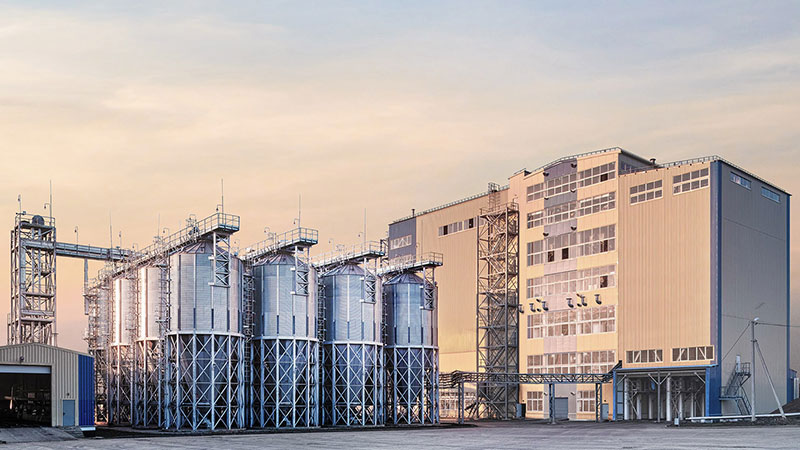
At RICHI, we go beyond project completion. With RICHI Servicee, we’re your dedicated partners in success. Count on us for expert guidance, minimal downtime, and optimized productivity. Choose RICHI for unmatched service and support.
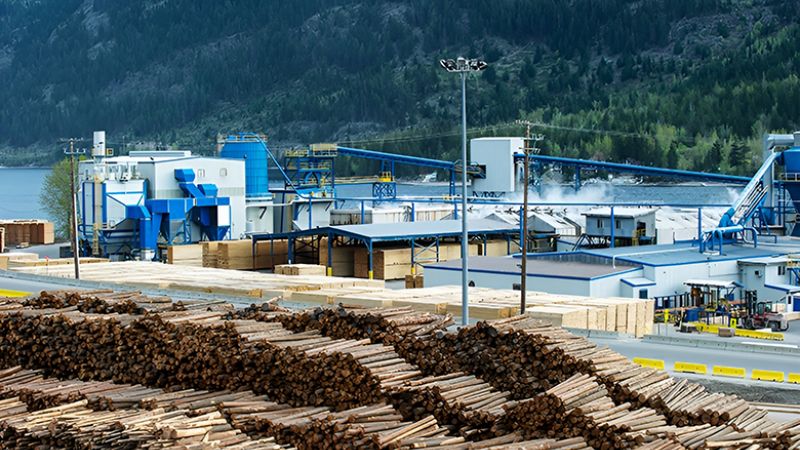


Meet global product demands and quality standards with industry-leading pellet plant design, engineering, equipment, and construction services for pellet processors.

Your Partner Beyond Project Completion
2000+ cases
RICHI is the leading designer, manufacturer and builder of pellet plants in the world, completing over 2000 projects in 140 countries across 6 continents.
Read More
Increase plant productivity, profitability, and safety by integrating high quality equipment into your pellet production line. Over the years, RICHI has become China's top pellet equipment manufacturer. At the same time, RICHI has established valuable partnerships with the world's leading component and raw material manufacturers to bring you the best there is in technology, automation, and efficiency in pelleting plant machinery.

For nearly 30 years, RICHI has been providing best-in-class pellet plant equipment and services to clients across a variety of industries, sizes, and needs. We pride ourselves on the knowledge and skill that each team member possesses – from our technical sales team to our process design engineers. You can count on RICHI Machinery to take your operation to the next level of innovation, quality, and success.
Need help with your pellet manufacturing plant project? Contact us today.
ANIMAL FEED
BIOMASS
WOOD
ORGANIC FERTILIZER
AQUA FEED
CAT LITTER
MUNICIPAL WASTE RECYCLING
SPECIAL PELLET PRODUCTION
RICHI Machinery continues to deliver world class pellet mill equipment, pellet plant engineering and project solutions that add value to our customers in the animal feed, wood waste, agriculture waste, organic fertilizer, cat litter and special pellet products industries. Throughout the years, we RICHI Machinery have built strong brand, becoming industry-leading pellet machine manufacturer. We value integrity, promise quality, and prioritize your success.
Learn MoreWith our expert team, we precisely implement your process engineering requirements in pellet mill and pelletizing plant systems. No matter which industry you’re in – we understand your needs and deliver solutions that meet the highest standards.
At RICHI, quality comes first. Our pellet making machine and related pellet line equipment undergo rigorous quality controls to ensure they meet the highest standards. Rely on products that are durable, safe, and efficient.
With decades of experience in pellet machine and pellet production line production, we have earned a reputation as a trusted partner in various industries. Our expertise allows us to cover a wide range of applications.
Not only do we offer premium pelleting equipment, but we are also experts at designing, building, installing, and maintaining facilities from the ground up. Our expertise is within pellt plant process design, discovering the most efficient, productive, and profitable way to handle your materials in an end-to-end cycle.
○ RICHI MACHINERY
Keeping in touch with us is an effective way to solve all your problems. If you have any needs or questions, please leave your contact information, then RICHI technical consultants will send design, quotation, videos to your mailbox. You can also contact us directly via WhatsApp: +86 13838389622
Copyright©2015-2026 by HENAN RICHI MACHINERY CO., LTD. All rights reserved.