
The Canadian pellet producer discovered its new bottleneck only after increasing pelletizing capacity. The ring-die section could now produce close to 12 T/H under suitable operating conditions, but the existing cooler belonged to the plant’s earlier, lower-capacity configuration. Hot pellets were accumulating faster than the cooling section could stabilize them.
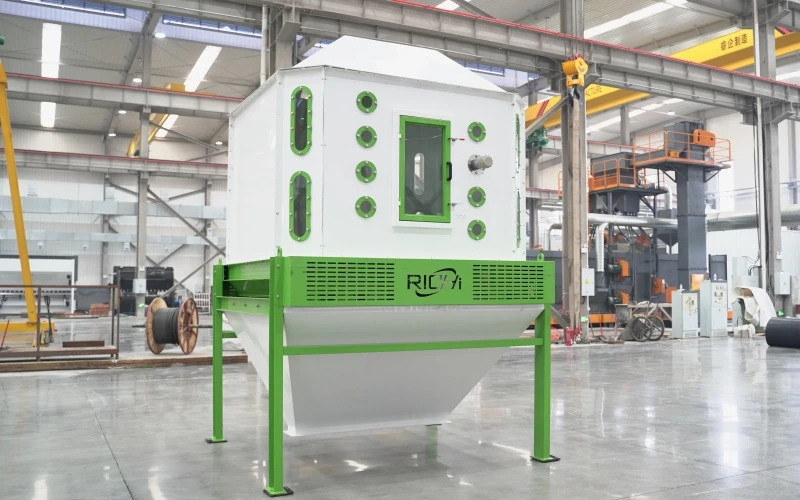
The Canadian pellet producer discovered its new bottleneck only after increasing pelletizing capacity. The ring-die section could now produce close to 12 T/H under suitable operating conditions, but the existing cooler belonged to the plant’s earlier, lower-capacity configuration. Hot pellets were accumulating faster than the cooling section could stabilize them.
For the British Columbia plant, this was not simply a matter of making pellets comfortable to touch. The company needed a hardwood pellet cooler in Canada that could receive hot pellets continuously, remove sensible heat without excessive breakage, and deliver a sufficiently stable product for screening, storage and subsequent shipment. One SKLF20×20 counterflow cooler was therefore selected as the retrofit point between pelletizing and final product handling.
Name:
Wood Pellet Cooler
Country:
Canada
Date:
2026
Capacity:
8–13 T/H
Model:
SKLF20×20
Residence Time:
6–15 minutes
Pellet Diameter:
6 mm
Cooling Principle:
Counterflow cooling
Before the production upgrade, the existing cooling equipment had been adequate for the amount of pellets leaving the press section.
That changed when pelletizing capacity increased.
A Counterflow Pellet Cooler cannot be selected from annual plant tonnage alone. What matters at this stage is the maximum continuous pellet flow reaching the cooler, the temperature of those pellets, pellet diameter, bulk density, ambient-air condition and the temperature required at discharge.
The Canadian customer therefore treated cooling as an independent process calculation rather than assuming that any cooler installed after a pellet mill would work.
Pellets leaving a ring-die pellet mill are still carrying heat generated during conditioning, compression and friction through the die.
They also remain mechanically vulnerable immediately after formation.
If a large quantity of hot product enters a silo or enclosed storage system, the pellet bed does not cool uniformly. Heat and water vapor continue moving through the bulk material, while colder surfaces can create conditions for condensation.
The cooling stage is therefore part of product stabilization, not merely an optional conveyor between the pellet mill and storage.
A commercial export pellet plant producing tens of thousands of tonnes annually normally has screening, storage and bulk-handling steps between pellet production and final shipment.
Hot pellets leaving a 12 T/H wood pellet mill therefore need to pass through an appropriately sized cooling and downstream handling section before entering storage or shipment preparation.
At this British Columbia plant, the undersized cooling section was delivering pellets too warm for the downstream storage and handling system during peak production.
That created a genuine process bottleneck even though the upstream pelletizing equipment still had available production capacity.
British Columbia’s pellet industry is strongly associated with coniferous forest resources and sawmill residues.
Spruce, pine and fir are softwoods, so they cannot be used as the raw-material description for a case whose core product is hardwood pellets.
This customer’s specialty production campaign instead uses suitable deciduous wood residues and hardwood-rich recovered clean fibre streams that are segregated from the plant’s conventional softwood feedstock.
The hardwood campaign is only one part of the factory’s overall production program.
The plant can be an approximately 80,000-tonne-class wood pellet operation while only part of its production is assigned to hardwood or hardwood-rich specialty pellets.
This is consistent with British Columbia’s pellet industry, where sawmill residues and other lower-value forest-industry fibre form the dominant feedstock base.
| Project Parameter | Configuration |
|---|---|
| Equipment | Hardwood pellet cooler |
| Model | SKLF20×20 |
| Cooling Principle | Counterflow cooling |
| Reference Capacity | 8–13 T/H |
| Discharge Drive | 1.5 kW |
| Reference Residence Time | Approximately 6–15 minutes, adjustable according to operating conditions |
| Project Pellet Diameter | 6 mm |
| Typical Incoming Condition | Hot pellets directly after ring-die pelletizing |
| Cooling Objective | Pellet temperature brought close to prevailing ambient/storage conditions |
| Installation Type | Retrofit into an existing wood pellet production line |
The SKLF20×20 provides approximately 8–13 T/H reference capacity, adjustable cooling residence time and a counterflow arrangement, making it appropriately sized around the customer’s approximately 12 T/H peak pellet flow.
Cooling equipment should have enough working margin to receive the expected maximum production rate without forcing the pellet mill to slow down every time the cooler reaches its limit.
The SKLF20×20 spans the required operating range without being dramatically oversized.
That makes the model more logical than retaining the old 5 T/H-class cooling section or jumping immediately to a much larger cooler intended for a future capacity the customer does not currently need.
The operating principle is straightforward.
Hot pellets enter the upper part of the cooler and gradually move downward through the pellet bed.
Cooling air travels through the bed in the opposite direction.
The arrangement creates progressive heat exchange instead of exposing the hottest pellets immediately to the coldest possible air at one concentrated point.
This helps control cooling while the pellets remain in a relatively deep, slowly moving bed.
A cooler cannot guarantee that pellets will always leave at 25°C.
British Columbia experiences major seasonal temperature differences, and the cooling air available in January is very different from the air available during a warm summer afternoon.
The useful target is therefore expressed relative to the ambient or subsequent storage environment.
For normal pellet cooling, bringing the product within roughly several degrees of the relevant ambient condition is a more meaningful control target than assigning one fixed discharge temperature to the entire year.
For this installation, ambient plus approximately 3–5°C is used as the desired discharge condition.
It is a reasonable operating objective, while actual performance still depends on incoming pellet temperature, airflow, residence time, pellet depth, ambient temperature and humidity.
Operators therefore use the temperature difference as a process target and adjust the cooler according to actual Canadian weather and production conditions.
The supplied equipment range allows approximately 6–15 minutes of residence-time adjustment.
The customer does not permanently lock the machine at 12 minutes.
During production, operators respond to actual pellet temperature and cooling conditions.
If the pellets enter hotter or ambient cooling air becomes warmer, the required residence time may increase. Under cooler conditions, the same product may reach its target more quickly.
The project mainly produces 6 mm hardwood pellets during this production campaign.
A larger pellet has a longer internal heat-transfer path than a smaller pellet.
Density and internal structure also affect how quickly heat can move from the pellet core toward the surrounding cooling air.
For that reason, cooler selection should include pellet dimensions rather than capacity alone.
Hardwood pellets can differ substantially depending on species, bark content, grinding, moisture and die conditions.
They should not automatically be assigned a longer or shorter cooling time simply because the feedstock is classified as hardwood.
The Canadian customer establishes cooler settings from the measured behavior of its actual pellets.
This is more useful than building a process around a generic hardwood-versus-softwood assumption.
A counterflow cooler primarily removes heat and some residual moisture from freshly formed pellets.
It is not a precision dryer designed to take any incoming pellet moisture and automatically produce exactly 6–8% at discharge.
Final moisture is influenced by upstream raw-material drying, pelletizing conditions, cooling air and residence time.
If sawdust enters the pellet mill far too wet, installing a larger cooler will not solve the underlying problem.
Likewise, overdrying the fibre upstream and expecting the cooler to restore moisture is not a sensible process strategy.
The Canadian plant controls fibre moisture before pelletizing and uses the SKLF20×20 to stabilize the hot finished pellets afterward.
This distinction is particularly useful for customers searching for a wood pellet cooling machine.
A sawdust dryer removes substantial quantities of water before pelletizing.
A pellet cooler removes the heat carried by newly compressed pellets and allows the finished product to stabilize before handling and storage.
Confusing these two functions often leads to incorrect equipment sizing.
The problem was not that belt coolers are inherently unsuitable for wood pellets.
Horizontal cooling systems can be engineered successfully.
The customer’s problem was that its existing unit belonged to the earlier production scale and could not comfortably accept the expanded pellet flow.
The replacement decision was therefore driven by capacity and process fit.
The vertical counterflow configuration gives the plant a relatively compact cooling section for the required throughput.
Pellets move largely by gravity through the vessel while the cooling air passes through the bed.
This suited a retrofit where the factory wanted to increase cooling capacity without rebuilding a long horizontal section of the production building.
Retrofitting an operating pellet plant creates different constraints from designing a greenfield factory.
The customer already had conveyors, screens, storage and building columns around the old cooling section.
The replacement machine therefore had to fit the available process height and connect to existing upstream and downstream equipment.
Vertical equipment can use height to reduce horizontal footprint, although adequate headroom and structural support are still required.
Freshly formed pellets are relatively vulnerable to breakage while still hot.
The customer therefore wanted to minimize aggressive mechanical transfer immediately after pelletizing.
Hot product enters the cooler from above and progresses downward before controlled discharge.
The process does not eliminate fines, but it avoids adding unnecessary conveying stages inside the cooling vessel.
Pellet breakage depends on much more than the cooler discharge mechanism.
Pellet durability, die compression, raw material, pellet length, drop height, conveyors and screening all contribute to final fines.
The swing-type discharge therefore focuses on controlled material release and reducing unnecessary mechanical damage as pellets leave the cooler.
Too little air can leave the center of the bed warm.
Excessive airflow can increase fan energy, disturb fines and change moisture removal without necessarily improving final product quality.
The plant therefore balances airflow against bed depth, pellet flow and measured discharge temperature.
The correct fan setting is established during commissioning rather than copied from another factory.
A single airflow number without cooler pressure, duct configuration, pellet-bed resistance and fan performance data is not enough to define the cooling system.
Air volume and static pressure are therefore selected from the complete cooling and aspiration design for the SKLF20×20 installation.
Wood pellets generate fines during handling.
Some of those fines can enter the air stream passing through the cooler.
The exhaust system therefore requires appropriate dust separation and plant-specific collection equipment.
The cooling fan should not be described as if it automatically performs all workshop dust-control functions.
Dry wood fines are combustible.
Cooling, conveying and screening areas therefore need good housekeeping and appropriate dust-management design.
The Canadian customer considers the cooler together with aspiration ducting, dust separation and the surrounding material-handling system rather than treating each component independently.
Mold growth cannot be predicted from pellet temperature alone.
Available moisture, storage conditions, contamination, time and temperature all matter.
The practical objective is therefore to avoid loading an unstable hot product into conditions where condensation or moisture redistribution can occur.
This is especially important for export pellets.
Condensation occurs when moist air or a surface reaches the relevant dew-point condition.
Pellet temperature, container or silo wall temperature, ambient humidity and subsequent temperature changes all interact.
Cooling pellets close to their storage environment reduces one important source of temperature differential, but it cannot make an ocean container immune to every condensation mechanism.
Ocean freight exposes cargo to changing external temperatures and humidity.
Container preparation, pellet moisture, ventilation strategy, voyage conditions and storage before loading also matter.
The SKLF20×20 reduces the risk associated with shipping pellets while still hot, while good storage and shipping practices remain necessary throughout the logistics chain.
The same principle applies before export.
If pellets enter a large silo with excessive residual heat, the bulk material can develop temperature gradients.
The customer therefore checks discharge temperature before product enters longer-term storage.
Cooling is integrated with silo management rather than treated as a standalone quality certificate.
Cooler inlet temperature tells the operator how much heat must be removed.
Discharge temperature shows whether the actual cooling objective has been reached.
The plant therefore monitors both process conditions rather than relying only on a timer setting.
A 12-minute residence time means little if the final pellet temperature remains too high.
In a Canadian winter, a fixed 25°C discharge target could actually leave the pellets much warmer than their surroundings.
During summer, 25°C may be close to ambient.
The operator therefore watches the difference between pellet discharge temperature and the relevant ambient or storage condition.
This approach works across seasonal changes.
Very cold outside air should not automatically be pulled through hot pellets at maximum flow.
An excessive temperature gradient can create unnecessary thermal stress and moisture movement.
Air mixing, damper control and operating strategy may therefore need seasonal adjustment.
The objective remains controlled cooling rather than the lowest possible pellet temperature.
Warm ambient air has less cooling potential than cold winter air.
During hotter periods, the customer may need to adjust airflow, residence time or pellet-bed loading to maintain the required discharge condition.
This is one reason a cooler with operational margin is preferable to a machine already running at its absolute limit.
A 12 T/H wood biomass pellet mill does not necessarily discharge exactly 12.0 tonnes every operating hour.
Different hardwood recipes and die conditions can change instantaneous output.
The SKLF20×20 gives the plant a working range around its normal production rather than creating another fixed 12 T/H ceiling immediately downstream.
An 80,000 T/Y plant could operate one long shift, multiple shifts or several production lines.
Those configurations would require different cooler arrangements even if annual tonnage were identical.
RICHI therefore selects a biomass pellet cooler primarily from peak hourly production and actual operating conditions.
The old cooling equipment was removed from the bottleneck position and the SKLF20×20 was connected downstream of the existing pellet press discharge arrangement.
Hot pellets are elevated or transferred to the cooler inlet, stabilized in the counterflow chamber, discharged into the downstream conveying system and then screened before storage.
This allowed the customer to preserve useful parts of the existing line.
The customer already owned raw-material receiving, drying, grinding, pelletizing, screening, storage and shipping infrastructure.
Purchasing a complete new production line would not have solved the actual constraint efficiently.
The investment was concentrated on the cooling stage that had become undersized after expansion.
A counterflow cooler requires enough vertical space for inlet equipment, cooling chamber, discharge mechanism and downstream conveyor connection.
Structural loads also have to account for the machine plus the pellet inventory inside it.
The foundation and support platform were therefore designed from the actual installation drawing.
The project equipment was configured for the customer’s actual site power conditions.
Canada commonly uses 60 Hz systems, but industrial supply voltage should always be confirmed at the individual plant rather than inferred from the country alone.
Motors, controls and protection were therefore matched to the customer’s electrical information before manufacturing.
The cooler system includes more than the 1.5 kW discharge motor.
Fans, airlocks, hydraulic components, discharge equipment, sensors and controls may be included in the complete installation.
Electrical protection is therefore selected from the actual connected load, starting method and local code requirements.
The first objective was to establish stable filling and discharge.
A counterflow cooler works best when the pellet bed remains reasonably uniform instead of developing channels where air bypasses most of the product.
The team therefore checked level control, discharge response and airflow before pushing the cooler toward peak production.
Cooling air naturally follows lower-resistance paths.
If pellet distribution is uneven, some areas of the bed can receive too much air while others receive too little.
Uniform inlet distribution and controlled discharge therefore contribute directly to cooling consistency.
Pellets do not travel through the cooler on a fixed-speed conveyor.
The operating level and discharge sequence determine how long the bulk material remains exposed to cooling air.
Changing discharge behavior therefore changes residence time and cooling performance.
Temperature is not the only check.
The quality team also watches fines, moisture, bulk density and mechanical durability according to the plant’s product specification.
If a cooling adjustment reduces temperature but creates excessive fines or moisture loss, the operating point still needs correction.
Fresh hot pellets have not fully stabilized mechanically.
Controlled cooling helps the pellet structure reach a more stable condition before aggressive conveying, screening and loading.
This is one reason the cooler belongs immediately downstream of pelletizing rather than after several rough transfer stages.
If pellets leave the die with poor mechanical integrity because of unsuitable raw material, moisture or die conditions, cooling cannot turn them into high-durability pellets.
The SKLF20×20 preserves and stabilizes properly formed pellets; it does not replace good pelletizing practice.
The swing-type discharge opens the bottom area in a controlled pattern so the pellet bed can leave without relying on a high-speed screw running through freshly cooled product.
This arrangement also helps maintain the required material level during continuous production.
Its main advantage is controlled bulk discharge and reduced unnecessary mechanical handling.
Hydraulic pressure, flow and oil requirements depend on the final discharge and hydraulic-system configuration supplied with the machine.
The customer therefore follows the supplied hydraulic manual for pressure, oil grade, inspection and maintenance requirements.
Operators inspect the discharge mechanism, bearings, level devices, airlock, fan system and dust-handling components according to operating hours and observed condition.
Duct accumulation is monitored because wood fines can restrict airflow.
Cleaning frequency is therefore determined from actual operating conditions and inspection results.
British Columbia has an established wood pellet manufacturing sector integrated with the province’s forest-products industry.
Pellet plants commonly obtain fibre from sawmill residues and other low-value forest-industry materials.
A Canadian pellet producer upgrading a cooler after increasing press capacity is therefore a realistic industrial scenario.
The province’s forest-products and pellet industries have strong coniferous feedstock exposure.
The customer’s hardwood pellet campaign is therefore a specific product stream inside a broader pellet operation rather than the dominant feedstock profile of British Columbia’s pellet industry.
The SKLF20×20 is not mechanically restricted to hardwood.
The same cooler can process suitable softwood or mixed wood pellets when throughput, pellet dimensions and operating conditions fall within the system’s working range.
The phrase hardwood pellet cooler describes this project’s product campaign, not an exclusive machine limitation.
The cooler was manufactured in China and shipped from Qingdao to the Port of Vancouver for delivery to the British Columbia customer.
Vancouver is a logical gateway for industrial equipment destined for many locations in southern and central British Columbia.
The exact inland route depends on the plant location and freight arrangement.
Vessel schedules, transshipment, terminal congestion and customs inspection all affect delivery time.
RICHI provides the required shipping documents and packing information, while actual logistics are confirmed against the shipment schedule.
Cooler investment depends on equipment configuration, fan and dust system, airlock, controls, supporting steel, conveyors, electrical specification, shipping and installation scope.
A buyer comparing cooler quotations should therefore confirm exactly which auxiliary systems are included.
The new cooler removes a genuine production constraint and reduces the operational risk associated with insufficient cooling.
Payback, however, depends on plant utilization, pellet value, downtime, rejected-product history, energy use and capital cost.
The commercial return should therefore be calculated from the customer’s actual production and financial data.
Proper cooling can materially improve storage stability, but shipment quality depends on more than the cooler.
Pellet moisture, fines, handling, container condition, voyage climate and storage practices all remain relevant.
The cooler therefore forms one part of the complete export-quality control system.
The plant now has cooling capacity aligned much more closely with the upgraded pelletizing section.
Operators can keep the pellet mill running near planned output without deliberately allowing hot product to bypass an undersized cooler.
More importantly, the downstream storage system receives pellets in a more stable thermal condition.
“The important change was that cooling stopped controlling the whole production rate. Before the upgrade, increasing pellet-mill output simply moved the bottleneck downstream. Now we can adjust residence time and airflow around the actual pellet temperature and keep the cooling section synchronized with production.”
For buyers searching for a counterflow pellet cooler, the SKLF20×20 fits projects where continuous pellet output approaches the upper single-digit to low-teen tonne-per-hour range.
Final selection still depends on pellet diameter, incoming temperature, ambient conditions and required discharge temperature.
A wood pellet cooling machine can be upgraded independently when the rest of an existing production line remains serviceable.
This is particularly relevant after a manufacturer installs additional pellet mills or replaces an older press with a higher-capacity unit.
A biomass pellet cooler retrofit requires more than checking machine footprint.
Engineers must verify inlet elevation, structural support, air ducting, fan position, discharge conveyor, dust collection and maintenance access before the old cooler is removed.
An industrial pellet cooler supports export production by stabilizing pellet temperature before storage and shipment.
It cannot independently guarantee that pellets will meet every destination-market specification, but insufficient cooling can undermine otherwise well-produced material.
This project mainly processes 6 mm pellets during the hardwood campaign.
Pellet diameter is one input to residence-time and airflow selection because internal heat transfer changes with pellet geometry and density.
When a pellet mill is upgraded from approximately 5 T/H to around 12 T/H, the cooler, screen, conveyors and storage transfer equipment should all be checked again.
Expanding only the pellet press often creates exactly the downstream bottleneck experienced by this Canadian customer.
This hardwood pellet cooler in Canada project uses one SKLF20×20 counterflow cooler as a retrofit inside an established British Columbia wood pellet plant.
The factory had increased pelletizing capacity toward approximately 12 T/H, while its previous cooling section remained sized around the earlier production level. The result was not a pellet-mill problem but a process imbalance: hot product could be produced faster than it could be properly stabilized for downstream handling.
The SKLF20×20 provides a reference capacity of approximately 8–13 T/H and adjustable residence time. Hot pellets enter from above, cooling air passes through the pellet bed in counterflow, and the discharge system controls material inventory and residence time. The operating objective is to bring pellet temperature close to the relevant ambient or storage condition rather than chase one fixed Celsius value throughout the year.
British Columbia’s pellet industry is strongly connected to softwood-oriented sawmill and forest residues. Spruce, pine and fir are softwoods, while this customer’s hardwood pellet production represents a segregated specialty campaign within a broader wood pellet operation.
For another producer comparing a hardwood pellet cooler in Canada, counterflow pellet cooler, wood pellet cooling machine, biomass pellet cooler, industrial pellet cooler, 6mm wood pellet cooler or pellet cooler for a 10–12 T/H wood pellet production line, RICHI Machinery would first review peak pellet output, pellet diameter and length, bulk density, inlet temperature, final temperature requirement, local summer and winter conditions, building height, existing conveyors, dust collection, storage method and available electrical supply.
A cooler should be sized from the heat and material arriving every hour, not from the annual production number printed on the factory brochure.
Having the right mix of reliable, high-quality pellet machine and pelletizing systems and expert support is essential to your success. Watch how our end-to-end feed pellet plant solutions have helped our customers optimize their performance.
Our customized and future-proofed turnkey pellet plant solutions is designed with you at the core. From vision to reality and beyond, our team stays connected with yours. Giving you peace-of-mind with an expert at your side.
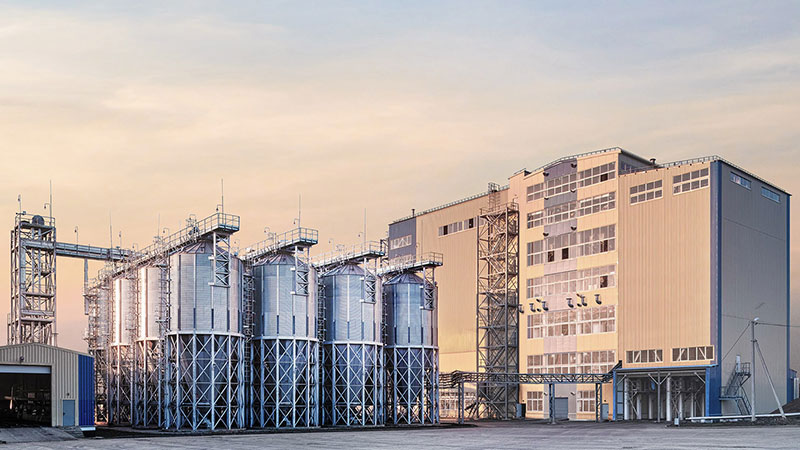
At RICHI, we go beyond project completion. With RICHI Servicee, we’re your dedicated partners in success. Count on us for expert guidance, minimal downtime, and optimized productivity. Choose RICHI for unmatched service and support.
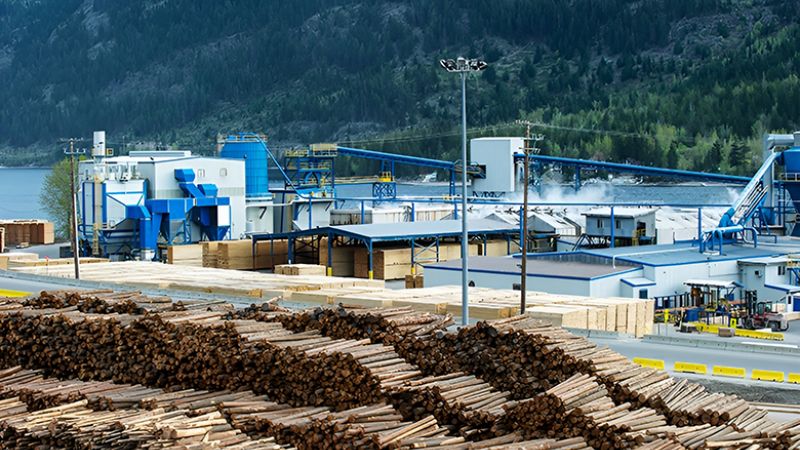


Meet global product demands and quality standards with industry-leading pellet plant design, engineering, equipment, and construction services for pellet processors.


Your Partner Beyond Project Completion
2000+ cases
RICHI is the leading designer, manufacturer and builder of pellet plants in the world, completing over 2000 projects in 140 countries across 6 continents.
Read More
Increase plant productivity, profitability, and safety by integrating high quality equipment into your pellet production line. Over the years, RICHI has become China's top pellet equipment manufacturer. At the same time, RICHI has established valuable partnerships with the world's leading component and raw material manufacturers to bring you the best there is in technology, automation, and efficiency in pelleting plant machinery.

For nearly 30 years, RICHI has been providing best-in-class pellet plant equipment and services to clients across a variety of industries, sizes, and needs. We pride ourselves on the knowledge and skill that each team member possesses – from our technical sales team to our process design engineers. You can count on RICHI Machinery to take your operation to the next level of innovation, quality, and success.
Need help with your pellet manufacturing plant project? Contact us today.
ANIMAL FEED
BIOMASS
WOOD
ORGANIC FERTILIZER
AQUA FEED
CAT LITTER
MUNICIPAL WASTE RECYCLING
SPECIAL PELLET PRODUCTION
RICHI Machinery continues to deliver world class pellet mill equipment, pellet plant engineering and project solutions that add value to our customers in the animal feed, wood waste, agriculture waste, organic fertilizer, cat litter and special pellet products industries. Throughout the years, we RICHI Machinery have built strong brand, becoming industry-leading pellet machine manufacturer. We value integrity, promise quality, and prioritize your success.
Learn MoreWith our expert team, we precisely implement your process engineering requirements in pellet mill and pelletizing plant systems. No matter which industry you’re in – we understand your needs and deliver solutions that meet the highest standards.
At RICHI, quality comes first. Our pellet making machine and related pellet line equipment undergo rigorous quality controls to ensure they meet the highest standards. Rely on products that are durable, safe, and efficient.
With decades of experience in pellet machine and pellet production line production, we have earned a reputation as a trusted partner in various industries. Our expertise allows us to cover a wide range of applications.
Not only do we offer premium pelleting equipment, but we are also experts at designing, building, installing, and maintaining facilities from the ground up. Our expertise is within pellt plant process design, discovering the most efficient, productive, and profitable way to handle your materials in an end-to-end cycle.
○ RICHI MACHINERY
Keeping in touch with us is an effective way to solve all your problems. If you have any needs or questions, please leave your contact information, then RICHI technical consultants will send design, quotation, videos to your mailbox. You can also contact us directly via WhatsApp: +86 13838389622
Copyright©2015-2026 by HENAN RICHI MACHINERY CO., LTD. All rights reserved.