
A UAE poultry farm selected an SFSP66×60b hammer mill for poultry feed to grind imported grains before mixing, improving control of particle size and in-house feed preparation.
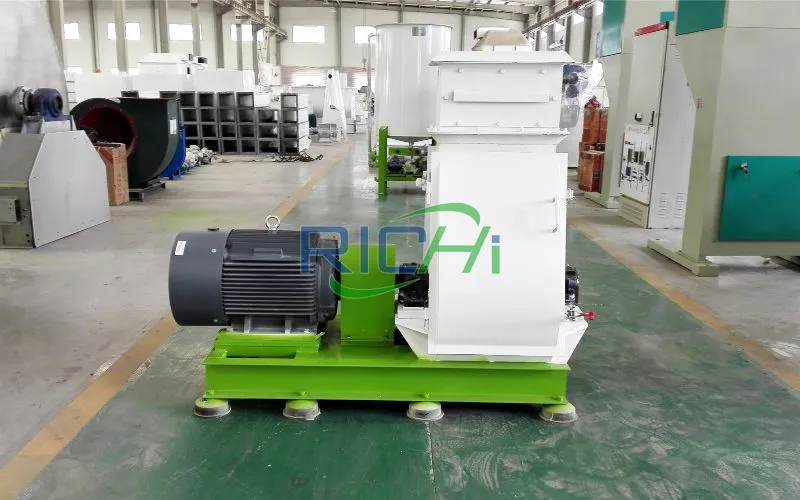
A poultry farm in Sharjah added one SFSP66×60b hammer mill for poultry feed in the United Arab Emirates after deciding to bring part of its feed preparation in-house. The farm was not building a complete feed factory. It already had ingredient storage and a small batching and mixing arrangement, while finished commercial feed was still purchased when required.
The missing process was controlled grain grinding. Corn and other whole grains could not enter the existing mixer in their original form, and the small crusher previously used on the farm produced an inconsistent mixture of fines, acceptable particles and partially broken kernels. Rather than replacing equipment that was still useful, the customer concentrated the investment on this one bottleneck.
Name:
poultry feed hammer mill
Country:
UAE
Date:
2026
Capacity:
6–9 T/H
Model:
SFSP66×60b
Main Motor Power:
75 kW
Rotational Speed:
2980 r/min
Main Material:
Corn and other grindable feed grains
This distinction shaped the equipment selection. The customer did not need receiving silos, a new mixer, pellet mill or complete poultry feed production line at this stage. The immediate requirement was a poultry feed hammer mill that could prepare grain reliably and then discharge the ground material into the farm's existing handling and mixing system.
The farm uses the machine in scheduled grinding campaigns rather than expecting it to operate continuously throughout every feed-making shift. Ground grain can be prepared ahead of mixing and held temporarily in a suitable intermediate bin, allowing the hammer mill and the smaller mixer to work at different instantaneous capacities.
This is important for standalone equipment projects. A 6–9 T/H animal feed hammer mill does not mean every downstream machine also has to operate at 6–9 T/H. Buffer storage and production scheduling allow a higher-capacity grinding machine to serve a smaller batch-mixing section without turning the entire farm into an industrial feed mill.
The UAE poultry sector depends heavily on traded feed ingredients, so the customer's formulas change with ingredient availability and purchasing conditions. The hammer mill is mainly used for materials that genuinely require particle-size reduction rather than sending every feed ingredient through the same machine.
This separation reduces unnecessary power consumption and avoids producing additional fines from materials that are already suitable for mixing.
| Project Parameter | Configuration |
|---|---|
| Equipment | Poultry feed hammer mill |
| Model | SFSP66×60b |
| Quantity | 1 unit |
| Main Motor | 75 kW |
| Rotor Diameter | 660 mm |
| Grinding Chamber Width | 600 mm |
| Rotational Speed | Approximately 2980 r/min |
| Reference Capacity | 6–9 T/H for suitable feed-grain grinding conditions |
| Main Material | Corn and other grindable feed grains |
| Installation Type | Standalone machine connected to existing farm feed equipment |
The published 6–9 T/H range is a machine reference rather than a promise that every formula will leave the grinder at the same rate. Actual throughput changes with grain type, incoming moisture, screen opening, feeder setting, hammer condition and the required particle-size distribution.
For this reason, the farm does not size daily feed output simply by multiplying the hammer mill's maximum catalogue capacity by the number of operating hours.
One of the problems with the previous crusher was the assumption that finer material meant better feed. In practice, the objective is a controlled particle distribution appropriate for the bird, feed form and downstream process.
The customer wanted to eliminate obvious whole kernels and excessively coarse fragments while avoiding unnecessary production of very fine dust. Screen selection and feeder speed are therefore adjusted together. Changing the screen affects not only particle size but also throughput, motor load and the percentage of fines.
Broiler starter feed, grower feed, finisher feed and layer feed do not have to use one identical grinding specification. A farm producing mash feed may also make different particle-size decisions from a plant that subsequently conditions and pelletizes the mixture.
This is why RICHI supplied the hammer mill around an adjustable grinding arrangement rather than defining one fixed particle diameter as universally suitable for every poultry formula.
Standalone machinery is only useful when the inlet, outlet and production rhythm match the equipment already on site. Before installation, attention was therefore given to the hammer mill's feeding arrangement, discharge position, intermediate storage and access for screen and hammer maintenance.
A controlled feeder is important because irregular grain feeding can cause motor-load fluctuations even when the hammer mill itself has sufficient nominal capacity. Magnetic protection ahead of the grinding chamber also helps prevent ferrous contamination from reaching the high-speed rotor.
After grinding, the material is transferred to the existing feed-preparation section rather than being discharged as a finished ration. The mixer still determines how corn, soybean meal, bran, minerals, premix and other ingredients are proportioned into the final feed.
The hammer mill changes the physical size of the grain. It does not formulate the ration, improve the nutrient value of poor ingredients or replace accurate batching and mixing.
Fine grain grinding generates airborne dust, so the UAE installation was not treated as simply a motor and grinding chamber placed beside a mixer. The feeding and discharge sections need controlled airflow, and the aspiration arrangement must be able to handle the amount of air and fines generated during milling.
Operators also need access for regular inspection of screens and hammers. Worn screens can change the particle distribution, while worn hammers can reduce grinding efficiency and increase the time material remains inside the chamber.
Sharjah's high ambient temperatures make ventilation around the motor and electrical equipment another practical consideration. Keeping air passages clean is particularly important where fine feed dust can accumulate around cooling surfaces.
The SFSP66×60b feed crusher machine was shipped from China to Jebel Ali before inland delivery to the customer's site in Sharjah. The project was handled as a standalone machinery shipment rather than a complete feed-mill installation.
Before dispatch, the customer received the information required to prepare the equipment position and connections. Remote installation guidance was appropriate because the farm already had its own technical team and the project did not involve erection of a multi-floor production line.
The supply also included the agreed grinding-screen configuration, routine spare and wear parts, and operating guidance covering feeding, screen inspection, hammer wear and normal shutdown procedures.
The most important change was not a claimed percentage increase in bird growth or an artificial payback figure. It was greater control over one production stage that had previously been unpredictable.
The farm can now prepare selected grain ingredients according to its own production schedule. Operators can change grinding conditions when the feed program changes, and batches entering the mixer have a more controllable physical structure than material produced by the previous low-speed crusher.
Whole or insufficiently broken kernels are easier to prevent, while operators no longer need to chase extremely fine grinding simply to compensate for poor crushing uniformity.
The project also gives the farm more flexibility in deciding how much feed preparation to perform internally. Commercial feed can still be purchased when that makes operational or economic sense; owning a hammer mill does not force the customer to manufacture every tonne of poultry feed on the farm.
Once grinding capacity is no longer the limiting stage, the next investment should be determined by the rest of the process.
If daily production increases, the customer may find that batching accuracy, mixing capacity, ingredient storage or material conveying becomes the new constraint. If the farm later decides to manufacture pellet feed, conditioning, pelletizing, cooling and screening would have to be evaluated as a separate expansion stage.
Simply adding another hammer mill would not automatically double usable feed production if the existing mixer, bins or conveying equipment cannot accept the additional ground material.
This hammer mill for poultry feed in the United Arab Emirates is a useful example of gradual feed-processing investment. The Sharjah customer did not purchase equipment simply because a larger feed plant was available. It identified grinding as the immediate constraint and installed one machine that could work with the equipment already in place.
For another poultry farm or feed processor considering a poultry feed grinder in the UAE, RICHI Machinery would first need to know the main grains, incoming moisture, required hourly grinding volume, target particle distribution, daily operating time, existing mixer capacity, available storage bins, material-conveying arrangement and local electrical conditions.
Those details determine whether an SFSP66×60b is appropriate or whether a smaller or larger feed hammer mill would provide a better match. The correct selection is based on the material and the complete production interface, not simply on choosing the machine with the highest catalogue capacity.
Having the right mix of reliable, high-quality pellet machine and pelletizing systems and expert support is essential to your success. Watch how our end-to-end feed pellet plant solutions have helped our customers optimize their performance.
Our customized and future-proofed turnkey pellet plant solutions is designed with you at the core. From vision to reality and beyond, our team stays connected with yours. Giving you peace-of-mind with an expert at your side.
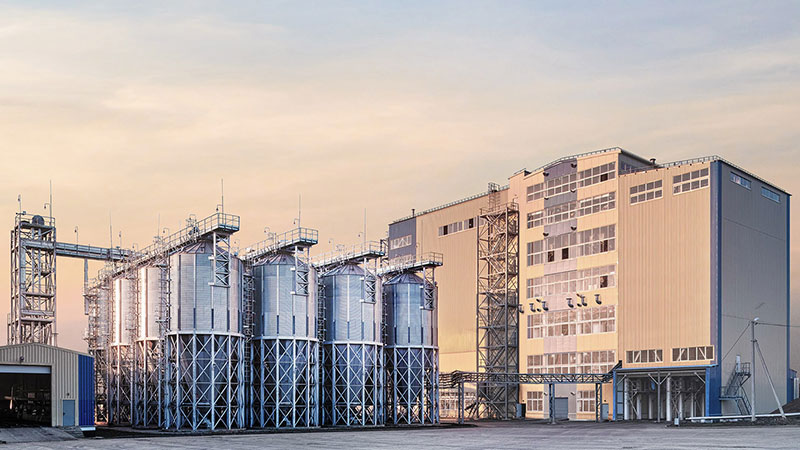
At RICHI, we go beyond project completion. With RICHI Servicee, we’re your dedicated partners in success. Count on us for expert guidance, minimal downtime, and optimized productivity. Choose RICHI for unmatched service and support.
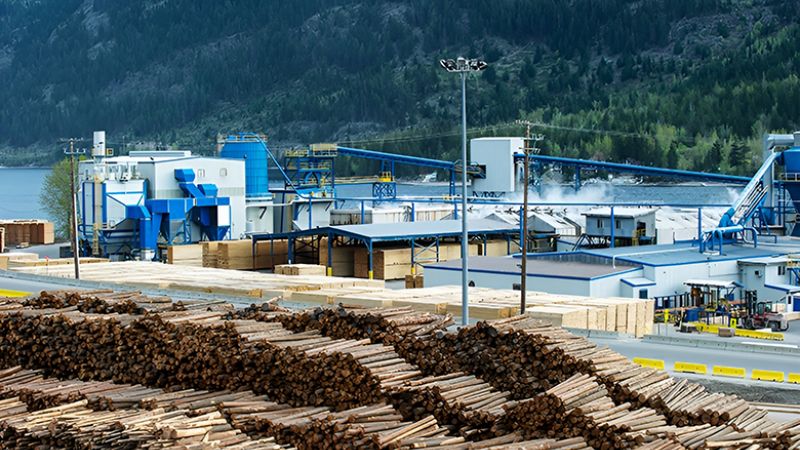


Meet global product demands and quality standards with industry-leading pellet plant design, engineering, equipment, and construction services for pellet processors.


Your Partner Beyond Project Completion
2000+ cases
RICHI is the leading designer, manufacturer and builder of pellet plants in the world, completing over 2000 projects in 140 countries across 6 continents.
Read More
Increase plant productivity, profitability, and safety by integrating high quality equipment into your pellet production line. Over the years, RICHI has become China's top pellet equipment manufacturer. At the same time, RICHI has established valuable partnerships with the world's leading component and raw material manufacturers to bring you the best there is in technology, automation, and efficiency in pelleting plant machinery.

For nearly 30 years, RICHI has been providing best-in-class pellet plant equipment and services to clients across a variety of industries, sizes, and needs. We pride ourselves on the knowledge and skill that each team member possesses – from our technical sales team to our process design engineers. You can count on RICHI Machinery to take your operation to the next level of innovation, quality, and success.
Need help with your pellet manufacturing plant project? Contact us today.
ANIMAL FEED
BIOMASS
WOOD
ORGANIC FERTILIZER
AQUA FEED
CAT LITTER
MUNICIPAL WASTE RECYCLING
SPECIAL PELLET PRODUCTION
RICHI Machinery continues to deliver world class pellet mill equipment, pellet plant engineering and project solutions that add value to our customers in the animal feed, wood waste, agriculture waste, organic fertilizer, cat litter and special pellet products industries. Throughout the years, we RICHI Machinery have built strong brand, becoming industry-leading pellet machine manufacturer. We value integrity, promise quality, and prioritize your success.
Learn MoreWith our expert team, we precisely implement your process engineering requirements in pellet mill and pelletizing plant systems. No matter which industry you’re in – we understand your needs and deliver solutions that meet the highest standards.
At RICHI, quality comes first. Our pellet making machine and related pellet line equipment undergo rigorous quality controls to ensure they meet the highest standards. Rely on products that are durable, safe, and efficient.
With decades of experience in pellet machine and pellet production line production, we have earned a reputation as a trusted partner in various industries. Our expertise allows us to cover a wide range of applications.
Not only do we offer premium pelleting equipment, but we are also experts at designing, building, installing, and maintaining facilities from the ground up. Our expertise is within pellt plant process design, discovering the most efficient, productive, and profitable way to handle your materials in an end-to-end cycle.
○ RICHI MACHINERY
Keeping in touch with us is an effective way to solve all your problems. If you have any needs or questions, please leave your contact information, then RICHI technical consultants will send design, quotation, videos to your mailbox. You can also contact us directly via WhatsApp: +86 13838389622
Copyright©2015-2026 by HENAN RICHI MACHINERY CO., LTD. All rights reserved.