
A Green Forage Rotary Dryer in Zimbabwe was selected by a dairy cooperative near Marondera to preserve part of its wet-season forage for use during periods when fresh feed becomes less available. The cooperative already had forage harvesting, chopping, ration preparation and storage facilities, so the investment focused on one Φ1.5×15 single-pass rotary dryer rather than a complete new feed production system.
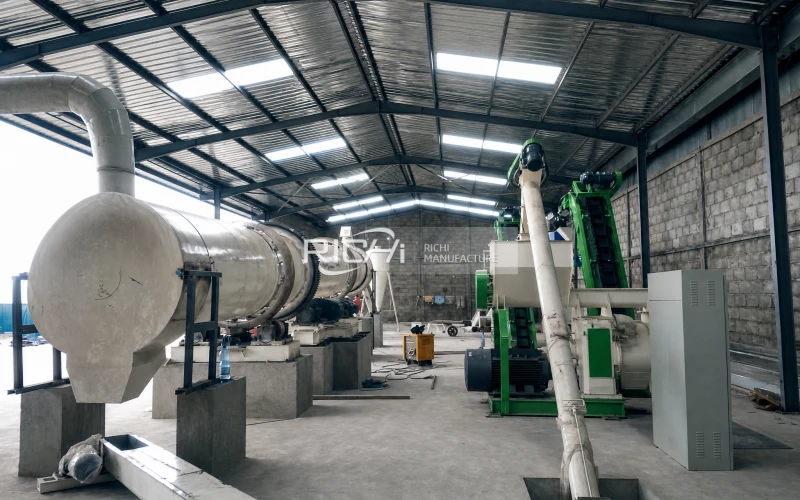
A Green Forage Rotary Dryer in Zimbabwe was selected by a dairy cooperative near Marondera to preserve part of its wet-season forage for use during periods when fresh feed becomes less available. The cooperative already had forage harvesting, chopping, ration preparation and storage facilities, so the investment focused on one Φ1.5×15 single-pass rotary dryer rather than a complete new feed production system.
The dryer is mainly used for chopped Napier grass and selected forage legumes such as lablab and velvet bean, with operating conditions adjusted according to the incoming material. Its purpose is not simply to “dry grass faster,” but to give the cooperative a controlled preservation option when field drying becomes unreliable and to create a more stable forage reserve for dairy feeding later in the year.
Name:
Forage Dryer
Country:
Zimbabwe
Date:
2025
Capacity:
5–7 T/H
Model:
Φ1.5×15
Dryer Type:
Single-pass
Raw Materials:
chopped Napier grass
Target Final Moisture:
12–14%
The customer manages forage supply for a group of dairy farms in Mashonaland East. Like many livestock operations working with seasonal forage production, the cooperative can have considerably more green biomass available during the growing season than during the drier part of the year.
Feed availability during the dry season is a recognized constraint in Zimbabwean livestock production, and forage legumes including lablab and velvet bean have been studied locally as ways to improve livestock feed resources.
The cooperative had traditionally preserved part of its grass and legumes by natural wilting and haymaking. That method remains useful and was not abandoned after the dryer was purchased.
The difficulty arose when freshly cut forage coincided with unstable weather.
Material spread for drying could be exposed to another rainfall event before reaching a suitable storage condition. Leafy forage was particularly difficult because repeated handling and prolonged exposure could increase physical losses, while material stored at excessive moisture carried a greater risk of deterioration.
The customer therefore wanted a Green Forage Rotary Dryer in Zimbabwe that could operate as a second preservation route when weather conditions did not support reliable outdoor drying.
This was not a new dairy feed factory.
The cooperative already owned forage harvesting and chopping equipment. It also had covered storage and equipment for preparing cattle rations.
RICHI therefore did not recommend another complete forage processing line simply to make the project larger.
The missing process was controlled moisture reduction.
One Φ1.5×15 rotary dryer provided a practical starting capacity for the centralized forage site while allowing the cooperative to continue using conventional haymaking whenever weather and forage condition made that more economical.
This also gave the customer an opportunity to establish real operating data for different forage species, fuel consumption and seasonal dryer utilization before considering any future capacity expansion.
The main raw material is chopped Napier grass.
Napier grass is relevant to forage production in southern and eastern Africa, including Zimbabwe, and Zimbabwean forage research has also evaluated Napier together with forage legumes such as lablab and velvet bean.
The cooperative also handles lablab and velvet bean according to seasonal availability.
These materials do not behave exactly like Napier grass in a dryer. Napier contains long fibrous stems and leaves, while legumes can contain a higher proportion of delicate leafy material.
This difference influences how aggressively the material should be handled and how drying conditions are adjusted.
Maize stover can also be processed when its moisture condition requires further drying, but it is treated as a different material rather than simply combined with fresh green forage under one fixed setting.
This raw-material flexibility is useful, but the customer does not expect one dryer recipe to work identically for every biomass material.
One of the most important parts of the project is upstream forage preparation.
Long freshly harvested grass should not enter the rotary dryer as tangled stems.
The cooperative uses its existing forage chopper to reduce the material to a more manageable length before drying. A typical project target is approximately 20–40 mm, although the exact chopping specification can be adjusted according to forage condition and handling requirements.
Chopping improves feeding stability and increases the surface area exposed to the drying air.
It also helps material move more evenly through the drum rather than forming large wet clumps.
This means the Green Forage Rotary Dryer in Zimbabwe is part of a forage preparation process even though the customer purchased the dryer as a standalone machine.
The customer selected the Φ1.5×15 single-pass rotary dryer after considering the available forage volume, incoming moisture, site space and expected seasonal working schedule. The supplied project specification uses a 1.5 m drum diameter, 15 m drum length and adjustable rotational speed.
| Project Item | Specification |
|---|---|
| Equipment | Green forage rotary dryer |
| Model | Φ1.5×15 |
| Quantity | 1 unit |
| Dryer Type | Single-pass rotary dryer |
| Drum Diameter | 1.5 m |
| Drum Length | 15 m |
| Rotating Speed | 3–12 rpm, adjustable |
| Main Raw Materials | Chopped Napier grass, lablab and velvet bean forage |
| Typical Chopped Length | Approximately 20–40 mm |
| Target Final Moisture | Approximately 12–14% when suitable for the intended storage method |
| Main Application | Preserved forage for later dairy feeding |
The dryer should not be evaluated by drum size alone.
A machine processing very wet fresh grass has to evaporate much more water per ton of finished forage than the same machine processing material that has already been field-wilted.
For this reason, RICHI evaluates both wet-material throughput and required water evaporation when selecting forage drying equipment.
The original project information associated the Φ1.5×15 dryer with a 5–7 T/H processing figure. That number needs context because fresh-material capacity and finished dry-forage output are not the same thing.
If fresh Napier grass enters at a very high moisture level, most of the incoming weight is water.
A large amount of that mass disappears as vapor during drying.
For example, two customers may both request a 5 T/H forage dryer, but one may supply freshly cut grass while the other supplies partially wilted grass. Their evaporation duties, heat requirements and finished-product outputs will be very different.
This is why customers considering a Green Forage Rotary Dryer in Zimbabwe should provide both initial and target moisture rather than capacity alone.
Prepared forage is metered into the rotating drum while heated air moves through the drying system.
Internal lifting and material-distribution structures repeatedly raise and redistribute the forage, improving contact with the drying medium.
As the material moves through the drum, water evaporates progressively.
Feed rate, airflow, drum speed and thermal input have to be balanced.
If too much wet forage is fed into the dryer, discharged material may remain above the required moisture. If the feed rate is too low or the thermal conditions are unnecessarily severe, dryer capacity is wasted and product quality can suffer.
The customer's operating target is therefore stable moisture removal rather than simply running the furnace at the highest possible temperature.
The original Φ1.5×15 project specification lists hot-gas inlet temperatures in the 400–500°C range and outlet-air temperatures around 70–80°C. Those figures refer to the drying gas, not to the forage itself.
This distinction is important.
Very hot gas enters a system containing a large quantity of wet biomass. Evaporation absorbs substantial thermal energy, so the plant material itself is not simply heated to the hot-gas inlet temperature.
The original statement that this temperature “kills mold spores instantly and preserves protein” was therefore removed.
Dryer operation should instead be adjusted according to incoming moisture, forage type, feed rate and required final quality.
Leafy legumes may require different operating attention from coarse Napier grass, particularly where minimizing unnecessary thermal exposure is important.
The cooperative wants the mechanically dried forage to be suitable for storage rather than merely warm and superficially dry.
For this project, approximately 12–14% moisture is used as a working final target when appropriate for the intended storage conditions.
The exact value still needs to be checked against the forage type and how the material will be stored.
Operators therefore monitor final moisture rather than judging the material only by appearance.
This is important because thicker stems and leafy fractions can lose moisture at different rates.
The finished product remains livestock forage.
The customer stores dried Napier grass and legume material for later use in dairy ration preparation when fresh forage is less readily available.
The dryer does not convert low-quality forage into high-quality feed automatically.
Nutritional quality still depends on the original plant material, harvest stage, contamination, storage and the complete ration in which it is used.
The value of drying is preservation.
By reducing moisture under controlled conditions, the cooperative can move a portion of forage production from a period of greater availability into a later feeding period.
This is the real commercial purpose of the Green Forage Rotary Dryer in Zimbabwe.
The customer does not mechanically dry every ton of forage it harvests.
When weather permits good haymaking, natural drying can remain the lower-cost option.
Some forage may also be better suited to ensiling depending on its condition and how the dairy ration is managed.
The rotary dryer provides another tool rather than replacing every forage preservation method.
This is important for project economics.
Mechanical drying requires heat, electricity and equipment operation. It is most valuable when those costs are justified by the amount of forage that would otherwise be difficult to preserve at the required time and quality.
The drum itself is only one part of a forage drying system.
A suitable heat source is also required.
The customer's fuel decision needs to consider what is consistently available near the project site, fuel price, handling requirements, ash and emissions management, and how precisely the thermal system can be controlled.
Possible project-specific options can include appropriate biomass fuels or other locally available energy sources, but RICHI does not assume one fuel is always cheapest.
Before finalizing a quotation, the customer should provide local fuel availability and price so that the hot-air system can be configured accordingly.
Dryer selection also needs to consider where the equipment will operate.
Air density and combustion conditions vary with elevation, so fan and hot-air-system selection should be evaluated for the actual installation site rather than copied blindly from another country.
The induced-draft system has to move enough drying gas through the drum while maintaining stable material movement and moisture removal.
This is another reason RICHI treats the Green Forage Rotary Dryer in Zimbabwe as a complete thermal-processing application rather than simply supplying a steel cylinder with a motor.
Drying chopped forage can generate light particles and dust, particularly toward the discharge end where the material has become much drier.
The exhaust system therefore needs appropriate separation and dust-control equipment.
The exact configuration depends on air volume, forage type, fuel system and local operating requirements.
RICHI considers these components together with the main dryer because poor airflow or inadequate exhaust handling can reduce dryer stability even if the drum itself is correctly sized.
Zimbabwe is landlocked, so the Φ1.5×15 dryer is shipped by sea from Qingdao Port in China to a suitable regional seaport serving Zimbabwean cargo.
For a Mashonaland East project, the final port can be selected according to the actual ocean-freight route and inland logistics arrangement rather than assuming that one southern African port will always be the lowest-cost choice.
Before shipment, RICHI provides foundation drawings, equipment dimensions, electrical information and installation requirements.
This allows the customer to prepare not only the dryer foundation but also the space required for feeding, hot-air generation, exhaust handling and maintenance.
The first operating period focused heavily on material consistency.
Uniformly chopped Napier grass could be fed more predictably than batches containing long stems and tangled forage.
The operators also learned that the same drum setting could not simply be used for every material.
A leafy lablab batch with one incoming moisture level may require a different combination of feed rate and thermal input from a wetter, stem-heavy Napier grass batch.
Final moisture therefore became the main operating reference rather than a fixed residence time or one furnace temperature.
The earlier version included precise figures for forage spoilage, protein retention, drying cost, monthly dried-forage sales and emergency reserves.
Those numbers should only appear on a public project page if they come from verified operating records.
The same applies to claims that the customer has already ordered a third dryer.
The revised case keeps the focus on what can be supported technically: seasonal forage preservation, controlled moisture reduction, material preparation and integration with the customer's existing dairy feeding system.
This makes the project more credible to an experienced agricultural buyer than using a series of highly specific financial results without documentation.
A mechanical forage dryer is not automatically suitable for every livestock farm.
A small operation with modest forage acreage may be able to preserve enough feed through haymaking or silage without the operating cost of a rotary dryer.
The economics become more relevant for larger dairy farms, forage cooperatives and commercial forage processors handling substantial seasonal biomass volumes.
The customer should know how much fresh forage needs to be processed during peak harvest, how wet it is, how many drying days are actually available and what heat source is locally economical.
These factors determine whether mechanical drying solves a real commercial problem.
The Φ1.5×15 was selected for this Marondera-area project because the cooperative already had forage harvesting and preparation capability but needed greater control over wet-season preservation.
Another Zimbabwean project may require a smaller or larger drying system.
Before recommending equipment, RICHI Machinery needs to know the forage species, fresh material available per hour and per day, initial moisture, target final moisture, chopped size and daily operating hours.
Customers should also provide information about available fuel, electricity, site elevation, storage requirements and existing forage chopping or conveying equipment.
If several forage types will be processed, their approximate proportions and harvest periods are useful because a dryer dominated by fresh Napier grass may require a different operating strategy from one handling partially wilted grass and crop residues.
With these details, RICHI Machinery can determine whether the Φ1.5×15 used in this Green Forage Rotary Dryer in Zimbabwe project is appropriate, calculate the required evaporation duty and configure the feeding, hot-air and exhaust systems around the actual site.
The objective is not simply to remove water from grass. It is to give a dairy operation a controlled way to preserve part of the forage produced when biomass is abundant so that it remains available when seasonal feeding conditions become more difficult.
Having the right mix of reliable, high-quality pellet machine and pelletizing systems and expert support is essential to your success. Watch how our end-to-end feed pellet plant solutions have helped our customers optimize their performance.
Our customized and future-proofed turnkey pellet plant solutions is designed with you at the core. From vision to reality and beyond, our team stays connected with yours. Giving you peace-of-mind with an expert at your side.
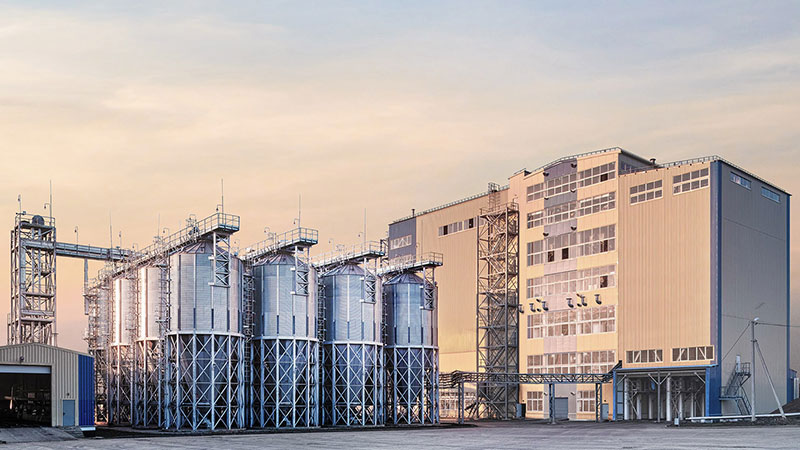
At RICHI, we go beyond project completion. With RICHI Servicee, we’re your dedicated partners in success. Count on us for expert guidance, minimal downtime, and optimized productivity. Choose RICHI for unmatched service and support.
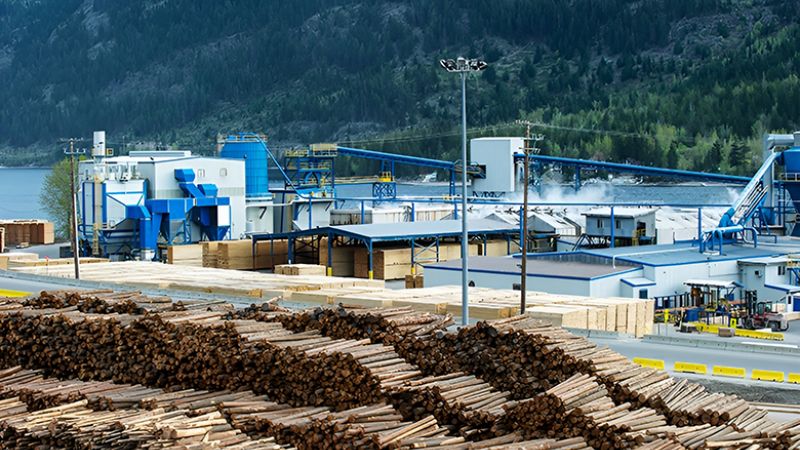


Meet global product demands and quality standards with industry-leading pellet plant design, engineering, equipment, and construction services for pellet processors.


Your Partner Beyond Project Completion
2000+ cases
RICHI is the leading designer, manufacturer and builder of pellet plants in the world, completing over 2000 projects in 140 countries across 6 continents.
Read More
Increase plant productivity, profitability, and safety by integrating high quality equipment into your pellet production line. Over the years, RICHI has become China's top pellet equipment manufacturer. At the same time, RICHI has established valuable partnerships with the world's leading component and raw material manufacturers to bring you the best there is in technology, automation, and efficiency in pelleting plant machinery.

For nearly 30 years, RICHI has been providing best-in-class pellet plant equipment and services to clients across a variety of industries, sizes, and needs. We pride ourselves on the knowledge and skill that each team member possesses – from our technical sales team to our process design engineers. You can count on RICHI Machinery to take your operation to the next level of innovation, quality, and success.
Need help with your pellet manufacturing plant project? Contact us today.
ANIMAL FEED
BIOMASS
WOOD
ORGANIC FERTILIZER
AQUA FEED
CAT LITTER
MUNICIPAL WASTE RECYCLING
SPECIAL PELLET PRODUCTION
RICHI Machinery continues to deliver world class pellet mill equipment, pellet plant engineering and project solutions that add value to our customers in the animal feed, wood waste, agriculture waste, organic fertilizer, cat litter and special pellet products industries. Throughout the years, we RICHI Machinery have built strong brand, becoming industry-leading pellet machine manufacturer. We value integrity, promise quality, and prioritize your success.
Learn MoreWith our expert team, we precisely implement your process engineering requirements in pellet mill and pelletizing plant systems. No matter which industry you’re in – we understand your needs and deliver solutions that meet the highest standards.
At RICHI, quality comes first. Our pellet making machine and related pellet line equipment undergo rigorous quality controls to ensure they meet the highest standards. Rely on products that are durable, safe, and efficient.
With decades of experience in pellet machine and pellet production line production, we have earned a reputation as a trusted partner in various industries. Our expertise allows us to cover a wide range of applications.
Not only do we offer premium pelleting equipment, but we are also experts at designing, building, installing, and maintaining facilities from the ground up. Our expertise is within pellt plant process design, discovering the most efficient, productive, and profitable way to handle your materials in an end-to-end cycle.
○ RICHI MACHINERY
Keeping in touch with us is an effective way to solve all your problems. If you have any needs or questions, please leave your contact information, then RICHI technical consultants will send design, quotation, videos to your mailbox. You can also contact us directly via WhatsApp: +86 13838389622
Copyright©2015-2026 by HENAN RICHI MACHINERY CO., LTD. All rights reserved.