
Forage grass drying machine in Paraguay for drying chopped pasture grass used in beef cattle feed preparation, with a rotary drum design matched to existing forage handling equipment.
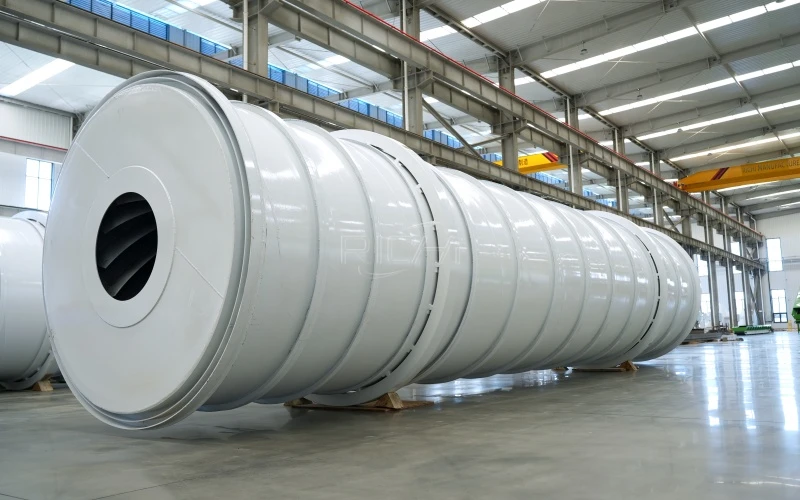
The forage grass drying machine in Paraguay was selected by a commercial forage processor supplying beef cattle farms with prepared roughage. The business already collected and chopped pasture grass for livestock feeding, but its ability to preserve harvested material depended heavily on field conditions and the timing of dry weather. The customer wanted a mechanical drying option that could handle selected batches of chopped grass before storage, without investing in a completely new forage processing line.
RICHI Machinery supplied one φ1.2 × 12 m rotary drum dryer for the project. The customer retained its existing harvesting, chopping and material-handling equipment, adding the dryer as a separate moisture-control stage. The purpose was to prepare chopped forage for more predictable storage and feed preparation during periods when freshly harvested grass was less convenient to preserve naturally.
Name:
Grass Drying Machine
Country:
Paraguay
Date:
2026
Capacity:
Flexible
Model:
Φ1.2 × 12
Drum Structure:
Single-cylinder rotary type
Inlet Air Temperature:
400–500°C
Outlet Air Temperature:
70–80°C
Paraguay has a substantial cattle industry, with extensive pasture-based beef production and a continuing need to manage forage availability across different seasons. Pasture conditions can change with rainfall, temperature and local growing conditions. When grass is harvested for preservation, the processor must consider not only how much forage is available but also whether it can be dried to a suitable condition before being stored.
The customer operated between pasture production and livestock feeding. Its raw material came from managed grassland and forage fields supplying cattle operations. The main material was chopped pasture grass, collected when growth was sufficient for harvesting. The business wanted to preserve part of this material instead of relying entirely on fresh forage or conventional field drying.
Natural drying remains a useful method when weather conditions are favorable. However, freshly cut grass contains substantial moisture, and the material cannot be treated in the same way as dry hay already suitable for storage. If rain interrupts field drying, the preservation schedule can be delayed. If partially dried forage is stored too early, moisture-related deterioration may become a concern.
The customer therefore added a rotary forage dryer to give its operation another way to manage harvested grass. This was a targeted investment in the drying stage, not a replacement for pasture management, harvesting machinery or the equipment used to prepare cattle rations.
The project used a single-cylinder rotary drum dryer with a diameter of 1.2 m and a length of 12 m. This model was selected as the planned configuration for a forage processor adding drying capacity to an existing operation.
The choice was based on the intended role of the machine and the need to coordinate it with the customer's available grass supply, chopping equipment and downstream storage arrangements. The final hourly throughput would need to be established from the actual inlet moisture, target outlet moisture, heat source and operating schedule.
| Project Parameter | Selected Specification |
|---|---|
| Equipment | Rotary drum forage grass dryer |
| Model | φ1.2 × 12 m |
| Quantity | 1 unit |
| Drum Diameter | 1.2 m |
| Drum Length | 12 m |
| Drum Structure | Single-cylinder rotary type |
| Reference Drum Speed | 3–12 rpm |
| Reference Inlet Air Temperature | 400–500°C |
| Reference Outlet Air Temperature | 70–80°C |
| Primary Raw Material | Chopped pasture grass |
| Intended Application | Moisture reduction before forage storage and feed preparation |
The temperature figures are the supplied equipment reference parameters, not fixed operating settings for every forage. Actual drying conditions must be determined from the material characteristics, heat source, feed rate and required final condition. The supplied specification also does not state a rated throughput for this model, so no unsupported capacity figure is assigned to the project.
The planned feedstock was chopped pasture grass collected from managed forage areas. Depending on the source and season, the material could include locally grown tropical or subtropical pasture grasses suitable for cattle feeding. The exact species would be confirmed from the customer's actual fields rather than assuming that every grass variety behaves identically during drying.
The material was intended to enter the dryer after chopping. This is important because long, tangled grass can be difficult to distribute consistently through a drying system. Chopping helps prepare the forage for feeding and movement through the drum, although the required particle length must be determined according to the machine's feeding arrangement and the downstream use.
Incoming moisture would vary with harvest timing, grass maturity and recent rainfall. Young, freshly cut grass can carry a high moisture load, while material that has already wilted in the field requires less water removal. The customer therefore needed to distinguish freshly harvested grass from partially wilted forage when planning the drying operation.
The project did not assume a fixed blend of grass and grain inside the dryer. The purpose of this machine was to remove moisture from the forage itself. Any later addition of grains, protein ingredients or minerals would take place in a separate feed preparation stage according to the cattle ration requirements.
The drying machine was positioned after grass collection and chopping. Prepared material would be transferred to the feed end of the rotary drum, where it enters the rotating cylinder and progresses through the drying section.
As the drum rotates, internal material-lifting and conveying elements repeatedly redistribute the grass. The material comes into contact with the hot drying medium as it advances toward the discharge end. Moisture evaporates and leaves with the exhaust stream, while the partially dried or dried grass moves out of the machine for cooling and subsequent handling.
Forage is fibrous and may behave differently from granular materials such as grain or mineral products. Its feeding consistency, moisture content and particle length influence how it moves through the drum. A stable supply of chopped material is therefore important to the overall process.
The rotary dryer does not replace the chopping stage. Nor does it automatically produce finished hay pellets. Its role in this project is moisture reduction. If the customer later decides to make forage meal or grass pellets, additional size reduction, mixing or pelletizing equipment may be needed after drying, depending on the required product.
The customer's existing operation already covered the main forage preparation activities. It could harvest grass, reduce its size and move the prepared material between working areas. The missing function was a controlled drying stage for selected batches.
Purchasing a complete forage pellet production line would have introduced equipment that the business did not immediately require. A single rotary drum dryer offered a more direct way to address the moisture problem while preserving the customer's existing investment.
This also gave the business flexibility in how it handled different harvests. Grass that could be preserved successfully through conventional field drying did not have to pass through the mechanical dryer. The rotary system could instead be used when the moisture condition or the operating schedule made additional drying necessary.
Such an arrangement is useful for a forage contractor because drying demand does not always remain constant throughout the year. Harvest volumes, grass moisture and customer demand may change. The machine's operating schedule can be planned around the actual material flow rather than requiring the whole business to operate as a continuous high-volume plant.
The principal application was preserved roughage for beef cattle feeding. Once dried and cooled to an appropriate condition, the grass could be moved into suitable storage and used as part of the customer's forage supply program.
For cattle producers, conserved forage provides a way to manage feed availability when pasture growth declines or when freshly cut grass is not available in sufficient quantities. Its nutritional value depends on the grass species, maturity at harvest, leaf-to-stem ratio and the handling conditions before and after drying.
Drying cannot restore nutrients that were already lost through poor harvesting or prolonged deterioration. For that reason, the customer needed to consider harvest timing and the quality of the incoming material alongside the dryer settings.
The output was not automatically classified as a complete cattle feed. It remained a forage ingredient. If the customer wanted to incorporate it into a mixed ration, the amount used would depend on the livestock category and the other ingredients in the feeding program.
Although this project focused on pasture grass for cattle, rotary drum dryers are used in a range of agricultural and industrial drying applications. Their suitability depends on the material's moisture, fibre characteristics, bulk density, abrasiveness and required final condition.
These are potential applications of rotary drying technology rather than a claim that one machine can process every material without adjustment. A change from pasture grass to a different raw material may require a new assessment of feeding behavior, moisture-removal demand, heat supply and product quality requirements.
For this project, the goal was not to use the highest possible temperature. It was to remove the required amount of water while maintaining the suitability of the grass for its intended use.
The equipment reference lists an inlet air temperature of 400–500°C and an outlet air temperature of 70–80°C. These values describe the specified hot-air operating reference; they should not be interpreted as the temperature of the grass itself throughout the drying process.
As moisture evaporates, the wet material absorbs heat. The actual product temperature depends on the inlet condition, airflow, residence time and process settings. Forage quality also depends on how the grass was harvested and handled before entering the machine.
RICHI's technical planning therefore needed to consider the material's starting moisture, the desired final moisture and the available heat source. The final operating settings would be established during commissioning rather than prescribed as one universal recipe for all grasses.
Drying does not end when material leaves the drum. The output needs to be handled in a way that prevents it from picking up moisture again before storage.
The customer therefore needed to consider the space available for cooling and the route from the dryer discharge to the storage area. Depending on the layout, a discharge conveyor or other transfer equipment could be used to reduce manual handling and keep the material flow organized.
Storage conditions also matter. Dried forage should be protected from rain and moisture ingress, with sufficient ventilation and handling practices appropriate to the product. Material that has not reached a suitable storage condition should not be treated as stable simply because it has passed through a dryer.
This was one reason RICHI reviewed the downstream arrangement before finalizing the equipment selection. The dryer had to fit into a practical material flow, not operate as an isolated machine without a clear discharge destination.
Before the equipment was dispatched, the customer needed to provide information about the type of grass, the approximate inlet moisture range, the expected material flow and the intended storage condition. These details helped establish the scope of the drying application and identify the interfaces that had to be prepared at the site.
RICHI could provide the equipment drawings, overall dimensions, installation guidance and operating documentation needed for site preparation. The customer would also need to confirm the available heat source, electrical arrangements, feed-end access and discharge clearance.
Commissioning would focus on observing how the actual grass moved through the drum and whether the selected operating conditions achieved the required moisture reduction. Operators would need instruction on routine inspection, lubrication, safe start-up and shutdown, and monitoring for abnormal vibration or changes in operating behavior.
These preparations are especially useful when a customer is adding one machine to an existing facility. The objective is to make the new drying stage work with equipment already on site rather than forcing unnecessary changes to the entire forage handling arrangement.
The φ1.2 × 12 m rotary dryer was planned for sea shipment from Qingdao Port in China to the Port of Montevideo, Uruguay. Paraguay is landlocked and relies on regional transport and river-port connections for international trade. Montevideo is a regional maritime gateway that can be considered for shipments destined for Paraguay, subject to the carrier's routing and cargo arrangements.
Before shipment, the customer needed to confirm the unloading plan, installation area, foundation requirements, heat-source connection and the interfaces between the dryer and existing equipment. The layout also had to allow safe access for inspection and maintenance.
RICHI could provide the equipment documentation and installation information required for site preparation. Technical support would focus on the rotary dryer, its operating conditions and the material flow through the drying stage, with commissioning procedures based on the customer's actual grass.
The forage grass drying machine in Paraguay was selected to address a specific requirement in the customer's forage handling operation. The business already collected and chopped pasture grass for cattle feeding, but wanted an additional preservation option when natural drying was not convenient for the planned material flow.
The φ1.2 × 12 m rotary drum dryer provided a defined drying stage without requiring a complete new forage processing line. The machine's reference drum speed and hot-air temperature ranges offered a starting point for process planning, while the actual throughput and final moisture would be determined from the incoming grass and the required storage condition.
For businesses comparing a forage grass dryer, grass rotary dryer or agricultural biomass drying machine, the most useful information to prepare includes the grass species, harvest condition, particle length, moisture range, required final moisture and intended downstream use. These details help RICHI Machinery assess whether this configuration is suitable or whether another drum size or drying arrangement should be considered.
The purpose of the project was straightforward: add controlled moisture reduction where the existing operation needed it, preserve the equipment already in use and create a more flexible way to prepare grass for cattle feed storage. A properly matched rotary dryer can serve that role without turning a focused equipment purchase into an unnecessarily large project.
Having the right mix of reliable, high-quality pellet machine and pelletizing systems and expert support is essential to your success. Watch how our end-to-end feed pellet plant solutions have helped our customers optimize their performance.
Our customized and future-proofed turnkey pellet plant solutions is designed with you at the core. From vision to reality and beyond, our team stays connected with yours. Giving you peace-of-mind with an expert at your side.

At RICHI, we go beyond project completion. With RICHI Servicee, we’re your dedicated partners in success. Count on us for expert guidance, minimal downtime, and optimized productivity. Choose RICHI for unmatched service and support.



Meet global product demands and quality standards with industry-leading pellet plant design, engineering, equipment, and construction services for pellet processors.


Your Partner Beyond Project Completion
2000+ cases
RICHI is the leading designer, manufacturer and builder of pellet plants in the world, completing over 2000 projects in 140 countries across 6 continents.
Read More
Increase plant productivity, profitability, and safety by integrating high quality equipment into your pellet production line. Over the years, RICHI has become China's top pellet equipment manufacturer. At the same time, RICHI has established valuable partnerships with the world's leading component and raw material manufacturers to bring you the best there is in technology, automation, and efficiency in pelleting plant machinery.

For nearly 30 years, RICHI has been providing best-in-class pellet plant equipment and services to clients across a variety of industries, sizes, and needs. We pride ourselves on the knowledge and skill that each team member possesses – from our technical sales team to our process design engineers. You can count on RICHI Machinery to take your operation to the next level of innovation, quality, and success.
Need help with your pellet manufacturing plant project? Contact us today.
ANIMAL FEED
BIOMASS
WOOD
ORGANIC FERTILIZER
AQUA FEED
CAT LITTER
MUNICIPAL WASTE RECYCLING
SPECIAL PELLET PRODUCTION
RICHI Machinery continues to deliver world class pellet mill equipment, pellet plant engineering and project solutions that add value to our customers in the animal feed, wood waste, agriculture waste, organic fertilizer, cat litter and special pellet products industries. Throughout the years, we RICHI Machinery have built strong brand, becoming industry-leading pellet machine manufacturer. We value integrity, promise quality, and prioritize your success.
Learn MoreWith our expert team, we precisely implement your process engineering requirements in pellet mill and pelletizing plant systems. No matter which industry you’re in – we understand your needs and deliver solutions that meet the highest standards.
At RICHI, quality comes first. Our pellet making machine and related pellet line equipment undergo rigorous quality controls to ensure they meet the highest standards. Rely on products that are durable, safe, and efficient.
With decades of experience in pellet machine and pellet production line production, we have earned a reputation as a trusted partner in various industries. Our expertise allows us to cover a wide range of applications.
Not only do we offer premium pelleting equipment, but we are also experts at designing, building, installing, and maintaining facilities from the ground up. Our expertise is within pellt plant process design, discovering the most efficient, productive, and profitable way to handle your materials in an end-to-end cycle.
○ RICHI MACHINERY
Keeping in touch with us is an effective way to solve all your problems. If you have any needs or questions, please leave your contact information, then RICHI technical consultants will send design, quotation, videos to your mailbox. You can also contact us directly via WhatsApp: +86 13838389622
Copyright©2015-2026 by HENAN RICHI MACHINERY CO., LTD. All rights reserved.