
The Floating Catfish Feed Extruder in Malaysia purchased by a feed mill in Perak has enabled the production of 1.5-2.0 tons per hour of highly expanded, water-stable floating pellets for hybrid catfish.
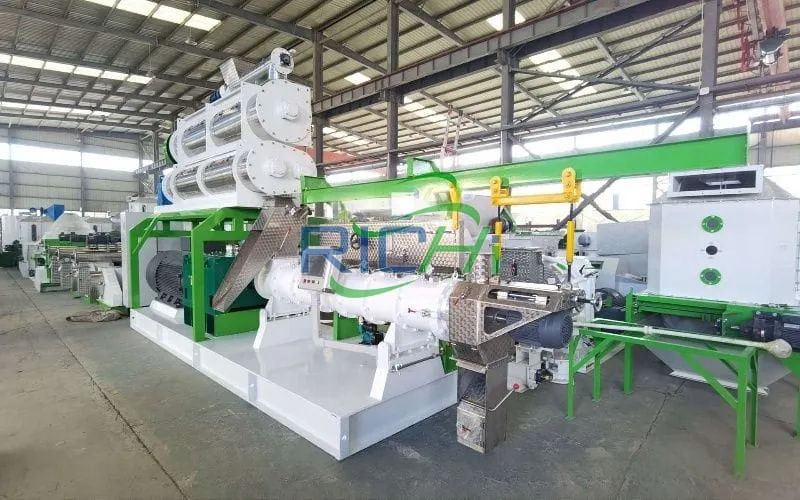
The Floating Catfish Feed Extruder in Malaysia purchased by a feed mill in Perak has enabled the production of 1.5-2.0 tons per hour of highly expanded, water-stable floating pellets for hybrid catfish.
After a decade of producing only sinking feed, the mill owner selected the SPHS120*2 twin-screw extruder from RICHI, featuring a 90kW main motor and 120mm twin screws. This machine provides precise expansion control, runs on the mill's existing 150A three-phase service, and produces three pellet sizes (1.5mm fry feed, 3mm fingerling feed, and 4.5-6mm grow-out feed) that float for 25-30 minutes.
The fish feed extruder handles a starch-rich formulation (30% wheat flour, 25% soybean meal, 20% fish meal) with moisture at 26-28% and die pressure at 25-30 bar, creating floating feed that hybrid catfish farmers now prefer over imported alternatives.
Name:
Catfish Feed Extruder
Country:
Malaysia
Date:
2025
Capacity:
1.5-2.0 tons per hour
Model:
SPHS120*2
Main Motor Power:
90kW
Raw Materials:
wheat flour, fish meal, soybean meal
Pellet diameter:
1.5-6mm
Malaysia is Southeast Asia's third-largest producer of catfish, with farms concentrated in Perak, Pahang, and Johor.
Most Malaysian catfish farmers use sinking feed. But a growing number of hybrid catfish varieties (Clarias gariepinus x Clarias batrachus) prefer feeding at the surface, especially in warmer months.
A feed mill in Perak had been producing sinking catfish feed for ten years. Farm customers kept asking for a floating alternative. The mill owner decided to expand.
He already had hammer mills, mixers, belt dryers, and bagging lines for sinking feed production. What he needed was a floating catfish feed extruder in Malaysia that could produce 1.5-2.0 tons per hour of highly expanded, water-stable floating pellets.
After studying options, he purchased one SPHS120*2 extruder from RICHI. RICHI has supplied similar floating feed extrusion systems to customers across Southeast Asia, including catfish feed producers in Malaysia, Thailand, Indonesia, Vietnam, the Philippines, Cambodia, and Laos.
The twin-screw technology has proven itself for high-expansion floating feed production in tropical climates. The mill owner's decision to add floating feed production has opened a new market segment without cannibalizing his sinking feed business.
Traditional African catfish are bottom feeders. They prefer sinking pellets. Hybrid catfish are different. They swim throughout the water column and will readily take floating feed.
Malaysian hybrid catfish production has increased 25% annually for five years. Farmers raising hybrids want floating feed because they can see the fish feeding and adjust rations in real time. No feed waste sinks to the bottom and pollutes the pond.
The mill owner calculated that floating catfish feed would command a 15-20% price premium over sinking feed. Production cost would be similar. The margin was attractive.
He already had customers who bought sinking feed from him. Many also raised hybrids and currently bought floating feed from a competitor. He could capture that business.
The SPHS120*2 floating catfish feed extruder in Malaysia has a 90kW main motor and twin screws with 120mm diameter. Output is rated at 1.5-2.0 tons per hour for floating feed.
The mill planned to run one shift per day, producing about 12 tons per day. That would be enough to supply 80-100 medium hybrid catfish farms.
The 90kW motor runs on the mill's existing 150A three-phase service. No electrical upgrade needed. The twin-screw design provides precise control over expansion, which is critical for floating feed.
The mill owner considered buying a larger SPHS150*2 but decided the extra capacity was unnecessary for his initial floating feed volume. The smaller machine also has a lower spare parts cost.
Floating feed requires more starch than sinking feed. The mill developed a formulation for hybrid catfish floating feed with higher wheat flour content.
Standard floating formulation:
Total starch is about 25%. The sinking feed formulation has only 15% wheat flour.
The mill also uses a different fish meal source for floating feed. Imported fish meal from Peru has higher fat content (8-10%) than local fish meal (5-6%). The higher fat helps with expansion during extrusion.
Moisture entering the extruder is 26-28% for floating feed, compared to 23-24% for sinking.
The conditioner heats the mash to 92-95°C. The extruder barrel has four heating zones: 60°C, 80°C, 105°C, and 110°C.
Die pressure is maintained at 25-30 bar – much lower than the 50-55 bar used for sinking feed. The mill runs the screws at 380 RPM for maximum expansion.
The floating catfish feed extruder in Malaysia produces three floating pellet sizes:
The 4.5mm pellets float for 25-30 minutes in still water at 28°C. The mill tested the pellets in a 1-meter column. They remained at the surface for 28 minutes on average.
Hybrid catfish are aggressive feeders and typically consume floating pellets within 5-8 minutes. The float time is more than adequate. The 6mm pellets float for 20-25 minutes, which is still acceptable.
The mill did not replace its sinking feed line. The new extruder runs alongside the old sinking feed press. The mill now offers both products.
Farmers raising traditional catfish buy sinking feed. Farmers raising hybrids buy floating feed. Some farmers with mixed ponds buy both.
The mill manager says the floating feed line has attracted 60 new customers who previously bought imported feed from Thailand. The floating feed business now accounts for 35% of the mill's aquaculture revenue.
The SPHS120*2 floating catfish feed extruder was shipped from Qingdao in July. The port of destination was Port Klang, Malaysia's largest seaport, located about 45 kilometers from Kuala Lumpur.
Sea freight took 12 days. Customs clearance at Port Klang took 4 days. Malaysian customs is efficient.
Import duty on extrusion equipment from China under ASEAN agreements is 0%. SST (sales and service tax) is 10% but recoverable. The total landed cost was 14% above the FOB price.
From Port Klang, the machine traveled 200 kilometers by truck to the mill in Perak. Installation took two weeks.
Installation was supervised by a service engineer from RICHI's distributor in Shah Alam. The SPHS120*2 required a level concrete foundation. RICHI provided detailed installation drawings in English and Malay. The mill's electrician handled the 415V three-phase connection.
Five operators trained for one week. They learned:
The operators also learned how to diagnose common problems:
Three problems required attention.
First, the floating pellets were not consistent. Some pellets floated well; others sank. The problem was uneven conditioning. The mill installed a new set of conditioner paddles with a more aggressive mixing profile. Moisture variation dropped from 4% to 1%. Float time became consistent.
Second, the cutter blade wore out after 200 hours. The high-expansion pellets are abrasive. The mill switched to a ceramic-coated cutter blade. Blade life increased to 800 hours.
Third, the pellets had a rough surface. Malaysian farmers prefer smooth pellets. The mill added 2% vegetable oil to the post-extrusion coater. The oil filled surface imperfections, producing smooth, glossy pellets that farmers preferred.
The mill's sales team visited 50 hybrid catfish farms in the first three months. Feedback was positive.
A farmer in Perak reported that feed conversion ratio improved from 1.7 to 1.5 after switching to floating feed. He could see his fish feeding, so he adjusted rations more precisely.
Another farmer in Johor said his pond water stayed clearer. Floating feed produced no waste on the pond bottom. He reduced pond cleaning frequency by 50%.
A third farmer in Pahang reported faster growth. His fish reached harvest size two weeks earlier. He attributed the faster growth to the better digestibility of extruded floating feed.
The mill now has 120 regular customers for floating catfish feed and sells 200-250 tons per month.
The SPHS120*2 floating catfish feed extruder in Malaysia is not limited to catfish floating feed. The mill produces three other floating feeds:
The mill's production manager shared operational data.
The floating catfish feed extruder in Malaysia runs 1,200 hours total. Production breakdown:
Die life data:
The 90kW main motor draws 86kW at normal load for floating feed. Power cost is about 45 ringgit per hour. Acceptable. The mill has become a regional leader in floating catfish feed production.
RICHI's distributor in Shah Alam provided extensive support. A service engineer visited the mill three times during the first two months. He helped dial in the screw configuration for floating feed and trained the maintenance team on preventive maintenance.
RICHI had extensive Southeast Asian experience, having supplied floating catfish feed extruders to:
The engineer brought expansion data from these installations. The mill used that data to optimize their settings. RICHI also provided a 24/7 WhatsApp support line. The mill has used it three times.
Malaysia's hybrid catfish industry continues to grow. Floating feed is gaining acceptance among farmers who see the benefits: better feed conversion, clearer pond water, and faster growth.
The mill in Perak proved that locally produced floating feed can compete with imports from Thailand. Other feed mills are taking notice. At least three have visited the facility since the extruder started running.
RICHI Machinery has received inquiries from mills in Malaysia, Indonesia, and the Philippines. For any feed producer looking to enter the floating catfish feed market, the same opportunity exists.
The floating catfish feed extruder in Malaysia that the Perak mill purchased is not the largest model. But it has the expansion control and reliability that Southeast Asian producers need.
One SPHS120*2 floating catfish feed extruder in Malaysia, a starch-rich formulation, and a commitment to consistent floating performance. That was enough to create a floating feed that Malaysian hybrid catfish farmers now prefer over imported alternatives.
Having the right mix of reliable, high-quality pellet machine and pelletizing systems and expert support is essential to your success. Watch how our end-to-end feed pellet plant solutions have helped our customers optimize their performance.
Our customized and future-proofed turnkey pellet plant solutions is designed with you at the core. From vision to reality and beyond, our team stays connected with yours. Giving you peace-of-mind with an expert at your side.
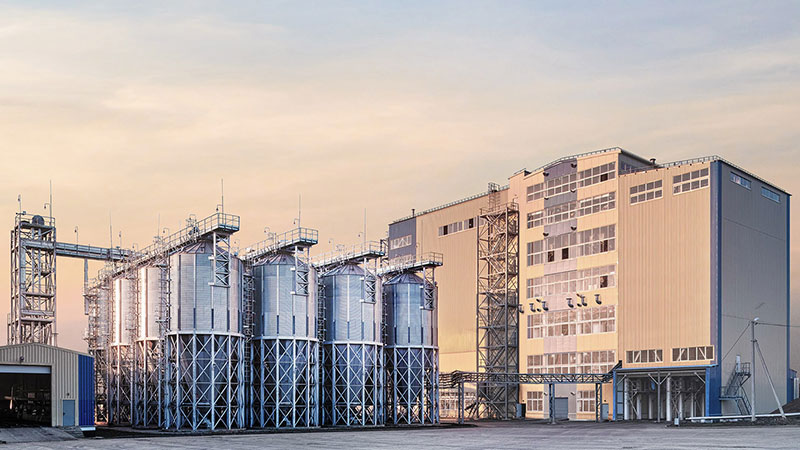
At RICHI, we go beyond project completion. With RICHI Servicee, we’re your dedicated partners in success. Count on us for expert guidance, minimal downtime, and optimized productivity. Choose RICHI for unmatched service and support.
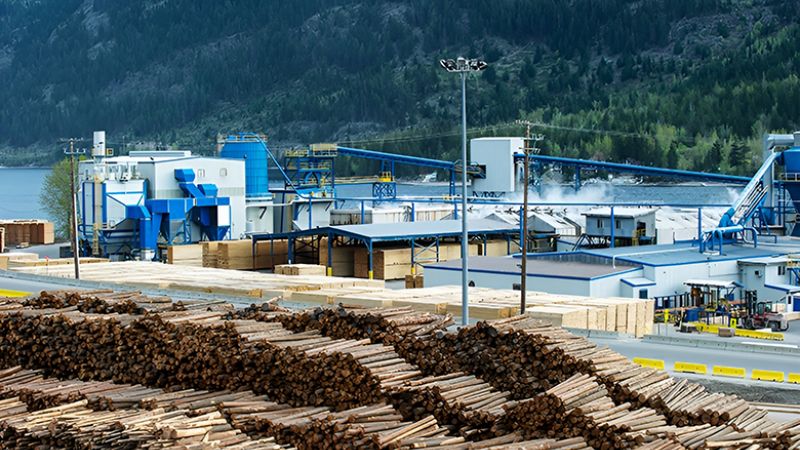


Meet global product demands and quality standards with industry-leading pellet plant design, engineering, equipment, and construction services for pellet processors.

Your Partner Beyond Project Completion
2000+ cases
RICHI is the leading designer, manufacturer and builder of pellet plants in the world, completing over 2000 projects in 140 countries across 6 continents.
Read More
Increase plant productivity, profitability, and safety by integrating high quality equipment into your pellet production line. Over the years, RICHI has become China's top pellet equipment manufacturer. At the same time, RICHI has established valuable partnerships with the world's leading component and raw material manufacturers to bring you the best there is in technology, automation, and efficiency in pelleting plant machinery.

For nearly 30 years, RICHI has been providing best-in-class pellet plant equipment and services to clients across a variety of industries, sizes, and needs. We pride ourselves on the knowledge and skill that each team member possesses – from our technical sales team to our process design engineers. You can count on RICHI Machinery to take your operation to the next level of innovation, quality, and success.
Need help with your pellet manufacturing plant project? Contact us today.
ANIMAL FEED
BIOMASS
WOOD
ORGANIC FERTILIZER
AQUA FEED
CAT LITTER
MUNICIPAL WASTE RECYCLING
SPECIAL PELLET PRODUCTION
RICHI Machinery continues to deliver world class pellet mill equipment, pellet plant engineering and project solutions that add value to our customers in the animal feed, wood waste, agriculture waste, organic fertilizer, cat litter and special pellet products industries. Throughout the years, we RICHI Machinery have built strong brand, becoming industry-leading pellet machine manufacturer. We value integrity, promise quality, and prioritize your success.
Learn MoreWith our expert team, we precisely implement your process engineering requirements in pellet mill and pelletizing plant systems. No matter which industry you’re in – we understand your needs and deliver solutions that meet the highest standards.
At RICHI, quality comes first. Our pellet making machine and related pellet line equipment undergo rigorous quality controls to ensure they meet the highest standards. Rely on products that are durable, safe, and efficient.
With decades of experience in pellet machine and pellet production line production, we have earned a reputation as a trusted partner in various industries. Our expertise allows us to cover a wide range of applications.
Not only do we offer premium pelleting equipment, but we are also experts at designing, building, installing, and maintaining facilities from the ground up. Our expertise is within pellt plant process design, discovering the most efficient, productive, and profitable way to handle your materials in an end-to-end cycle.
○ RICHI MACHINERY
Keeping in touch with us is an effective way to solve all your problems. If you have any needs or questions, please leave your contact information, then RICHI technical consultants will send design, quotation, videos to your mailbox. You can also contact us directly via WhatsApp: +86 13838389622
Copyright©2015-2026 by HENAN RICHI MACHINERY CO., LTD. All rights reserved.