
Fish feed micron powder grinder in Greece for producing 75–100 micron larval feed ingredients, with SWFL90 ultrafine grinding technology and precision particle classification.
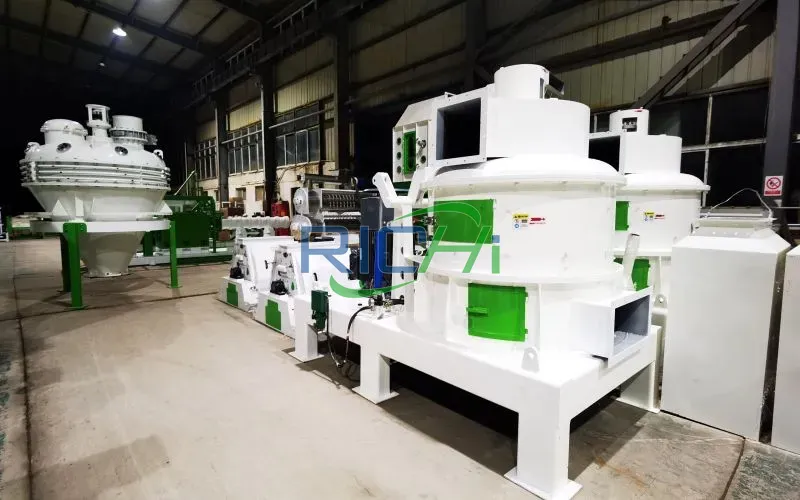
A hatchery feed manufacturer near Patras, in western Greece, needed a more precise way to grind ingredients for the first-feeding diets used in European seabass and gilthead seabream (Sparus aurata) hatcheries. The company supplied specialized starter feeds to aquaculture businesses in Greece and neighboring Mediterranean markets, where consistent feed particle size was an important consideration for early-stage fish nutrition.
The manufacturer produced approximately 3,000 tons of hatchery feed annually, including rotifer enrichment diets, artemia replacement feeds and specialized starter formulations. Its conventional hammer mill could handle preliminary size reduction, but it struggled to achieve the finer particle distribution required for selected larval feed products. The production team therefore needed a dedicated grinding machine rather than a complete new feed production line.
Name:
Fish Feed Micron Powder Grinder
Country:
Greece
Date:
2026
Capacity:
0.6–0.8 T/H
Model:
SWFL90
Main Motor Power:
90 kW
Initial classifier setting:
3,200 RPM
Final product size:
75–100 microns
After reviewing the target particle size, ingredient characteristics and daily production requirements, the company selected an SWFL90 ultrafine grinder from RICHI Machinery. The machine was integrated into the existing process to prepare micron-sized powder for premium larval feed production, allowing the manufacturer to retain its established upstream equipment while improving control over the fine-grinding stage.
First-feeding fish require feed particles appropriate to their mouth gape, feeding behavior and developmental stage. Particles that are too large may be difficult for larvae to ingest, while inconsistent particle distribution can make it harder to deliver a suitable feed to the entire population. For the Greek manufacturer, the target was approximately 75–100 microns, corresponding roughly to 150–200 mesh.
The existing hammer mill could reduce material to a useful intermediate size, but it did not provide sufficient control over the finest fraction. The SWFL90 offered a different grinding arrangement, combining high-speed impact with an internal classifier wheel. Rather than allowing particles to leave solely according to a screen opening, the classification system separates finer material from coarser particles and returns oversized material for further grinding.
The selected model has a 90 kW main motor and a nominal capacity of 1–2 tons per hour under standard conditions. With a finer 1.0 mm pre-screen used for the larval feed application, the expected working capacity was lower, at approximately 0.6–0.8 tons per hour. This was a better match for the manufacturer's premium product requirements than choosing a larger machine based only on its maximum rated output.
| Parameter | Specification |
|---|---|
| Model | SWFL90 |
| Equipment type | Ultrafine grinder with classifier |
| Main motor power | 90 kW |
| Classifier wheel motor | 7.5 kW |
| Feeder motor | 1.5 kW |
| Nominal capacity | 1–2 T/H under standard conditions |
| Application-specific capacity | Approximately 0.6–0.8 T/H with 1.0 mm pre-screening |
| Target particle size | 75–100 microns |
| Initial classifier setting | Approximately 3,200 RPM |
| Airflow reference | Approximately 3,800 m³/h |
| Primary application | Fine grinding of ingredients for marine fish larval feed |
These operating figures describe the selected project's configuration. Actual output and particle distribution depend on ingredient composition, moisture, oil content, pre-grinding quality, classifier settings and the performance of the air-handling system. The final settings should be established through material testing and commissioning rather than treated as universal values for every fish feed formula.
The manufacturer's larval feed formulations used several nutrient-dense ingredients that required careful size reduction. Fish meal supplied concentrated protein, while squid meal and krill meal contributed additional nutrients and feeding-related properties. Algae ingredients, fish oil and specialized vitamin-mineral premixes were incorporated according to the requirements of each product.
Indicative ingredient inclusion ranges used during formulation planning were as follows:
These ranges represent ingredient options rather than a single balanced recipe; their combined inclusion must be adjusted to total 100%, with the remaining ingredients and nutrient specifications determined by a qualified aquafeed formulator. Oil-rich ingredients also require particular attention because their physical properties can affect flow, heat generation and particle separation during grinding.
The fine grinder was primarily assigned to ingredients that needed additional size reduction before final feed preparation. The existing hammer mill remained useful for preliminary crushing, while the SWFL90 handled the finer grinding requirement. This division of work helped avoid using a conventional hammer mill for a task beyond its intended operating range.
For this application, the grinding process began with preliminary size reduction through a 1.0 mm screen. This finer pre-screen was selected to reduce the workload on the ultrafine grinding stage and help achieve the required final particle distribution. It also reduced the potential throughput compared with a standard 2.0 mm pre-screen, making capacity planning important.
The classifier wheel was particularly important because the manufacturer needed a controlled fine fraction rather than simply a high proportion of material passing through a conventional screen. During initial trials, the classifier was set at approximately 3,200 RPM, with the airflow adjusted to suit the material and target particle size.
The collected powder then underwent particle-size testing before being released for subsequent feed manufacturing stages. This verification was essential because the percentage of particles within the target range mattered as much as the nominal average size.
The SWFL90 was shipped from Qingdao, China, to the Port of Piraeus in Greece. The sea voyage was planned at approximately 30–35 days, followed by inland transportation to the manufacturer's facility near Patras, around 200 km west of the port. Customs clearance and final delivery were coordinated with the customer's local logistics provider.
The delivered equipment package included the 90 kW grinder, classifier wheel assembly, feeder, cyclone and airlock discharge components, along with spare hammers, screens and installation documentation. The classifier assembly used bearings selected for its high-speed operating conditions.
At the facility, the customer prepared a reinforced concrete foundation with vibration-damping mounts. The machine's installation weight was approximately 4.5 tons, so the foundation and lifting arrangements needed to accommodate the equipment safely. The electrical installation was configured for the local 400 V, 50 Hz, three-phase supply, with motor protection and cable sizing determined by the electrical contractor.
The air-handling system was also planned as part of the installation. A high-efficiency baghouse filter was fitted to collect airborne fines and reduce the loss of expensive feed ingredients. Dust collection, ducting, access for maintenance and safe isolation of electrical equipment were all important considerations for the completed installation.
During the initial fish meal trial, the classifier was operated at approximately 3,200 RPM with the 1.0 mm pre-screen. The manufacturer's sieve-test records indicated that around 92% of the tested sample passed a 150-mesh sieve, while approximately 85% passed a 200-mesh sieve. These results supported the decision to use the SWFL90 for the fine-grinding stage, although final acceptance depended on the agreed particle-size distribution for each product.
After six months of operation, the company reported that the new system was producing larval feed ingredients within its intended fine-particle range more consistently than the previous hammer-mill-only arrangement. The production team also reported positive feedback from hatchery customers using the resulting starter feeds.
The company's operating records compared larval survival rates of approximately 25–30% before the grinding upgrade with reported rates of 45–55% after introducing the finer feed. These were customer-reported observations, not a controlled trial proving that grinding alone caused the change. Larval survival also depends on hatchery management, water quality, stocking density, feeding frequency, feed composition and the suitability of particle size for each developmental stage.
With the finer pre-screen, the SWFL90 delivered approximately 0.6–0.8 tons per hour under the reported operating conditions. At an eight-hour production schedule, this represented roughly 5–6 tons per day, sufficient for the manufacturer's premium larval feed requirement. The fine-grinding stage was reported to process approximately 1,500 tons annually, depending on operating days and product demand.
Fine grinding requires a more deliberate maintenance routine than occasional coarse crushing. The 1.0 mm pre-screen increased the workload on the hammers, so the customer planned inspections and replacement around actual wear rather than waiting for a noticeable decline in output.
The machine's hydraulic cover-opening arrangement also simplified access to the grinding chamber. For a plant that routinely inspects hammers and cleans the chamber, easier access can reduce maintenance time, provided the equipment is safely isolated before servicing.
RICHI's support covered more than the supply of the grinder. The technical team provided guidance on pre-screen selection, classifier adjustment, installation requirements and the spare parts needed for the customer's planned operating schedule. Greek-language installation documentation and electrical drawings helped the local team coordinate the work.
During commissioning, the production team could use remote technical support to review operating settings and address questions about the classifier. The customer also received recommendations for keeping replacement hammers, screens and classifier components available so that routine maintenance would not unnecessarily interrupt production.
These measures were particularly relevant because the grinder was introduced into an existing production process. The aim was to improve the fine-grinding stage while preserving the value of the customer's existing equipment and avoiding the cost and disruption of replacing the complete hatchery feed line.
For hatchery feed manufacturers producing diets for seabass, seabream and other marine fish larvae, selecting an ultrafine grinder requires more than comparing nominal capacity figures. Buyers should establish the required particle-size distribution, test representative raw materials and assess how oil content, moisture and ingredient abrasiveness affect the grinding process.
The SWFL90 was selected for this Greek project because the customer needed a fine-particle product, a practical production rate and a classification system that could separate the desired fine fraction from oversized particles. Its application-specific capacity was more relevant to the project than its standard maximum output.
RICHI Machinery supplies grinding and feed processing equipment for aquaculture applications. By matching the grinder configuration to the intended ingredients, target particle size and daily output, manufacturers can make a more informed equipment investment and build a repeatable process for specialized larval feed production.
If your hatchery feed operation requires micron-sized powder for early-stage marine fish diets, share your raw materials, target particle-size distribution and hourly capacity with RICHI Machinery. These details provide a practical starting point for evaluating the appropriate ultrafine grinder and its supporting classification and dust-collection systems.
Having the right mix of reliable, high-quality pellet machine and pelletizing systems and expert support is essential to your success. Watch how our end-to-end feed pellet plant solutions have helped our customers optimize their performance.
Our customized and future-proofed turnkey pellet plant solutions is designed with you at the core. From vision to reality and beyond, our team stays connected with yours. Giving you peace-of-mind with an expert at your side.

At RICHI, we go beyond project completion. With RICHI Servicee, we’re your dedicated partners in success. Count on us for expert guidance, minimal downtime, and optimized productivity. Choose RICHI for unmatched service and support.



Meet global product demands and quality standards with industry-leading pellet plant design, engineering, equipment, and construction services for pellet processors.


Your Partner Beyond Project Completion
2000+ cases
RICHI is the leading designer, manufacturer and builder of pellet plants in the world, completing over 2000 projects in 140 countries across 6 continents.
Read More
Increase plant productivity, profitability, and safety by integrating high quality equipment into your pellet production line. Over the years, RICHI has become China's top pellet equipment manufacturer. At the same time, RICHI has established valuable partnerships with the world's leading component and raw material manufacturers to bring you the best there is in technology, automation, and efficiency in pelleting plant machinery.

For nearly 30 years, RICHI has been providing best-in-class pellet plant equipment and services to clients across a variety of industries, sizes, and needs. We pride ourselves on the knowledge and skill that each team member possesses – from our technical sales team to our process design engineers. You can count on RICHI Machinery to take your operation to the next level of innovation, quality, and success.
Need help with your pellet manufacturing plant project? Contact us today.
ANIMAL FEED
BIOMASS
WOOD
ORGANIC FERTILIZER
AQUA FEED
CAT LITTER
MUNICIPAL WASTE RECYCLING
SPECIAL PELLET PRODUCTION
RICHI Machinery continues to deliver world class pellet mill equipment, pellet plant engineering and project solutions that add value to our customers in the animal feed, wood waste, agriculture waste, organic fertilizer, cat litter and special pellet products industries. Throughout the years, we RICHI Machinery have built strong brand, becoming industry-leading pellet machine manufacturer. We value integrity, promise quality, and prioritize your success.
Learn MoreWith our expert team, we precisely implement your process engineering requirements in pellet mill and pelletizing plant systems. No matter which industry you’re in – we understand your needs and deliver solutions that meet the highest standards.
At RICHI, quality comes first. Our pellet making machine and related pellet line equipment undergo rigorous quality controls to ensure they meet the highest standards. Rely on products that are durable, safe, and efficient.
With decades of experience in pellet machine and pellet production line production, we have earned a reputation as a trusted partner in various industries. Our expertise allows us to cover a wide range of applications.
Not only do we offer premium pelleting equipment, but we are also experts at designing, building, installing, and maintaining facilities from the ground up. Our expertise is within pellt plant process design, discovering the most efficient, productive, and profitable way to handle your materials in an end-to-end cycle.
○ RICHI MACHINERY
Keeping in touch with us is an effective way to solve all your problems. If you have any needs or questions, please leave your contact information, then RICHI technical consultants will send design, quotation, videos to your mailbox. You can also contact us directly via WhatsApp: +86 13838389622
Copyright©2015-2026 by HENAN RICHI MACHINERY CO., LTD. All rights reserved.