
RICHI supplied a 1–1.5 T/H SZLH250 Feed Pellet Granulator in Ghana to convert 1–3 mm pellet-ready mash into 4 mm broiler finisher pellets near Kumasi.
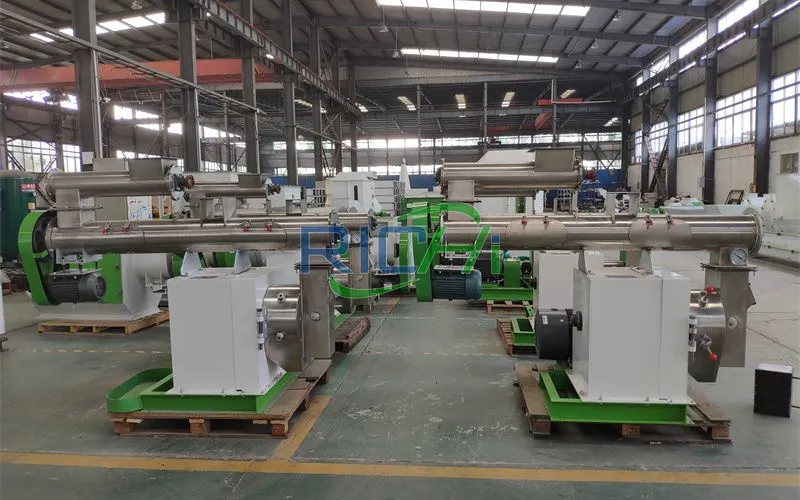
A startup feed producer near Kumasi selected one RICHI SZLH250 Feed Pellet Granulator in Ghana as the first major machine for a small commercial broiler-feed business. Instead of purchasing a complete grinding, batching and mixing line immediately, the customer arranged for a larger feed manufacturer to supply complete pellet-ready broiler mash under an agreed formulation and particle-size specification. The new workshop therefore focuses on conditioning, pelletizing, cooling, screening and packing one finished feed product while keeping the initial equipment investment relatively controlled.
The SZLH250 uses a 22 kW main motor, 1.1 kW feeder and 1.5 kW conditioner and provides approximately 1–1.5 T/H of pelletizing capacity. Purchased mash arrives already formulated and mixed, with major ingredients generally ground to approximately 1–3 mm. The customer's main product is approximately 4 mm broiler finisher pellets. An annual production target of around 2,500 tonnes gives the startup enough commercial volume to justify a ring die machine without requiring continuous multi-shift operation.
Name:
Broiler feed pellet granulator
Country:
Ghana
Date:
2026
Capacity:
1–1.5 T/H
Model:
SZLH250
Main Motor Power:
22 kW
Main Product:
broiler finisher pellets
Pellet diameter:
4 mm
For this business model, purchasing only the feed pellet machine first is practical because the customer does not attempt to formulate raw maize, soybean meal and premix manually on site. A partner feed mill supplies complete mash manufactured to the startup's agreed broiler-feed specification. This removes the immediate need for a hammer mill, batching scale and full-size mixer machine while the customer develops a local sales base.
However, the feed pellet mill is not literally the only equipment required around the process. Hot pellets must still be cooled and screened before packaging, and the workshop needs mash storage, conveying and finished-feed handling. These smaller supporting sections are arranged around the SZLH250 while the pellet granulator remains the project's main purchased processing machine.
If sales grow, the customer can later add its own grinding, dosing and mixing equipment and bring more of the manufacturing process in-house.
| Project Parameter | Specification |
|---|---|
| Equipment | Ring die feed pellet granulator |
| Model | SZLH250 |
| Main Motor | 22 kW |
| Feeder Motor | 1.1 kW |
| Conditioner Motor | 1.5 kW |
| Pelletizing Capacity | Approximately 1–1.5 T/H |
| Prepared Mash Size | Approximately 1–3 mm |
| Project Pellet Diameter | Approximately 4 mm |
| Annual Production Target | Approximately 2,500 T/Y |
| Required Pelleting Time | Approximately 1,667–2,500 h/year |
| Main Product | Commercial broiler finisher pellets |
The 1–1.5 T/H range is used as the machine's working reference rather than fixing output at 1.2 T/H. Practical capacity changes with mash composition, particle-size distribution, moisture, oil level, steam condition and ring die resistance. A formula purchased from an outside supplier must therefore be evaluated for pelletability as well as nutritional composition.
Buying mash from another feed manufacturer does not mean purchasing random finished mash from the market. The Kumasi startup requires a contract-produced batch that is suitable for subsequent steam conditioning and ring die compression.
The supplier confirms the formula, batch identification, major ingredient particle size and relevant feed-quality information. Ground material is generally maintained in an approximately 1–3 mm range before mixing. The startup then receives the complete mash without changing the formula before pelleting.
This approach also helps maintain traceability. If several unrelated mash formulas were combined at the startup workshop, it would become difficult to control nutrient specifications and investigate a finished-feed quality issue.
The startup does not begin by producing starter, grower, layer, pig and cattle feeds simultaneously. Its initial commercial product is approximately 4 mm broiler finisher feed for poultry farms around Kumasi and the wider Ashanti market.
Concentrating on one product reduces die changes, formula changeovers, cleaning requirements and finished-feed inventory during the early stage of the business. It also allows the operator to establish repeatable settings for one mash specification before introducing additional products.
If starter feed is added later, the feed form needs to be evaluated separately. Young broilers commonly require a smaller crumble or particle form rather than simply using the same intact 4 mm finisher pellet.
Pellet-ready mash moves from the receiving or buffer bin through the 1.1 kW feeder into the 1.5 kW conditioner. Steam prepares the mash for compression through the ring die by changing its temperature, moisture and physical characteristics.
The project does not use one permanent conditioning temperature such as 70–75°C or a fixed 17% moisture value. The correct operating condition depends on the purchased formula, incoming mash moisture, steam quality, oil content and the required pellet characteristics.
Operators monitor feeder stability, conditioner performance, main-motor load and the appearance of finished pellets when establishing the working settings. The conditioner supports pellet formation, but it does not correct an inaccurate or nutritionally unbalanced formula.
After conditioning, the prepared mash enters the SZLH250 ring die section, where rollers compress the material through the selected die openings. The project uses approximately 4 mm finished pellets for its broiler finisher product.
Pellet diameter is only one part of die selection. Effective compression length also needs to match the formula. RICHI therefore does not specify a universal compression ratio simply because the customer wants a 4 mm pellet.
Likewise, the project does not promise a fixed ring die life in tonnes or operating hours. Ingredient abrasiveness, mineral contamination, roller adjustment, throughput and maintenance all influence wear.
Pellets leaving the ring die are warm and are not ready to go directly into sealed bags. The startup therefore requires a cooling section sized for the 1–1.5 T/H pellet flow. Cooling stabilizes the hot product before subsequent handling.
After cooling, a screen separates loose fines from qualified pellets. Only then does the finished feed move into the bagging and storage section.
The startup process is therefore pellet-ready mash receiving → buffer storage → controlled feeding → steam conditioning → SZLH250 pelletizing → cooling → screening → finished-feed packaging.
This is important for buyers considering a similar startup model: purchasing one pellet machine can reduce initial investment, but it does not remove the basic downstream process requirements of pellet production.
At approximately 1.5 T/H, producing 2,500 tonnes requires about 1,667 effective pelletizing hours per year. At 1 T/H, the same volume requires about 2,500 hours.
Across 300 operating days, this represents approximately 5.6–8.3 effective pelleting hours per day. The target therefore fits a normal startup production schedule without relying on the machine operating continuously at its maximum capacity.
The customer can initially manufacture against confirmed orders rather than filling the warehouse with speculative feed inventory. If annual sales later move well beyond the existing capacity envelope, the next investment can be selected from actual production and customer data.
Ashanti has established poultry production and feed-processing activity, while the Kumasi metropolitan area provides access to farms, ingredient traders and existing feed manufacturers. This makes the region suitable for a business that initially purchases contract-manufactured mash and adds a specialized pelleting service.
Maize and soybean products remain important to Ghana's poultry-feed supply chain, but the startup does not purchase these raw materials separately during its first stage. Ingredient purchasing and formulation remain the responsibility of the contracted mash producer until the new business installs its own grinding and mixing system.
The customer already has three-phase electrical service, but machine selection is not based simply on the statement that three-phase power is available. The site must confirm voltage, frequency, transformer or generator capacity, motor starting method and the total connected load of the pellet mill and supporting equipment.
The same applies to steam. A suitable steam source is required for the SZLH250 conditioner. Boiler capacity and steam pressure are calculated from actual production conditions rather than assuming one small generic boiler will suit every 1–1.5 T/H feed project.
The Feed Pellet Granulator in Ghana is prepared for export from Qingdao, China, with the Port of Tema used as the national container gateway before inland delivery toward Kumasi and the Ashanti Region.
Before shipment, RICHI reviews the workshop dimensions, foundation, electrical supply, mash-bin arrangement, steam connection, cooler capacity, screening equipment and finished-feed handling. This allows the startup to install the pelletizer as the core machine while leaving practical interfaces for later grinding and mixing expansion.
This Feed Pellet Granulator in Ghana project uses one RICHI SZLH250 with a 22 kW main motor to establish a small commercial broiler pellet operation near Kumasi. Complete pellet-ready mash is supplied by an established feed manufacturer, with major ingredients already ground to approximately 1–3 mm and correctly mixed before delivery. The SZLH250 conditions and pelletizes the mash into approximately 4 mm broiler finisher pellets at a reference capacity of around 1–1.5 T/H.
With an initial production target of approximately 2,500 T/Y, the machine requires about 1,667–2,500 effective pelleting hours annually. For another Ghanaian startup considering this model, RICHI Machinery needs the mash supplier specification, annual target, particle size, pellet diameter, operating hours, steam source, electrical conditions and downstream cooling and packaging plan before confirming the final configuration.
Having the right mix of reliable, high-quality pellet machine and pelletizing systems and expert support is essential to your success. Watch how our end-to-end feed pellet plant solutions have helped our customers optimize their performance.
Our customized and future-proofed turnkey pellet plant solutions is designed with you at the core. From vision to reality and beyond, our team stays connected with yours. Giving you peace-of-mind with an expert at your side.
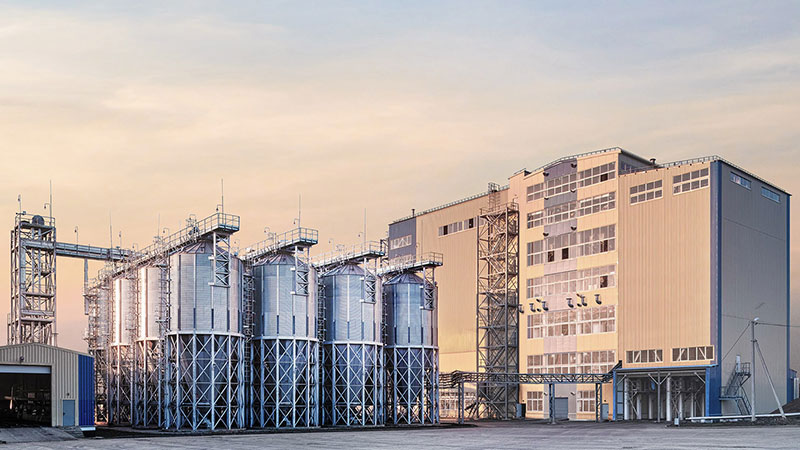
At RICHI, we go beyond project completion. With RICHI Servicee, we’re your dedicated partners in success. Count on us for expert guidance, minimal downtime, and optimized productivity. Choose RICHI for unmatched service and support.
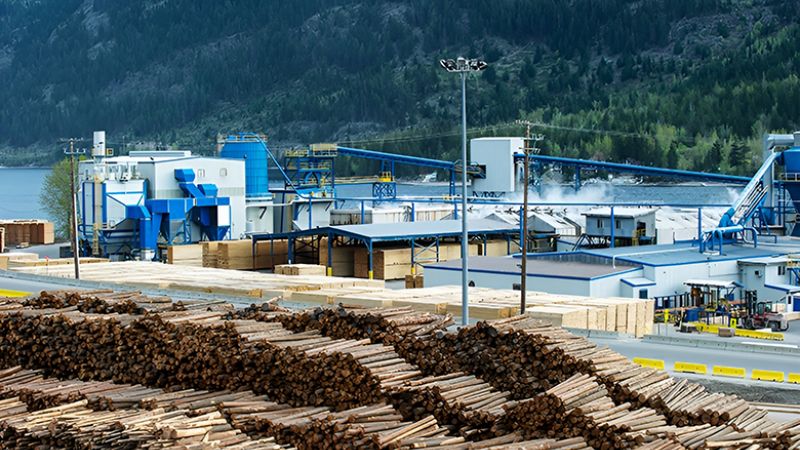


Meet global product demands and quality standards with industry-leading pellet plant design, engineering, equipment, and construction services for pellet processors.


Your Partner Beyond Project Completion
2000+ cases
RICHI is the leading designer, manufacturer and builder of pellet plants in the world, completing over 2000 projects in 140 countries across 6 continents.
Read More
Increase plant productivity, profitability, and safety by integrating high quality equipment into your pellet production line. Over the years, RICHI has become China's top pellet equipment manufacturer. At the same time, RICHI has established valuable partnerships with the world's leading component and raw material manufacturers to bring you the best there is in technology, automation, and efficiency in pelleting plant machinery.

For nearly 30 years, RICHI has been providing best-in-class pellet plant equipment and services to clients across a variety of industries, sizes, and needs. We pride ourselves on the knowledge and skill that each team member possesses – from our technical sales team to our process design engineers. You can count on RICHI Machinery to take your operation to the next level of innovation, quality, and success.
Need help with your pellet manufacturing plant project? Contact us today.
ANIMAL FEED
BIOMASS
WOOD
ORGANIC FERTILIZER
AQUA FEED
CAT LITTER
MUNICIPAL WASTE RECYCLING
SPECIAL PELLET PRODUCTION
RICHI Machinery continues to deliver world class pellet mill equipment, pellet plant engineering and project solutions that add value to our customers in the animal feed, wood waste, agriculture waste, organic fertilizer, cat litter and special pellet products industries. Throughout the years, we RICHI Machinery have built strong brand, becoming industry-leading pellet machine manufacturer. We value integrity, promise quality, and prioritize your success.
Learn MoreWith our expert team, we precisely implement your process engineering requirements in pellet mill and pelletizing plant systems. No matter which industry you’re in – we understand your needs and deliver solutions that meet the highest standards.
At RICHI, quality comes first. Our pellet making machine and related pellet line equipment undergo rigorous quality controls to ensure they meet the highest standards. Rely on products that are durable, safe, and efficient.
With decades of experience in pellet machine and pellet production line production, we have earned a reputation as a trusted partner in various industries. Our expertise allows us to cover a wide range of applications.
Not only do we offer premium pelleting equipment, but we are also experts at designing, building, installing, and maintaining facilities from the ground up. Our expertise is within pellt plant process design, discovering the most efficient, productive, and profitable way to handle your materials in an end-to-end cycle.
○ RICHI MACHINERY
Keeping in touch with us is an effective way to solve all your problems. If you have any needs or questions, please leave your contact information, then RICHI technical consultants will send design, quotation, videos to your mailbox. You can also contact us directly via WhatsApp: +86 13838389622
Copyright©2015-2026 by HENAN RICHI MACHINERY CO., LTD. All rights reserved.