
RICHI supplied a 3–4 T/H SZLH320 Feed Mill Pellet Machine in Kenya to expand a Rift Valley cooperative poultry feed plant from 5,000 to 8,000 T/Y.
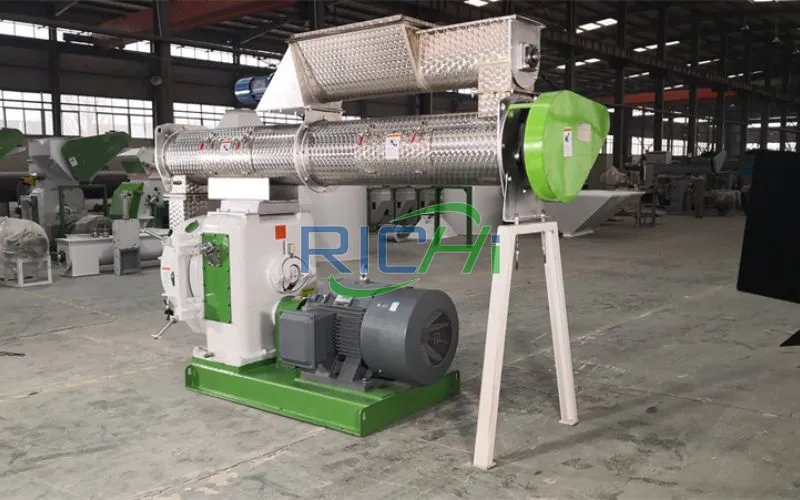
A farmers' cooperative in Kenya's Rift Valley selected one RICHI SZLH320 Feed Mill Pellet Machine in Kenya to expand an existing poultry feed plant from approximately 5,000 T/Y toward an 8,000 T/Y production target. The cooperative serves around 800 smallholder members, while its original SZLH250 feed pellet mill had become the main capacity restriction as demand for locally manufactured feed increased. Grinding, batching, mixing, steam preparation, cooling and packaging equipment were already available, so the customer chose to replace the undersized pelletizing unit rather than rebuild the entire feed mill.
The SZLH320 uses a 37 kW main motor and provides a clear pelletizing capacity of approximately 3–4 T/H. Prepared poultry-feed mash is generally ground to approximately 1–3 mm before batching and mixing. The main production program includes broiler feed, with approximately 3 mm parent pellets used ahead of crumbling for starter products and approximately 4 mm pellets for later growth stages. At the cooperative's 8,000 T/Y target, one SZLH320 requires roughly 2,000–2,667 effective pelleting hours per year.
Name:
Broiler Feed Pellet Machine
Country:
Kenya
Date:
2026
Capacity:
3–4 T/H
Model:
SZLH320
Main Motor Power:
37 kW
Application:
Commercial broiler feed production
Pellet diameter:
1–4 mm
The previous SZLH250 feed pellet machine provides approximately 1–1.5 T/H. At an annual production volume of around 5,000 tonnes, that smaller machine would require approximately 3,333–5,000 effective pelleting hours every year, creating long operating schedules and limited reserve capacity for maintenance or seasonal peaks.
The 3–4 T/H SZLH320 changes the operating balance. Producing 8,000 tonnes requires approximately 2,000 hours at 4 T/H or about 2,667 hours at 3 T/H. Across 300 production days, this equals roughly 6.7–8.9 effective pelleting hours per day. The cooperative can therefore expand annual production without forcing the pellet mill to operate close to continuous duty.
The old SZLH250 can also be retained as standby equipment or assigned to smaller specialty batches if its condition and plant layout allow, giving the cooperative additional production flexibility.
| Project Parameter | Specification |
|---|---|
| Equipment | Ring die feed pellet machine |
| Model | SZLH320 |
| Main Motor | 37 kW |
| Feeder Motor | 1.5 kW |
| Conditioner Motor | 4 kW |
| Pelletizing Capacity | Approximately 3–4 T/H |
| Prepared Mash Size | Approximately 1–3 mm |
| Starter Parent Pellet | Approximately 3 mm before crumbling |
| Grower / Finisher Pellet | Approximately 4 mm |
| Existing Annual Production | Approximately 5,000 T/Y |
| Expansion Target | Approximately 8,000 T/Y |
| Required Annual Pelleting Time | Approximately 2,000–2,667 h/year |
| Main Application | Commercial broiler feed production |
The 3–4 T/H range refers to suitable poultry-feed formulas under correctly prepared grinding, conditioning and die conditions. Actual output varies with formula composition, pellet diameter, mash moisture, oil level, steam quality and ring die resistance. The machine should therefore be sized from the required annual production schedule rather than assuming that every formula will continuously operate at exactly 4 T/H.
The cooperative uses ingredients available through Kenya's feed and grain markets rather than one fixed recipe. Maize and maize-milling by-products provide important energy sources, while wheat bran and wheat pollard are widely used feed ingredients. Oilseed materials such as sunflower cake and cottonseed cake can contribute protein and energy, while soybean meal, minerals, amino acids and premixes are incorporated according to formulation requirements and availability.
Kenyan agricultural data confirms that maize remains a major crop, while feed-industry surveys in the Rift Valley identify maize, maize germ, wheat bran, wheat pollard, sunflower cake and other oilseed cakes among ingredients handled by regional feed processors.
The project does not lock the cooperative into percentages such as 50–60% maize or 10–15% sunflower cake. Ingredient prices, nutrient analysis and availability fluctuate, so the nutritionist adjusts the formulation while maintaining the required energy, protein, amino acid, mineral and vitamin specifications.
Before pelletizing, cereal ingredients are cleaned and ground to an approximately 1–3 mm range where required. Already fine materials such as some meals or premixes do not need unnecessary regrinding. Ingredients are then weighed through the batching system and mixed into a homogeneous mash before entering the SZLH320 feeder and conditioner.
The conditioner introduces steam to prepare the mash for compression through the ring die. Steam can improve mash plasticity and support pellet formation, but the operating temperature is not fixed permanently at 75–80°C. Formula composition, initial moisture, steam quality, retention time and the feed mill's product requirements determine the actual conditioning settings.
For starter feed, the plant can produce an approximately 3 mm parent pellet and then pass it through the existing crumbler to obtain the required smaller feed form. Later broiler products use approximately 4 mm pellets. This is more technically accurate than describing broiler starter feed simply as intact 3 mm pellets in every production program.
The SZLH320 is the central forming machine, but pellet quality depends on the complete preparation process. Poor grinding uniformity, inaccurate batching, inadequate mixing, unstable steam supply or incorrect cooling can all increase fines even when the pellet mill itself is operating correctly.
Ring die compression ratio also cannot be selected from pellet diameter alone. RICHI evaluates the actual formula, fiber level, oil content and desired pellet characteristics before specifying the die. Likewise, claims such as a fixed 1,500–2,500-tonne die life are avoided because wear depends on formulation, mineral contamination, operating adjustment and die metallurgy.
The same principle applies to energy consumption. A 37 kW motor rating does not mean every tonne of feed consumes one universal number of kilowatt-hours. Practical specific energy depends on throughput and actual machine load.
Replacing an SZLH250 with an SZLH320 only solves the original bottleneck if the surrounding equipment can support the higher production rate. The cooperative therefore checks hammer-mill capacity, mixer batch cycle, mash-bin volume, steam supply, cooler throughput, crumbler and screen capacity, and finished-feed packaging before increasing scheduled output.
The cooler in particular must be able to receive the full 3–4 T/H pellet flow. If an old cooler was originally sized only around the SZLH250, increasing pellet-mill capacity without checking cooling would simply create another restriction immediately downstream.
This interface review is one of the main advantages of upgrading one machine inside an existing mill: equipment that remains correctly sized can be retained, while only the true bottlenecks need modification.
Kenya continues to face significant demand for affordable livestock feed and feed ingredients. Government and FAO material has identified feed availability and cost as constraints to livestock production, while national feed assessments have documented substantial supply gaps.
For this cooperative, however, expansion is based on its own member demand rather than a national market forecast. At 3–4 T/H, producing 8,000 tonnes requires roughly one normal production shift on most operating days. This gives the plant room for maintenance, product changeovers and seasonal production peaks without requiring unrealistic 20-hour continuous schedules.
The Feed Mill Pellet Machine in Kenya is prepared for export from Qingdao, China, with the Port of Mombasa used as the national gateway before inland transport toward the Rift Valley. Kenya Ports Authority describes Mombasa as a major East and Central African gateway with conventional and container terminals and extensive inland connectivity.
Before shipment, RICHI Machinery checks the existing foundation, electrical supply, mash-bin position, steam connection, pellet discharge elevation, cooler capacity and maintenance access. This allows the SZLH320 to be integrated into the operating plant with targeted modifications instead of assuming it can simply occupy the exact SZLH250 installation position without dimensional or load checks.
This Feed Mill Pellet Machine in Kenya project uses one RICHI SZLH320 poultry feed pellet machine with a 37 kW main motor to expand a Rift Valley cooperative feed plant from approximately 5,000 T/Y toward 8,000 T/Y. Prepared poultry-feed mash is generally controlled around 1–3 mm before conditioning and pelletizing, while the main broiler products use approximately 3 mm parent pellets for crumbling and approximately 4 mm finished pellets for later growth stages.
At 3–4 T/H, the 8,000 T/Y target requires approximately 2,000–2,667 effective pelletizing hours per year, or roughly 6.7–8.9 hours per production day over 300 days. For another cooperative considering an upgrade, RICHI needs the current machine capacity, annual output, target tonnage, formulas, pellet sizes, operating schedule and capacities of the existing upstream and downstream equipment before confirming whether SZLH320 is the correct expansion model.
Having the right mix of reliable, high-quality pellet machine and pelletizing systems and expert support is essential to your success. Watch how our end-to-end feed pellet plant solutions have helped our customers optimize their performance.
Our customized and future-proofed turnkey pellet plant solutions is designed with you at the core. From vision to reality and beyond, our team stays connected with yours. Giving you peace-of-mind with an expert at your side.
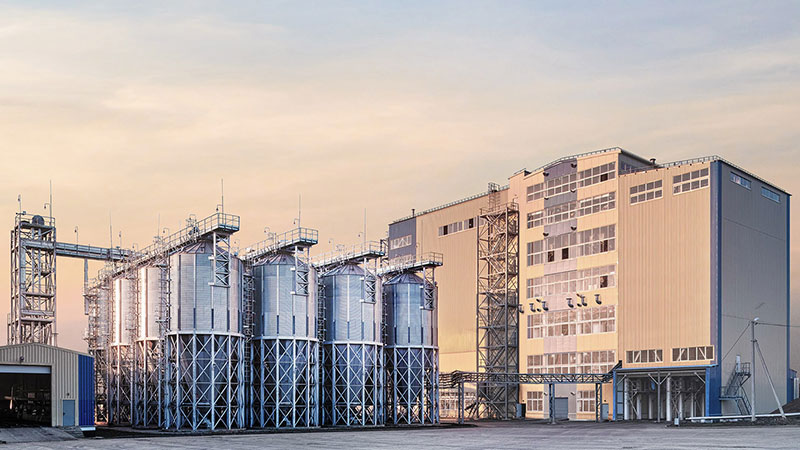
At RICHI, we go beyond project completion. With RICHI Servicee, we’re your dedicated partners in success. Count on us for expert guidance, minimal downtime, and optimized productivity. Choose RICHI for unmatched service and support.
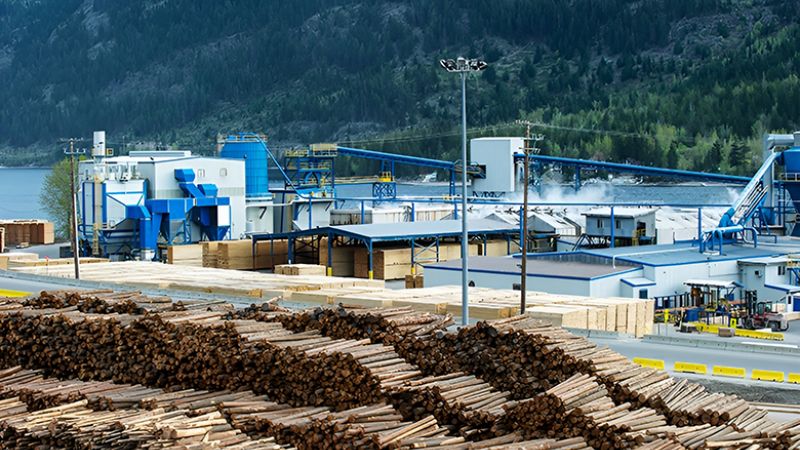


Meet global product demands and quality standards with industry-leading pellet plant design, engineering, equipment, and construction services for pellet processors.


Your Partner Beyond Project Completion
2000+ cases
RICHI is the leading designer, manufacturer and builder of pellet plants in the world, completing over 2000 projects in 140 countries across 6 continents.
Read More
Increase plant productivity, profitability, and safety by integrating high quality equipment into your pellet production line. Over the years, RICHI has become China's top pellet equipment manufacturer. At the same time, RICHI has established valuable partnerships with the world's leading component and raw material manufacturers to bring you the best there is in technology, automation, and efficiency in pelleting plant machinery.

For nearly 30 years, RICHI has been providing best-in-class pellet plant equipment and services to clients across a variety of industries, sizes, and needs. We pride ourselves on the knowledge and skill that each team member possesses – from our technical sales team to our process design engineers. You can count on RICHI Machinery to take your operation to the next level of innovation, quality, and success.
Need help with your pellet manufacturing plant project? Contact us today.
ANIMAL FEED
BIOMASS
WOOD
ORGANIC FERTILIZER
AQUA FEED
CAT LITTER
MUNICIPAL WASTE RECYCLING
SPECIAL PELLET PRODUCTION
RICHI Machinery continues to deliver world class pellet mill equipment, pellet plant engineering and project solutions that add value to our customers in the animal feed, wood waste, agriculture waste, organic fertilizer, cat litter and special pellet products industries. Throughout the years, we RICHI Machinery have built strong brand, becoming industry-leading pellet machine manufacturer. We value integrity, promise quality, and prioritize your success.
Learn MoreWith our expert team, we precisely implement your process engineering requirements in pellet mill and pelletizing plant systems. No matter which industry you’re in – we understand your needs and deliver solutions that meet the highest standards.
At RICHI, quality comes first. Our pellet making machine and related pellet line equipment undergo rigorous quality controls to ensure they meet the highest standards. Rely on products that are durable, safe, and efficient.
With decades of experience in pellet machine and pellet production line production, we have earned a reputation as a trusted partner in various industries. Our expertise allows us to cover a wide range of applications.
Not only do we offer premium pelleting equipment, but we are also experts at designing, building, installing, and maintaining facilities from the ground up. Our expertise is within pellt plant process design, discovering the most efficient, productive, and profitable way to handle your materials in an end-to-end cycle.
○ RICHI MACHINERY
Keeping in touch with us is an effective way to solve all your problems. If you have any needs or questions, please leave your contact information, then RICHI technical consultants will send design, quotation, videos to your mailbox. You can also contact us directly via WhatsApp: +86 13838389622
Copyright©2015-2026 by HENAN RICHI MACHINERY CO., LTD. All rights reserved.