
For a cattle feedlot in Mato Grosso, bringing concentrate production in-house was less about adding another piece of equipment and more about gaining control over one of its largest recurring feed costs. The operation selected an SZLH350 feed granulator machine in Brazil to produce 6 mm cattle concentrate pellets from locally available corn, soybean meal, cottonseed by-products, minerals and other formulation ingredients, using the farm’s existing grain storage and feed-handling infrastructure.
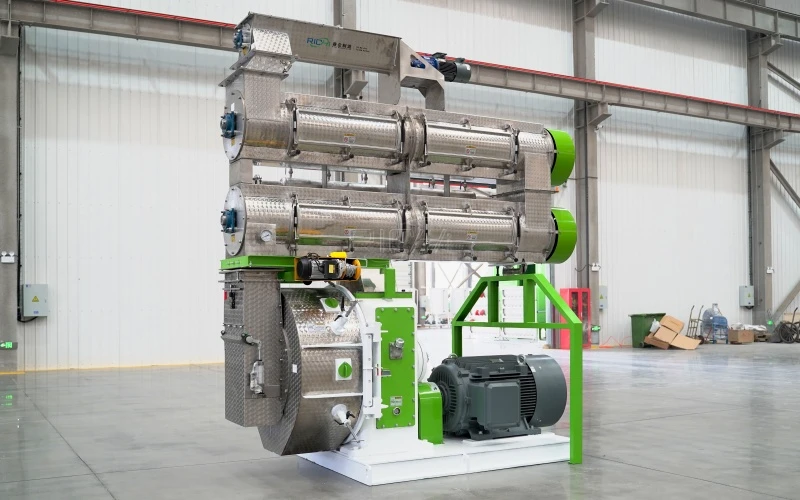
For a cattle feedlot in Mato Grosso, bringing concentrate production in-house was less about adding another piece of equipment and more about gaining control over one of its largest recurring feed costs. The operation selected an SZLH350 feed granulator machine in Brazil to produce 6 mm cattle concentrate pellets from locally available corn, soybean meal, cottonseed by-products, minerals and other formulation ingredients, using the farm’s existing grain storage and feed-handling infrastructure.
The project was designed around approximately 5–6 T/H of pelleting capacity rather than a complete replacement of the feedlot’s existing feed system. By adding the pellet mill together with the necessary grinding, batching, mixing, steam-conditioning and cooling connections, the customer could manufacture concentrate according to its own cattle formulations, adjust production as ingredient prices changed, and reduce dependence on externally supplied pellets.
Name:
cattle feed granulator
Country:
Brazil
Date:
2026
Capacity:
5–6 T/H
Model:
SZLH350
Main Motor Power:
55 kW
Raw Materials:
Corn, Soybean meal, Cottonseed meal
Pellet diameter:
6mm
The customer operates a large finishing operation in Mato Grosso, one of Brazil’s most important cattle, corn, soybean and cotton-producing states. This combination matters for feed manufacturing: a large feedlot creates consistent feed demand, while regional grain and oilseed production provides access to many of the ingredients used in cattle concentrate.
Previously, pelleted concentrate was purchased from commercial feed manufacturers and incorporated into the feedlot’s feeding program with silage and other ration components. The arrangement worked operationally, but it left the customer exposed to supplier pricing, transportation costs, delivery schedules and variations between purchased batches.
The feedlot therefore evaluated whether it had sufficient demand to justify its own pelleting system. Rather than constructing an oversized commercial feed plant intended for external sales, the customer wanted a relatively compact system dedicated primarily to internal consumption.
Its existing infrastructure also changed the investment decision. Grain receiving and storage facilities were already available, as were parts of the feed handling system. The project could therefore concentrate capital on the equipment actually missing from the production chain.
The required output placed the project in the range of the SZLH350 ring-die pellet mill. For the customer’s cattle feed formulations, the machine was configured to produce approximately 5–6 T/H under suitable operating conditions.
| Project Parameter | Configuration |
|---|---|
| Country | Brazil |
| Application | Pelleted cattle concentrate |
| Pellet mill model | SZLH350 |
| Main motor | 55 kW |
| Feeder motor | 1.5 kW |
| Conditioner motor | 4 kW |
| Ring die inner diameter | 350 mm |
| Project capacity | Approximately 5–6 T/H |
| Selected pellet diameter | 6 mm |
The 5–6 T/H range also gave the customer a useful distinction between machine capacity and actual daily production. A pellet mill does not have to operate sixteen or twenty-four hours every day simply because it can. Production hours can instead be scheduled around cattle numbers, formulation requirements, storage capacity and maintenance.
This is particularly important for an internal-use feed mill. The objective is not maximum annual utilization of the machine; it is reliable production at a cost and schedule that suit the feedlot.
Local ingredient availability was one of the strongest reasons this project made sense in Mato Grosso. Corn and soybean products are readily available in the region, while cotton processing also creates feed ingredients that can be incorporated into cattle diets when the formulation and nutritional limits permit.
A representative concentrate formulation for the project can include:
RICHI did not treat a fixed percentage recipe as a machine requirement. Ingredient ratios can change with cattle weight, finishing stage, nutritional targets, raw material analysis and commodity prices. The pellet mill therefore had to tolerate realistic formulation changes rather than being optimized around only one recipe.
This flexibility has commercial value. When the relative cost of corn, soybean meal or suitable local by-products changes, the feedlot can reformulate within nutritional limits instead of remaining tied to the formulation offered by an outside pellet supplier.
One important correction to the original project concept is that installing a feed granulator machine in Brazil does not by itself turn stored grain into finished cattle pellets. The SZLH350 cattle feed pellet making machine is the central pelleting machine, but properly prepared mash must reach it first, and hot pellets leaving the die normally require downstream treatment.
For this project, the practical process was arranged around:
Raw Material Storage → Grinding → Batching → Mixing → Steam Conditioning → Pelletizing → Cooling → Screening → Finished Pellet Storage
The customer could retain compatible existing equipment and add only the missing processing sections. This retrofit approach avoided paying twice for usable infrastructure while ensuring that the new pellet mill was not restricted by inadequate upstream preparation or downstream cooling.
RICHI therefore reviewed more than the pellet mill itself. The engineering discussion covered material particle size, mixer discharge rate, surge-bin capacity, steam supply, conditioner requirements, cooler capacity, conveying equipment, electrical load and the physical connection with the feedlot’s existing storage system.
Conditioning is an important part of producing durable compound feed pellets. Before entering the ring die, mixed feed passes through the conditioner, where controlled steam addition raises temperature and moisture and changes the physical characteristics of the mash.
The correct settings are formulation-dependent. A corn-rich formula does not necessarily respond exactly like a ration containing more fibrous by-products, and steam quality, initial mash moisture and required pellet durability all influence the operating point.
For this reason, RICHI does not recommend treating values such as 75°C or 17% moisture as universal settings for every cattle concentrate. During commissioning, the operators establish a practical conditioning window based on actual ingredients, pellet quality, mill load and production stability.
The customer’s goal was straightforward: produce sufficiently durable pellets without introducing unnecessary steam or creating unstable pelleting conditions.
The customer selected a 6 mm ring die for its finishing concentrate. This diameter is a practical commercial choice for cattle feed, but it should not be interpreted as the only suitable cattle pellet size.
Pellet diameter depends on cattle category, formulation, feeding system and customer preference. The SZLH350 can be equipped with different dies when another finished specification is required.
The 6 mm specification worked well here because the pellets needed to remain sufficiently robust during conveying, storage and subsequent handling while still integrating easily into the feedlot’s ration preparation system.
The previous claim that smaller pellets automatically cause bloat or that cattle have difficulty chewing pellets above 8 mm was removed from the project because pellet diameter alone does not justify those conclusions. Rumen health depends on the complete ration, effective fiber, fermentable carbohydrate intake, feeding management and other nutritional factors.
Feedlot size alone should not be used to select a pellet mill. The more useful calculation is based on how much pelleted concentrate is actually required per day.
For example, if a feedlot uses 50 tonnes of pellets per day, a machine producing approximately 5 T/H requires around ten net pelleting hours to manufacture that quantity. If demand increases to 80 tonnes, the same machine requires roughly sixteen net hours, before allowing for start-up, die changes, cleaning and scheduled maintenance.
This calculation gives potential buyers a much better basis for model selection than a rule such as “20,000 cattle need an SZLH350.” Two feedlots with identical cattle numbers may use completely different quantities of pellets depending on their feeding programs.
For the Brazilian customer, the selected capacity provided enough output for the planned concentrate requirement without moving immediately to a substantially larger pellet mill and the additional electrical, steam and supporting-equipment investment that would accompany it.
The equipment was manufactured for the electrical conditions confirmed for the customer’s site. Brazil uses 60 Hz power, but industrial voltage arrangements can differ by location, so motor voltage and control-system configuration must be confirmed against the actual facility rather than assumed from the country alone.
The installation also required adequate foundations, working platforms, access around the ring die and rollers, electrical protection, steam connections and space for maintenance. These details were incorporated into the layout before equipment installation.
Because the customer was integrating the machine into an existing facility, interface dimensions were particularly important. RICHI provided the drawings required to coordinate the feeder inlet, pellet discharge, service clearances and connections with surrounding equipment.
The equipment was exported from China to Brazil by sea and then moved inland to Mato Grosso. Santos is a major Brazilian gateway for containerized industrial equipment, although the final shipping route for any project should be selected according to freight schedules, inland destination, customs arrangements and total logistics cost.
For an inland project such as this one, ocean freight is only part of the logistics calculation. Buyers also need to account for port handling, customs clearance, taxes and duties where applicable, domestic trucking, unloading and site installation.
This is why RICHI separates equipment quotation from destination-specific landed cost. Statements such as “landed cost is always 25% above FOB” are not reliable for Brazil because import costs depend on the equipment classification, tax treatment, freight conditions, state, importer structure and other project-specific factors.
The most important result was not an unrealistic one-week equipment payback. It was control.
The feedlot could determine when concentrate was produced, which raw materials entered each formulation and what pellet specification was required. Purchasing decisions could be made around regional commodity prices, and the nutrition team no longer had to work only with the formulas offered by an external pellet supplier.
Operationally, the customer also gained better control over:
The economic advantage depends on the difference between the delivered price of purchased pellets and the feedlot’s own raw-material, processing, labor, energy, maintenance and capital costs. For a high-volume operation with access to competitively priced ingredients, that difference can justify in-house production, but it must be calculated from current local numbers rather than from a generic percentage.
Before approving the project, the customer compared purchased concentrate with internal production using a cost model rather than looking only at the pellet mill purchase price.
| Cost Area | Purchased Pellets | In-House Production |
|---|---|---|
| Feed ingredients | Included in supplier price | Purchased or sourced directly by feedlot |
| Pelleting and processing | Included in supplier price | Electricity, steam, labor and wear parts |
| Supplier margin | Included | Not applicable |
| Inbound finished-feed freight | Applicable depending on supplier | Reduced when pellets are produced on site |
| Maintenance | Supplier responsibility | Feedlot responsibility |
| Capital investment | No production equipment required | Pelleting and supporting equipment required |
The feedlot can then calculate a realistic production cost per tonne and compare it with current delivered quotations from commercial feed suppliers. This approach is much more useful for investment decisions than assuming a fixed 15–20% commercial feed mill markup.
Because the feed pellet machine became a critical part of the feedlot’s internal feed supply, maintenance planning was considered during equipment selection rather than after commissioning.
The customer keeps commonly required wear parts available on site and routinely inspects the ring die, roller assemblies, feeder, conditioner and transmission components. Wear life is monitored from actual production rather than fixed claims such as one die always lasting 3,000–4,000 tonnes. Abrasiveness, mineral content, formulation, die compression ratio, operating practice and foreign-material control can all substantially change wear rates.
The feedlot also schedules maintenance around finished-feed inventory. Maintaining a buffer of concentrate allows routine service to be carried out without immediately disrupting cattle feeding.
The strongest candidates for an in-house feed granulator are not defined by a single minimum cattle number. They are operations where sufficient pellet demand, ingredient access, infrastructure and purchasing economics make internal production worthwhile.
A Brazilian feedlot evaluating the same investment should first determine:
These answers determine whether a standalone SZLH350, a larger feed pellet mill or a more complete cattle feed production system offers the better investment.
This project demonstrates a practical route into in-house feed manufacturing. The customer did not replace useful storage and feed-handling assets simply to create a completely new factory. Instead, the project was engineered around what was already available and added the processing equipment necessary to produce consistent pelleted concentrate.
For the Mato Grosso operation, the SZLH350 feed granulator machine in Brazil provided approximately 5–6 T/H of pelleting capacity with a 6 mm finished pellet specification. More importantly, it gave the feedlot direct control over formulation, ingredient purchasing, production scheduling and pellet quality.
RICHI Machinery can configure similar projects as a standalone pellet mill upgrade or as a complete cattle feed production system. For an existing feedlot, the useful starting information is the required tonnes of pellets per day, ingredient list, current equipment, desired pellet size, available steam and electricity, and plant layout. With those figures, the equipment can be selected around the actual production requirement instead of simply choosing a machine according to cattle head count.
Having the right mix of reliable, high-quality pellet machine and pelletizing systems and expert support is essential to your success. Watch how our end-to-end feed pellet plant solutions have helped our customers optimize their performance.
Our customized and future-proofed turnkey pellet plant solutions is designed with you at the core. From vision to reality and beyond, our team stays connected with yours. Giving you peace-of-mind with an expert at your side.
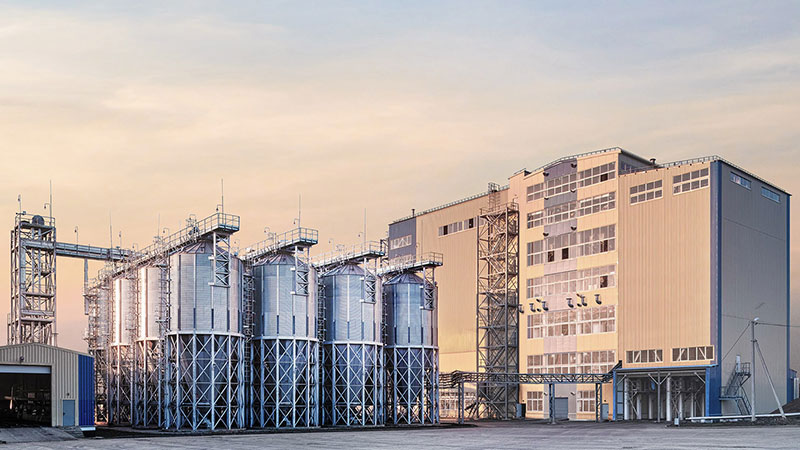
At RICHI, we go beyond project completion. With RICHI Servicee, we’re your dedicated partners in success. Count on us for expert guidance, minimal downtime, and optimized productivity. Choose RICHI for unmatched service and support.
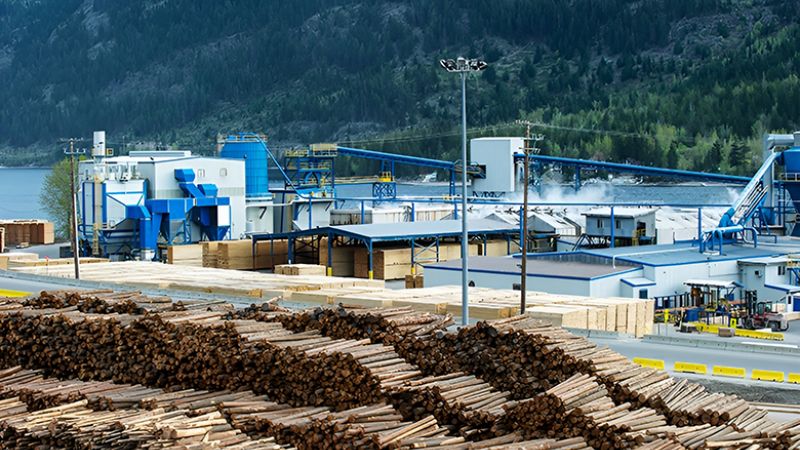


Meet global product demands and quality standards with industry-leading pellet plant design, engineering, equipment, and construction services for pellet processors.


Your Partner Beyond Project Completion
2000+ cases
RICHI is the leading designer, manufacturer and builder of pellet plants in the world, completing over 2000 projects in 140 countries across 6 continents.
Read More
Increase plant productivity, profitability, and safety by integrating high quality equipment into your pellet production line. Over the years, RICHI has become China's top pellet equipment manufacturer. At the same time, RICHI has established valuable partnerships with the world's leading component and raw material manufacturers to bring you the best there is in technology, automation, and efficiency in pelleting plant machinery.

For nearly 30 years, RICHI has been providing best-in-class pellet plant equipment and services to clients across a variety of industries, sizes, and needs. We pride ourselves on the knowledge and skill that each team member possesses – from our technical sales team to our process design engineers. You can count on RICHI Machinery to take your operation to the next level of innovation, quality, and success.
Need help with your pellet manufacturing plant project? Contact us today.
ANIMAL FEED
BIOMASS
WOOD
ORGANIC FERTILIZER
AQUA FEED
CAT LITTER
MUNICIPAL WASTE RECYCLING
SPECIAL PELLET PRODUCTION
RICHI Machinery continues to deliver world class pellet mill equipment, pellet plant engineering and project solutions that add value to our customers in the animal feed, wood waste, agriculture waste, organic fertilizer, cat litter and special pellet products industries. Throughout the years, we RICHI Machinery have built strong brand, becoming industry-leading pellet machine manufacturer. We value integrity, promise quality, and prioritize your success.
Learn MoreWith our expert team, we precisely implement your process engineering requirements in pellet mill and pelletizing plant systems. No matter which industry you’re in – we understand your needs and deliver solutions that meet the highest standards.
At RICHI, quality comes first. Our pellet making machine and related pellet line equipment undergo rigorous quality controls to ensure they meet the highest standards. Rely on products that are durable, safe, and efficient.
With decades of experience in pellet machine and pellet production line production, we have earned a reputation as a trusted partner in various industries. Our expertise allows us to cover a wide range of applications.
Not only do we offer premium pelleting equipment, but we are also experts at designing, building, installing, and maintaining facilities from the ground up. Our expertise is within pellt plant process design, discovering the most efficient, productive, and profitable way to handle your materials in an end-to-end cycle.
○ RICHI MACHINERY
Keeping in touch with us is an effective way to solve all your problems. If you have any needs or questions, please leave your contact information, then RICHI technical consultants will send design, quotation, videos to your mailbox. You can also contact us directly via WhatsApp: +86 13838389622
Copyright©2015-2026 by HENAN RICHI MACHINERY CO., LTD. All rights reserved.