
EFB Pellet Machine in Brazil: MZLH420 application in Pará, with wet EFB preparation, drying-load calculations and 8 mm industrial fuel pellets.
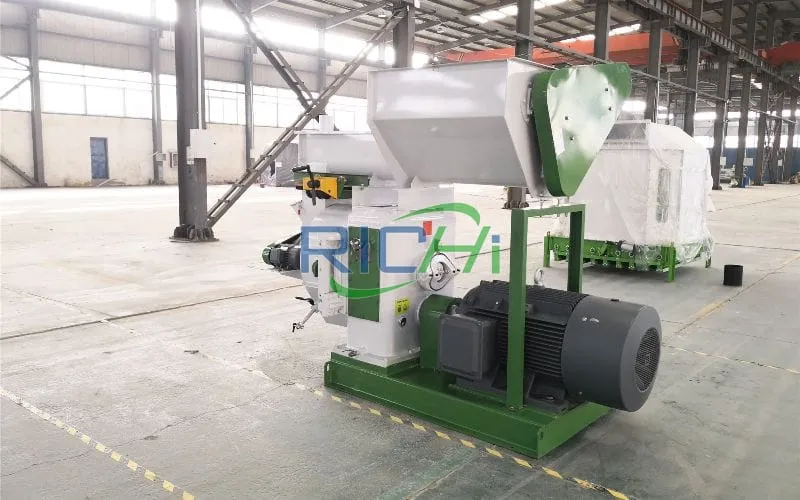
At a palm-residue processing site in Pará, pellet output starts with the water-removal capacity available upstream. Empty fruit bunches arrive as wet, interlocked fibre after fruit stripping at the oil mill. They need opening, dewatering, drying and final size reduction before pressing.
This illustrative application of an EFB pellet machine in Brazil concerns a regional biomass processor working near a palm oil mill. It wants to supply industrial boiler users with a defined agricultural-residue fuel. Existing preparation equipment is assessed for reuse, with one MZLH420 proposed for the pelleting stage.
Name:
efb pellet machine
Country:
Brazil
Date:
2026
Capacity:
1,500–1,800 kg/hour
Model:
MZLH520
Main Motor Power:
90 kW
Pellet Diameter:
8 mm
Pellet length:
15–30 mm
Pará is a suitable setting for this application because it has an established oil palm processing industry. The processor’s collection plan concentrates on nearby mills and records available dry solids as well as delivered wet weight.
The material specification covers oil palm empty fruit bunches. Collection records identify the supplying mill, delivery weight, moisture and contamination. Covered receiving areas and clean handling surfaces help keep rainwater, soil and grit out of the process.
The existing wet shredder opens bunches for mechanical dewatering. The rotary dryer then removes further water, and final milling reduces the dried fibre to a provisional 3–5 mm working length. Trials inspect longer strands that can wrap or bridge, alongside the particle-size distribution.
Liquid expressed by the dewatering unit remains part of the mill’s effluent-management duty. Water squeezed from fibre is a separate stream from evaporated dryer moisture, so both outlets are checked in the site balance.
A mass balance makes the preparation duty visible. The following calculation uses 1,500 kg/hour of finished pellets at 10% moisture, with constant dry solids of 1,350 kg/hour. All moisture figures are on a wet basis.
| Calculation stage | Assumed moisture | Material flow, rounded |
|---|---|---|
| Fresh EFB received | 65% | 3,857 kg/hour |
| After mechanical dewatering | 50% | 2,700 kg/hour |
| Prepared fibre entering the press | 12% | 1,534 kg/hour |
| Finished pellets | 10% | 1,500 kg/hour |
These assumptions give approximately 1,170 kg/hour of dryer evaporation between the dewatering and press-feed stages. If dewatering reaches only 60% moisture, that calculated duty rises to about 1,840 kg/hour. The measured dewatering result therefore directly affects usable plant capacity.
The balance excludes dry-solids losses. Press liquor, screened contaminants and collected fines must be weighed during trials. The remaining moisture reduction during pressing and cooling also requires verification. Dryer heat demand is assessed separately from the pellet mill’s electrical load.
The MZLH520 biomass pellet machine appears in RICHI’s published EFB equipment range. Its reference capacity provides a selection starting point; the working target is established with the customer’s dried fibre, required pellet dimensions and complete finishing circuit.
| Parameter | Specification or application basis |
|---|---|
| Equipment | One MZLH520 EFB palm pellet machine |
| Main motor | 90 kW |
| Arch-breaking feeder | 3 kW |
| Forced feeder | 1.5 kW |
| Combined listed motor power | 94.5 kW, excluding auxiliary equipment |
| Ring die inner diameter | 420 mm |
| Published EFB output reference | 1,500–2,000 kg/hour |
| Application output target | 1,500–1,800 kg/hour of accepted cooled pellets, subject to trials |
| Pellet dimensions | 8 mm diameter; target length 15–30 mm |
| Electrical specification | Three-phase, 60 Hz; motor voltage matched to the confirmed site bus |
The order covers the biomass pellet mill and its specified feeding package; any extra preparation or finishing equipment is priced separately.
The arch-breaking feeder helps the light fibre leave the hopper, while forced feeding supplies the pressing chamber. Uniform moisture and controlled fibre length remain necessary. Die compression and roller adjustment follow representative trials rather than a general wood-pellet setting.
The 8 mm ring die fixes diameter; the cutter controls length. Screened fines return at a controlled rate and are excluded from net production reporting. A larger press would require additional prepared fibre and finishing capacity; this selection begins with the existing preparation duty.
The launch market is domestic industrial heat. Buyers need fuel analysis covering moisture, ash, calorific value on a stated basis, chlorine, sulphur and relevant ash-forming elements such as potassium. Their combustion system, fuel feeder and ash handling must be suitable for the accepted EFB fuel.
Soil contamination can add ash, while the fibre itself contains mineral constituents. Pellet density and appearance cannot establish combustion suitability. A controlled fuel trial checks feeding, ash behaviour and operating observations before a supply agreement is finalised.
If analysis shows that mineral reduction is necessary for the intended buyer, washing or leaching is evaluated as a separate pretreatment. Its effectiveness requires testing. Water demand, wastewater handling, solids losses and resulting drying duty belong in that assessment; ordinary drying and pressing are not desalination steps.
The production budget uses 1,500 kg/hour of accepted finished pellets for seven productive hours on 250 days. That equals 2,625 tonnes annually. Using the illustrative 65% receiving moisture and excluding solids losses, the corresponding fresh EFB requirement is 6,750 tonnes per year.
The supply agreement must confirm available EFB after the oil mill’s existing residue uses. Actual intake requirements follow measured yield. Startup, cleaning, wear-part changes and interruptions require additional scheduled time.
The quotation specifies a 60 Hz drive package, confirmed motor voltage and the arrangement needed to maintain the specified press speed. Electrical assessment covers the site transformer, starting demand, protection and all simultaneous auxiliary loads. A single nationwide low-voltage assumption is insufficient for this industrial installation.
Drawings establish feed-bin discharge, press outlet height, foundation loading, lifting access and die-removal space. Cooling, screening and conveying must support the agreed output. Dust collection and fire protection follow the site’s process assessment.
Cooled pellets are checked for moisture, temperature, fines and handling durability before protected storage and dispatch. The section allows one press operator and one finishing/dispatch position, with shared material handling and the existing preparation team.
Shipment planning can assess Qingdao to the container facilities at Vila do Conde, Barcarena, followed by inland delivery in Pará. The supply scope defines packing, Portuguese operating documentation, installation guidance, commissioning assistance and spare dies and roller shells.
For an EFB pellet machine in Brazil, give RICHI Machinery the receiving and dewatered moisture readings, dryer evaporation capacity, representative prepared fibre and the boiler buyer’s fuel specification. Those details determine whether the proposed press can deliver useful capacity within the existing operation.
Having the right mix of reliable, high-quality pellet machine and pelletizing systems and expert support is essential to your success. Watch how our end-to-end feed pellet plant solutions have helped our customers optimize their performance.
Our customized and future-proofed turnkey pellet plant solutions is designed with you at the core. From vision to reality and beyond, our team stays connected with yours. Giving you peace-of-mind with an expert at your side.

At RICHI, we go beyond project completion. With RICHI Servicee, we’re your dedicated partners in success. Count on us for expert guidance, minimal downtime, and optimized productivity. Choose RICHI for unmatched service and support.



Meet global product demands and quality standards with industry-leading pellet plant design, engineering, equipment, and construction services for pellet processors.


Your Partner Beyond Project Completion
2000+ cases
RICHI is the leading designer, manufacturer and builder of pellet plants in the world, completing over 2000 projects in 140 countries across 6 continents.
Read More
Increase plant productivity, profitability, and safety by integrating high quality equipment into your pellet production line. Over the years, RICHI has become China's top pellet equipment manufacturer. At the same time, RICHI has established valuable partnerships with the world's leading component and raw material manufacturers to bring you the best there is in technology, automation, and efficiency in pelleting plant machinery.

For nearly 30 years, RICHI has been providing best-in-class pellet plant equipment and services to clients across a variety of industries, sizes, and needs. We pride ourselves on the knowledge and skill that each team member possesses – from our technical sales team to our process design engineers. You can count on RICHI Machinery to take your operation to the next level of innovation, quality, and success.
Need help with your pellet manufacturing plant project? Contact us today.
ANIMAL FEED
BIOMASS
WOOD
ORGANIC FERTILIZER
AQUA FEED
CAT LITTER
MUNICIPAL WASTE RECYCLING
SPECIAL PELLET PRODUCTION
RICHI Machinery continues to deliver world class pellet mill equipment, pellet plant engineering and project solutions that add value to our customers in the animal feed, wood waste, agriculture waste, organic fertilizer, cat litter and special pellet products industries. Throughout the years, we RICHI Machinery have built strong brand, becoming industry-leading pellet machine manufacturer. We value integrity, promise quality, and prioritize your success.
Learn MoreWith our expert team, we precisely implement your process engineering requirements in pellet mill and pelletizing plant systems. No matter which industry you’re in – we understand your needs and deliver solutions that meet the highest standards.
At RICHI, quality comes first. Our pellet making machine and related pellet line equipment undergo rigorous quality controls to ensure they meet the highest standards. Rely on products that are durable, safe, and efficient.
With decades of experience in pellet machine and pellet production line production, we have earned a reputation as a trusted partner in various industries. Our expertise allows us to cover a wide range of applications.
Not only do we offer premium pelleting equipment, but we are also experts at designing, building, installing, and maintaining facilities from the ground up. Our expertise is within pellt plant process design, discovering the most efficient, productive, and profitable way to handle your materials in an end-to-end cycle.
○ RICHI MACHINERY
Keeping in touch with us is an effective way to solve all your problems. If you have any needs or questions, please leave your contact information, then RICHI technical consultants will send design, quotation, videos to your mailbox. You can also contact us directly via WhatsApp: +86 13838389622
Copyright©2015-2026 by HENAN RICHI MACHINERY CO., LTD. All rights reserved.