
A large integrated duck producer in the Bago Region selected a RICHI SZLH320 duck feed pellet mill for waterfowl farming system in Myanmar to upgrade the pelleting section of its centralized feed mill.
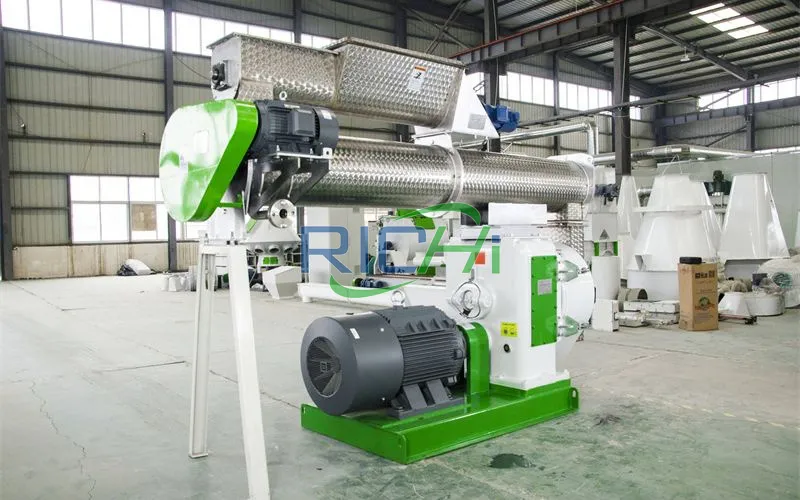
A large integrated duck producer in the Bago Region selected a RICHI SZLH320 duck feed pellet mill for waterfowl farming system in Myanmar to upgrade the pelleting section of its centralized feed mill. The company operates breeder, hatchery and grow-out activities and already had ingredient receiving, grinding, batching, mixing, steam supply, cooling and feed-handling equipment, so it did not need another complete feed plant.
The investment focused on replacing an undersized pelleting stage with one 37 kW SZLH320 ring die pellet mill. With a reference output of approximately 3–4 T/H for suitable compound-feed formulations, the machine gives the company a practical capacity range for an annual duck-feed program of around 10,000 tonnes while allowing the existing upstream and downstream systems to remain in service.
Name:
Duck Feed Pellet Machine
Country:
Myanmar
Date:
2026
Capacity:
3–4 T/H
Model:
SZLH320
Main Motor Power:
37 kW
Main Product:
Compound duck feed
Typical Feed Forms:
Starter crumble and grower/finisher pellets
An integrated waterfowl company needs more than enough feed tonnage. It also needs consistent physical feed form across different production stages.
Duck starter, grower, finisher and breeder feeds can differ in nutrient density, ingredient composition and physical presentation. A centralized feed mill therefore needs a pelletizing system that can handle formula changes without creating an unnecessary production bottleneck.
The customer’s existing grinding and mixing equipment was still usable, but pelleting capacity had become the limiting section as internal feed requirements increased.
Installing a larger feed pellet mill was more economical than replacing equipment that could already support the required production rate.
The SZLH320 was selected as a conventional compound-feed pellet mill rather than an aquafeed machine.
This distinction is important.
Ducks are waterfowl and require ready access to drinking water, but commercial duck feed is not normally designed around a requirement to remain submerged for 20 or 25 minutes.
The relevant physical targets are stable handling, controlled fines, appropriate particle size and a feed form suited to bird age and the farm’s feeding system.
| Project Parameter | Configuration |
|---|---|
| Equipment | Duck feed pellet machine |
| Model | SZLH320 |
| Main Motor | 37 kW |
| Feeder Motor | 1.5 kW |
| Conditioner Motor | 4 kW |
| Reference Capacity | Approximately 3–4 T/H |
| Main Product | Compound duck feed |
| Annual Feed Program | Approximately 10,000 T/Y |
| Typical Feed Forms | Starter crumble and grower/finisher pellets |
| Project Type | Existing feed-mill pelleting-section upgrade |
The annual production target and pellet-mill capacity are reasonably aligned.
At 3 T/H, pelletizing 10,000 tonnes requires approximately 3,333 operating hours per year.
At 4 T/H, the requirement falls to approximately 2,500 hours.
If the feed mill operates around 300 days annually, that equals approximately 8.3–11.1 actual pelleting hours per operating day before maintenance and production interruptions are considered.
This means the SZLH320 can fit a one-to-two-shift operating pattern depending on actual throughput, formula mix, changeovers and line utilization.
It would be misleading to say that the machine only needs to operate six hours per day while simultaneously producing 10,000 tonnes annually.
At 3–4 T/H and six hours per day for 300 days, theoretical annual production would only be approximately 5,400–7,200 tonnes.
The complete feed mill also has to support the new pelleting capacity.
If the mixer, mash bin, steam supply, cooler or finished-feed handling section can only sustain 2 T/H, the SZLH320 cannot independently make the complete plant a 3–4 T/H system.
The customer does not operate with one permanent formula such as 50% imported maize, 15% soybean meal and fixed percentages of rice bran, fishmeal, oil and premix.
Feed formulation changes according to bird stage, ingredient analysis, availability and cost.
Myanmar has a useful local feed-material base.
Common commercial-feed ingredients include maize, broken rice, rice bran, wheat bran, oilseed cakes and fishmeal. Imported soybean meal is also an important protein ingredient in the livestock sector.
Lower Myanmar feed operations can make particular use of rice-derived ingredients because broken rice and rice bran are locally available from the rice industry.
A practical duck ration may therefore draw from several of the following materials:
The pellet mill does not determine these percentages.
The nutrition team sets the formula first, and RICHI then evaluates whether ingredient composition creates special pelleting requirements.
High rice-bran content, additional oil, fibrous ingredients and variations in starch can all change die resistance, conditioning response and pellet durability.
One of the most important product decisions is feed form at different ages.
Very young ducklings do not necessarily need a finished 3.5 mm full-size pellet directly from the ring die.
A common commercial approach is to produce a suitable parent pellet and then pass it through a crumbler to obtain smaller particles for the starter stage.
As birds grow, larger intact pellets can be introduced.
For this project, the feed mill can therefore be configured around starter crumble plus grower and finisher pellets rather than maintaining three rigid die sizes for three age groups.
Grower and finisher pellet diameter is selected according to duck size, feeding equipment and farm preference. A practical commercial range can often fall around several millimeters, but the exact specification is confirmed with the customer rather than prescribing permanent 4.5 mm and 5.5 mm dies.
The same principle applies to breeder feed.
Breeder ducks have different nutrient requirements and feeding objectives from meat ducks, but this does not automatically require another pellet mill.
The SZLH320 can process different compound-feed formulas as long as the complete system provides adequate batching, mixing, changeover and quality control.
The SZLH320 uses a conditioner ahead of the ring die to introduce controlled steam into the mixed feed before compression.
Conditioning changes mash temperature and moisture and can improve the way starch, protein and fibre components respond during pellet formation.
However, the conditioner should not be described as an extended aquafeed conditioner installed primarily to make duck pellets survive twenty minutes underwater.
Duck-feed pellet quality is evaluated around normal handling and feeding requirements.
The feed has to withstand cooling, conveying, screening, storage and delivery to the farm with an acceptable level of fines.
Conditioning parameters are established during commissioning.
There is no universal requirement that duck starter must always reach 85–90°C while finisher feed must be conditioned at 80–85°C.
Steam addition also should not be fixed automatically at 5%, 6% or 7%.
Actual conditioning depends on incoming mash moisture, ingredient composition, steam quality, throughput, feed-safety program and required pellet characteristics.
Motor load and pellet response are monitored as settings are adjusted.
The aim is stable production and suitable feed quality, not achieving an arbitrary conditioning number.
The customer can keep more than one ring die if different pellet diameters are required, but diameter is only one part of die selection.
The effective working length of the die holes affects compression resistance.
Formula composition matters as well.
A mash containing substantial rice bran can behave differently from one dominated by maize and soybean meal. Oil level, fibre, particle size and moisture also influence how readily the material passes through the die.
This is why fixed compression ratios such as 1:12 for starter and 1:10 for finisher are not applied universally.
RICHI evaluates die configuration from the actual formula family and target product.
Using an unnecessarily restrictive die can reduce output and increase motor load.
Using too little effective compression can result in weak pellets and excessive fines.
The commissioning process therefore balances throughput, die resistance and acceptable physical quality rather than selecting a compression ratio from bird age alone.
The SZLH320 cannot be evaluated in isolation from the cooler and screener already installed in the Myanmar feed mill.
Pellets leave the ring die warm.
They need to be cooled before storage or bagging so that the finished product reaches a more stable temperature and moisture condition.
After cooling, screening removes loose fines.
Where starter crumble is required, the appropriate crushing and screening arrangement is incorporated into the downstream process.
This gives the complete production route:
ingredient receiving → grinding → batching → mixing → mash buffer → conditioning → SZLH320 pelletizing → cooling → crumbling where required → screening → finished-feed storage or packing.
If the existing cooler was selected around the previous smaller pellet mill, its real capacity has to be checked before commissioning the SZLH320.
The same applies to elevators, conveyors and the finished-feed bins.
A successful pellet-mill retrofit increases usable line output only when downstream equipment can accept the additional pellets.
The customer’s farm-management objective is to deliver a consistent physical feed form to the ducks.
Ducks should have sufficient drinking water available when consuming dry feed, but this requirement should not be confused with producing aquatic feed.
There is no need to design the SZLH320 duck poultry feed pellet machine around a claim that every pellet must remain intact in water for at least 20 minutes.
If the farm uses troughs or feeding systems where water contamination frequently wets the feed, management should first evaluate feeder and drinker placement, water spillage and the time feed remains exposed.
Making excessively hard pellets simply to survive prolonged immersion can work against other physical feed requirements.
The relevant quality checks for the feed mill include pellet dimensions, fines after screening, bulk density, moisture, physical integrity during conveying and consistency between production batches.
Where the customer wants a numerical pellet-durability specification, a defined laboratory test method should be used so that results from different batches are comparable.
That is more meaningful than placing pellets in a bucket of water and treating survival time as the primary performance standard for duck feed.
This duck feed pellet mill for waterfowl farming system in Myanmar uses one RICHI SZLH320 ring die pellet machine with a 37 kW main motor, 1.5 kW feeder and 4 kW conditioner.
The machine provides a reference capacity of approximately 3–4 T/H for suitable compound-feed formulations and is integrated with the customer’s existing feed-mill infrastructure in the Bago Region.
The main application is duck feed.
The project does not need to expand the machine’s role into goose, quail, fish or shrimp feed simply because some equipment components may be used across different feed sectors.
For this integrated waterfowl operation, the relevant products are starter crumble and grower, finisher or breeder duck feed according to the company’s production program.
Raw materials are selected around Myanmar’s real feed supply.
Locally available maize, broken rice, rice bran and selected protein ingredients can be combined with imported soybean meal and other feed materials as required by the nutrition program.
Formula percentages remain flexible rather than being locked to one generic recipe.
The approximately 10,000 T/Y annual feed target also has to be connected to real operating hours.
At the SZLH320’s 3–4 T/H reference range, the pellet mill requires roughly 2,500–3,333 annual production hours to pellet this quantity before downtime and other losses.
This production math is important for any customer comparing a 3 T/H duck feed pellet machine with larger alternatives.
If the required annual output increases substantially, RICHI can evaluate a larger model rather than forcing the SZLH320 to operate continuously at its upper reference limit.
For another buyer searching for a duck feed pellet mill for waterfowl farming system in Myanmar, duck feed pellet machine Myanmar, waterfowl feed pellet mill, 3–4 T/H duck feed plant, SZLH320 feed pellet machine or duck feed production equipment, RICHI first evaluates both annual feed demand and the existing feed mill.
Useful information includes the number and type of ducks, annual feed requirement, starter/grower/finisher or breeder product mix, major ingredients, required feed form, operating hours, existing hammer-mill and mixer capacities, steam conditions, cooler capacity and finished-feed handling method.
If the customer already owns adequate grinding, mixing, cooling and packing equipment, replacing only the pellet mill can be a practical investment.
If those systems cannot support approximately 3–4 T/H, RICHI Machinery can identify the actual bottleneck before the machine is installed.
For a Myanmar duck-feed project, send RICHI your annual feed tonnage, duck production stages, major ingredients and approximate inclusion ranges, required pellet or crumble sizes, existing feed-mill equipment and daily operating schedule. These parameters provide a stronger basis for SZLH320 selection and die configuration than relying on generic waterfowl-feed settings.
Having the right mix of reliable, high-quality pellet machine and pelletizing systems and expert support is essential to your success. Watch how our end-to-end feed pellet plant solutions have helped our customers optimize their performance.
Our customized and future-proofed turnkey pellet plant solutions is designed with you at the core. From vision to reality and beyond, our team stays connected with yours. Giving you peace-of-mind with an expert at your side.
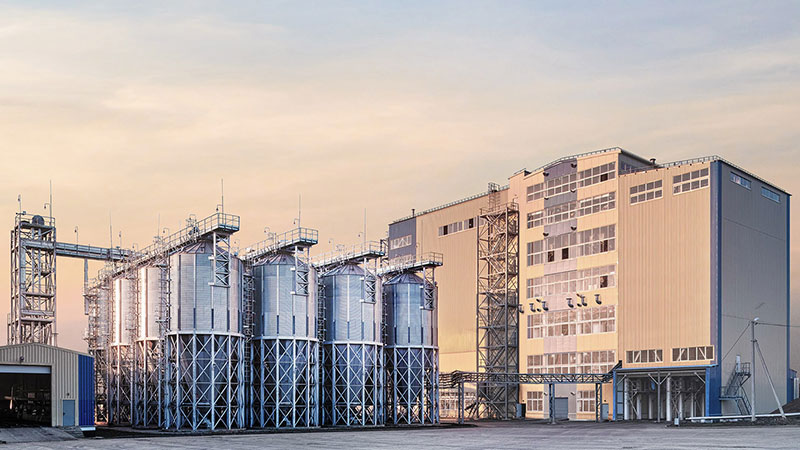
At RICHI, we go beyond project completion. With RICHI Servicee, we’re your dedicated partners in success. Count on us for expert guidance, minimal downtime, and optimized productivity. Choose RICHI for unmatched service and support.
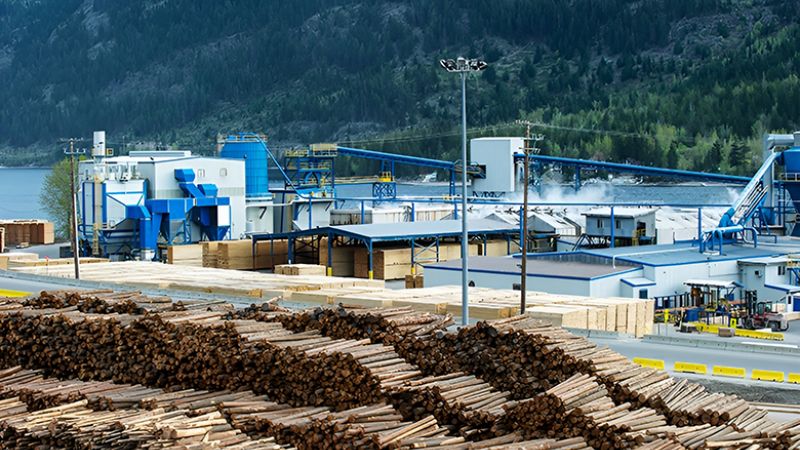


Meet global product demands and quality standards with industry-leading pellet plant design, engineering, equipment, and construction services for pellet processors.


Your Partner Beyond Project Completion
2000+ cases
RICHI is the leading designer, manufacturer and builder of pellet plants in the world, completing over 2000 projects in 140 countries across 6 continents.
Read More
Increase plant productivity, profitability, and safety by integrating high quality equipment into your pellet production line. Over the years, RICHI has become China's top pellet equipment manufacturer. At the same time, RICHI has established valuable partnerships with the world's leading component and raw material manufacturers to bring you the best there is in technology, automation, and efficiency in pelleting plant machinery.

For nearly 30 years, RICHI has been providing best-in-class pellet plant equipment and services to clients across a variety of industries, sizes, and needs. We pride ourselves on the knowledge and skill that each team member possesses – from our technical sales team to our process design engineers. You can count on RICHI Machinery to take your operation to the next level of innovation, quality, and success.
Need help with your pellet manufacturing plant project? Contact us today.
ANIMAL FEED
BIOMASS
WOOD
ORGANIC FERTILIZER
AQUA FEED
CAT LITTER
MUNICIPAL WASTE RECYCLING
SPECIAL PELLET PRODUCTION
RICHI Machinery continues to deliver world class pellet mill equipment, pellet plant engineering and project solutions that add value to our customers in the animal feed, wood waste, agriculture waste, organic fertilizer, cat litter and special pellet products industries. Throughout the years, we RICHI Machinery have built strong brand, becoming industry-leading pellet machine manufacturer. We value integrity, promise quality, and prioritize your success.
Learn MoreWith our expert team, we precisely implement your process engineering requirements in pellet mill and pelletizing plant systems. No matter which industry you’re in – we understand your needs and deliver solutions that meet the highest standards.
At RICHI, quality comes first. Our pellet making machine and related pellet line equipment undergo rigorous quality controls to ensure they meet the highest standards. Rely on products that are durable, safe, and efficient.
With decades of experience in pellet machine and pellet production line production, we have earned a reputation as a trusted partner in various industries. Our expertise allows us to cover a wide range of applications.
Not only do we offer premium pelleting equipment, but we are also experts at designing, building, installing, and maintaining facilities from the ground up. Our expertise is within pellt plant process design, discovering the most efficient, productive, and profitable way to handle your materials in an end-to-end cycle.
○ RICHI MACHINERY
Keeping in touch with us is an effective way to solve all your problems. If you have any needs or questions, please leave your contact information, then RICHI technical consultants will send design, quotation, videos to your mailbox. You can also contact us directly via WhatsApp: +86 13838389622
Copyright©2015-2026 by HENAN RICHI MACHINERY CO., LTD. All rights reserved.