
Dried vegetable belt dryer in Côte d’Ivoire for drying sliced onions, chili peppers and okra. Explore RICHI QHG-500 specifications, steam heating, drying applications and customized processing solutions.
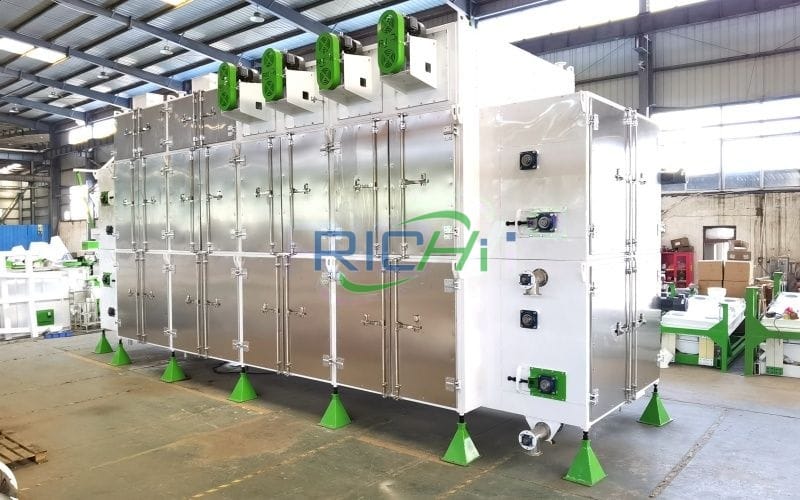
A vegetable processor in Côte d’Ivoire is adding a steam-heated belt dryer to its existing food processing operation. The business handles seasonal supplies of chili peppers, okra and other vegetables purchased from local growers, but the amount of fresh produce arriving at the facility can change considerably from one period to another. The processor wants to develop a more consistent drying operation for ingredients that can be sold to food processors, spice traders and other buyers requiring dried agricultural products.
Instead of investing in a complete new drying plant, the processor plans to purchase one RICHI QHG-500 dried vegetable belt dryer. The proposed installation will use an existing steam supply, subject to a check of available boiler capacity, and will add a dedicated drying stage to the current operation. With five mesh-belt layers, a 1.0 m belt width and 21 m² of drying area, the machine provides a practical starting point for processing prepared vegetables in batches and adjusting the operating conditions to suit different products.
Name:
Vegetable Dryer
Country:
Côte d’Ivoire
Date:
2026
Capacity:
Flexible
Model:
QHG-500
Power:
2.2 × 2 + 0.75 kW
Mesh-belt layers:
5
Belt width:
1.0 m
Côte d’Ivoire has an established agricultural sector, and okra, eggplant, tomatoes and peppers are among the vegetables grown locally. For processors handling these products, the difficulty is not simply finding raw materials. Fresh vegetables contain substantial moisture, deteriorate during storage and do not all respond to the same drying conditions. A processor that wants to sell a dried product needs better control over preparation, drying and storage than a business selling fresh produce alone.
The proposed customer is an agricultural processing business that purchases vegetables from growers and market suppliers. Its plan is to expand from basic cleaning, sorting and preparation into more controlled dehydration. Chili peppers and okra are the initial priorities, with sliced eggplant and selected tomato batches considered for later trials where market demand justifies processing them.
The purchase is driven by a specific operating problem. Sun drying can be useful for small quantities, but exposure to rain, dust, insects and changing weather makes it difficult to maintain a predictable production schedule. A belt dryer provides an enclosed, mechanically controlled alternative that can be operated according to a defined temperature, airflow and residence-time setting.
The customer is not replacing an existing belt dryer. This is an additional machine intended to establish a more reliable drying stage while keeping the investment focused on one piece of equipment. The existing sorting, washing and cutting arrangements can remain in use if they are suitable for the products being processed.
The customer has access to a steam boiler used for other processing operations. That makes a steam-heated dryer worth evaluating, provided the boiler can supply the required heat consistently and the steam pressure, flow rate and condensate arrangement are compatible with the selected machine.
The QHG-500 has a 1.0 m belt width and 21 m² of drying area. It is larger than a small tray dryer but does not commit the business to the 43 m² or 58 m² drying areas offered by the larger models in the supplied range. The five-layer belt arrangement provides a compact way to move material through successive drying zones, although the actual throughput depends on the product, loading depth, moisture reduction required and residence time.
| Parameter | RICHI QHG-500 |
|---|---|
| Equipment type | Steam-heated belt dryer |
| Quantity | 1 unit |
| Heating method | Steam heating |
| Mesh-belt layers | 5 |
| Belt width | 1.0 m |
| Drying area | 21 m² |
| Listed auxiliary power | 2.2 × 2 + 0.75 kW |
| Calculated listed auxiliary power | 5.15 kW |
The listed 5.15 kW covers the electrical loads represented in the supplied specification; it is not the total thermal energy requirement of the dryer. Steam generation consumes energy separately, and the existing boiler must be checked against the required steam demand. The final utility assessment should also include conveying equipment and any upstream or downstream machinery included in the installation.
There is no single reliable tonnes-per-hour figure for every vegetable that can be processed in this machine. Fresh chili peppers, sliced okra and eggplant differ in moisture content, shape and drying behavior. RICHI would need details of the incoming material and the required final moisture level before estimating practical output or confirming a production schedule.
The first processing trials will focus on chili peppers and okra. These products are relevant to Côte d’Ivoire's agricultural sector and can be prepared for drying in a relatively straightforward way. However, the two products should not automatically be run using the same belt speed or temperature profile.
For chili peppers, the customer may need to dry whole peppers or cut pieces, depending on the intended market. Whole peppers can require a different residence time from sliced material. The processor will also need to protect the finished product from moisture pickup after drying, especially if it is intended for spice grinding or extended storage.
For okra, the initial trials will use sorted, cleaned pods cut into consistent pieces. The cut size influences how quickly moisture leaves the product. If the intended final product is for grinding, the processor may prioritize a sufficiently dry, easily milled material. If it is for sale as dried vegetable pieces, appearance, color and shape become more important.
Other products can be assessed once the initial operation is stable. Tomatoes and eggplant may be suitable candidates for sliced or diced drying, but they have different moisture loads and can behave differently as their surfaces dry. Each product needs its own preparation and operating settings rather than being treated as a direct substitute for chili peppers.
The belt dryer is only one stage in the process. Product quality is also affected by what happens before the vegetables reach the mesh belt and how they are handled after leaving it. A consistent incoming material makes it easier to establish a repeatable drying profile and reduces the chance of some pieces leaving too wet while others become unnecessarily dry.
For food applications, the drying profile should be established using product trials and appropriate food-safety procedures. Drying alone should not be treated as proof that a product is microbiologically safe. The processor needs suitable hygiene controls, validated product handling and storage practices for its intended market.
The QHG-500 is being considered because the facility already has a steam source. Steam heating may allow the business to make better use of its existing utilities, but that benefit depends on the boiler's spare capacity, operating schedule and condition. A boiler already working near its limit may not be able to support an additional dryer without changes to the utility system.
Before confirming the order, the customer should establish the available steam pressure and flow, the expected condensate return arrangement, insulation requirements and the operating hours available for drying. The equipment layout should leave suitable access for inspection, cleaning and maintenance. The electrical supply for the belt drive and auxiliary equipment must also be checked.
Compared with the DHG-500 electric-heating model, the QHG-500 uses steam as its heat source rather than relying on the electric heating arrangement listed for the DHG series. The choice should therefore be based on the site's available utilities and total operating costs, not on the auxiliary motor rating alone.
A belt dryer machine is not restricted to one vegetable. With an appropriate material-contact design, suitable temperature control and a product-specific process, the same general equipment type can be used for different prepared agricultural materials. The practical range depends on the machine configuration, cleaning requirements and whether the products can share the same equipment hygienically.
These are potential applications, not a guarantee that every material can be processed on the same settings. Sticky fruit pieces, fine leafy products and thick root slices can require different belt loading, residence times and cleaning arrangements. A product trial is the most useful way to determine whether a proposed application is practical.
Kenya provides a useful example of how a belt dryer can support several agricultural value chains beyond dried vegetables. Commercial and cooperative processors may evaluate this type of dryer for prepared mango, banana and pineapple pieces, sliced tomatoes, leafy vegetables, chili peppers, herbs and spices. The suitability of each product depends on the required quality and the machine's configuration.
Other possible applications include prepared cassava and sweet potato pieces for further processing, as well as selected cereal or agricultural materials where controlled drying is required. These materials should not automatically be treated as interchangeable with vegetables. Grain drying may require a different process configuration, while coffee and tea have specific processing requirements that must be considered before selecting a dryer.
Kenyan processors working with fish or other animal-derived products would also need to confirm that the dryer is designed and approved for the intended material. Food-contact surfaces, hygiene procedures, odor transfer and cleaning between batches can determine whether a shared machine is appropriate. In many cases, a dedicated processing arrangement is preferable to using one machine indiscriminately for every product.
The main commercial advantage of a versatile belt dryer is the possibility of using the equipment across more than one suitable product line. That does not mean a processor should buy a larger model before it has confirmed demand. A practical starting point is to identify the primary material, estimate the amount available during the season and check whether the same machine can serve a second product without disrupting the main production schedule.
For the Côte d’Ivoire processor, buying one QHG-500 keeps the initial project focused on the drying bottleneck. It avoids the expense of replacing upstream equipment that is still suitable and allows the business to learn how different products behave under controlled drying conditions.
The investment should be assessed against more than the machine price. The business needs to consider steam consumption, electricity, labor, raw-material losses, packaging, cleaning time and the proportion of finished product that meets the buyer's requirements. These factors determine the real cost per kilogram of dried material.
RICHI can support the equipment selection process by reviewing the raw materials, target moisture levels, desired product form, available steam supply and installation space. Depending on the project's needs, technical planning can also cover belt configuration, material distribution, conveying arrangements and the connection between the dryer and existing equipment.
If production expands later, the business can review whether the constraint lies in the dryer itself or in upstream preparation, steam supply, packing or seasonal raw-material availability. Adding a larger dryer is not always the best next step; the decision should follow operating data from the initial installation.
The dryer is planned for sea shipment from Qingdao Port in China. The Port of Abidjan is a suitable destination to consider for this project. The final port selection and shipping arrangements should be confirmed when the freight booking is made.
For this illustrative project, the processor's main evaluation points are the ability to use an existing steam source, the flexibility to dry different vegetables and the amount of operator attention required during a batch. Those points should be confirmed through technical review and production trials rather than presented as a verified customer testimonial.
The first operating assessment should record drying time, steam consumption, electricity use, finished moisture, color, product breakage and cleaning time. The processor can then compare the results for chili peppers and okra and decide whether the same machine can economically handle additional products.
This is an illustrative project scenario based on the supplied QHG-500 specifications and agricultural processing applications. It is not a verified installation, and no actual customer statement or confirmed production result is claimed.
A dried vegetable belt dryer can be a useful investment for processors that need more consistent moisture control, want to reduce reliance on open-air drying or plan to expand their range of dried agricultural products. The right configuration depends on the material, initial and final moisture levels, required daily output and available heat source.
RICHI Machinery supplies individual dryers as well as equipment for complete processing lines. For a project using the QHG-500, the most useful starting information is the type of vegetables, their condition before drying, target moisture, required output and available steam supply. With those details, the equipment selection and process arrangement can be discussed on a practical technical basis.
Having the right mix of reliable, high-quality pellet machine and pelletizing systems and expert support is essential to your success. Watch how our end-to-end feed pellet plant solutions have helped our customers optimize their performance.
Our customized and future-proofed turnkey pellet plant solutions is designed with you at the core. From vision to reality and beyond, our team stays connected with yours. Giving you peace-of-mind with an expert at your side.

At RICHI, we go beyond project completion. With RICHI Servicee, we’re your dedicated partners in success. Count on us for expert guidance, minimal downtime, and optimized productivity. Choose RICHI for unmatched service and support.



Meet global product demands and quality standards with industry-leading pellet plant design, engineering, equipment, and construction services for pellet processors.


Your Partner Beyond Project Completion
2000+ cases
RICHI is the leading designer, manufacturer and builder of pellet plants in the world, completing over 2000 projects in 140 countries across 6 continents.
Read More
Increase plant productivity, profitability, and safety by integrating high quality equipment into your pellet production line. Over the years, RICHI has become China's top pellet equipment manufacturer. At the same time, RICHI has established valuable partnerships with the world's leading component and raw material manufacturers to bring you the best there is in technology, automation, and efficiency in pelleting plant machinery.

For nearly 30 years, RICHI has been providing best-in-class pellet plant equipment and services to clients across a variety of industries, sizes, and needs. We pride ourselves on the knowledge and skill that each team member possesses – from our technical sales team to our process design engineers. You can count on RICHI Machinery to take your operation to the next level of innovation, quality, and success.
Need help with your pellet manufacturing plant project? Contact us today.
ANIMAL FEED
BIOMASS
WOOD
ORGANIC FERTILIZER
AQUA FEED
CAT LITTER
MUNICIPAL WASTE RECYCLING
SPECIAL PELLET PRODUCTION
RICHI Machinery continues to deliver world class pellet mill equipment, pellet plant engineering and project solutions that add value to our customers in the animal feed, wood waste, agriculture waste, organic fertilizer, cat litter and special pellet products industries. Throughout the years, we RICHI Machinery have built strong brand, becoming industry-leading pellet machine manufacturer. We value integrity, promise quality, and prioritize your success.
Learn MoreWith our expert team, we precisely implement your process engineering requirements in pellet mill and pelletizing plant systems. No matter which industry you’re in – we understand your needs and deliver solutions that meet the highest standards.
At RICHI, quality comes first. Our pellet making machine and related pellet line equipment undergo rigorous quality controls to ensure they meet the highest standards. Rely on products that are durable, safe, and efficient.
With decades of experience in pellet machine and pellet production line production, we have earned a reputation as a trusted partner in various industries. Our expertise allows us to cover a wide range of applications.
Not only do we offer premium pelleting equipment, but we are also experts at designing, building, installing, and maintaining facilities from the ground up. Our expertise is within pellt plant process design, discovering the most efficient, productive, and profitable way to handle your materials in an end-to-end cycle.
○ RICHI MACHINERY
Keeping in touch with us is an effective way to solve all your problems. If you have any needs or questions, please leave your contact information, then RICHI technical consultants will send design, quotation, videos to your mailbox. You can also contact us directly via WhatsApp: +86 13838389622
Copyright©2015-2026 by HENAN RICHI MACHINERY CO., LTD. All rights reserved.