
A commercial beet pulp dryer in Kazakhstan was recently installed at an agricultural processing facility in the Almaty region, near the city of Talgar at the foothills of the Trans-Ili Alatau mountains.
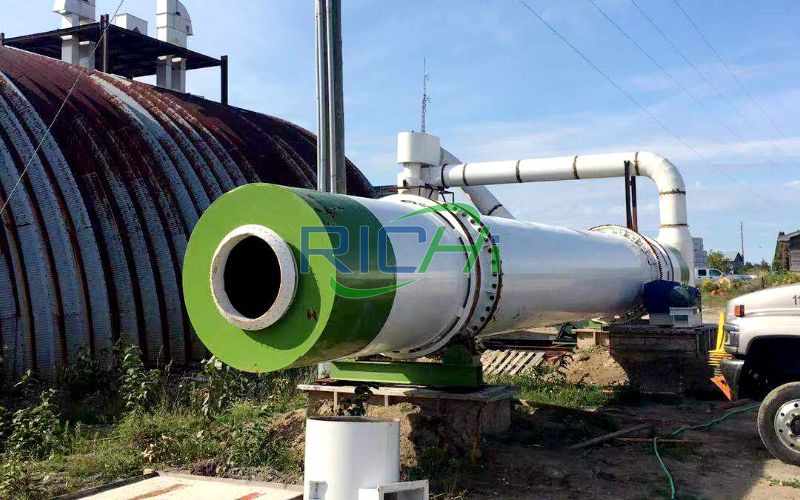
A commercial beet pulp dryer in Kazakhstan was recently installed at an agricultural processing facility in the Almaty region, near the city of Talgar at the foothills of the Trans-Ili Alatau mountains.
This customer operates a unique business. They are not a sugar processor. They are a fruit and vegetable processor that also handles sugar beets from local farmers.
During the autumn harvest, they receive both sugar beets for processing and apples for juice production.
The waste from both operations - beet pulp from sugar extraction and apple pomace from juicing - had always been a disposal problem.
The customer was paying a local company to haul both waste streams to a landfill, costing them approximately 1.8 million tenge per month during peak season.
Name:
Country:
Kazakhstan
Date:
2026
Capacity:
5 to 7 tons per hour
Model:
φ1.8*18
Rotational Speed Range:
3 to 10 rpm
Inlet Temperature:
400 to 500°C
Outlet Temperature:
70 to 80°C
The customer purchased a single rotary drying unit from RICHI rather than a complete new production line because their existing extraction equipment, juice presses, and storage facilities were all in good working condition.
The only missing component was a drying stage that could handle two different materials, sometimes separately and sometimes blended together.
This commercial beet pulp dryer in Kazakhstan now operates between their waste discharge points and a new bagging line, transforming two disposal problems into a single sellable product.
The customer's idea came from talking to their dairy farm customers.
Local dairy farmers in the Almaty region feed their cows a mix of dried beet pulp and apple pomace during the winter.
Beet pulp provides digestible fiber. Apple pomace provides sugar and flavor that makes the feed more palatable.
Farmers were buying both ingredients separately and mixing them on the farm.
The processor realized they could do the mixing at their facility and sell a blended product.
This would save farmers time and labor, and the processor could charge a premium for the convenience.
The optimal blend, based on feeding trials conducted with a local agricultural university, is 70% beet pulp and 30% apple pomace on a dry matter basis.
The wet materials arrive at different times.
Beet pulp comes from sugar extraction at about 78% moisture.
Apple pomace comes from juice pressing at about 80% moisture.
The customer needed a dryer that could handle either material alone or the blended mixture, depending on what was available each day.
The customer's facility sits at 850 meters above sea level.
At this altitude, air pressure is lower than at sea level.
Lower air pressure means lower oxygen content, which affects combustion.
It also means the exhaust fan moves less air mass for the same volume, reducing drying efficiency.
Many equipment suppliers do not account for altitude in their designs.
The result is a dryer that underperforms at high elevation.
We calculated the altitude correction factor for this installation.
At 850 meters, air density is approximately 90% of sea level density.
This means the exhaust fan needed to be sized 10% larger to move the same mass of air.
The burner also needed larger air intake openings to compensate for lower oxygen.
We provided a 45 kW exhaust fan instead of the standard 37 kW, and we enlarged the combustion air inlet by 15%.
Here is the complete configuration they selected after we presented these altitude-specific calculations:
| Parameter | Specification | Remarks |
|---|---|---|
| Selected Model | φ1.8*18 single-pass rotary dryer | Modified for high altitude |
| Drum Diameter | 1.8 meters | Single-pass design |
| Drum Length | 18 meters | Standard configuration |
| Exhaust Fan Power | 45 kW | Altitude compensation |
| Main Drive Power | 30 kW | Variable operation |
| Water Evaporation Capacity | 2.5 to 3.2 tons per hour | Mixed material drying |
Apple pomace is stickier than beet pulp.
It contains pectin, a natural gelling agent.
When heated, pectin becomes tacky and can stick to the dryer flights and drum walls.
This was a major concern for the customer.
We addressed it in three ways.
The customer built a simple blending system before the beet pulp dryer.
Two screw conveyors feed from separate wet bins into a common hopper.
Variable-speed drives on both screws allow precise control of the blend ratio.
For the 70/30 beet pulp to apple pomace blend, the beet pulp screw runs at 70% speed and the apple pomace screw at 30% speed.
The blended material then drops into the dryer feed conveyor.
The customer tested three different blend ratios during the first month of operation.
The 70/30 blend dried fastest and produced the most uniform product.
Pure apple pomace took 15% longer to dry and consumed 10% more fuel per ton.
Pure beet pulp was in between.
The customer now runs the 70/30 blend as their standard product and only processes pure materials when one of the waste streams is unavailable.
The customer does not have access to natural gas. The Almaty region is not fully connected to the gas grid. Diesel is available but expensive at approximately 320 tenge per liter.
The customer needed an alternative fuel source. They found it in the form of walnut shells.
Kazakhstan is a major walnut producer, and the Almaty region has hundreds of small walnut processing operations.
These operations generate tons of walnut shells as waste. The shells have a high lignin content and burn hot and clean. The customer negotiated agreements with five walnut processors to take their shells for free. The only cost is trucking, which is about 25,000 tenge per load. The walnut shells are inconsistent in size.
Some are whole half-shells. Others are crushed into small pieces.
We designed a fuel handling system with a hammer mill to grind the shells to a uniform size before feeding them to the furnace. The hammer mill runs only when the shell storage bin gets low, so it does not consume significant power.
Before the customer committed to this commercial beet pulp dryer in Kazakhstan, RICHI's team conducted tests that no other supplier was willing to do.
We requested separate samples of their wet beet pulp and wet apple pomace, plus a blended sample at 70/30 ratio.
Our lab ran all three materials through our pilot dryer at simulated high-altitude conditions.
We adjusted the pilot dryer's exhaust fan to 90% of normal airflow to mimic 850 meters elevation.
The tests showed that the blend dried more efficiently than either pure material - the apple pomace's natural sugars seemed to help release moisture from the beet pulp fibers.
We provided a 22-page report documenting the test results, including drying curves for each material, fuel consumption projections, and recommendations for the self-cleaning flight design.
We also sent a senior engineer to Almaty to measure the actual air pressure at the customer's site and confirm our altitude calculations.
The customer later told us that no other supplier had even mentioned altitude as a factor, let alone tested for it.
The customer runs the dryer for about 12 hours per day during the autumn harvest season.
Wet beet pulp arrives from their sugar extraction line.
Wet apple pomace arrives from their juice press.
Both materials are stored in separate holding bins.
The operator selects a blend ratio on the control panel, and the screw conveyors automatically proportion the two materials into the common hopper.
The blended material feeds into the dryer at a controlled rate.
Inside the 18-meter drum, the self-cleaning flights lift and shower the material through hot air generated by burning walnut shells.
The dried blend exits at approximately 11% moisture.
After cooling, it is bagged in 25kg sacks and sold to dairy farmers across the Almaty region.
The customer has already identified several other applications for this commercial beet pulp dryer in Kazakhstan during the off-season.
The same dryer can handle all of these materials because of the self-cleaning flight design and the variable-speed feed system.
The customer estimates they can run the dryer for an additional 200 days per year processing these other materials, turning their facility into a regional drying center for agricultural byproducts.
"The altitude modifications worked exactly as calculated.
We have no loss of drying efficiency compared to sea level operations.
The self-cleaning flights solved the apple pomace sticking problem completely.
We have run pure pomace for three full days without any buildup on the flights.
The walnut shell fuel system is working well.
We processed approximately 40 tons of shells during the harvest season.
Our fuel cost was essentially zero.
The blended product is selling well.
We are getting 95,000 tenge per ton for the 70/30 blend, compared to 110,000 tenge per ton for pure beet pulp and 85,000 tenge per ton for pure dried apple pomace.
The farmers tell us their cows prefer the blended product and eat it more readily than either ingredient alone.
The only issue we had was a failed temperature sensor on the exhaust.
Your technician sent us a replacement within five days, and we installed it ourselves.
We are now looking at adding a second dryer specifically for tomato pomace, as that market is opening up."
Kazakhstan is landlocked, so all ocean freight arrives at neighboring ports.
The complete drying system was loaded at RICHI's Qingdao port facility.
The 18-meter drum was shipped in two sections that bolt together on-site.
The drum sections, support rollers, drive assembly, control panel, and fuel handling system were packed into a combination of open-top containers and flat racks.
The shipment traveled to Poti Port in Georgia, the most common Black Sea gateway for industrial equipment heading to Kazakhstan and other Central Asian countries.
From Poti, the equipment traveled by rail across Azerbaijan and by ferry across the Caspian Sea to the port of Aktau in western Kazakhstan, then by rail again to the Almaty region.
The total transit time from Qingdao to the customer's facility was approximately 45 days.
This project demonstrates that a commercial beet pulp dryer in Kazakhstan can serve multiple purposes beyond traditional sugar beet processing.
The customer identified an opportunity to blend two waste streams into a premium product. The altitude-specific modifications were essential for proper performance. The self-cleaning flight design solved the sticking problem.
And the walnut shell fuel system eliminated fuel costs. For any agricultural processor in Kazakhstan generating wet organic waste, the same approach could work. The key is identifying complementary waste streams that can be blended for animal feed.
RICHI Machinery provided the equipment, the testing, the altitude calculations, and the logistical coordination to make it happen.
Having the right mix of reliable, high-quality pellet machine and pelletizing systems and expert support is essential to your success. Watch how our end-to-end feed pellet plant solutions have helped our customers optimize their performance.
Our customized and future-proofed turnkey pellet plant solutions is designed with you at the core. From vision to reality and beyond, our team stays connected with yours. Giving you peace-of-mind with an expert at your side.
At RICHI, we go beyond project completion. With RICHI Servicee, we’re your dedicated partners in success. Count on us for expert guidance, minimal downtime, and optimized productivity. Choose RICHI for unmatched service and support.


Meet global product demands and quality standards with industry-leading pellet plant design, engineering, equipment, and construction services for pellet processors.


Your Partner Beyond Project Completion
2000+ cases
RICHI is the leading designer, manufacturer and builder of pellet plants in the world, completing over 2000 projects in 140 countries across 6 continents.
Read More
Increase plant productivity, profitability, and safety by integrating high quality equipment into your pellet production line. Over the years, RICHI has become China's top pellet equipment manufacturer. At the same time, RICHI has established valuable partnerships with the world's leading component and raw material manufacturers to bring you the best there is in technology, automation, and efficiency in pelleting plant machinery.

For nearly 30 years, RICHI has been providing best-in-class pellet plant equipment and services to clients across a variety of industries, sizes, and needs. We pride ourselves on the knowledge and skill that each team member possesses – from our technical sales team to our process design engineers. You can count on RICHI Machinery to take your operation to the next level of innovation, quality, and success.
Need help with your pellet manufacturing plant project? Contact us today.
ANIMAL FEED
BIOMASS
WOOD
ORGANIC FERTILIZER
AQUA FEED
CAT LITTER
MUNICIPAL WASTE RECYCLING
SPECIAL PELLET PRODUCTION
RICHI Machinery continues to deliver world class pellet mill equipment, pellet plant engineering and project solutions that add value to our customers in the animal feed, wood waste, agriculture waste, organic fertilizer, cat litter and special pellet products industries. Throughout the years, we RICHI Machinery have built strong brand, becoming industry-leading pellet machine manufacturer. We value integrity, promise quality, and prioritize your success.
Learn MoreWith our expert team, we precisely implement your process engineering requirements in pellet mill and pelletizing plant systems. No matter which industry you’re in – we understand your needs and deliver solutions that meet the highest standards.
At RICHI, quality comes first. Our pellet making machine and related pellet line equipment undergo rigorous quality controls to ensure they meet the highest standards. Rely on products that are durable, safe, and efficient.
With decades of experience in pellet machine and pellet production line production, we have earned a reputation as a trusted partner in various industries. Our expertise allows us to cover a wide range of applications.
Not only do we offer premium pelleting equipment, but we are also experts at designing, building, installing, and maintaining facilities from the ground up. Our expertise is within pellt plant process design, discovering the most efficient, productive, and profitable way to handle your materials in an end-to-end cycle.
○ RICHI MACHINERY
Keeping in touch with us is an effective way to solve all your problems. If you have any needs or questions, please leave your contact information, then RICHI technical consultants will send design, quotation, videos to your mailbox. You can also contact us directly via WhatsApp: +86 13838389622
Copyright©2015-2026 by HENAN RICHI MACHINERY CO., LTD. All rights reserved.