
Chicken feed pelletizer for feed processing system in Ethiopia: discover how a Debre Zeit feed mill integrated a 37 kW SZLH320 pellet mill into its existing poultry feed processing system.
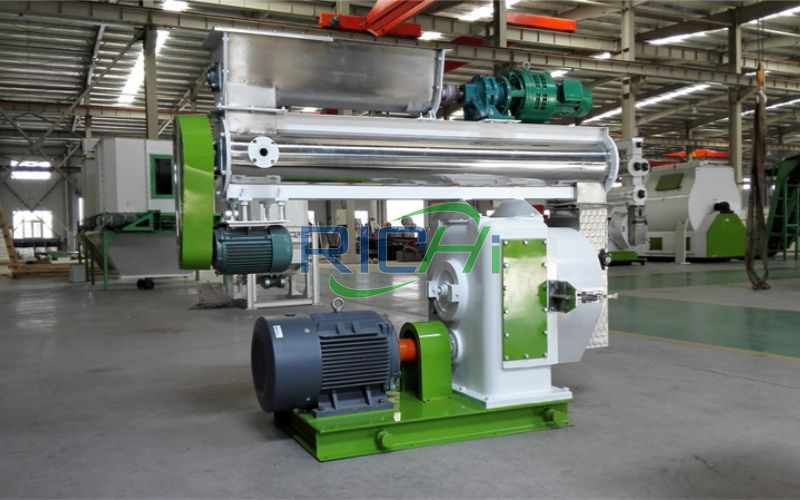
A feed manufacturer in Debre Zeit, approximately 50 km southeast of Addis Ababa, decided to expand its product range after years of producing poultry mash feed. The company supplied commercial poultry farms and had established a processing system for grinding Ethiopian-grown maize, mixing ingredients and handling finished feed. However, some customers increasingly wanted pelleted products, prompting the plant to add a dedicated pelletizing stage.
Rather than replace its existing machinery, the manufacturer purchased an SZLH320 ring die pellet mill from RICHI Machinery. The objective was to connect the new machine to the existing grinding and mixing equipment while retaining the cooler already available at the factory. This approach allowed the business to introduce broiler and layer feed pellets without rebuilding its entire production facility.
The chicken feed pelletizer for feed processing system in Ethiopia was selected with a rated capacity of 3–4 tons per hour. The plant reported total annual feed production of approximately 60,000 tons across its operations, including mash feed. The new pelletizing unit was intended to handle part of this volume, with additional capacity planned as demand for pelleted products developed.
Name:
Chicken Feed Pelletizer
Country:
Ethiopia
Date:
2026
Capacity:
3–4 T/H
Model:
SZLH320
Main Motor Power:
37 kW
Feed Type:
Layer, Broiler starter, Broiler finisher
Pellet diameter:
3.5-4.5mm
The factory already operated hammer mills for maize grinding and a twin-shaft paddle mixer with a 3,000 kg batch capacity. These machines remained suitable for preparing poultry feed mash, so replacing them would have added investment without addressing the plant's main limitation.
The missing equipment was a feed pellet mill capable of converting conditioned mash into uniform pellets. By adding one machine, the manufacturer could serve customers who preferred pelleted feed while continuing to supply mash to farms using their established feeding practices.
This phased investment also made capacity planning more manageable. A 3–4 T/H pellet mill can theoretically produce 9,000–12,000 tons over 3,000 productive hours, before downtime and process losses. It would not independently pelletize the plant's entire 60,000-ton annual output. Instead, it provided a starting capacity for the new product category while the existing system continued supporting the broader business.
RICHI recommended the SZLH320 ring die pellet mill with a 37 kW main motor. The plant selected three dies to accommodate different poultry feed products, allowing the operator to change configurations according to the production schedule.
| Parameter | Specification |
|---|---|
| Model | SZLH320 |
| Equipment type | Ring die feed pellet mill |
| Main motor power | 37 kW |
| Rated capacity | 3–4 T/H |
| Broiler starter die | 3.5 mm |
| Broiler finisher die | 4.0 mm |
| Layer feed die | 4.5 mm |
| Primary applications | Compound broiler and layer feed |
The 3.5 mm die was designated for the plant's starter-feed product, the 4.0 mm die for finisher feed, and the 4.5 mm die for layer feed. Actual output varies with the formulation, grinding fineness, conditioning conditions and die configuration. The selected pellet diameters should also be checked against bird age and feeding requirements; very young chicks may require smaller crumbles or mini-pellets.
Locally available maize formed the main energy component of the plant's broiler feed. Wheat bran and noug cake, a byproduct of Ethiopian oilseed processing, provided additional formulation options. Soybean meal and other protein ingredients were included according to the nutritional requirements of each product.
The plant's example starter formulation was based on the following ingredient proportions:
The formulation totals 100%. It provides a starting point for evaluating ingredient handling and pellet formation, but commercial use requires nutritional verification. Crude protein, metabolizable energy, digestible amino acids, minerals and the quality of individual raw materials must be assessed before the diet is approved for a specific broiler growth stage.
For laying hens, the plant used a separate formulation containing maize, soybean meal, wheat bran and limestone:
This formulation also totals 100%. Its final calcium content must be calculated from the actual ingredients and premix specification rather than inferred from the limestone inclusion rate alone. Layer diets require particular attention to calcium availability, phosphorus balance and the nutritional requirements of the hens.
Noug cake was one of the materials requiring close monitoring. Its fiber and residual oil content can vary between batches, affecting mash flow, conditioning and pellet durability. The plant therefore needed to adjust inclusion rates and processing conditions according to the quality of the incoming material rather than relying on one fixed operating recipe.
The SZLH320 poultry feed pellet machine was installed as an additional stage within the existing feed processing system. The project retained the upstream hammer mills and paddle mixer, while modifying the material flow to supply the new pellet mill and return finished pellets to the cooling stage.
The surge bin helped separate batch mixing from the continuous pelletizing stage. It provided a buffer between the mixer and pellet mill, reducing the need for both machines to discharge at exactly the same moment.
After pelleting, the hot product passed through the relocated cooler before further handling. Cooling was necessary to remove excess heat and moisture introduced during conditioning, helping the pellets retain their structure during storage and transportation. The finished product also needed appropriate screening and handling to control fines before packaging or bulk delivery.
The plant's initial operating settings varied by product. Broiler starter mash was conditioned at approximately 85–90°C, finisher feed at 80–85°C, and layer feed at 70–75°C. Indicative steam addition ranged from 3% to 7%, depending on the formulation and required pellet characteristics.
These figures served as starting settings rather than universal operating requirements. Actual steam consumption depends on incoming mash moisture, ingredient composition, steam quality and the target durability. The plant also needed to ensure that the boiler could maintain sufficient pressure and flow while the pellet mill operated at the intended production rate.
RICHI's technical consultation covered a preliminary steam-demand range of approximately 250–350 kg/h for the pelletizing process. Although the selected boiler was rated at 500 kg/h, effective available steam output depended on operating pressure, steam quality, distribution losses and the needs of other connected equipment. The final system therefore required commissioning checks under actual production conditions.
Noug cake presented a particular challenge because its fibrous and oily characteristics could affect pellet formation. The production team found that adjusting its inclusion rate and conditioning settings helped improve consistency. Regular checks of pellet durability, moisture and fines were important for determining whether a formulation change had achieved the desired result.
Approximately 14 months after delivery, the plant manager reported that the SZLH320 had accumulated around 3,000 operating hours. The mill generally ran for 10 hours per day, five days per week, although actual operating time depended on production schedules and maintenance.
The reported service experience differed by die size. The 3.5 mm starter die had lasted approximately 800 hours, the 4.0 mm finisher die around 1,000 hours, and the 4.5 mm layer die remained in service after approximately 1,200 hours. These figures reflected the customer's particular materials and operating practices rather than guaranteed replacement intervals.
“Adding the pelletizer has allowed us to supply products that our customers had been requesting. We can continue making mash feed while offering pellets to farms that prefer them. We have also learned more about the relationship between ingredient quality and pellet durability.
“Noug cake was one of the main challenges because its characteristics vary between batches. We adjusted the formulation and steam settings to improve pellet consistency. As demand grows, we plan to expand our pelletizing capacity with another SZLH320.”
The operating experience reinforced the importance of recording throughput, steam use, die condition and finished-product quality. These records helped the plant identify formulation-related problems and establish a more reliable basis for maintenance and future capacity planning.
The feed pellet machine was shipped from Qingdao, China, to the Port of Djibouti, Ethiopia's principal maritime gateway. From Djibouti, the cargo continued by road for approximately 850 km to the Debre Zeit area.
Before delivery, the customer prepared the installation location, electrical connection and material-transfer arrangements. RICHI provided system-integration guidance, wiring diagrams, a recommended spare-parts package and remote commissioning assistance. This support was particularly important because the new pellet mill had to work with machinery already installed at the factory.
The installation also required the plant to coordinate the pellet mill, steam boiler, cooler and conveying equipment as one process. Checking interlocks, material flow and operating sequences helped the team establish a more consistent production routine.
The manufacturer subsequently ordered a second SZLH320 to respond to growing demand for pelleted poultry feed and was evaluating the SZLH350 for a future expansion. Additional capacity would allow the company to increase its share of pelleted products without immediately replacing the entire processing system.
For feed manufacturers in Debre Zeit, Addis Ababa and other Ethiopian poultry-producing areas, the appropriate investment depends on the required product mix, operating hours, raw-material availability and capacity of existing equipment. A pellet mill should be selected as part of the complete process, including grinding, mixing, steam generation, cooling and finished-feed handling.
This project demonstrates how a chicken feed pelletizer for feed processing system in Ethiopia can help a manufacturer move beyond mash production through a targeted equipment upgrade. The SZLH320 provided the missing pelletizing stage, while existing machinery continued to serve the broader feed manufacturing operation.
RICHI Machinery supplies ring die pellet mills and related feed processing equipment for manufacturers upgrading existing plants or planning new production facilities. By evaluating the required capacity, feed formulations, pellet dimensions and available utilities, buyers can identify a practical configuration for their own production objectives.
Having the right mix of reliable, high-quality pellet machine and pelletizing systems and expert support is essential to your success. Watch how our end-to-end feed pellet plant solutions have helped our customers optimize their performance.
Our customized and future-proofed turnkey pellet plant solutions is designed with you at the core. From vision to reality and beyond, our team stays connected with yours. Giving you peace-of-mind with an expert at your side.

At RICHI, we go beyond project completion. With RICHI Servicee, we’re your dedicated partners in success. Count on us for expert guidance, minimal downtime, and optimized productivity. Choose RICHI for unmatched service and support.



Meet global product demands and quality standards with industry-leading pellet plant design, engineering, equipment, and construction services for pellet processors.


Your Partner Beyond Project Completion
2000+ cases
RICHI is the leading designer, manufacturer and builder of pellet plants in the world, completing over 2000 projects in 140 countries across 6 continents.
Read More
Increase plant productivity, profitability, and safety by integrating high quality equipment into your pellet production line. Over the years, RICHI has become China's top pellet equipment manufacturer. At the same time, RICHI has established valuable partnerships with the world's leading component and raw material manufacturers to bring you the best there is in technology, automation, and efficiency in pelleting plant machinery.

For nearly 30 years, RICHI has been providing best-in-class pellet plant equipment and services to clients across a variety of industries, sizes, and needs. We pride ourselves on the knowledge and skill that each team member possesses – from our technical sales team to our process design engineers. You can count on RICHI Machinery to take your operation to the next level of innovation, quality, and success.
Need help with your pellet manufacturing plant project? Contact us today.
ANIMAL FEED
BIOMASS
WOOD
ORGANIC FERTILIZER
AQUA FEED
CAT LITTER
MUNICIPAL WASTE RECYCLING
SPECIAL PELLET PRODUCTION
RICHI Machinery continues to deliver world class pellet mill equipment, pellet plant engineering and project solutions that add value to our customers in the animal feed, wood waste, agriculture waste, organic fertilizer, cat litter and special pellet products industries. Throughout the years, we RICHI Machinery have built strong brand, becoming industry-leading pellet machine manufacturer. We value integrity, promise quality, and prioritize your success.
Learn MoreWith our expert team, we precisely implement your process engineering requirements in pellet mill and pelletizing plant systems. No matter which industry you’re in – we understand your needs and deliver solutions that meet the highest standards.
At RICHI, quality comes first. Our pellet making machine and related pellet line equipment undergo rigorous quality controls to ensure they meet the highest standards. Rely on products that are durable, safe, and efficient.
With decades of experience in pellet machine and pellet production line production, we have earned a reputation as a trusted partner in various industries. Our expertise allows us to cover a wide range of applications.
Not only do we offer premium pelleting equipment, but we are also experts at designing, building, installing, and maintaining facilities from the ground up. Our expertise is within pellt plant process design, discovering the most efficient, productive, and profitable way to handle your materials in an end-to-end cycle.
○ RICHI MACHINERY
Keeping in touch with us is an effective way to solve all your problems. If you have any needs or questions, please leave your contact information, then RICHI technical consultants will send design, quotation, videos to your mailbox. You can also contact us directly via WhatsApp: +86 13838389622
Copyright©2015-2026 by HENAN RICHI MACHINERY CO., LTD. All rights reserved.