
Chicken feed crushing machine in Austria for on-farm grain processing, featuring a 75 kW SFSP66×60 hammer mill with 6–7 T/H capacity for poultry feed preparation.
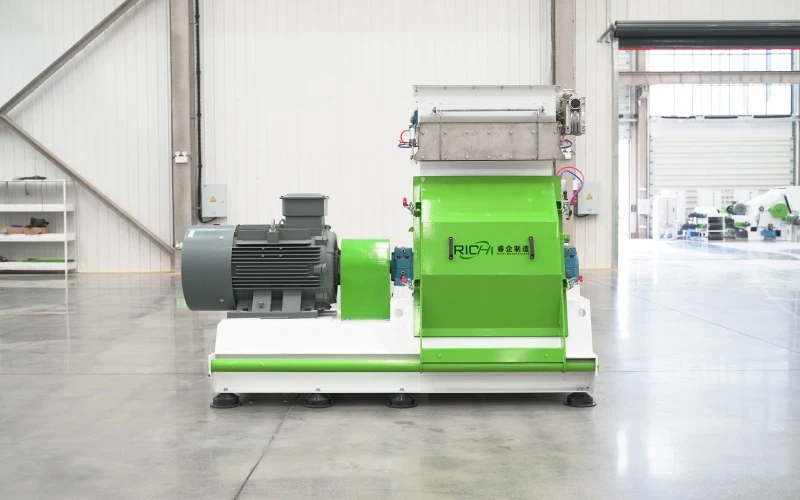
A poultry farm in Lower Austria wanted to reduce its dependence on commercial feed suppliers by bringing grain processing in-house. Rising feed costs and the need for greater control over ingredient quality had encouraged the farm to explore a gradual approach to feed manufacturing. Rather than invest immediately in a complete production line, the owner chose a single chicken feed crushing machine as the first step toward partial self-production.
The farm raises broilers for regional markets and requires approximately 5–8 tons of feed per day. Its main ingredients include wheat, barley and maize, with soybean meal, sunflower meal, minerals and premixes incorporated according to the formulation. The immediate requirement was to crush whole grains into a consistent particle size before mixing, while leaving room for a future expansion into pelleted feed production.
After reviewing the farm's processing objectives, RICHI Machinery recommended the SFSP66×60 water-drop hammer mill. The machine has a 75 kW main motor and a nominal grain-processing capacity of 6–7 tons per hour. The farm selected it as a standalone grinding unit, allowing the owner to begin processing locally sourced cereals without replacing the equipment planned for later stages.
Name:
Chicken Feed Crusher
Country:
Austria
Date:
2026
Capacity:
6–7 T/H
Model:
SFSP66×60
Main Motor Power:
75 kW
Initial screen selection:
2.5 mm perforation
Primary application:
Grinding cereals
The selected chicken feed crushing machine is designed to process dry, brittle feed ingredients such as wheat, maize and barley. Its high-speed rotor carries replaceable hammers that reduce the material through impact. A screen determines the maximum particle size that can pass through the grinding chamber, while the actual particle-size distribution also depends on the material, screen condition and operating settings.
| Parameter | Specification |
|---|---|
| Machine model | SFSP66×60 |
| Machine type | Water-drop feed hammer mill |
| Rotor diameter | 660 mm |
| Crushing chamber width | 600 mm |
| Rotor speed | 2,980 rpm |
| Hammer tip speed | Approximately 103 m/s |
| Main motor power | 75 kW |
| Nominal grain capacity | 6–7 T/H |
| Initial screen selection | 2.5 mm perforation |
| Primary application | Grinding cereals for poultry feed |
The nominal capacity should not be interpreted as a guaranteed output for every raw material. Wheat, barley and maize differ in hardness, moisture and grinding behavior, so actual throughput must be confirmed under the farm's operating conditions. The 75 kW motor also requires verification of the available electrical supply, motor starting method, protection devices and cable sizing before installation.
The farm's main advantage is access to cereals from agricultural suppliers in Austria and neighboring European markets. Instead of purchasing every ingredient in processed form, the owner can receive whole grains, inspect their condition and grind the required quantities before mixing.
For this installation, the farm initially selected a 2.5 mm screen for cereal grinding. This provides a practical starting point for producing relatively fine material, but a screen with 2.5 mm perforations does not automatically produce particles measuring 500–700 microns. The finished distribution needs to be checked through sieve analysis. If the feed formula requires coarser particles or a different distribution, the screen and grinding settings should be reassessed.
Particle size also depends on bird age and the intended feed form. Broiler diets may require different grinding specifications at different growth stages, and excessively fine material can increase dust and affect feed handling. The target should therefore be set according to the nutritionist's formulation and the requirements of the subsequent mixing or pelleting process.
The installation is intended to operate as a dedicated grinding station rather than a complete chicken feed production line. During the initial stage, the farm receives and stores whole cereals, transfers the required quantity to the hammer mill, and collects the ground material for weighing and mixing.
If the farm later adds a pellet press, the existing grinding station can become the front end of a more complete process. A mixer, suitable conveying equipment, steam conditioning where required, a pellet mill and a cooler would need to be selected according to the desired output and feed specifications. The future line should be designed around actual demand rather than simply matching the grinder's nominal capacity.
Although the SFSP66×60 is a single crusher machine, successful installation requires more than allocating floor space. The foundation, feeding arrangement, discharge route, dust collection and maintenance access must all be considered together.
For preliminary planning, the farm should allow approximately 15–20 m² for the grinder and immediate service access, excluding any separate raw-material storage, finished-material bins or larger dust collection equipment. The final footprint depends on the hopper arrangement, cyclone position, conveyor layout and the manufacturer's installation drawings.
The electrical installation should be checked for the 75 kW motor and associated auxiliary equipment. Three-phase power, appropriate motor protection, emergency stopping and grounding are important parts of the installation. The farm should also confirm that the electrical infrastructure can support the grinder alongside its other equipment without overloading the supply.
One trained operator can generally supervise the grinding process when feeding and discharge are properly arranged, although additional labor may be needed for manual bag handling, raw-material movement and cleaning. The farm should establish inspection routines for hammers, screens, bearings, fasteners and the dust collection system. Grain dust management, suitable housekeeping and effective foreign-material separation are particularly important in a dry grinding area.
The machine can be shipped from China by sea freight to a suitable European port, followed by road transport to Lower Austria. The Port of Hamburg is one possible logistics route, but the final shipping arrangement should be selected according to freight quotations, cargo dimensions, customs requirements and inland delivery costs.
Before dispatch, RICHI can provide equipment drawings, foundation and connection information, motor specifications and guidance on integrating the grinder with the farm's planned material-handling arrangement. These documents allow the customer to prepare the installation area and electrical connections before the machine arrives.
Remote commissioning support can help the operator check the rotation direction, feeding rate, screen installation, vibration, bearing temperature and discharge performance. The farm should begin with a controlled test using its actual cereals, then inspect the ground material before moving to routine production.
By processing whole grains on-site, the farm gains greater control over when ingredients are ground and how they are prepared for mixing. Local sourcing may also reduce the need to purchase pre-ground cereals, although the actual financial benefit depends on raw-material prices, electricity consumption, labor, maintenance and the utilization rate of the machine.
The farm's daily requirement of 5–8 tons is below the grinder's stated nominal hourly capacity. At full nominal throughput, that volume represents roughly one to two hours of grinding, before allowing for material changes, cleaning, loading and downtime. This makes it particularly important to compare the investment with the farm's actual workload and future expansion plans. A larger grinder can offer operating flexibility, but its 75 kW motor and associated electrical infrastructure must be justified by the intended utilization.
The owner plans to assess the results of on-site grinding before purchasing a mixer and pelletizer. That staged approach allows the farm to establish a reliable grinding process first, measure its actual costs and then decide which additional equipment will provide the greatest benefit.
This chicken feed crushing machine in Austria project illustrates how a poultry farm can begin developing its own feed-processing capability with a standalone hammer mill. The SFSP66×60 offers a nominal grain capacity of 6–7 T/H, a 75 kW main motor and a configuration suited to cereal size reduction. Its performance in practice will depend on the feedstock, screen selection, electrical supply, feeding arrangement and dust collection system.
For farms planning a similar investment, the most useful starting information includes daily grain consumption, raw-material types, required particle size, available electrical power and plans for future mixing or pelleting. These details help determine whether a standalone grinder is the appropriate first purchase or whether a smaller machine would better match the current workload.
RICHI Machinery supplies feed hammer mills and related equipment for farms and commercial feed manufacturers. Contact our technical team to discuss your grain types, processing requirements and target capacity, and to obtain a machine configuration suited to your operation in Austria.
Having the right mix of reliable, high-quality pellet machine and pelletizing systems and expert support is essential to your success. Watch how our end-to-end feed pellet plant solutions have helped our customers optimize their performance.
Our customized and future-proofed turnkey pellet plant solutions is designed with you at the core. From vision to reality and beyond, our team stays connected with yours. Giving you peace-of-mind with an expert at your side.

At RICHI, we go beyond project completion. With RICHI Servicee, we’re your dedicated partners in success. Count on us for expert guidance, minimal downtime, and optimized productivity. Choose RICHI for unmatched service and support.



Meet global product demands and quality standards with industry-leading pellet plant design, engineering, equipment, and construction services for pellet processors.


Your Partner Beyond Project Completion
2000+ cases
RICHI is the leading designer, manufacturer and builder of pellet plants in the world, completing over 2000 projects in 140 countries across 6 continents.
Read More
Increase plant productivity, profitability, and safety by integrating high quality equipment into your pellet production line. Over the years, RICHI has become China's top pellet equipment manufacturer. At the same time, RICHI has established valuable partnerships with the world's leading component and raw material manufacturers to bring you the best there is in technology, automation, and efficiency in pelleting plant machinery.

For nearly 30 years, RICHI has been providing best-in-class pellet plant equipment and services to clients across a variety of industries, sizes, and needs. We pride ourselves on the knowledge and skill that each team member possesses – from our technical sales team to our process design engineers. You can count on RICHI Machinery to take your operation to the next level of innovation, quality, and success.
Need help with your pellet manufacturing plant project? Contact us today.
ANIMAL FEED
BIOMASS
WOOD
ORGANIC FERTILIZER
AQUA FEED
CAT LITTER
MUNICIPAL WASTE RECYCLING
SPECIAL PELLET PRODUCTION
RICHI Machinery continues to deliver world class pellet mill equipment, pellet plant engineering and project solutions that add value to our customers in the animal feed, wood waste, agriculture waste, organic fertilizer, cat litter and special pellet products industries. Throughout the years, we RICHI Machinery have built strong brand, becoming industry-leading pellet machine manufacturer. We value integrity, promise quality, and prioritize your success.
Learn MoreWith our expert team, we precisely implement your process engineering requirements in pellet mill and pelletizing plant systems. No matter which industry you’re in – we understand your needs and deliver solutions that meet the highest standards.
At RICHI, quality comes first. Our pellet making machine and related pellet line equipment undergo rigorous quality controls to ensure they meet the highest standards. Rely on products that are durable, safe, and efficient.
With decades of experience in pellet machine and pellet production line production, we have earned a reputation as a trusted partner in various industries. Our expertise allows us to cover a wide range of applications.
Not only do we offer premium pelleting equipment, but we are also experts at designing, building, installing, and maintaining facilities from the ground up. Our expertise is within pellt plant process design, discovering the most efficient, productive, and profitable way to handle your materials in an end-to-end cycle.
○ RICHI MACHINERY
Keeping in touch with us is an effective way to solve all your problems. If you have any needs or questions, please leave your contact information, then RICHI technical consultants will send design, quotation, videos to your mailbox. You can also contact us directly via WhatsApp: +86 13838389622
Copyright©2015-2026 by HENAN RICHI MACHINERY CO., LTD. All rights reserved.