
Cattle Pellet Machine in Venezuela: one SZLH350 ring die press for a beef-feed mill near Valencia, with 5–6 T/H reference capacity.
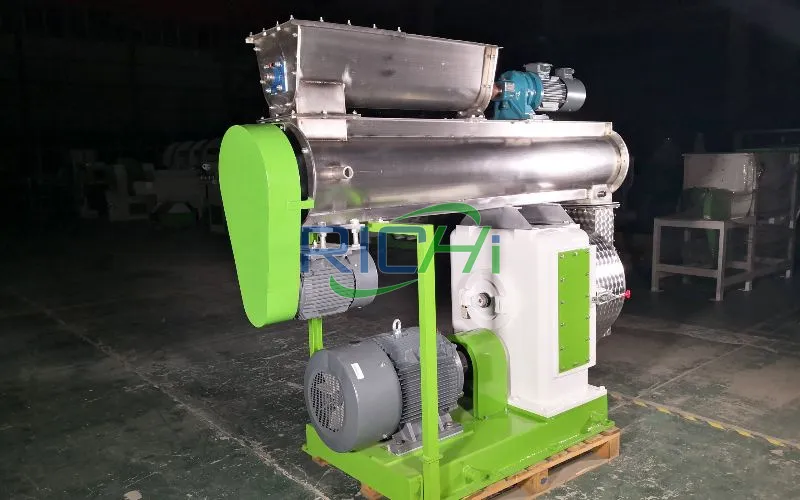
A medium-sized feed mill near Valencia, Carabobo, supplies formulated feed to cattle farms focused mainly on beef production. The business already had equipment for grinding, mixing, and drying feed ingredients, but its ageing pellet press had become a constraint on product consistency and dependable output. Selecting a cattle pellet machine in Venezuela for this site meant renewing the pelleting stage without replacing equipment that remained useful.
RICHI Machinery supplied one SZLH350 ring die cattle pellet machine for the existing mill. The purchase was limited to a single press rather than a complete cattle feed production line. The new machine works within the customer's established material-preparation operation, allowing the feed mill to retain serviceable upstream equipment while modernizing the stage that forms the finished pellets.
Name:
Ring Die Feed Pellet Mill
Country:
Venezuela
Date:
2026
Capacity:
5–6 T/H
Model:
SZLH350
Main Motor Power:
55 kW
Feeder Power:
1.5 kW
Pellet diameter:
8mm
The project serves beef cattle producers around Valencia. Feed requirements vary with animal weight, growth stage, forage availability, and each farm's feeding system. Venezuela's livestock sector includes specialized beef and dual-purpose herds; USDA FAS estimated around 12 million cattle in 2024.
A single-machine replacement was the practical scope for this site. The existing grinder, mixer machine, and dryer were retained, so the project did not require a new raw-material receiving system or a complete batching line. The SZLH350 became the main equipment purchase in the pelleting section, with its feeder and conditioner forming part of the supplied assembly.
Maize is a suitable energy ingredient for grain-based cattle concentrate, while sorghum can be considered when local supply, price, and nutrient analysis support its use. Protein is supplied through soybean meal or other approved oilseed cakes and protein meals. Inclusion rates belong to the feed formulation and should be set from ingredient analysis rather than one fixed percentage for every beef ration.
Tropical grass hay and suitable crop residues can contribute fibre where the product requires a forage-containing pellet. Long stems need to be chopped and, where necessary, ground before mixing so that the mash flows consistently through the feeder and conditioner. Vitamin and mineral premixes are added according to the cattle category, with calcium, phosphorus, salt, and trace minerals balanced for the intended feeding programme. Changes in fibre, oil content, and ingredient moisture affect mash flow, die resistance, and output.
The SZLH350 cattle feed pellet making machine produces formulated cattle feed pellets; it does not replace the whole feeding programme on the farm. Beef cattle still require suitable roughage from pasture, hay, silage, or other forage sources according to their production stage and ration design. The pellet product supplies the concentrate portion or a formulated supplement, with the feeding rate determined by the farm's nutritionist.
A grain-rich concentrate can be prepared differently from a pellet containing more chopped forage. Higher fibre generally changes grinding and feeding behaviour and can reduce the attainable press rate. The cattle feed pellet mill in Venezuela must therefore be operated against the actual formula rather than a headline capacity alone. The SZLH350 accepts ring dies across a 2–12 mm diameter range; this is the available tooling range, not the diameter of one finished product. An 8 mm die is a practical trial candidate for beef concentrate, while the final selection depends on cattle class and feeding method.
The SZLH350 cattle pellet mill in Venezuela was selected as the single ring die press for the mill's replacement requirement. Its 55 kW main motor drives the pelleting assembly, while the 1.5 kW feeder motor controls mash delivery and the 4 kW conditioner motor drives the conditioning section. The 350 mm ring die provides the working surface for compressing conditioned feed into pellets.
| Parameter | Project Specification |
|---|---|
| Pellet Mill Model | SZLH350 |
| Installed Quantity | 1 Unit |
| Main Motor Power | 55 kW |
| Feeder Motor Power | 1.5 kW |
| Conditioner Motor Power | 4 kW |
| Combined Listed Motor Power | 60.5 kW, excluding external auxiliary equipment |
| Ring Die Inner Diameter | 350 mm |
| Available Die-Hole Diameter Range | 2–12 mm |
| Reference Capacity | 5–6 T/H for suitable formulations |
| Machine Type | Ring Die Feed Pellet Mill |
The 5–6 T/H figure is a reference capacity for suitable feed formulations, not a guaranteed rate for every cattle diet. A higher forage fraction, changes in oil content, a small die opening, or a demanding durability target can increase resistance and lower throughput. Saleable output also depends on whether downstream cooling, screening, and conveying can keep pace with the press.
Incoming maize and other coarse grains are cleaned and ground before batching. A mean particle size around 1.5–2.5 mm is a useful starting range for the grain fraction, verified by sieve analysis; grass hay and crop residues follow a separate route, with long fibres chopped before any further size reduction. Protein meals are inspected for lumps, foreign matter, and moisture variation before mixing.
The existing mixer combines prepared ingredients with measured mineral and vitamin additions. Each batch should be fully blended before release to the pellet mill. Dry mixed mash can be trialed around 12–13% moisture on a wet basis, then adjusted for the formula and ingredient condition. The existing dryer is used only when incoming forage or crop residues require moisture reduction; dry grain and meals do not need to pass through it automatically.
After mixing, the mash is metered by the SZLH350 feeder into the conditioner. The conditioner prepares the material before it reaches the ring die, using controlled moisture and heat where required by the recipe. Steam quality, moisture addition, residence time, and mash composition affect compression, so settings need to be adjusted together when the ingredient mix changes. A conditioning temperature around 75–80°C can serve as an initial trial window, not a fixed setting for every formula.
Pellets leave the die hot and mechanically fragile. They need sufficient cooling and air contact before screening, storage, or bagging. The screen separates acceptable pellets from loose fines, and only clean, suitable fines should be returned under the mill's operating procedure. Cooler capacity, screen area, and conveyor rates must match the actual press output; they are not included in the 55 kW main-motor rating. Cooling should bring pellets close to ambient temperature before storage, with moisture, durability, fines, and breakage checked after handling. Product trials should confirm that beef cattle feed pellets in Venezuela remain intact through conveying and farm delivery.
The SZLH350 feed pellet machine installation requires a level foundation, access for removing the ring die and rollers, and clearance around the motor and drive assembly. The feeder inlet must align with the prepared-mash discharge, while the pellet outlet must connect safely to the downstream finishing route. Final foundation dimensions, lifting points, and service clearances should follow the approved machine drawings.
Venezuela uses a 60 Hz electrical system, but the actual site voltage and available supply capacity must be confirmed before the motor and control configuration are finalized. The electrical review covers starting current, protection, cable sizing, grounding, and the loads of the feeder and conditioner. The 60.5 kW figure in the table is only the sum of the three listed machine motors; it is not the complete feed mill connected load.
For machinery shipped from Qingdao to a plant near Valencia, Puerto Cabello is the practical seaport to assess. Major container carriers list Puerto Cabello among the Venezuelan terminals they serve, and port-service providers maintain offices in both Valencia and Puerto Cabello. The actual discharge port and inland delivery arrangement must follow the booked service and shipping documents.
Before commissioning, the operating team checks the ring die and rollers, lubrication points, feeder speed, conditioner rotation, steam connections, and emergency stops. Initial runs begin at a controlled feed rate while operators record motor current, mash moisture, conditioning conditions, throughput, and pellet appearance. The working rate is increased only when the press and downstream equipment remain stable.
The equipment scope centres on one SZLH350 cattle pellet machine rather than a full plant replacement. The feed mill retains its existing grinding, mixing, and drying assets and adds a ring die press to renew the pelleting stage. This keeps the project focused on the equipment requiring replacement while preserving the value of serviceable machinery already on site.
For RICHI, a single-machine cattle feed upgrade in Venezuela begins with the customer's ingredients, required pellet form, and existing process interfaces. The die, feeder, conditioner, motor configuration, foundation, and downstream handling route are assessed as one operating system.
RICHI Machinery can provide model selection, equipment documentation, installation and commissioning guidance, operator training, and spare-parts support for feed mill projects. A manufacturer planning a similar upgrade can provide its ingredient list, target cattle feed specification, current press details, mixer capacity, dryer arrangement, and site electrical information. These details allow the replacement machine to be matched to actual production conditions rather than selected from motor power alone.
For a feed mill serving beef cattle farms around Valencia, the SZLH350 offers a single-machine route to modernize pellet production while continuing to use existing preparation equipment. A cattle pellet machine in Venezuela should be specified against the feed formulation, pellet dimensions, operating rate, and installation interfaces. Contact RICHI Machinery to discuss these requirements for your project.
Having the right mix of reliable, high-quality pellet machine and pelletizing systems and expert support is essential to your success. Watch how our end-to-end feed pellet plant solutions have helped our customers optimize their performance.
Our customized and future-proofed turnkey pellet plant solutions is designed with you at the core. From vision to reality and beyond, our team stays connected with yours. Giving you peace-of-mind with an expert at your side.

At RICHI, we go beyond project completion. With RICHI Servicee, we’re your dedicated partners in success. Count on us for expert guidance, minimal downtime, and optimized productivity. Choose RICHI for unmatched service and support.



Meet global product demands and quality standards with industry-leading pellet plant design, engineering, equipment, and construction services for pellet processors.


Your Partner Beyond Project Completion
2000+ cases
RICHI is the leading designer, manufacturer and builder of pellet plants in the world, completing over 2000 projects in 140 countries across 6 continents.
Read More
Increase plant productivity, profitability, and safety by integrating high quality equipment into your pellet production line. Over the years, RICHI has become China's top pellet equipment manufacturer. At the same time, RICHI has established valuable partnerships with the world's leading component and raw material manufacturers to bring you the best there is in technology, automation, and efficiency in pelleting plant machinery.

For nearly 30 years, RICHI has been providing best-in-class pellet plant equipment and services to clients across a variety of industries, sizes, and needs. We pride ourselves on the knowledge and skill that each team member possesses – from our technical sales team to our process design engineers. You can count on RICHI Machinery to take your operation to the next level of innovation, quality, and success.
Need help with your pellet manufacturing plant project? Contact us today.
ANIMAL FEED
BIOMASS
WOOD
ORGANIC FERTILIZER
AQUA FEED
CAT LITTER
MUNICIPAL WASTE RECYCLING
SPECIAL PELLET PRODUCTION
RICHI Machinery continues to deliver world class pellet mill equipment, pellet plant engineering and project solutions that add value to our customers in the animal feed, wood waste, agriculture waste, organic fertilizer, cat litter and special pellet products industries. Throughout the years, we RICHI Machinery have built strong brand, becoming industry-leading pellet machine manufacturer. We value integrity, promise quality, and prioritize your success.
Learn MoreWith our expert team, we precisely implement your process engineering requirements in pellet mill and pelletizing plant systems. No matter which industry you’re in – we understand your needs and deliver solutions that meet the highest standards.
At RICHI, quality comes first. Our pellet making machine and related pellet line equipment undergo rigorous quality controls to ensure they meet the highest standards. Rely on products that are durable, safe, and efficient.
With decades of experience in pellet machine and pellet production line production, we have earned a reputation as a trusted partner in various industries. Our expertise allows us to cover a wide range of applications.
Not only do we offer premium pelleting equipment, but we are also experts at designing, building, installing, and maintaining facilities from the ground up. Our expertise is within pellt plant process design, discovering the most efficient, productive, and profitable way to handle your materials in an end-to-end cycle.
○ RICHI MACHINERY
Keeping in touch with us is an effective way to solve all your problems. If you have any needs or questions, please leave your contact information, then RICHI technical consultants will send design, quotation, videos to your mailbox. You can also contact us directly via WhatsApp: +86 13838389622
Copyright©2015-2026 by HENAN RICHI MACHINERY CO., LTD. All rights reserved.