
Cattle feed grinder machine in Malaysia for dried Napier: SFSP66×60, 55 kW, 1,000–1,200 kg/h planning duty and a 2–3 mm mean grinding target.
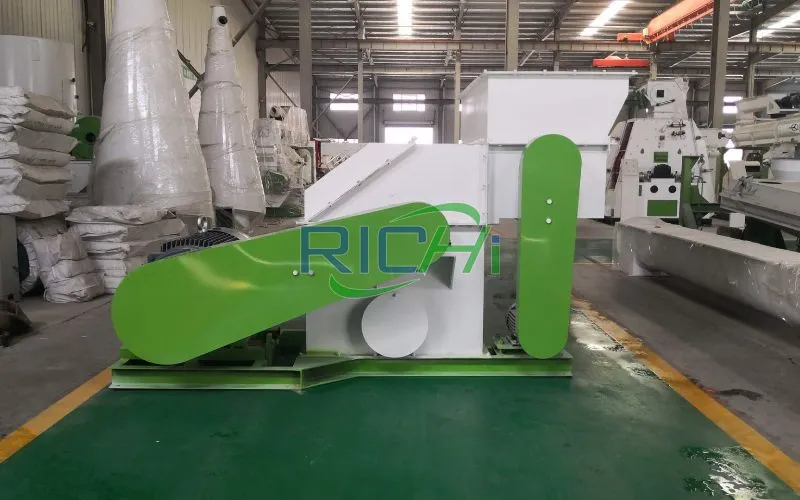
Long Napier stems and damp forage can slow a feed mill even when its mixer and pellet press have spare capacity. For the Johor Bahru mill considered in this application example, the cattle feed grinder machine in Malaysia is selected around a defined job: preparing dry Napier meal for cattle feed blends.
The customer profile is a regional ruminant feed producer supplying beef farms and dairy operators in southern Peninsular Malaysia. The mill already has forage preparation equipment, ingredient storage, mixing, pelleting and packing facilities. The planned purchase replaces an older grinder with one SFSP66×60 hammer mill. Existing equipment remains in service where its capacity and condition suit the new grinding duty.
Name:
Cattle Feed Grinder
Country:
Malaysia
Date:
2026
Capacity:
1,000–1,200 kg/h
Model:
SFSP66×60
Main Motor Power:
55 kW
Raw Materials:
Napier
Final product size:
2–3 mm
The main material is dried Napier stalks and leaves, with a starting grinding moisture specification of 12–15% on a wet basis. Harvest age matters: older stems are generally more fibrous and lignified, so their grinding behaviour and feeding value differ from younger material. Moisture and stem content are recorded for each delivery.
The pre-chopping target is approximately 20–40 mm, avoiding long strands that can bridge above the grinding chamber. Material wet from rain is held for moisture correction. Feedstock with mould or spoilage is rejected rather than treated as a grinding problem.
The 55 kW configuration has a published grass-and-straw capacity reference of 1,000–1,500 kg/h. For this Napier application, the planning range is 1,000–1,200 kg/h, subject to trials at the required moisture and particle size. Grain output figures are not used to size the forage duty.
| Parameter | Specification or project basis |
|---|---|
| Model and quantity | One SFSP66×60 hammer mill |
| Main motor power | 55 kW |
| Rotor diameter | 660 mm |
| Grinding chamber width | 600 mm |
| Reference rotor speed | 2,980 rpm |
| Calculated hammer tip speed | Approximately 103 m/s |
| Published dry grass/straw capacity | 1,000–1,500 kg/h |
| Napier planning range | 1,000–1,200 kg/h, pending material trials |
| Trial screen aperture | 6 mm, adjusted after sieve analysis |
| Ground-meal target | Mean particle size approximately 2–3 mm |
| External auxiliary loads | Feeder, fan, dust collection and conveying specified separately |
This configuration gives the grass crusher machine a defined starting point without purchasing a larger grinding station before testing its own forage. The final screen and hammer arrangement must produce acceptable meal at a stable motor load. Changing to a smaller screen can reduce throughput and increase energy demand.
A 6 mm screen aperture does not mean every discharged particle measures 6 mm. Hammer impacts produce a distribution of sizes, and elongated fibres may pass through openings differently from compact grain fragments. The 2–3 mm mean-size target therefore needs an agreed sieve-analysis procedure, together with inspection of the longer fibre fraction.
The grinder produces a feed ingredient. In this application, the existing mixer combines Napier meal with prepared maize meal, palm kernel expeller, rice bran and the specified supplements. Each ingredient follows its own preparation route; purchased fine meals do not automatically need another pass through the forage grinder.
The downstream pellet specification for the example is 8 mm diameter with a target length of 10–20 mm, controlled by the existing pellet mill’s die and cutter. These pellets are intended for use within a balanced cattle feeding programme. Fine grinding and pelleting do not remove the need to assess physically effective fibre in the complete ration or provide suitable longer forage.
A planning recipe using 300 kg of Napier meal in a 1,000 kg mixing batch illustrates the connection. At 1,000 kg/h, one hour of forage grinding supplies slightly more than three such batches. The nutritionist determines the actual inclusion rate; this example checks equipment flow rather than prescribing a diet.
Four productive grinding hours on 250 operating days would process 1,000 tonnes of prepared forage annually at that calculation point. This is grinder throughput before handling losses, separate from total compound-feed output. Cleaning, screen changes and maintenance sit outside those productive hours.
A covered intermediate bin allows the grinder and mixer to run on different schedules. Its capacity follows the batch plan and measured meal bulk density. A small, frequently replenished stock is preferable where humid conditions make extended storage difficult.
Dry grass is bulky, so feeder capacity must be checked by volume as well as weight. Controlled feeding limits sudden loads when dense stem bundles enter the chamber. The operator watches motor current, discharge flow and screen condition, reducing feed when the material becomes harder to process.
Aspiration and dust collection are part of the grinding assessment. The fan duty depends on the mill arrangement, ducts, separator and filter resistance. An existing fan is retained only after its performance is checked. A restricted filter or poorly arranged discharge can limit production even when the main motor has spare capacity.
Trial records should include weighed throughput, moisture, sieve results, electrical consumption and interruptions. Comparable runs on representative forage establish whether the replacement can keep the meal bin supplied. Any claim of lower energy use requires measurements under equivalent grinding conditions.
The installation review checks foundation loads, feeder and discharge heights, duct connections and access for screen and hammer replacement. Existing floor space is assessed from the equipment drawing. Staffing provision allows one grinding operator with shared help for bale opening and loading.
Electrical selection uses Malaysia’s nominal 400 V, 50 Hz three-phase supply as a design basis, with actual site conditions and motor starting capacity confirmed before manufacture. The 55 kW main drive is not the installed power of the whole grinding station. Feeder, aspiration and conveying loads are added separately.
Shipment planning starts at Qingdao. For a Johor destination, a quotation can compare arrival through Tanjung Pelepas with Port Klang and the respective inland haulage. Carrier availability, packing dimensions and delivered cost determine the selected route.
For a cattle feed grinder machine in Malaysia, a useful enquiry starts with photographs of the delivered forage and a recent moisture result. Add the incoming length, required ground size, tonnes needed per shift, current mixer schedule and existing extraction details. RICHI Machinery can use this information to define a Napier grinding trial and quote the machine with its required connections.
Having the right mix of reliable, high-quality pellet machine and pelletizing systems and expert support is essential to your success. Watch how our end-to-end feed pellet plant solutions have helped our customers optimize their performance.
Our customized and future-proofed turnkey pellet plant solutions is designed with you at the core. From vision to reality and beyond, our team stays connected with yours. Giving you peace-of-mind with an expert at your side.
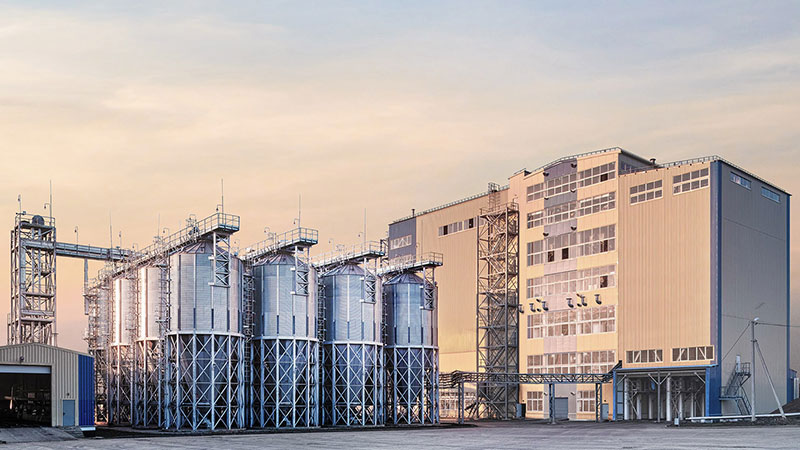
At RICHI, we go beyond project completion. With RICHI Servicee, we’re your dedicated partners in success. Count on us for expert guidance, minimal downtime, and optimized productivity. Choose RICHI for unmatched service and support.
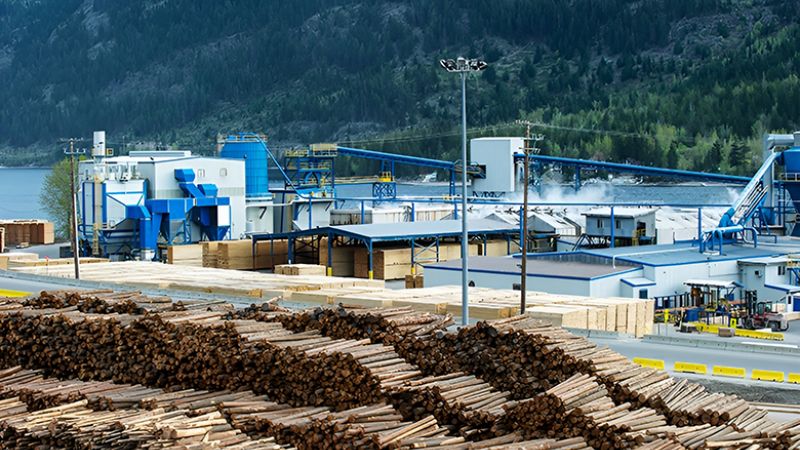


Meet global product demands and quality standards with industry-leading pellet plant design, engineering, equipment, and construction services for pellet processors.


Your Partner Beyond Project Completion
2000+ cases
RICHI is the leading designer, manufacturer and builder of pellet plants in the world, completing over 2000 projects in 140 countries across 6 continents.
Read More
Increase plant productivity, profitability, and safety by integrating high quality equipment into your pellet production line. Over the years, RICHI has become China's top pellet equipment manufacturer. At the same time, RICHI has established valuable partnerships with the world's leading component and raw material manufacturers to bring you the best there is in technology, automation, and efficiency in pelleting plant machinery.

For nearly 30 years, RICHI has been providing best-in-class pellet plant equipment and services to clients across a variety of industries, sizes, and needs. We pride ourselves on the knowledge and skill that each team member possesses – from our technical sales team to our process design engineers. You can count on RICHI Machinery to take your operation to the next level of innovation, quality, and success.
Need help with your pellet manufacturing plant project? Contact us today.
ANIMAL FEED
BIOMASS
WOOD
ORGANIC FERTILIZER
AQUA FEED
CAT LITTER
MUNICIPAL WASTE RECYCLING
SPECIAL PELLET PRODUCTION
RICHI Machinery continues to deliver world class pellet mill equipment, pellet plant engineering and project solutions that add value to our customers in the animal feed, wood waste, agriculture waste, organic fertilizer, cat litter and special pellet products industries. Throughout the years, we RICHI Machinery have built strong brand, becoming industry-leading pellet machine manufacturer. We value integrity, promise quality, and prioritize your success.
Learn MoreWith our expert team, we precisely implement your process engineering requirements in pellet mill and pelletizing plant systems. No matter which industry you’re in – we understand your needs and deliver solutions that meet the highest standards.
At RICHI, quality comes first. Our pellet making machine and related pellet line equipment undergo rigorous quality controls to ensure they meet the highest standards. Rely on products that are durable, safe, and efficient.
With decades of experience in pellet machine and pellet production line production, we have earned a reputation as a trusted partner in various industries. Our expertise allows us to cover a wide range of applications.
Not only do we offer premium pelleting equipment, but we are also experts at designing, building, installing, and maintaining facilities from the ground up. Our expertise is within pellt plant process design, discovering the most efficient, productive, and profitable way to handle your materials in an end-to-end cycle.
○ RICHI MACHINERY
Keeping in touch with us is an effective way to solve all your problems. If you have any needs or questions, please leave your contact information, then RICHI technical consultants will send design, quotation, videos to your mailbox. You can also contact us directly via WhatsApp: +86 13838389622
Copyright©2015-2026 by HENAN RICHI MACHINERY CO., LTD. All rights reserved.