
An Australian premium pet food manufacturer upgraded its cooling section with an SKLF17×17 cat food pellet cooler in Australia to handle approximately 6 T/H of coated cat kibble. The new cooler was installed after the coating system to reduce kibble temperature from around 65–70°C to a level suitable for downstream handling and packaging while minimizing unnecessary abrasion of the freshly coated product.
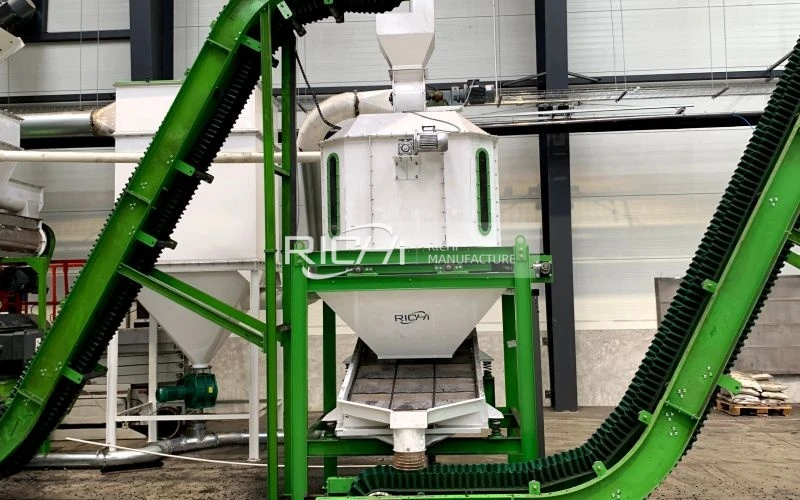
An Australian premium pet food manufacturer upgraded its cooling section with an SKLF17×17 cat food pellet cooler in Australia to handle approximately 6 T/H of coated cat kibble. The new cooler was installed after the coating system to reduce kibble temperature from around 65–70°C to a level suitable for downstream handling and packaging while minimizing unnecessary abrasion of the freshly coated product.
Rather than rebuilding the complete pet food line, the customer replaced an aggressive rotary cooling system with a counterflow cooler sized for its existing production capacity. With a rated capacity of 6–8 T/H and adjustable cooling time, the equipment gave the plant a more suitable cooling solution for 8 mm premium cat kibble while retaining its existing extrusion, drying, coating and packaging equipment.
Name:
Cat Food Pellet Coole
Country:
Australia
Date:
2025
Capacity:
6 T/H
Model:
SKLF17×17
Main Motor Power:
1.5 KW
Cooling time:
6–15 minutes
Main product:
8 mm coated cat kibble
For a premium pet food manufacturer in Victoria, Australia, cooling had become a quality-control problem rather than simply the final temperature-reduction step. The plant was producing coated cat kibble for the super-premium market, and its existing rotary cooler was creating too much mechanical movement after coating. The kibble reached the cooler at approximately 65–70°C, when the recently applied digest-and-fat palatability coating was still relatively soft. As the product tumbled inside the old cooler, part of that coating transferred from the kibble surface to the equipment and other particles.
The problem was especially important because palatability was one of the main selling points of the product. The plant was running approximately 6 T/H of 8 mm cat kibble and needed to bring the coated product down to a temperature suitable for storage and bagging without increasing fines or damaging the surface treatment. Instead of replacing other parts of the pet food line, the manufacturer decided to upgrade only the cooling section and began evaluating a dedicated cat food pellet cooler in Australia.
After reviewing the plant’s throughput, kibble dimensions, incoming temperature and coating requirements, RICHI recommended the SKLF17×17 counterflow cooler. Its 6–8 T/H capacity provided sufficient margin above the plant’s normal 6 T/H production rate, while the counterflow cooling principle offered substantially gentler product handling than the rotary equipment it replaced.
The customer’s production sequence was extrusion, drying, coating, cooling and packaging. This meant the cooler was positioned after the palatability coating had already been applied. At this stage, the objective was not simply to remove heat. The cooling system also had to protect the kibble surface and keep the coating distributed as uniformly as possible.
The plant’s typical coated product had the following characteristics:
The previous rotary cooler could reduce product temperature, but the tumbling action was undesirable for freshly coated kibble. Surface abrasion also increased the amount of coating and fines accumulating inside the machine. This created additional cleaning requirements when the factory changed between chicken, fish and other formulations.
For the customer, therefore, the replacement cooler had to satisfy three conditions at the same time: approximately 6 T/H continuous throughput, controlled cooling close to ambient temperature, and low mechanical disturbance of the coated kibble.
The SKLF17×17 was selected around the actual operating point rather than simply matching the nominal capacity of the upstream equipment. Its rated 6–8 T/H capacity allowed the plant to operate at its normal 6 T/H output without selecting a cooler that would immediately become undersized when the extrusion line was running at its upper production rate.
| Project Parameter | Configuration |
|---|---|
| Equipment | Cat food pellet cooler |
| Model | SKLF17×17 |
| Required production rate | Approximately 6 T/H |
| Cooler capacity | 6–8 T/H |
| Cooling time | Approximately 6–15 minutes, adjustable according to operating conditions |
| Typical discharge temperature | Approximately ambient temperature +3–5°C under suitable operating conditions |
| Main product | 8 mm coated cat kibble |
| Installation position | After the coating section and before finished-product handling and packaging |
Another important consideration was hygiene. The manufacturer produces several premium formulas, so product-contact areas require regular cleaning between production campaigns. A stainless-steel configuration was therefore selected for the relevant contact surfaces to simplify cleaning and provide better resistance to residues from fats and palatability coatings.
The operating principle differs considerably from the customer’s former rotary cooler. Rather than repeatedly lifting and dropping the kibble, the counterflow cooler forms a product bed and passes cooling air through the material. This allows heat to be removed with much less mechanical agitation.
For coated pet food, this is particularly useful because the product surface is most vulnerable immediately after the coating stage. Reducing unnecessary rubbing, rolling and impact helps preserve the physical appearance of the kibble and reduces the transfer of coating onto equipment surfaces.
During commissioning, cooling time and airflow were adjusted according to the actual kibble temperature and the ambient conditions in the plant. A test condition using kibble entering at approximately 68°C and an ambient temperature of around 22°C produced discharge temperatures close to 26°C after approximately 12 minutes of cooling. The exact cooling result varies with ambient temperature, airflow, product moisture, bed depth, kibble geometry and production rate, so the settings are adjusted rather than treated as fixed values.
This was an equipment replacement project, not a new complete pet food plant. The customer already had the extrusion, drying, coating and packaging sections required for commercial production. RICHI therefore focused on fitting the new cooler between the existing coating and downstream handling systems.
The arrangement followed this production sequence:
Extrusion → Drying → Palatability Coating → Counterflow Cooling → Finished Product Handling → Packaging
The Counterflow Pellet Cooler was installed on an elevated support structure so the cooled kibble could discharge into the downstream conveying and packaging section with minimal additional transfer equipment. This was important because every extra screw conveyor, long drop or aggressive transfer point after coating could introduce another opportunity for surface damage.
The machine was also configured for the plant’s Australian electrical supply. During engineering, RICHI reviewed the available installation height, discharge elevation, upstream coater connection, downstream conveyor position, dust and air handling requirements, and access space required for cleaning and maintenance.
One of the operational changes made during commissioning was to treat cooling as a controlled process rather than running the fan at the highest possible setting. Excessive airflow is not automatically better for pet food. The required airflow depends on product temperature, ambient conditions, bed depth, residence time and kibble characteristics.
The operators therefore monitor the temperature of the kibble entering and leaving the cooler and adjust the operating conditions accordingly. During warmer periods in Victoria, the achievable discharge temperature naturally rises with ambient air temperature. For this reason, the practical specification is based on the temperature difference above ambient rather than expecting a fixed 25°C outlet temperature throughout the year.
This is particularly important for a cat food pellet cooler in Australia, where seasonal ambient conditions can change considerably. Designing around ambient +3–5°C gives the production team a more realistic cooling target than specifying one absolute discharge temperature for every operating condition.
Cooling the kibble gently would provide limited benefit if the product were then subjected to aggressive mechanical handling during discharge. The customer therefore paid particular attention to the cooler’s discharge arrangement.
The SKLF system uses a controlled discharge mechanism that releases the cooled product without the continuous tumbling associated with the previous rotary cooler. This helps maintain kibble shape while reducing unnecessary rubbing between coated particles.
The change was also beneficial for fines control. Premium cat kibble has relatively strict appearance requirements, and excessive broken pieces or surface abrasion can affect both packaging presentation and the amount of material returned to the process.
The Australian manufacturer does not run only one recipe. Chicken-based, fish-based and other premium formulas may use different fats, oils and palatability enhancers. Residue from one campaign therefore needs to be controlled before another formulation is introduced.
The cooler was designed with cleaning access in mind. Smooth product-contact surfaces make it easier for operators to remove kibble fragments, dust and oily residues during product changeovers. The plant established its cleaning schedule according to production sequencing and its own hygiene procedures rather than relying on one fixed cleaning interval.
This was an important purchasing factor because the customer was not simply looking for a machine capable of handling 6 T/H. The cooler had to fit the hygiene and product-change requirements of a commercial premium pet food facility.
After commissioning, the most noticeable difference was the condition of the kibble leaving the cooling section. The product surface remained more consistent because the cooling process no longer depended on continuous tumbling. The plant also achieved a more stable discharge temperature, allowing the downstream packaging section to operate without waiting for excessively warm product to cool separately.
The customer reported improvements in several areas:
The improvement was particularly valuable because the coating represents both an ingredient cost and an important part of the finished product’s sensory performance. Preserving it through the final stages of production was therefore more valuable to this manufacturer than simply purchasing the lowest-cost cooling system.
The cat food pellet cooler was shipped from China to the Port of Melbourne and then transported to the customer’s facility in Victoria. Because the project involved replacing existing equipment, installation planning concentrated on minimizing disruption to the operating pet food line.
Before shipment, RICHI supplied the equipment drawings and interface information required for the customer to prepare the supporting structure and connection points. This allowed much of the site work to be completed before the cooler arrived.
During installation and commissioning, the main work included positioning the cooler, connecting the upstream and downstream equipment, checking the air system, configuring the electrical controls and establishing the initial cooling parameters using the customer’s actual coated kibble.
This Australian project also illustrates why cooler capacity alone is not enough when selecting equipment for pet food. Two factories producing 6 T/H may require different configurations if one handles small uncoated pellets while the other produces larger kibble with a high-fat surface coating.
For coated cat food, RICHI normally evaluates several operating conditions before recommending a cooler:
These parameters determine not only the cooler model but also the residence time, airflow arrangement, discharge configuration and material of construction.
For this manufacturer, purchasing the SKLF17×17 was not part of a complete factory replacement. It solved a specific bottleneck in an otherwise functional production system. The existing extruder, dryer, coating equipment and packaging section could remain in service while the cooling stage was upgraded around the characteristics of premium coated cat kibble.
The project shows the role a properly selected cat food pellet cooler in Australia can play when finished-product quality depends on more than temperature alone. At approximately 6 T/H, the customer needed enough cooling capacity to match continuous production, but it also needed controlled residence time, gentle product handling, hygienic construction and compatibility with the existing coating and packaging sections.
For pet food manufacturers planning a similar retrofit, RICHI Machinery can select the cooler according to actual kibble size, production rate, incoming temperature, coating type, ambient conditions and existing plant layout. This allows the cooling system to be engineered around the finished product rather than selected only from a nominal tons-per-hour figure.
Having the right mix of reliable, high-quality pellet machine and pelletizing systems and expert support is essential to your success. Watch how our end-to-end feed pellet plant solutions have helped our customers optimize their performance.
Our customized and future-proofed turnkey pellet plant solutions is designed with you at the core. From vision to reality and beyond, our team stays connected with yours. Giving you peace-of-mind with an expert at your side.
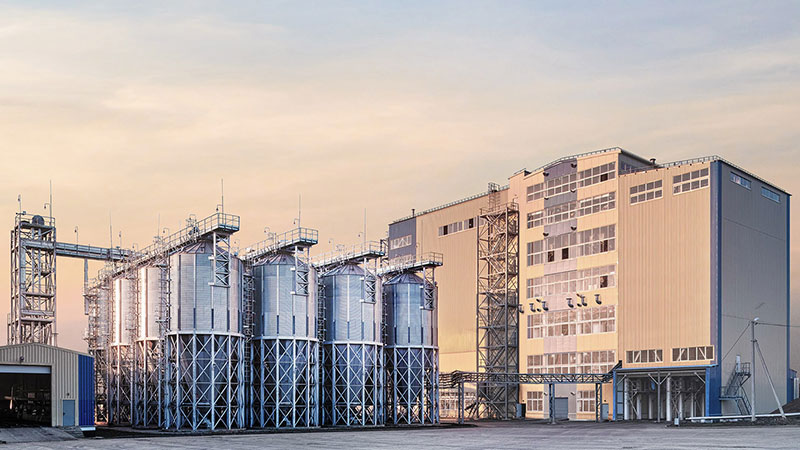
At RICHI, we go beyond project completion. With RICHI Servicee, we’re your dedicated partners in success. Count on us for expert guidance, minimal downtime, and optimized productivity. Choose RICHI for unmatched service and support.
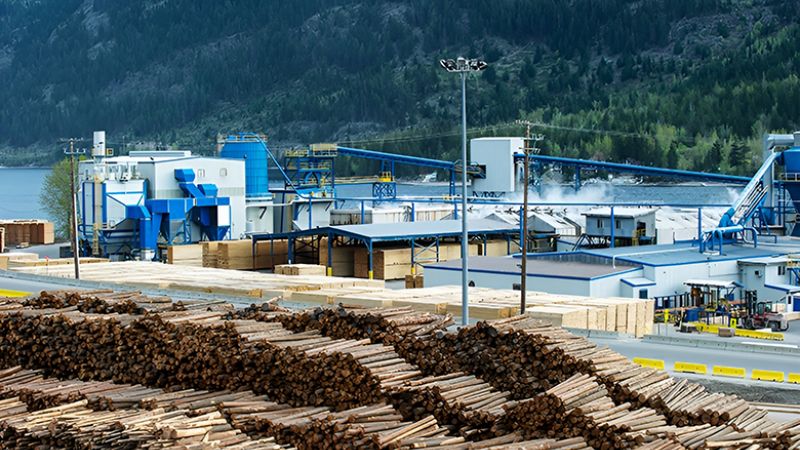


Meet global product demands and quality standards with industry-leading pellet plant design, engineering, equipment, and construction services for pellet processors.

Your Partner Beyond Project Completion
2000+ cases
RICHI is the leading designer, manufacturer and builder of pellet plants in the world, completing over 2000 projects in 140 countries across 6 continents.
Read More
Increase plant productivity, profitability, and safety by integrating high quality equipment into your pellet production line. Over the years, RICHI has become China's top pellet equipment manufacturer. At the same time, RICHI has established valuable partnerships with the world's leading component and raw material manufacturers to bring you the best there is in technology, automation, and efficiency in pelleting plant machinery.

For nearly 30 years, RICHI has been providing best-in-class pellet plant equipment and services to clients across a variety of industries, sizes, and needs. We pride ourselves on the knowledge and skill that each team member possesses – from our technical sales team to our process design engineers. You can count on RICHI Machinery to take your operation to the next level of innovation, quality, and success.
Need help with your pellet manufacturing plant project? Contact us today.
ANIMAL FEED
BIOMASS
WOOD
ORGANIC FERTILIZER
AQUA FEED
CAT LITTER
MUNICIPAL WASTE RECYCLING
SPECIAL PELLET PRODUCTION
RICHI Machinery continues to deliver world class pellet mill equipment, pellet plant engineering and project solutions that add value to our customers in the animal feed, wood waste, agriculture waste, organic fertilizer, cat litter and special pellet products industries. Throughout the years, we RICHI Machinery have built strong brand, becoming industry-leading pellet machine manufacturer. We value integrity, promise quality, and prioritize your success.
Learn MoreWith our expert team, we precisely implement your process engineering requirements in pellet mill and pelletizing plant systems. No matter which industry you’re in – we understand your needs and deliver solutions that meet the highest standards.
At RICHI, quality comes first. Our pellet making machine and related pellet line equipment undergo rigorous quality controls to ensure they meet the highest standards. Rely on products that are durable, safe, and efficient.
With decades of experience in pellet machine and pellet production line production, we have earned a reputation as a trusted partner in various industries. Our expertise allows us to cover a wide range of applications.
Not only do we offer premium pelleting equipment, but we are also experts at designing, building, installing, and maintaining facilities from the ground up. Our expertise is within pellt plant process design, discovering the most efficient, productive, and profitable way to handle your materials in an end-to-end cycle.
○ RICHI MACHINERY
Keeping in touch with us is an effective way to solve all your problems. If you have any needs or questions, please leave your contact information, then RICHI technical consultants will send design, quotation, videos to your mailbox. You can also contact us directly via WhatsApp: +86 13838389622
Copyright©2015-2026 by HENAN RICHI MACHINERY CO., LTD. All rights reserved.