
A feed-processing project in Tay Ninh Province selected one RICHI SZLH320 cassava peel poultry feed pellet machine in Vietnam to produce compound broiler feed containing processed cassava peel meal. The customer had access to cassava-processing by-products and wanted to use a controlled portion of this material as a locally available energy ingredient rather than treating fresh peel as a finished feed material.
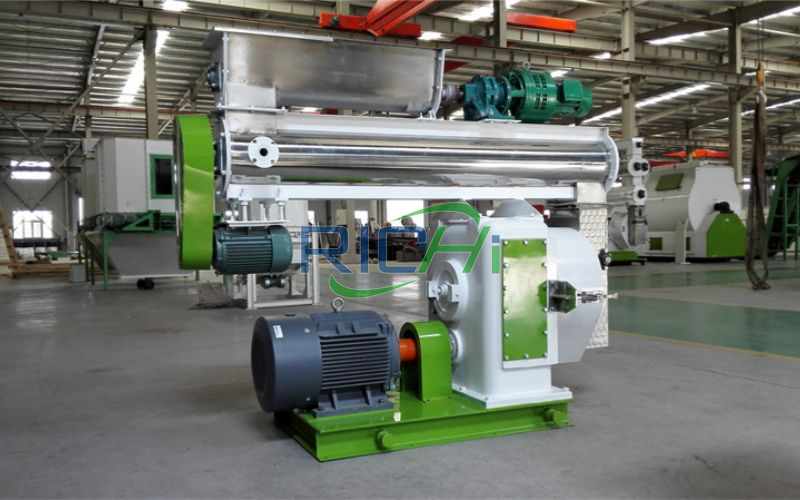
A feed-processing project in Tay Ninh Province selected one RICHI SZLH320 cassava peel poultry feed pellet machine in Vietnam to produce compound broiler feed containing processed cassava peel meal. The customer had access to cassava-processing by-products and wanted to use a controlled portion of this material as a locally available energy ingredient rather than treating fresh peel as a finished feed material.
The project therefore separates cassava treatment from feed pelleting. Fresh peel is first processed to reduce cyanogenic compounds, moisture and microbial risk. Only after drying, grinding and quality verification does the resulting cassava peel meal enter the feed mill, where it is combined with protein, cereal, oil, mineral and vitamin ingredients before conditioning and pelletizing through the SZLH320.
Name:
Poultry Feed Pelletizer
Country:
Vietnam
Date:
2026
Capacity:
3–4 T/H
Model:
SZLH320
Main Motor Power:
37 kW
Raw Materials:
cassava peel meal
Pellet diameter:
3 mm, 4.5 mm or 6 mm
Cassava peel can have value as an animal-feed ingredient, but it is not nutritionally equivalent to maize or soybean meal and should not be fed simply because it is an abundant starch-industry by-product.
Fresh cassava tissue contains cyanogenic glycosides that can release hydrogen cyanide. Cassava peel also tends to be more fibrous and lower in protein than conventional cereal and protein ingredients.
These characteristics create three different engineering requirements.
First, the peel has to undergo a validated treatment process before it becomes a feed ingredient.
Second, the treated material needs laboratory verification rather than relying on one fixed HCN value taken from another project or research paper.
Third, a poultry nutritionist must determine how much processed cassava peel meal can be included in the final formula while still meeting energy, protein, amino-acid, fibre, mineral and vitamin requirements.
The feed pellet mill comes after these decisions.
It densifies the formulated feed into a controlled physical form, but it is not the primary detoxification device and cannot compensate for an unsafe or poorly balanced cassava ingredient.
| Project Parameter | Configuration |
|---|---|
| Equipment | Cassava peel poultry feed pellet machine |
| Model | SZLH320 |
| Main Motor | 37 kW |
| Feeder Motor | 1.5 kW |
| Conditioner Motor | 4 kW |
| Reference Capacity | Approximately 3–4 T/H |
| Main Product | Compound broiler feed |
| Cassava Material | Processed, dried and tested cassava peel meal |
| Typical Feed Form | Starter crumble and grower/finisher pellets |
| Typical Pellet Diameter | Selected according to broiler stage and customer specification |
| Project Location | Tay Ninh Province, Vietnam |
The SZLH320 provides a reference capacity of approximately 3–4 T/H for suitable compound-feed formulations.
This capacity refers to finished feed passing through the feed pellet machine.
It does not refer to tonnes of fresh cassava peel received at the starch-processing site.
This distinction is essential because fresh cassava peel contains substantial water.
For example, 100 tonnes of fresh peel at 72% moisture contains only 28 tonnes of dry solids.
If those solids are dried to a final ingredient moisture of about 12%, the resulting dry cassava peel meal would be approximately 32 tonnes before other processing losses.
A 500 T/day fresh-peel stream at similar moisture would therefore generate a dry-material quantity far above what one SZLH320 can pellet in a conventional operating day.
For this project, the SZLH320 handles only the proportion of treated cassava ingredient allocated to the poultry-feed section.
The most important technical correction in a cassava poultry-feed project is to keep cyanide reduction upstream of final pelletizing.
Research and feed-industry guidance describe several possible processing routes for reducing cyanogenic compounds in cassava products, including chopping or grating, soaking, drying, boiling, ensiling and fermentation.
No single fixed sequence such as “24-hour soaking plus 100°C steaming for 30 minutes” should be treated as universally sufficient for every cassava peel source.
Residual cyanide depends on cassava variety, peel composition, initial concentration, particle size, treatment conditions and drying method.
A commercial feed project therefore needs a defined upstream process supported by testing.
For a larger industrial operation, fermentation can also be evaluated because it can reduce cyanogenic compounds while potentially changing fibre and nutritional characteristics.
The customer can select the treatment route according to raw-material volume, available water and thermal energy, wastewater handling, fermentation capability and final feed specification.
The practical process logic is:
The SZLH320 therefore processes formulated mash, not wet untreated cassava peel.
The poultry-feed formula is designed around nutrient requirements rather than the desire to consume the maximum possible amount of cassava waste.
Processed cassava peel can contribute energy, but it also brings fibre and relatively low protein.
As its inclusion increases, the nutritionist has less formulation space for ingredients needed to supply amino acids, protein and other nutrients.
This is particularly important in broilers because high dietary fibre or an imbalanced amino-acid supply can limit performance.
RICHI therefore does not build the project around a permanent 60–70% cassava peel formula.
The treated peel meal is combined with other ingredients such as maize or broken rice where required, soybean meal or other suitable protein sources, rice by-products, vegetable oil, minerals, vitamins and amino-acid supplementation according to the final feed specification.
Actual inclusion is established by a qualified feed formulator using laboratory data from the processed cassava peel.
If fermentation substantially changes crude protein, fibre or residual cyanide, that updated analysis needs to enter the formulation system.
The pellet machine is then configured to handle the resulting formula family.
The customer mainly targets commercial broiler production.
For very young birds, finished full-size pellets are not necessarily the best feed form.
A common feed-mill approach is to produce a parent pellet and then pass it through a crumbler to make starter crumble.
Grower and finisher feed can use larger intact pellets selected according to bird age and customer specification.
This is more realistic than prescribing a universal 4.5 mm die for all broiler feed.
Pellet diameter also should not be treated as the main solution to cassava-related feed limitations.
Nutrition, residual cyanide, fibre, feed moisture and formula balance remain more important than choosing between a 3 mm, 4.5 mm or 6 mm hole.
Where the customer produces several broiler SKUs, RICHI can evaluate the necessary ring dies and downstream crumbling arrangement as part of the complete process.
The SZLH320 includes a 4 kW conditioner that prepares mixed feed before it enters the ring die.
Steam conditioning changes mash moisture and temperature and can improve pellet formation for starch-containing compound feeds.
However, the conditioner should not be described as the machine that removes cassava cyanide.
Its residence time is relatively short compared with the upstream treatment methods used for cassava detoxification.
The processed cassava peel therefore needs to meet the customer’s ingredient safety specification before it reaches the conditioner.
During feed-mill commissioning, steam addition and conditioning temperature are adjusted around formula composition, incoming moisture, throughput and required pellet quality.
There is no universal requirement that the conditioner must operate at exactly 80°C or that mash moisture must always rise to 17–18%.
The operator monitors motor load, pellet formation, fines and finished-product condition while adjusting the production settings.
This keeps two different control points clearly separated: cassava safety is established upstream, while conditioning is optimized for feed manufacture.
A cassava peel poultry-feed project can easily become more constrained by water removal than by pelletizing capacity.
Fresh peel may contain around 70% or more moisture, which means a large proportion of every incoming tonne is water.
That water has to be removed before the ingredient can be stored, ground and incorporated into a stable feed.
Dryer sizing therefore needs to be based on water evaporation rather than only tonnes of wet material per hour.
For example, 10 tonnes of peel at 72% moisture contains approximately 2.8 tonnes of dry solids.
Bringing those solids to 12% final moisture produces roughly 3.2 tonnes of dried material and requires removal of about 6.8 tonnes of water.
This calculation shows why thermal-energy supply, dryer type and wastewater or condensate handling can dominate the economics of processing large cassava by-product streams.
A feed mill should therefore not buy an SZLH320 first and assume the dryer can later be sized around the same 3–4 T/H number.
Wet-feed capacity, evaporation load, dried-ingredient output and finished-feed output are four different quantities.
The customer treats processed cassava peel as a controlled feed ingredient.
Each production lot can vary because cassava variety, peeling method and upstream starch-process conditions are not always identical.
Quality control therefore needs to cover the processed ingredient as well as the finished compound feed.
Residual cyanide is one important parameter, but it is not the only one.
The customer may also evaluate moisture, crude protein, fibre, ash, contamination and other relevant feed-analysis indicators.
Where wet treatment or sun drying is used, microbial and mycotoxin risks also need attention.
After pelletizing, the feed mill checks physical pellet quality, fines, moisture and product consistency.
A specific PDI such as 90%, 92% or 95% should not be guaranteed from machine selection alone because durability depends on formula, grinding, conditioning, die configuration, cooling and handling.
Likewise, the pellet mill cannot guarantee one feed conversion ratio or bird growth result.
Those outcomes depend on nutritional formulation, cassava inclusion, farm management, genetics, bird health and many other factors.
This cassava peel poultry feed pellet machine in Vietnam project uses one RICHI SZLH320 ring die pellet mill to produce compound poultry feed containing processed cassava peel meal in Tay Ninh Province.
The machine uses a 37 kW main motor, 1.5 kW feeder and 4 kW conditioner and provides a reference production capacity of approximately 3–4 T/H for suitable feed formulations.
The machine does not receive fresh cassava peel directly.
Fresh by-product first passes through contamination control and a validated cyanide-reduction process such as drying, soaking, fermentation or an engineered combination of treatments.
The processed material is then dried, tested and ground before it enters the batching system as one ingredient in a balanced broiler ration.
This project structure is critical because cassava peel is not simply a low-cost replacement for maize.
Its fibre, low protein and cyanogenic compounds place practical limits on inclusion, and the actual formula must be calculated from laboratory analysis.
The SZLH320 then performs the physical feed-manufacturing stage: controlled feeding, conditioning and ring die pelletization.
The finished pellets proceed to cooling, crumbling where starter feed is required, screening and final storage or packaging.
For another buyer searching for a cassava peel poultry feed pellet machine in Vietnam, cassava waste feed pellet machine, cassava peel feed pelletizer, SZLH320 poultry feed machine, cassava by-product feed line or 3–4 T/H poultry feed pellet mill, RICHI first evaluates the cassava-processing side and feed-mill side separately.
Useful project information includes tonnes of fresh peel per day, actual incoming moisture, current peel-treatment method, tested residual cyanide after treatment, dry cassava peel meal output, laboratory nutrient analysis, proposed inclusion rate, broiler production stage, other feed ingredients, target feed tonnes per hour and existing drying, grinding, mixing and cooling equipment.
This information also prevents a common capacity mistake.
A starch factory generating hundreds of tonnes of wet cassava peel per day will normally require a much larger residue-treatment and drying system than one SZLH320 feed pellet mill can consume.
The customer may therefore process only a defined portion into poultry feed while directing other cassava by-products to separate approved uses.
If the required compound-feed output is significantly above 3–4 T/H, RICHI Machinery can evaluate a larger pellet-mill configuration instead of forcing the SZLH320 beyond its reference capacity.
For a Tay Ninh cassava-to-feed project, send RICHI your fresh-peel tonnage, moisture, detoxification method, dried-material analysis, proposed feed formula, required T/H, pellet or crumble specification and existing process equipment. These parameters allow the cassava treatment system and poultry-feed pelleting section to be sized as two connected but technically distinct parts of the project.
Having the right mix of reliable, high-quality pellet machine and pelletizing systems and expert support is essential to your success. Watch how our end-to-end feed pellet plant solutions have helped our customers optimize their performance.
Our customized and future-proofed turnkey pellet plant solutions is designed with you at the core. From vision to reality and beyond, our team stays connected with yours. Giving you peace-of-mind with an expert at your side.
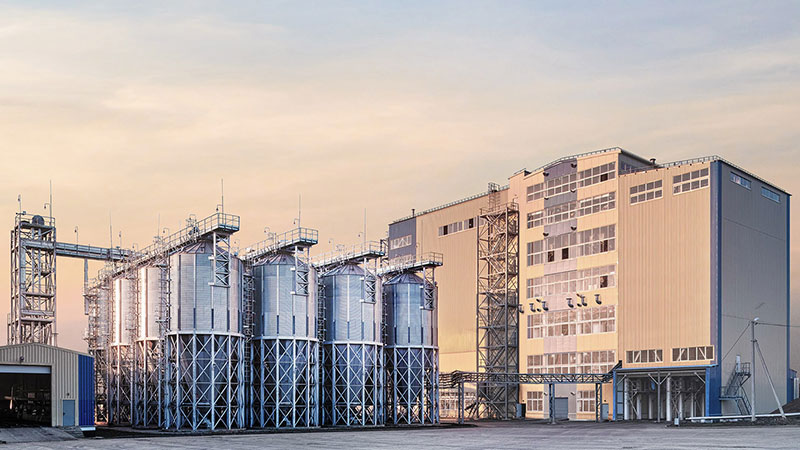
At RICHI, we go beyond project completion. With RICHI Servicee, we’re your dedicated partners in success. Count on us for expert guidance, minimal downtime, and optimized productivity. Choose RICHI for unmatched service and support.
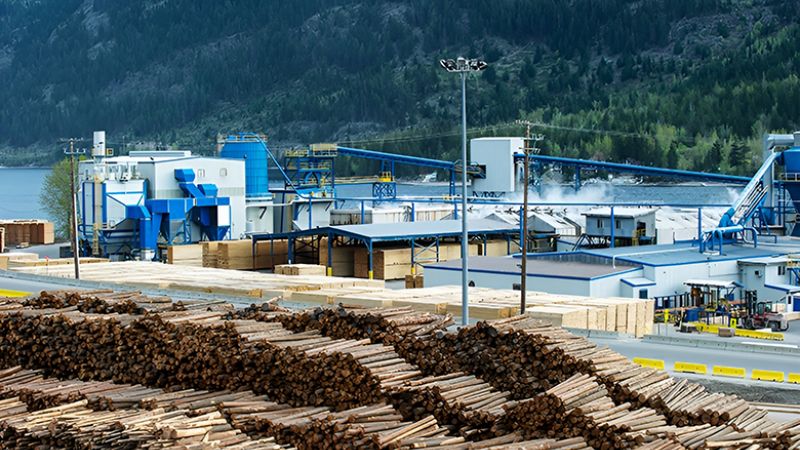


Meet global product demands and quality standards with industry-leading pellet plant design, engineering, equipment, and construction services for pellet processors.

Your Partner Beyond Project Completion
2000+ cases
RICHI is the leading designer, manufacturer and builder of pellet plants in the world, completing over 2000 projects in 140 countries across 6 continents.
Read More
Increase plant productivity, profitability, and safety by integrating high quality equipment into your pellet production line. Over the years, RICHI has become China's top pellet equipment manufacturer. At the same time, RICHI has established valuable partnerships with the world's leading component and raw material manufacturers to bring you the best there is in technology, automation, and efficiency in pelleting plant machinery.

For nearly 30 years, RICHI has been providing best-in-class pellet plant equipment and services to clients across a variety of industries, sizes, and needs. We pride ourselves on the knowledge and skill that each team member possesses – from our technical sales team to our process design engineers. You can count on RICHI Machinery to take your operation to the next level of innovation, quality, and success.
Need help with your pellet manufacturing plant project? Contact us today.
ANIMAL FEED
BIOMASS
WOOD
ORGANIC FERTILIZER
AQUA FEED
CAT LITTER
MUNICIPAL WASTE RECYCLING
SPECIAL PELLET PRODUCTION
RICHI Machinery continues to deliver world class pellet mill equipment, pellet plant engineering and project solutions that add value to our customers in the animal feed, wood waste, agriculture waste, organic fertilizer, cat litter and special pellet products industries. Throughout the years, we RICHI Machinery have built strong brand, becoming industry-leading pellet machine manufacturer. We value integrity, promise quality, and prioritize your success.
Learn MoreWith our expert team, we precisely implement your process engineering requirements in pellet mill and pelletizing plant systems. No matter which industry you’re in – we understand your needs and deliver solutions that meet the highest standards.
At RICHI, quality comes first. Our pellet making machine and related pellet line equipment undergo rigorous quality controls to ensure they meet the highest standards. Rely on products that are durable, safe, and efficient.
With decades of experience in pellet machine and pellet production line production, we have earned a reputation as a trusted partner in various industries. Our expertise allows us to cover a wide range of applications.
Not only do we offer premium pelleting equipment, but we are also experts at designing, building, installing, and maintaining facilities from the ground up. Our expertise is within pellt plant process design, discovering the most efficient, productive, and profitable way to handle your materials in an end-to-end cycle.
○ RICHI MACHINERY
Keeping in touch with us is an effective way to solve all your problems. If you have any needs or questions, please leave your contact information, then RICHI technical consultants will send design, quotation, videos to your mailbox. You can also contact us directly via WhatsApp: +86 13838389622
Copyright©2015-2026 by HENAN RICHI MACHINERY CO., LTD. All rights reserved.