
A commercial pig producer in Paraná, Brazil, purchased one RICHI SZLH350 cassava feeds pellet machine to upgrade an existing on-farm feed mill. The farm already had ingredient storage, a hammer mill and a batch mixer, but part of its grower-finisher feed was still supplied as mash. As the company increased its use of locally produced cassava meal, dust, segregation and inconsistent physical handling became more noticeable.
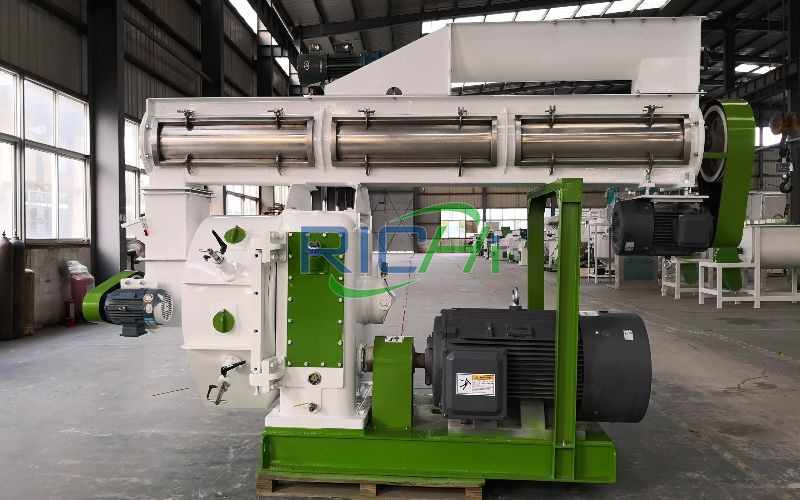
A commercial pig producer in Paraná, Brazil, purchased one RICHI SZLH350 cassava feeds pellet machine to upgrade an existing on-farm feed mill. The farm already had ingredient storage, a hammer mill and a batch mixer, but part of its grower-finisher feed was still supplied as mash. As the company increased its use of locally produced cassava meal, dust, segregation and inconsistent physical handling became more noticeable.
The customer therefore added one feed pellet mill rather than replacing the whole feed plant. Its purpose was clear: convert a nutritionally balanced cassava-based pig-feed mash into durable grower and finisher pellets. Cassava provides part of the dietary energy, while soybean meal and other ingredients compensate for the root’s naturally low protein and amino-acid content.
Name:
Cassava Feeds Pellet Mill
Country:
Brazil
Date:
2026
Capacity:
5–6 T/H
Model:
SZLH350
Main Motor Power:
55 kW
Application:
grower and finisher pig feed
Pellet diameter:
4–5 mm
Paraná combines a substantial cassava industry with large-scale commercial pig production. IBGE data show that the state produced about 3.7 million tonnes of cassava roots in 2024, making it one of Brazil’s leading cassava-producing states. Paraná is also one of Brazil’s most important pig-producing regions.
The customer operates its own cassava acreage and also has access to additional roots and processed cassava products from regional growers and processors. This gives the farm a broader supply base than relying only on its own 500 hectares throughout the year.
The farm’s approximately 500 hectares of cassava can provide a substantial quantity of fresh roots, with actual annual yield depending on cultivar, field conditions and crop performance.
Fresh roots, however, contain a large proportion of water. Once roots are chipped and dried into stable cassava meal, the available dry feed mass is far below the original fresh-root tonnage.
A farm feeding tens of thousands of market pigs therefore cannot calculate cassava availability simply as hectares multiplied by fresh root yield.
The customer uses company-grown roots as the base supply and supplements them with contracted cassava when required.
| Project Parameter | Specification |
|---|---|
| Equipment | Cassava feeds pellet machine |
| Model | SZLH350 |
| Quantity | 1 unit |
| Main Motor | 55 kW |
| Feeder | 1.5 kW |
| Conditioner | 4 kW |
| Ring Die Diameter | 350 mm |
| Reference Capacity | Approximately 5–6 T/H |
| Project Pellet Diameter | Approximately 4–5 mm |
| Main Application | Cassava-based grower and finisher pig feed |
The SZLH350 is configured for the customer’s cassava-based grower and finisher feed and integrated with the farm’s existing grinding, mixing and downstream handling equipment.
A 5–6 T/H pellet mill operating eight hours per day for 22 production days has a theoretical gross output of approximately 880–1,056 tonnes per month before downtime, changeovers and maintenance.
Actual monthly production must therefore remain below the corresponding theoretical gross output once normal production losses and maintenance time are included.
The customer plans pellet production according to actual SZLH350 throughput, operating hours and uptime. If future pellet demand approaches 2,000 tonnes per month, the farm would need longer operating hours, a second shift or additional pelleting capacity.
The farm markets roughly 50,000 pigs annually, but feed demand changes substantially from nursery through grower and finishing stages.
This machine is dedicated primarily to grower-finisher pellet production rather than implying one 50–60% cassava formula is supplied to every pig from weaning to market.
Nutritionists adjust cassava inclusion according to pig weight, ingredient analysis, amino-acid balance, energy requirement and economic formulation.
Dried cassava root meal is rich in starch but contains relatively little protein. FAO feed references describe cassava root meal as a useful substitute for maize in pig diets when it has been properly processed and the ration is balanced with suitable protein and other nutrients.
That makes cassava a practical energy ingredient, but not a complete replacement for everything supplied by a conventional cereal-based formula.
The customer combines cassava meal with soybean meal and the required mineral, vitamin and amino-acid supplementation.
FAO references report that relatively high levels of dried cassava root can be used successfully in growing-finishing pig diets when other nutrients are properly balanced.
For this reason, RICHI does not recommend a fixed 50–60% cassava inclusion merely because the pellet mill can physically process it. Feed formulation remains the responsibility of the farm’s nutrition team.
Cassava and corn costs change with crop year, region, starch demand, transport distance, root moisture and whether the comparison is based on fresh roots or dried feed material.
A fair economic comparison must use cost per unit of usable dry matter and dietary energy rather than comparing one tonne of wet cassava roots with one tonne of dry corn grain.
Fresh roots contain too much water for conventional dry compound-feed pelleting.
The farm first processes the roots into a stable feed ingredient.
Cassava contains cyanogenic compounds that can release hydrogen cyanide. Their concentration varies significantly with cultivar and plant part.
FAO references identify chopping, grating, drying, soaking, fermentation, boiling and combinations of these processes as methods used to reduce cyanide before cassava is fed to pigs. They also cite approximately 100 mg/kg HCN in cassava feed material as an important reference ceiling in the literature.
The farm therefore controls cassava safety during raw-material preparation and verification rather than expecting the pellet conditioner to detoxify inadequately processed roots.
Cassava contains both free cyanide and cyanogenic glycosides, and processing effectiveness depends on particle disruption, cultivar, drying method and residence time. FAO literature specifically notes that different drying methods remove cyanogenic compounds differently.
Steam conditioning is therefore used to prepare the mixed feed for pelleting, not as a substitute for cassava detoxification.
Cassava leaves can contain meaningful crude protein, but they also contain fibre and cyanogenic compounds. Some cassava varieties may have particularly high cyanogenic-glycoside concentrations in the leaves.
The farm may evaluate properly processed cassava leaf meal as a limited feed ingredient, but this project does not automatically include 5–10% foliage in every pig ration.
Soybean meal remains the principal protein-balancing ingredient in the core formulation.
Pelleting can improve physical feed form, reduce segregation and transform a dusty mash into easier-to-handle pellets.
It does not correct deficient amino acids, excessive fibre, residual cyanide or an inappropriate energy-to-protein ratio.
The customer therefore treats nutrition formulation and physical pelleting as separate engineering tasks.
Cassava’s high starch content can contribute to pellet binding when moisture and thermal conditions are properly controlled.
However, the exact degree of starch gelatinization cannot be assumed to be 70–80% simply from conditioner temperature.
Particle size, steam quality, residence time, formulation and mechanical work inside the die all affect the final result.
The customer begins with a practical process window and adjusts steam addition according to pellet quality, motor load and mash condition.
There is no universal rule that pig feed must always be conditioned at 70–75°C or that a higher temperature automatically damages the product.
The appropriate setting depends on formula and feed-safety objectives.
The farm uses approximately 4–5 mm pellets for its main grower-finisher production.
The exact choice depends on pig stage and customer feeding practice.
Pellet diameter is selected according to the feeding stage and physical feed requirements rather than treating one diameter as universally correct for every grower or finisher pig.
RICHI selects the effective die specification from cassava inclusion, fibre level, formulation, required durability and machine load.
A die that performs well on one cassava-soy formulation may not be optimal for another.
The SZLH350’s actual throughput depends on the cassava percentage, meal fineness, moisture, fat addition, protein ingredients, die specification and required pellet quality.
The machine should therefore not be advertised as delivering exactly 5.5 T/H for every cassava-based formula.
Cassava roots contain substantial water, so converting farm-grown roots into stable dry meal requires significant moisture removal.
FAO processing references note that reducing cassava below approximately 14% moisture creates a more stable dried product and that drying is also important in reducing cyanide.
The economics of cassava feed therefore include harvesting, cleaning, size reduction and drying. Fresh-root production cost alone cannot be compared directly with delivered dry corn.
Sun drying can reduce cyanide effectively under suitable conditions, but weather and microbial contamination must be controlled. Mechanical drying provides better throughput control but still has to be designed with cassava detoxification and product quality in mind.
The Brazilian customer uses controlled drying capacity to support commercial-scale year-round feed manufacturing.
Dried cassava chips are reduced in the existing grinding system, and ingredients are blended in the farm’s established mixer.
Only the pelleting stage was missing.
This is why purchasing one SZLH350 made more sense than ordering a complete feed production line.
Fresh feed pellets leave the die warm and contain moisture introduced during conditioning.
They therefore pass through the customer’s downstream cooling section before storage.
Target finished moisture is confirmed from storage stability and feed specification rather than declaring 12–13% as an automatic result from the pellet mill.
The farm assesses fines and pellet durability during trials and adjusts the die, conditioning and formulation when physical quality is insufficient.
Specific PDI values are confirmed from actual testing rather than assumed from machine operation alone.
Feed conversion ratio and daily gain cannot be attributed directly to the SZLH350 without a controlled feeding comparison.
Animal performance depends on nutrient density, genetics, health, environment, feed intake and management as well as feed form.
The machine therefore contributes to physical processing while biological performance is evaluated through the complete ration and production system.
Brazilian studies on cassava starch-industry residue in growing and finishing pigs have shown that animal response can change with inclusion level and growth stage. One study found performance effects in growing pigs while finishing pigs tolerated higher inclusion of the tested cassava residue.
That reinforces the project’s central rule: cassava is not one standardized ingredient that can be inserted at the same percentage into every pig formula.
Return on investment depends on cassava yield, processing energy, drying cost, soybean meal requirement, labour, machine utilization and the real price difference between nutritionally equivalent formulas.
The customer therefore evaluates the economics of cassava production, ingredient substitution and pelletizing as connected but separate cost components.
The SZLH350 was prepared for export from Qingdao and shipped to the Port of Paranaguá before inland delivery to the customer’s facility in Paraná.
Paranaguá provides a maritime gateway for machinery delivered to customers within the state. Actual ocean transit, customs clearance and landed cost depend on the carrier schedule, shipping arrangement and import process.
A cassava pig feed pellet machine is suitable for processing nutritionally balanced mash containing properly prepared cassava meal. It should not be used as a shortcut for processing wet or inadequately detoxified fresh roots.
A cassava feed pellet mill in Brazil is particularly relevant in cassava-producing states where feed manufacturers can secure a reliable supply of dried root products and formulate them economically against maize and other energy ingredients.
For a pig feed pellet machine in Brazil, buyers should calculate capacity from actual hourly feed demand rather than annual herd numbers alone. Existing grinding, mixing, cooling and storage equipment should also be included in the capacity check.
A cassava meal pellet machine processes dry prepared feed ingredients, not freshly harvested cassava. Proper drying, HCN control and nutritional balancing occur before pelleting.
A swine feed pellet machine can reduce mash dust and ingredient segregation while producing a controlled physical feed form. Feed-conversion improvement, however, must be demonstrated by the complete ration and animal results rather than assumed from pelletizing alone.
This Cassava Feeds Pellet Machine in Brazil project uses one RICHI SZLH350 as a standalone pelleting upgrade at a commercial pig operation in Paraná. The farm grows part of its cassava requirement and supplements this supply from regional sources when necessary.
Fresh cassava is first converted into a suitable dry feed ingredient through cleaning, size reduction, detoxification and drying. Cassava meal is then combined with soybean meal and the required nutritional supplements before mixing, conditioning and pelleting. The SZLH350 uses a 55 kW main motor, 1.5 kW feeder and 4 kW conditioner, with a reference output of approximately 5–6 T/H.
For buyers comparing a Cassava Feeds Pellet Machine in Brazil, cassava pig feed pellet machine, cassava feed pellet mill, cassava meal pellet machine, pig feed pellet machine Brazil, swine feed pellet machine, cassava-based animal feed pellet machine or 5–6 T/H pig feed pellet mill, RICHI Machinery would first review cassava form, dry-matter availability, HCN control method, formula inclusion rate, required pellet diameter, hourly feed demand, existing grinding and mixing equipment, steam supply and downstream cooling capacity.
The economic value of the project comes from combining locally competitive cassava with a correctly balanced swine ration. The pellet mill gives that ration a controlled physical form; it does not turn untreated cassava into safe, complete pig feed by itself.
Having the right mix of reliable, high-quality pellet machine and pelletizing systems and expert support is essential to your success. Watch how our end-to-end feed pellet plant solutions have helped our customers optimize their performance.
Our customized and future-proofed turnkey pellet plant solutions is designed with you at the core. From vision to reality and beyond, our team stays connected with yours. Giving you peace-of-mind with an expert at your side.
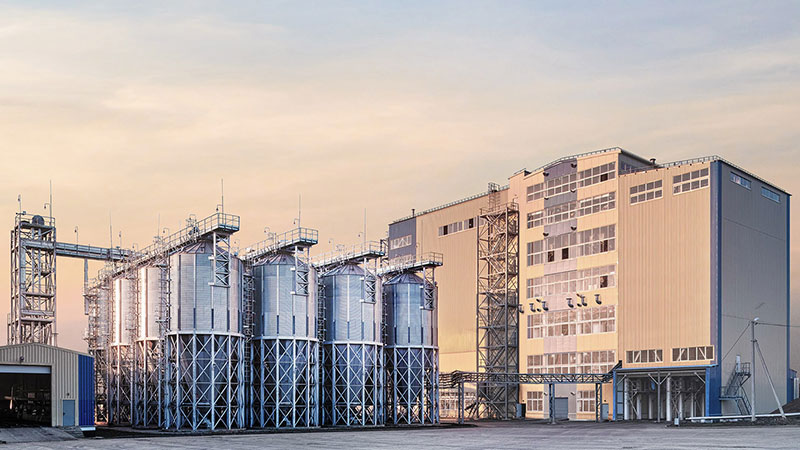
At RICHI, we go beyond project completion. With RICHI Servicee, we’re your dedicated partners in success. Count on us for expert guidance, minimal downtime, and optimized productivity. Choose RICHI for unmatched service and support.
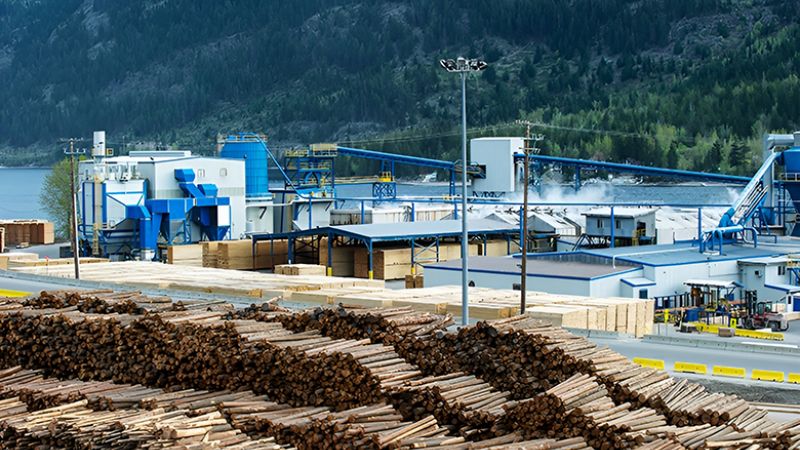


Meet global product demands and quality standards with industry-leading pellet plant design, engineering, equipment, and construction services for pellet processors.


Your Partner Beyond Project Completion
2000+ cases
RICHI is the leading designer, manufacturer and builder of pellet plants in the world, completing over 2000 projects in 140 countries across 6 continents.
Read More
Increase plant productivity, profitability, and safety by integrating high quality equipment into your pellet production line. Over the years, RICHI has become China's top pellet equipment manufacturer. At the same time, RICHI has established valuable partnerships with the world's leading component and raw material manufacturers to bring you the best there is in technology, automation, and efficiency in pelleting plant machinery.

For nearly 30 years, RICHI has been providing best-in-class pellet plant equipment and services to clients across a variety of industries, sizes, and needs. We pride ourselves on the knowledge and skill that each team member possesses – from our technical sales team to our process design engineers. You can count on RICHI Machinery to take your operation to the next level of innovation, quality, and success.
Need help with your pellet manufacturing plant project? Contact us today.
ANIMAL FEED
BIOMASS
WOOD
ORGANIC FERTILIZER
AQUA FEED
CAT LITTER
MUNICIPAL WASTE RECYCLING
SPECIAL PELLET PRODUCTION
RICHI Machinery continues to deliver world class pellet mill equipment, pellet plant engineering and project solutions that add value to our customers in the animal feed, wood waste, agriculture waste, organic fertilizer, cat litter and special pellet products industries. Throughout the years, we RICHI Machinery have built strong brand, becoming industry-leading pellet machine manufacturer. We value integrity, promise quality, and prioritize your success.
Learn MoreWith our expert team, we precisely implement your process engineering requirements in pellet mill and pelletizing plant systems. No matter which industry you’re in – we understand your needs and deliver solutions that meet the highest standards.
At RICHI, quality comes first. Our pellet making machine and related pellet line equipment undergo rigorous quality controls to ensure they meet the highest standards. Rely on products that are durable, safe, and efficient.
With decades of experience in pellet machine and pellet production line production, we have earned a reputation as a trusted partner in various industries. Our expertise allows us to cover a wide range of applications.
Not only do we offer premium pelleting equipment, but we are also experts at designing, building, installing, and maintaining facilities from the ground up. Our expertise is within pellt plant process design, discovering the most efficient, productive, and profitable way to handle your materials in an end-to-end cycle.
○ RICHI MACHINERY
Keeping in touch with us is an effective way to solve all your problems. If you have any needs or questions, please leave your contact information, then RICHI technical consultants will send design, quotation, videos to your mailbox. You can also contact us directly via WhatsApp: +86 13838389622
Copyright©2015-2026 by HENAN RICHI MACHINERY CO., LTD. All rights reserved.