
The Spanish buyer did not begin by asking for the highest-capacity pellet mill. The first question was whether a plant-based litter made from locally available agricultural residues could meet the things pet owners would actually notice: absorption, clump strength, dust, tracking, odor, granule feel, and stability inside a retail bag. Only after those targets were defined did the biodegradable cat litter pellet machine in Spain become an equipment decision.
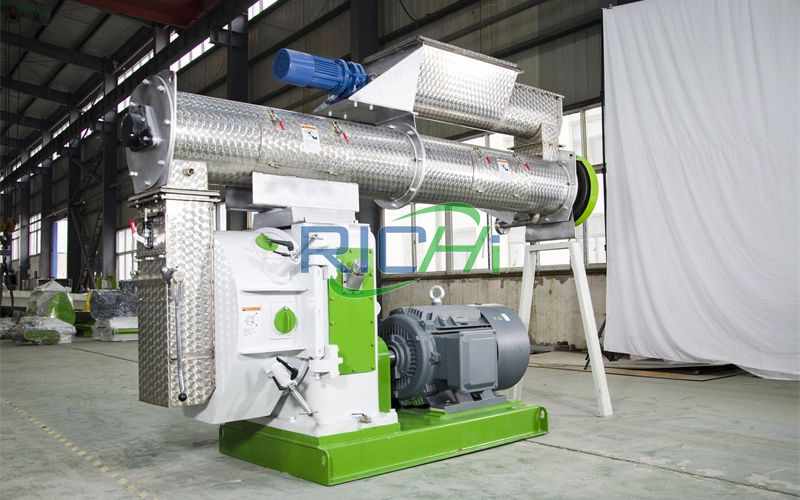
The Spanish buyer did not begin by asking for the highest-capacity pellet mill. The first question was whether a plant-based litter made from locally available agricultural residues could meet the things pet owners would actually notice: absorption, clump strength, dust, tracking, odor, granule feel, and stability inside a retail bag. Only after those targets were defined did the biodegradable cat litter pellet machine in Spain become an equipment decision.
The customer is an agricultural by-product processor in Andalusia that already handles cereal straw and residues from the olive-processing sector. Rather than attempting to turn wet olive pomace directly into cat litter, the company developed a dry plant-fiber formulation using cleaned straw fiber together with a controlled proportion of dried, low-oil olive-derived material and starch-based binders. Two MSZLH250 units were selected for the first commercial stage, providing modular production without committing the business to the 10–12 T/H capacity that two larger MSZLH350 machines would have created.
Name:
biodegradable cat litter machine
Country:
Spain
Date:
2025
Capacity:
2.0–3.0 T/H
Model:
2*MSZLH250
Main Motor Power:
22 kW
Raw Materials:
Olive pomace, Wheat straw
Pellet diameter:
2.5–3.5 mm
Spain is a credible market for this type of project, and Andalusia provides a strong fit for an olive-pomace-based litter business.
Spain’s olive sector is concentrated much more heavily in the south. The Spanish Ministry of Agriculture reports that Andalusia accounts for around 80% of national olive-oil production, with Jaén, Córdoba, Sevilla, and Granada among the principal production areas.
The customer operates in Andalusia, where it can obtain olive-processing residues without creating an unnecessarily long raw-material supply chain.
The company also has access to cereal straw through regional agricultural suppliers, giving it more than one plant-fiber source instead of depending entirely on olive residue.
Fresh olive pomace is unsuitable for direct cat-litter granulation.
It contains substantial moisture and residual organic compounds, and depending on the extraction process it can retain enough oil to affect feeding, binding, odor, storage, and absorption behavior.
The customer therefore does not take freshly discharged pomace from an olive mill and send it directly to the pelletizer.
Only a dried and suitably processed olive-derived fraction is considered for the litter formulation. Moisture, residual oil, odor, particle size, and cleanliness are checked before it is blended with the main fibrous material.
This keeps the olive component as a useful regional by-product without allowing it to dominate the formulation simply because Spain produces large quantities of olives.
The principal fiber in the product is finely processed cereal straw.
After cleaning and grinding, straw provides a porous plant structure that can absorb liquid while also giving the granule enough internal fiber to avoid becoming an excessively dense starch pellet.
The olive-derived fraction is used as a secondary ingredient rather than 40–50% of every batch.
A representative development formula may contain a majority of cleaned straw fiber, a smaller percentage of dried olive-derived material, starch-based binder, and limited functional additions for clumping or odor control.
The final percentages are adjusted because formulation changes alter several competing properties at once. More binder can improve dry granule strength but may reduce porosity. More olive material can change odor, density, color, and absorption. More straw can improve lightness but may increase fines if the particle preparation is poor.
Two MSZLH350 machines would have provided a nominal combined capacity of around 10–12 T/H. For a company introducing a new biodegradable litter formula, that would require a very large amount of prepared raw material and an established sales network capable of absorbing tens of tonnes per production day.
The customer therefore selected two smaller MSZLH250 units instead.
| Project Item | Configuration |
|---|---|
| Equipment | Biodegradable cat litter pellet machine |
| Model | MSZLH250 |
| Quantity | 2 units |
| Main Motor Power | 22 kW per unit |
| Feeder Power | 1.1 kW per unit |
| Conditioner Power | 1.5 kW per unit |
| Ring Die Inner Diameter | 250 mm |
| Available Pellet Diameter | 2–12 mm |
| Project Granule Diameter | Approximately 2.5–3.5 mm |
| Reference Capacity | Approximately 1.0–1.5 T/H per unit |
| Combined Reference Capacity | Approximately 2.0–3.0 T/H under suitable formulation conditions |
This capacity is large enough for commercial private-label and distributor orders but still realistic for a company building a new plant-based litter category.
The second machine is not simply an emergency backup sitting idle.
The company uses the modular arrangement to separate stable production from product development. One MSZLH250 can continue running the established formula while the other is used for trials involving different binder levels, granule dimensions, or olive-fiber inclusion.
During periods of lower demand, only one machine needs to operate.
When a larger order is confirmed, both can run in parallel.
This is commercially more useful than operating a single oversized pelletizer at a small fraction of its available capacity.
The customer initially discussed a broad 3–5 mm product range.
Trials showed that the consumer experience changed noticeably with granule diameter.
Larger cylindrical pellets were durable but produced a coarser litter bed. For a product positioned as a clumping plant-based litter, the customer preferred a smaller granule that distributed more evenly in the tray and offered more surface contact with liquid.
The main commercial specification therefore moved toward approximately 2.5–3.5 mm.
This is not presented as a universal standard for biodegradable litter. A non-clumping absorbent product could use larger pellets, while a different binder system might work better at another diameter.
Almost all of the main ingredients in this formulation are plant-derived, but that alone does not create a competitive product.
A biodegradable litter can still fail if it creates excessive dust, produces weak wet clumps, tracks badly through the house, develops odor in storage, or absorbs slowly.
The customer therefore evaluates the finished granules as a pet product rather than simply as an agricultural pellet.
Absorption capacity, wet-clump integrity, dry granule durability, dust generation, bulk density, tracking tendency, odor behavior, and breakdown after wetting are evaluated separately.
A narrow 13–14% moisture level is not suitable as a permanent assumption because the optimum condition changes with the straw fraction, residual oil in the olive-derived material, binder system, and ambient humidity.
The plant therefore measures material condition before granulation and makes controlled adjustments.
If the mixture is too dry, fines increase and binding can become unstable. If it is too wet, granules may leave the die soft and require excessive post-pelleting drying.
Operators use machine load, granule appearance, strength, cooling behavior, and final moisture together to determine whether the formulation is inside a workable processing window.
The MSZLH250 includes a conditioner because this project contains starch-based binding ingredients.
Controlled moisture and thermal treatment can help distribute the binder and improve the consistency of the mixture entering the die.
However, the customer does not simply maximize steam addition.
Excessive heat or moisture can create a sticky feed, raise drying demand, and change the behavior of the olive-derived fraction. Conditioning is therefore kept subordinate to the finished-litter specification.
The purpose is to make the formulation processable, not to achieve the highest possible conditioner temperature.
The project could not use a generic biomass-pellet die and assume that a good litter granule would result.
Cat litter needs enough compression to survive conveying and packaging, but it must still allow rapid liquid penetration when used.
A very high compression ratio can produce an unnecessarily hard granule. Insufficient compression creates breakage and fines.
The final ring-die specification was therefore selected through product trials with the actual straw, olive-derived material, and binder blend.
This is one of the reasons the selected cat litter pellet machines were evaluated as part of a product-development process rather than as ordinary straw pellet equipment.
Straw grinding creates fine dust long before the material reaches the ring die.
The original grain-storage workshop therefore required changes to extraction and material transfer.
The customer enclosed key powder-transfer points and matched the feeding system to the low bulk density of the plant fibers.
This proved more important than adding a simple vibration device and assuming the problem had been solved permanently.
Stable feeding depends on particle size, hopper geometry, bulk density, moisture, feeder speed, and the proportion of fibrous material in the blend.
A machine can produce good granules and the final retail product can still become dusty if it is handled poorly afterward.
Fresh granules are cooled before screening. Loose fines are removed, and clean reusable fines can return to the preparation section when appropriate.
The customer also reduced unnecessary drop heights between conveyors.
This matters because repeated impact can generate new fines after the first screening step.
The low-dust characteristic is therefore the result of raw-material preparation, granulation, cooling, screening, and gentle handling together.
Spain already has many conventional mineral and plant-based pet litter products. The customer therefore did not want to enter the market with another anonymous straw pellet.
The olive-sector connection gives the product a regional story, but the marketing remains technically restrained.
The company describes the litter as plant-based and made partly from valorized agricultural by-products. It does not claim that using olive residue automatically makes the product carbon-neutral or superior to every other litter.
Spain’s scale in olive production supports the raw-material story: Andalusia alone accounts for the great majority of national olive-oil output and contains a large associated processing industry.
At first, the technical team assumed higher-density granules would always be preferable because they appeared stronger.
Retail feedback changed that view.
One of the advantages consumers expect from plant-based litter is easier handling compared with heavy mineral litter. Making the granule excessively dense reduced that advantage.
The customer therefore stopped optimizing only for pellet hardness.
The preferred operating window became the one that provided adequate bag durability without making the finished litter unnecessarily heavy.
The commercialization plan begins with domestic distributors and private-label opportunities.
Export inquiries can be developed later, but the company first needs repeatable product specifications, reliable packaging, and actual reorder data.
This reduces the risk of building production capacity around speculative export demand.
The customer already owned crushing, grinding, drying, mixing, and storage equipment for agricultural materials.
Those assets were retained where they were suitable.
The main modifications involved finer material handling, dust collection, pellet-machine foundations, electrical distribution, conditioner connections, cooling, screening, and hygienic separation of the finished pet product from ordinary agricultural residues.
This is what makes the project a standalone-machine upgrade rather than a turnkey cat-litter factory.
With the production facility in Andalusia, the two MSZLH250 units were exported from Qingdao Port to southern Spain.
The destination port was selected according to the customer’s final inland location and freight schedule.
This reduces unnecessary inland transport between the port and the production facility.
RICHI provided the customer with equipment dimensions, electrical requirements, foundation data, connection points, and spare-part recommendations before shipment so that workshop preparation could proceed in parallel.
“We expected the difficult part to be making a pellet from agricultural fiber. The harder part was deciding what the pellet should do after a cat urinates on it. We changed the granule density and binder system several times because a strong dry pellet does not automatically make a good wet clump.”
This changed the way the customer evaluates production.
Tonnes per hour remain important, but production records now include fines percentage, bulk density, absorption behavior, clump integrity, final moisture, and rejected product.
The company learned that maximizing machine output is not profitable if the faster setting produces a granule that later fails the retail specification.
One of the strongest reasons for buying two units became clear after commercial trials began.
The customer can maintain an approved formula on one machine while experimenting with another formulation on the second.
That reduces the risk of destabilizing established production every time the development team evaluates a different starch, plant fiber, deodorizing component, or granule diameter.
For a new consumer product, this flexibility has more value than simply describing the second machine as “backup capacity.”
The MSZLH platform can be configured for several plant-fiber materials, but the customer does not switch casually between cat litter, fuel pellets, and unrelated agricultural granules.
A pet-product plant has different requirements for contamination control, formulation consistency, cleaning, and finished-product quality.
Producing biomass fuel in the same equipment simply because demand for cat litter is temporarily low would complicate cleaning and product-control procedures.
The two units in this project are therefore dedicated to plant-based litter development and production.
The first proof is raw-material consistency. A buyer should know not only how many tonnes of residue are produced annually, but how much remains after drying, cleaning, grading, and rejecting unsuitable material.
The second is product formulation. The customer needs to decide whether the litter is clumping or non-clumping and what level of absorption, dust, density, and wet strength the market requires.
The third is sales capacity. Even two 1.0–1.5 T/H machines can produce a substantial amount of packaged litter over a normal operating week.
Machine capacity should therefore follow confirmed product and market assumptions, not lead them.
This biodegradable cat litter pellet machine in Spain project uses regional agricultural resources to produce a plant-based litter product.
The Andalusian customer uses cleaned cereal straw as the main structural fiber, supplemented with a controlled quantity of suitably dried olive-derived material and plant-based binders. Two MSZLH250 units provide approximately 2.0–3.0 T/H of combined reference capacity under suitable formulation conditions, with the principal granule size around 2.5–3.5 mm.
The equipment is only one part of the result. Grinding controls fiber size. Formulation determines clumping and absorption. Conditioning affects binding. The ring die controls density and shape. Cooling stabilizes the granules. Screening controls fines. Packaging and dry storage protect the product before it reaches the consumer.
For another agricultural processor evaluating a biodegradable cat litter pellet machine in Spain, RICHI would first test the actual plant fibers, residual oil, moisture, binder system, target granule dimensions, required clump performance, dust limit, daily sales volume, existing preparation equipment, cooling and screening capacity, and available workshop space before deciding whether one MSZLH250, two smaller machines, or a larger model is the right commercial configuration.
A practical route into biodegradable litter manufacturing begins with the product specification and the usable residue stream, then selects production capacity around what the market and raw-material network can genuinely support.
Having the right mix of reliable, high-quality pellet machine and pelletizing systems and expert support is essential to your success. Watch how our end-to-end feed pellet plant solutions have helped our customers optimize their performance.
Our customized and future-proofed turnkey pellet plant solutions is designed with you at the core. From vision to reality and beyond, our team stays connected with yours. Giving you peace-of-mind with an expert at your side.
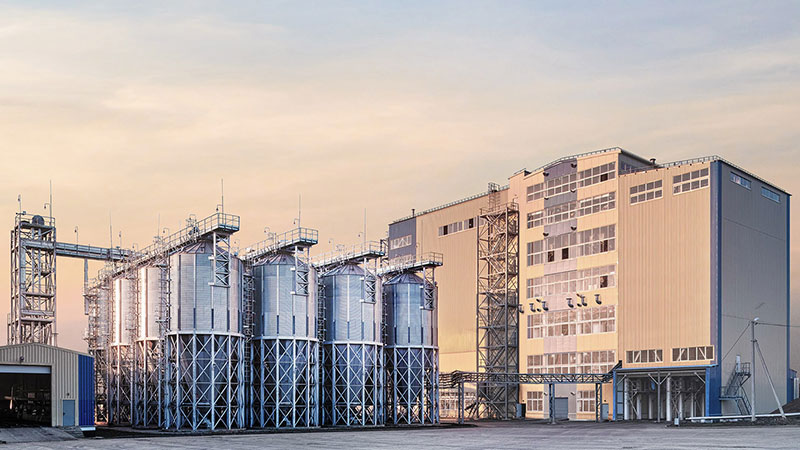
At RICHI, we go beyond project completion. With RICHI Servicee, we’re your dedicated partners in success. Count on us for expert guidance, minimal downtime, and optimized productivity. Choose RICHI for unmatched service and support.
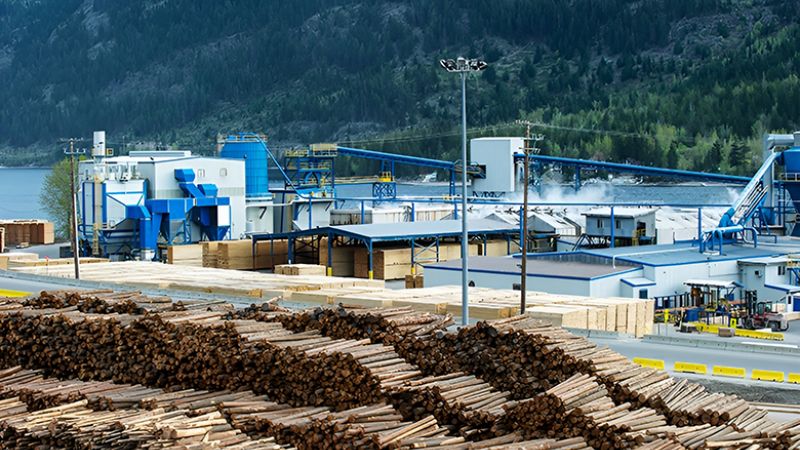


Meet global product demands and quality standards with industry-leading pellet plant design, engineering, equipment, and construction services for pellet processors.

Your Partner Beyond Project Completion
2000+ cases
RICHI is the leading designer, manufacturer and builder of pellet plants in the world, completing over 2000 projects in 140 countries across 6 continents.
Read More
Increase plant productivity, profitability, and safety by integrating high quality equipment into your pellet production line. Over the years, RICHI has become China's top pellet equipment manufacturer. At the same time, RICHI has established valuable partnerships with the world's leading component and raw material manufacturers to bring you the best there is in technology, automation, and efficiency in pelleting plant machinery.

For nearly 30 years, RICHI has been providing best-in-class pellet plant equipment and services to clients across a variety of industries, sizes, and needs. We pride ourselves on the knowledge and skill that each team member possesses – from our technical sales team to our process design engineers. You can count on RICHI Machinery to take your operation to the next level of innovation, quality, and success.
Need help with your pellet manufacturing plant project? Contact us today.
ANIMAL FEED
BIOMASS
WOOD
ORGANIC FERTILIZER
AQUA FEED
CAT LITTER
MUNICIPAL WASTE RECYCLING
SPECIAL PELLET PRODUCTION
RICHI Machinery continues to deliver world class pellet mill equipment, pellet plant engineering and project solutions that add value to our customers in the animal feed, wood waste, agriculture waste, organic fertilizer, cat litter and special pellet products industries. Throughout the years, we RICHI Machinery have built strong brand, becoming industry-leading pellet machine manufacturer. We value integrity, promise quality, and prioritize your success.
Learn MoreWith our expert team, we precisely implement your process engineering requirements in pellet mill and pelletizing plant systems. No matter which industry you’re in – we understand your needs and deliver solutions that meet the highest standards.
At RICHI, quality comes first. Our pellet making machine and related pellet line equipment undergo rigorous quality controls to ensure they meet the highest standards. Rely on products that are durable, safe, and efficient.
With decades of experience in pellet machine and pellet production line production, we have earned a reputation as a trusted partner in various industries. Our expertise allows us to cover a wide range of applications.
Not only do we offer premium pelleting equipment, but we are also experts at designing, building, installing, and maintaining facilities from the ground up. Our expertise is within pellt plant process design, discovering the most efficient, productive, and profitable way to handle your materials in an end-to-end cycle.
○ RICHI MACHINERY
Keeping in touch with us is an effective way to solve all your problems. If you have any needs or questions, please leave your contact information, then RICHI technical consultants will send design, quotation, videos to your mailbox. You can also contact us directly via WhatsApp: +86 13838389622
Copyright©2015-2026 by HENAN RICHI MACHINERY CO., LTD. All rights reserved.