
Beet Pulp Drying Equipment in Ukraine featuring a semi-mobile rotary dryer, variable-speed feeding, natural gas and diesel firing, and a separate sunflower-husk furnace for flexible sugar beet pulp processing.
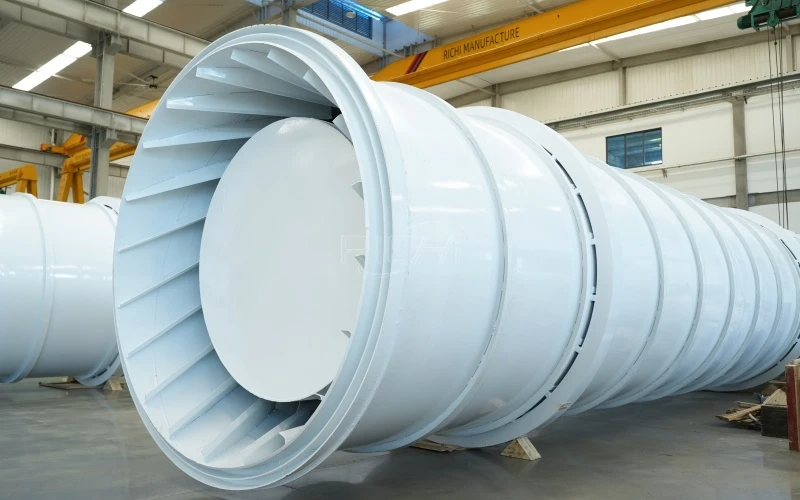
A sugar processing facility in the Vinnytsia region of Ukraine, approximately 250 km southwest of Kyiv, invested in new beet pulp drying equipment after its original dryer was destroyed in 2022.
The sugar extraction equipment and screw presses remained operational, but without a functioning dryer, the plant could no longer produce dried beet pulp for customers requiring a shelf-stable product. For two years, it had to sell wet pulp at low prices to buyers able to collect it quickly.
When the company decided to restore drying capacity, it chose a targeted equipment replacement rather than rebuilding the entire production line. RICHI supplied a single-pass rotary dryer designed to connect with the surviving screw presses and a new bagging section.
The project also addressed two requirements that had become especially important to the customer: processing beet pulp with highly variable moisture content and retaining the option to relocate the drying system if operating conditions changed.
Name:
Beet Pulp Drying Equipment
Country:
Ukraine
Date:
2026
Capacity:
3–5 T/H
Model:
Φ1.8 × 20 m
Main Motor Power:
30 kW
Water evaporation capacity:
2.5–3.5 T/H
Customer type:
Sugar processing facility
The resulting installation combined a 20 m rotary drum, variable-speed feeding, a semi-mobile skid arrangement and alternative heating options. It gave the sugar processor a way to recover value from wet pulp without replacing equipment that was still working.
| Project Item | Specification |
|---|---|
| Project location | Vinnytsia region, Ukraine |
| Customer type | Sugar processing facility |
| Project purpose | Replace destroyed drying equipment and restore dried pulp production |
| Selected dryer | Φ1.8 × 20 m single-pass rotary dryer |
| Drum diameter and length | 1.8 m × 20 m |
| Main drive power | 30 kW |
| Feed screw drive | 7.5 kW with variable-speed control |
| Wet pulp feed rate | Approximately 3–5 T/H, depending on moisture and material condition |
| Water evaporation capacity | Approximately 2.5–3.5 T/H, subject to operating conditions |
| Heating arrangement | Natural gas or diesel burner, plus a separate sunflower-husk biomass furnace |
| System arrangement | Semi-mobile skid-mounted equipment |
The project was a dryer replacement, not a complete sugar processing plant installation. The existing extraction and pressing sections continued to supply wet pulp, while the new drying system handled moisture removal before the material reached the bagging section.
The previous dryer had been installed on a substantial concrete foundation and was difficult to relocate. Reconstructing the same arrangement would have restored drying capacity but left the company with little flexibility if the site needed to change in the future.
The replacement system therefore used a semi-mobile layout. The drum, support rollers and drive assembly were mounted on a steel skid secured to the concrete pad with bolts. The cyclone and exhaust fan occupied a separate skid, while the control panel was installed in a portable enclosure.
The customer did not intend to move the dryer during normal operation. The value of the design was the option to dismantle and transport the equipment if circumstances required it. Based on the project arrangement, the customer planned for the complete system to be disconnected, loaded and relocated using four trucks within approximately 10 days, subject to transport permits, lifting arrangements and site access.
The feed material presented a second challenge. The processor received pulp from normal sugar beet batches as well as frozen-and-thawed beets and beets affected by rot. These materials did not behave identically during feeding and drying.
| Material Condition | Observed Moisture Content | Processing Concern | Equipment Response |
|---|---|---|---|
| Normal beet pulp | Approximately 76–78% | High water content requiring substantial evaporation | Standard controlled feeding and drum operation |
| Frozen-and-thawed beet pulp | Within the broader 74–84% range observed in tested batches | Variable moisture and inconsistent material texture | Adjustable feed rate according to measured conditions |
| Pulp from visibly damaged beets | Within the broader 74–84% range observed in tested batches | Clumping, sticky texture and more difficult feeding | Heavier-duty feed screw, larger inlet and extended speed adjustment |
Before finalizing the configuration, samples from three beet batches were tested. The results showed that damaged-beet pulp could have a much wider moisture range than normal material and was more prone to clumping.
To accommodate this variation, the feed screw was designed with a larger inlet opening and a heavier-duty construction. Its variable-speed drive also provided a wider adjustment range, allowing operators to reduce the feed rate when wet pulp became more difficult to handle.
This matters because the dryer must remove water at a rate consistent with its available heat-transfer and evaporation capacity. Feeding more wet pulp than the dryer can process does not necessarily increase finished output. It can instead raise final moisture, destabilize operation or require the line to be slowed down.
The selected Φ1.8 × 20 m single-pass rotary dryer was configured around the customer's need to process both normal and damaged beet pulp. Its operating settings could be adjusted to balance throughput, residence time and drying conditions.
| Parameter | Project Configuration | Operating Purpose |
|---|---|---|
| Drum diameter | 1.8 m | Provides the drying chamber cross-section |
| Drum length | 20 m | Provides the material travel path through the dryer |
| Drum speed range | 2–10 rpm | Allows adjustment of material movement and residence time |
| Hot-gas inlet temperature | 380–500°C | Provides an adjustable thermal operating range |
| Dryer outlet temperature | 70–85°C | Project operating range, to be interpreted against the installed temperature measurement point |
| Main drive | 30 kW | Drives drum rotation |
| Feed screw drive | 7.5 kW | Controls wet pulp feeding |
| Target finished moisture | Approximately 12% | Customer-reported drying result for damaged pulp |
The temperature values above describe the specified operating range, not a requirement to run every batch at the maximum setting. The appropriate temperature profile depends on feed moisture, throughput, the installed heat source and the desired product condition. The final operating procedure should also distinguish hot-gas inlet temperature from actual material temperature at discharge.
During the first harvest season, the operations team found that feed adjustment was particularly important when processing pulp from damaged beets.
In the customer's reported operating example, the feed screw was run at approximately 40% of its normal speed when processing difficult pulp, while the drum speed was reduced from 5 rpm to 3 rpm. This gave the material more time in the dryer without increasing the temperature setting.
These settings are specific to the tested material and operating conditions. They should not be treated as universal settings for all beet pulp dryers. Changes in drum speed, feed rate and heat input need to be coordinated because each affects the drying balance.
Incoming moisture is one of the main factors determining the actual capacity of beet pulp drying equipment. A dryer processing pulp at 84% moisture has a greater water-removal burden per tonne of wet feed than one processing material at 76% moisture.
The following simplified moisture balance illustrates the relationship between incoming material and the target of 12% final moisture.
| Incoming Moisture | Approximate Water Removed per Tonne of Wet Feed | Practical Implication |
|---|---|---|
| 76% | 727 kg | Higher feed rates may be possible within the available evaporation capacity |
| 78% | 750 kg | Feed rate must account for the dryer’s sustained water-removal capacity |
| 84% | 818 kg | More evaporation is required per tonne, so throughput generally needs to decrease |
These figures are calculated from the incoming and final moisture contents on a wet basis. They are theoretical water-removal requirements, not measured performance figures for the installed machine. Actual drying capacity also depends on heat transfer, exhaust conditions, feed distribution and operating stability.
For this project, the practical feed rate was therefore treated as variable rather than fixed. Normal pulp could be processed at a higher rate than particularly wet, sticky batches. The operating team used the feed screw adjustment to keep the material load within the dryer’s working range.
Before the dryer was destroyed, the plant had relied on natural gas. For the replacement project, the customer wanted to retain gas firing while gaining the option to use diesel or locally available biomass if fuel prices or supply conditions changed.
The final configuration used two separate heating arrangements rather than expecting one burner to handle every fuel type.
| Heat Source | Equipment Arrangement | Role in the Project |
|---|---|---|
| Natural gas | Gas-capable burner | Retains the plant's established fuel option |
| Diesel | Alternative mode of the dual-fuel burner | Provides another liquid-fuel option when required |
| Sunflower husks | Separate biomass furnace with vibrating grate and screw feeding | Uses locally available agricultural byproduct as a heat source |
Sunflower husks were selected because the customer could source them from an oilseed processing plant approximately 40 km away. The material was available at low cost, with trucking representing the principal procurement expense reported by the customer.
The biomass furnace used a vibrating grate and screw feeding system. This arrangement was separate from the gas-and-diesel burner because solid biomass requires different fuel handling and combustion equipment.
The customer initially regarded biomass as a backup option. During operation, however, sunflower husks proved sufficiently economical and reliable for the furnace to become the primary heat source. The customer reported that switching between gas firing and biomass operation took approximately 30 minutes under its operating arrangement.
Fuel flexibility does not remove the need to assess fuel quality. The first biomass commissioning required an adjustment because the delivered sunflower husks were finer than the material used in the initial test and tended to fall through the grate. A finer mesh screen was fabricated locally and installed above the grate, after which the furnace operated satisfactorily.
The plant needed its new dryer operating before the September harvest. Manufacturing, shipping, customs clearance and installation therefore had to fit within a limited window.
| Milestone | Project Timing |
|---|---|
| Order received | Early May |
| Shipment departed Qingdao | Mid-June |
| Arrival at Gdańsk, Poland | Mid-July |
| Customs clearance | Approximately two weeks |
| Delivery to Vinnytsia region | Early August |
| Installation and commissioning | Approximately three weeks |
| Target operational date | First week of September |
The 20 m drum was transported in two sections. The skids, support rollers, drive assembly, biomass furnace and control panel were shipped using suitable open-top containers and flat racks. The route passed through the Port of Gdańsk in Poland before the equipment continued by truck to the Vinnytsia region.
Customs clearance took longer than initially expected because additional documentation was required for equipment entering Ukraine through Poland. The shipment nevertheless reached the customer in early August, leaving time for installation and commissioning before the planned harvest start.
The installation team coordinated with local contractors to level and secure the skids. The mechanical installation was completed in the planned period, while commissioning of the biomass furnace required the additional grate adjustment described above.
Replacing only the dryer reduced the amount of new infrastructure required, but the rotary drum and its auxiliary systems still needed adequate space and access for operation and maintenance.
| Planning Item | Requirement or Consideration |
|---|---|
| Drying drum | 20 m long, with additional space required for feeding, discharge and maintenance |
| Known drive motors | 30 kW drum drive and 7.5 kW feed screw drive |
| Auxiliary electrical loads | Exhaust fan, fuel handling and other installed auxiliaries must be added to the electrical load calculation |
| Fuel infrastructure | Gas and diesel connections for the burner, plus a separate biomass feeding and combustion arrangement |
| Preliminary layout allowance | Approximately 30–35 m long by 10–15 m wide for the main drying equipment zone, subject to the approved general arrangement drawing |
| Operating personnel | Approximately 2–3 operators per shift as an initial planning estimate, depending on automation and the division of duties |
| Maintenance access | Clearance for roller and drive inspection, grate cleaning, dust collection servicing and lifting operations |
The footprint and staffing figures are preliminary planning allowances, not measured as-built project data. The final civil layout should be based on the approved equipment drawings, fuel system arrangement, local safety requirements and access for transport vehicles.
Following one full harvest season, the customer reported that the dryer had processed approximately 8,000 tonnes of wet pulp, including around 2,000 tonnes from damaged beets. The more difficult material required lower feeding rates, but the operations team reported achieving a final moisture content of approximately 12% for the damaged pulp.
The plant also reported that its fuel expenditure for the season was approximately 40% of the estimated cost of running the dryer on natural gas. This was the customer's reported comparison under its own fuel procurement and operating conditions, not a guaranteed saving for other installations.
The project delivered several practical benefits:
The dryer arrived later than we hoped but still in time for harvest. The installation team worked with our local contractors to secure the skids, and the biomass furnace required an additional adjustment because the sunflower husks we received were finer than the test material.
We processed approximately 8,000 tonnes of wet pulp during the season, including about 2,000 tonnes from damaged beets. The damaged pulp required slower feeding, but we consistently dried it to around 12% moisture.
Our fuel cost for the season was approximately 40% of what it would have been using natural gas. The ability to switch between fuel sources is valuable. We have already recommended this dryer to two other sugar processors in the region who are still operating without drying capacity.
We have not needed to use the mobility feature, and we hope we never need to. But knowing it is available gives us greater confidence in the investment.
Because the dryer can accommodate adjustments to feeding and drum operation, the customer has identified several potential applications beyond sugar beet pulp. These remain planned or prospective uses and would require testing before commercial production begins.
Each material has its own moisture content, fiber characteristics and drying behavior. Before changing products, the processor should verify the required feed rate, target moisture, thermal conditions, material handling method and cleaning requirements. A successful beet pulp trial does not automatically establish the same throughput for every other wet byproduct.
This project shows how a sugar processor can restore an essential production stage without rebuilding an entire factory. The customer retained its working extraction and pressing equipment, replaced the missing dryer, and added flexibility to address variable beet pulp moisture, fuel availability and potential relocation requirements.
The key engineering considerations were not limited to the drum dimensions or motor power. They also included the relationship between incoming moisture and evaporation capacity, the feeding behavior of damaged pulp, the separation of gaseous-fuel and biomass combustion systems, and the practical requirements of installation and transport.
For sugar processors evaluating beet pulp drying equipment in Ukraine, the appropriate configuration depends on wet pulp throughput, incoming moisture range, final product requirements, available fuel sources and the condition of existing upstream and downstream equipment.
RICHI Machinery supplies rotary drying systems and related material-handling equipment for agricultural and industrial byproducts. Share your wet pulp moisture range, target output, available fuels and existing equipment configuration to assess a drying solution that fits your actual operating conditions.
Having the right mix of reliable, high-quality pellet machine and pelletizing systems and expert support is essential to your success. Watch how our end-to-end feed pellet plant solutions have helped our customers optimize their performance.
Our customized and future-proofed turnkey pellet plant solutions is designed with you at the core. From vision to reality and beyond, our team stays connected with yours. Giving you peace-of-mind with an expert at your side.

At RICHI, we go beyond project completion. With RICHI Servicee, we’re your dedicated partners in success. Count on us for expert guidance, minimal downtime, and optimized productivity. Choose RICHI for unmatched service and support.



Meet global product demands and quality standards with industry-leading pellet plant design, engineering, equipment, and construction services for pellet processors.


Your Partner Beyond Project Completion
2000+ cases
RICHI is the leading designer, manufacturer and builder of pellet plants in the world, completing over 2000 projects in 140 countries across 6 continents.
Read More
Increase plant productivity, profitability, and safety by integrating high quality equipment into your pellet production line. Over the years, RICHI has become China's top pellet equipment manufacturer. At the same time, RICHI has established valuable partnerships with the world's leading component and raw material manufacturers to bring you the best there is in technology, automation, and efficiency in pelleting plant machinery.

For nearly 30 years, RICHI has been providing best-in-class pellet plant equipment and services to clients across a variety of industries, sizes, and needs. We pride ourselves on the knowledge and skill that each team member possesses – from our technical sales team to our process design engineers. You can count on RICHI Machinery to take your operation to the next level of innovation, quality, and success.
Need help with your pellet manufacturing plant project? Contact us today.
ANIMAL FEED
BIOMASS
WOOD
ORGANIC FERTILIZER
AQUA FEED
CAT LITTER
MUNICIPAL WASTE RECYCLING
SPECIAL PELLET PRODUCTION
RICHI Machinery continues to deliver world class pellet mill equipment, pellet plant engineering and project solutions that add value to our customers in the animal feed, wood waste, agriculture waste, organic fertilizer, cat litter and special pellet products industries. Throughout the years, we RICHI Machinery have built strong brand, becoming industry-leading pellet machine manufacturer. We value integrity, promise quality, and prioritize your success.
Learn MoreWith our expert team, we precisely implement your process engineering requirements in pellet mill and pelletizing plant systems. No matter which industry you’re in – we understand your needs and deliver solutions that meet the highest standards.
At RICHI, quality comes first. Our pellet making machine and related pellet line equipment undergo rigorous quality controls to ensure they meet the highest standards. Rely on products that are durable, safe, and efficient.
With decades of experience in pellet machine and pellet production line production, we have earned a reputation as a trusted partner in various industries. Our expertise allows us to cover a wide range of applications.
Not only do we offer premium pelleting equipment, but we are also experts at designing, building, installing, and maintaining facilities from the ground up. Our expertise is within pellt plant process design, discovering the most efficient, productive, and profitable way to handle your materials in an end-to-end cycle.
○ RICHI MACHINERY
Keeping in touch with us is an effective way to solve all your problems. If you have any needs or questions, please leave your contact information, then RICHI technical consultants will send design, quotation, videos to your mailbox. You can also contact us directly via WhatsApp: +86 13838389622
Copyright©2015-2026 by HENAN RICHI MACHINERY CO., LTD. All rights reserved.