
A fruit snack processor in Washington State installed one RICHI DHG-1000 apple chip belt drying machine in United States to expand its production of dried apple chips.
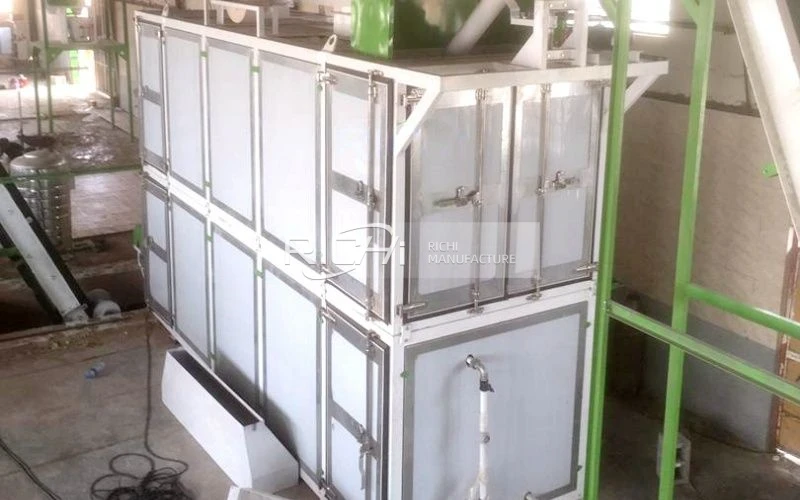
A fruit snack processor in Washington State installed one RICHI DHG-1000 apple chip belt drying machine in United States to expand its production of dried apple chips. The company works with several locally available apple varieties and already had washing, slicing, pretreatment and finished-product packaging equipment, so its investment focused on replacing the drying bottleneck rather than building another complete fruit processing line.
The project uses a five-layer mesh belt dryer with approximately 43 m² of drying area. Fresh apple slices with roughly 80–85% moisture are continuously distributed onto the belt and dried toward the moisture specification required for the customer’s crisp apple-chip products. Temperature, airflow, belt speed and product loading are adjusted together according to apple variety, slice thickness and incoming moisture rather than relying on one fixed drying recipe.
Name:
Apple Chip Belt Dryer
Country:
United States
Date:
2026
Capacity:
Flexible
Model:
DHG-1000
Drying Area:
43 m²
Incoming Moisture:
80–85%
Finished Moisture Target:
8–10%
Washington State is one of the most important apple-growing regions in the United States, giving commercial fruit processors access to substantial volumes of fresh apples and multiple varieties.
The customer processes Fuji, Gala, Honeycrisp and Granny Smith apples into packaged dried snacks. These varieties differ in sugar content, acidity, firmness and initial moisture, so they do not necessarily behave identically inside a dryer.
The company prepares the fruit as approximately 3–5 mm slices. Maintaining reasonably consistent thickness is important because drying time is strongly affected by the distance moisture must travel from the center of the slice to its surface.
A 3 mm slice and a 7 mm slice cannot be expected to reach the same final moisture simultaneously under identical airflow and temperature conditions.
Before drying, the apples pass through washing, inspection, cutting and an anti-browning pretreatment. An ascorbic-acid-based treatment can be used as part of the customer’s color-control process because ascorbic acid can help limit enzymatic browning after apple tissue is cut and exposed to oxygen.
The prepared slices are then drained before entering the dryer. Excess free water carried from washing or dipping would unnecessarily increase the drying load and can affect belt conditions.
This preparation stage is one reason RICHI evaluates an apple drying project as a complete material-flow problem even when the customer purchases only one dryer.
| Project Parameter | Configuration |
|---|---|
| Equipment | Apple chip belt drying machine |
| Model | DHG-1000 |
| Quantity | 1 unit |
| Drying Structure | Five-layer continuous mesh belt |
| Reference Drying Area | Approximately 43 m² |
| Main Raw Material | Fresh apple slices |
| Apple Varieties | Fuji, Gala, Honeycrisp and Granny Smith |
| Typical Slice Thickness | Approximately 3–5 mm |
| Incoming Moisture | Typically around 80–85%, variety and season dependent |
| Finished Moisture Target | Approximately 8–10% for the customer’s dried chip specification, subject to product validation |
| Electrical Frequency | 60 Hz configuration for the US installation |
| Main Application | Continuous drying of sliced apples for packaged fruit snacks |
The five-layer arrangement provides a relatively large effective drying area without requiring the same building length as a comparable single-layer conveyor.
Apple slices enter the upper drying section and move progressively through the machine. As the product transfers between belts, its position changes and different surfaces are exposed to the drying air.
The engineering objective is not simply to keep the fruit inside the machine for the longest possible time. The objective is to match residence time with heat and mass transfer so that moisture can migrate from the interior of the slice while the surface remains within the required product-quality range.
Belt speed provides an important control variable. When incoming apples have higher moisture or the slices are slightly thicker, the operator can increase residence time within the usable operating range. When the incoming product is drier or thinner, residence time and thermal input can be adjusted accordingly.
Airflow is equally important. Too little air movement limits moisture removal, while poor air distribution can leave different areas of the belt at different moisture levels.
This is why RICHI evaluates temperature, airflow, belt loading and residence time as one drying system rather than selling the DHG-1000 on temperature alone.
Fruit dryer capacity can be misleading when expressed only as tonnes per hour.
A buyer needs to know whether a capacity figure represents fresh apple input, evaporated water or finished dried chips.
For example, 1,000 kg of fresh apple slices at 83% moisture contain approximately 170 kg of dry solids and 830 kg of water.
If those solids are dried to 9% final moisture, the theoretical finished mass is only about 187 kg. Approximately 813 kg of water therefore has to leave the product.
This mass balance explains why an apple chip dryer cannot be sized from belt area alone.
Increasing fresh feed rate sharply increases evaporation demand. Heating capacity, recirculating airflow, exhaust air, ambient conditions and residence time all have to support that water removal.
For the same reason, the electrical rating of fans, drives and other components should not be confused with the thermal energy required to evaporate water.
An electrically heated apple dryer must have a heating system sized from the actual evaporation duty and real system efficiency. The final heater configuration therefore depends on fresh throughput and moisture rather than using one generic electrical figure for every DHG-1000 installation.
RICHI asks customers to provide fresh apple input in kilograms or tonnes per hour, measured incoming moisture, slice thickness and target final moisture. From these values, the required water evaporation can be calculated before the thermal system is finalized.
The Washington processor uses moderate-temperature convective drying because color, texture and final moisture are important characteristics of its apple-chip products.
A working range around the mid-60s to low-70s °C can provide a useful commissioning region for thin apple slices, but there is no universal 68°C setting that produces the best apple chip from every variety and every batch.
Apple drying is a coupled heat- and mass-transfer process.
Higher air temperature can accelerate moisture removal, but product quality also depends on exposure time, air velocity, relative humidity, slice geometry and apple composition. Lower temperature does not automatically guarantee crispness either; inadequate drying can leave too much residual moisture for the intended product.
Color needs similar process control.
Cut apples are susceptible to enzymatic browning because tissue damage exposes phenolic compounds to enzymes and oxygen. Pretreatment, processing time and drying conditions all influence the resulting color.
The customer therefore combines controlled slicing and anti-browning pretreatment with the dryer rather than expecting the belt dryer alone to prevent discoloration.
Sugar behavior is also more complex than a single temperature threshold. Apple browning during drying can involve enzymatic and non-enzymatic reactions influenced by temperature, moisture and time. It is not technically sound to assume that apple sugars suddenly caramelize whenever drying air passes one fixed temperature.
For commissioning, RICHI evaluates several operating points and compares final moisture, color, texture and drying time. Once the customer identifies the acceptable product window for a particular SKU, those parameters become the production reference for that apple variety and slice specification.
Material preparation has a direct effect on the performance of an apple chip belt drying machine.
The Washington customer controls slice thickness at approximately 3–5 mm and distributes the prepared fruit across the usable belt area. The goal is to avoid heavy overlapping and localized piles that restrict airflow through the product.
This does not require every slice to sit at an exact measured distance from every other slice. Industrial capacity would become unnecessarily dependent on manual placement if workers had to maintain a precise 5 or 10 mm gap between thousands of individual pieces.
Instead, the feeding arrangement is designed to create a controlled, relatively uniform product layer with limited overlap.
Air follows the easiest path through or around a product bed. If one section of the belt is heavily loaded while another is nearly empty, the airflow distribution and local drying rate can become uneven.
Uniform feeding therefore matters almost as much as average temperature.
Apple variety also affects the process. Honeycrisp, Granny Smith, Fuji and Gala do not have identical tissue structure, soluble solids or moisture characteristics. A setting developed for one product should be checked before being transferred unchanged to another.
The same applies when the processor changes slice geometry. Rings, half-rings and wedges can expose different surface areas and may load the belt differently.
This flexibility is one advantage of a continuous belt system: operators can adjust belt speed, product loading, airflow and temperature without replacing the complete dryer when a new apple SKU is introduced.
The customer targets approximately 8–10% moisture for its dried apple-chip product, but moisture percentage alone is not enough to determine commercial shelf stability.
Water activity is also important because it describes how much water is available to participate in microbial growth and quality deterioration.
Two apple-chip batches can have similar moisture percentages while behaving differently in storage because formulation, sugar concentration and drying history affect water binding.
The processor therefore verifies the finished product against its own moisture and water-activity specifications before packaging.
Texture is evaluated at the same stage.
A product leaving the hot drying zone may not have exactly the same texture it develops after cooling and moisture equilibration. Packaging while the chips are still warm can also create problems if residual heat contributes to condensation inside a moisture-barrier package.
The downstream sequence therefore includes cooling or equilibration before final packing.
Packaging material must then protect the dried product from moisture pickup. Dried apple chips are hygroscopic enough that poor packaging can allow them to absorb atmospheric moisture and lose the crisp texture achieved in the dryer.
This means the dryer, cooling stage and packaging barrier work together. Increasing drying intensity cannot compensate for a package that allows significant moisture ingress during storage.
Quality control for the finished snack can include final moisture, water activity, color, texture, piece integrity and sensory evaluation according to the processor’s product specification.
Apple processing requires a different sanitation approach from biomass or ordinary agricultural drying.
Apple juice, sugars and small fruit particles can accumulate on product-contact areas, transfer points and mesh surfaces. If these residues remain in warm equipment, they can become difficult to remove and create hygiene problems.
The Washington installation therefore gives operators access to the belt and relevant product-contact areas for inspection and cleaning.
Cleaning frequency is established through the processor’s sanitation program rather than a universal rule such as “wash the belt for exactly 30 minutes every evening.”
Actual cleaning needs depend on production hours, apple variety, juice release, pretreatment and product accumulation.
The cleaning method also needs to be compatible with belt material, bearings, electrical components and food-contact requirements. Water should not simply be sprayed into areas that are not designed for washdown.
During equipment configuration, RICHI therefore considers belt access, residue discharge, drainage where applicable and separation between food-contact cleaning zones and electrical or drive components.
This becomes especially important for processors running several apple varieties during the same production week.
Operators can inspect transfer points during product changes, remove accumulated pieces and confirm that the belt is ready before another production batch enters the dryer.
The DHG-1000 was prepared for the US installation with a 60 Hz electrical configuration and shipped from Qingdao toward Washington State through the Seattle-area port system. Final inland delivery connected the imported dryer with the customer’s existing fruit preparation and packaging operation.
The project was designed as a standalone drying-section upgrade. Washing, apple inspection, slicing, pretreatment and packaging remained part of the customer’s established process, allowing investment to concentrate on the section that actually required additional drying control.
This apple chip belt drying machine in United States uses a five-layer continuous structure with approximately 43 m² of drying area. The customer processes Fuji, Gala, Honeycrisp and Granny Smith apples, normally cutting them into approximately 3–5 mm slices before drying.
Fresh apple moisture is commonly around 80–85% for the material considered in this project, while the customer’s dried snack specification is approximately 8–10% moisture. That large moisture difference makes water evaporation the central sizing parameter.
For every 1,000 kg of apple slices entering at 83% moisture, approximately 813 kg of water must theoretically be removed to reach 9% final moisture. A buyer planning a larger apple chip drying machine therefore needs to provide wet input and moisture data rather than asking only for “a 1 T/H dryer.”
The five-layer belt provides the residence area needed for controlled convective drying while giving operators several variables to work with. Belt speed changes residence time, airflow influences evaporation and uniformity, and temperature can be adjusted according to the fruit and product specification.
The dryer is not marketed around a universal 68°C recipe. A moderate temperature range can be used as the starting point for trials, but the correct setting is established from actual apple variety, slice thickness, incoming moisture, airflow, loading and required final quality.
The same engineering approach applies to capacity. RICHI does not treat fresh apple throughput and dried-chip output as the same number. Dry solids, water evaporation and thermal demand are calculated separately before the final heating and airflow configuration is confirmed.
For US fruit processors searching for an apple chip belt drying machine in United States, apple slice dryer, continuous apple dryer, fruit chip belt dryer, multi-layer fruit dryer or commercial apple dehydration machine, the most useful project information includes fresh apple throughput, incoming moisture, apple varieties, slice thickness and geometry, target final moisture, water-activity requirement, available electrical and thermal utilities, operating hours and the upstream and downstream equipment already installed.
A processor that already has washing, slicing, pretreatment, cooling and packaging equipment may only need a properly engineered belt drying section. A new fruit snack factory may require the dryer to be designed together with feeding, cooling, conveying and hygienic product handling.
RICHI Machinery uses these project conditions to determine drying area, evaporation load, heating capacity, airflow, belt speed range and material distribution rather than selecting an apple dryer from nominal tonnes per hour alone. This gives the customer a drying system built around the actual fruit and finished snack specification while leaving room to optimize individual apple varieties during commissioning.
Having the right mix of reliable, high-quality pellet machine and pelletizing systems and expert support is essential to your success. Watch how our end-to-end feed pellet plant solutions have helped our customers optimize their performance.
Our customized and future-proofed turnkey pellet plant solutions is designed with you at the core. From vision to reality and beyond, our team stays connected with yours. Giving you peace-of-mind with an expert at your side.
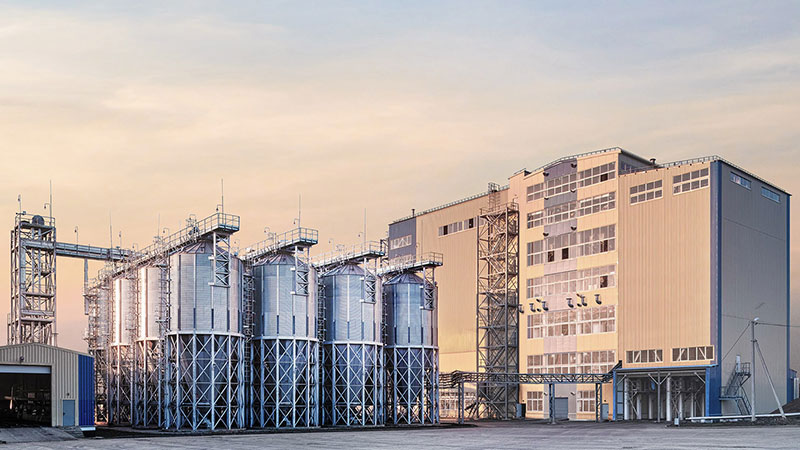
At RICHI, we go beyond project completion. With RICHI Servicee, we’re your dedicated partners in success. Count on us for expert guidance, minimal downtime, and optimized productivity. Choose RICHI for unmatched service and support.
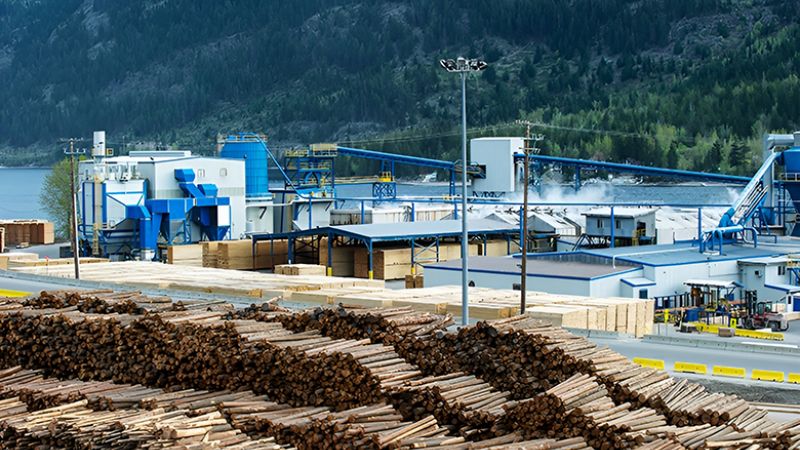


Meet global product demands and quality standards with industry-leading pellet plant design, engineering, equipment, and construction services for pellet processors.

Your Partner Beyond Project Completion
2000+ cases
RICHI is the leading designer, manufacturer and builder of pellet plants in the world, completing over 2000 projects in 140 countries across 6 continents.
Read More
Increase plant productivity, profitability, and safety by integrating high quality equipment into your pellet production line. Over the years, RICHI has become China's top pellet equipment manufacturer. At the same time, RICHI has established valuable partnerships with the world's leading component and raw material manufacturers to bring you the best there is in technology, automation, and efficiency in pelleting plant machinery.

For nearly 30 years, RICHI has been providing best-in-class pellet plant equipment and services to clients across a variety of industries, sizes, and needs. We pride ourselves on the knowledge and skill that each team member possesses – from our technical sales team to our process design engineers. You can count on RICHI Machinery to take your operation to the next level of innovation, quality, and success.
Need help with your pellet manufacturing plant project? Contact us today.
ANIMAL FEED
BIOMASS
WOOD
ORGANIC FERTILIZER
AQUA FEED
CAT LITTER
MUNICIPAL WASTE RECYCLING
SPECIAL PELLET PRODUCTION
RICHI Machinery continues to deliver world class pellet mill equipment, pellet plant engineering and project solutions that add value to our customers in the animal feed, wood waste, agriculture waste, organic fertilizer, cat litter and special pellet products industries. Throughout the years, we RICHI Machinery have built strong brand, becoming industry-leading pellet machine manufacturer. We value integrity, promise quality, and prioritize your success.
Learn MoreWith our expert team, we precisely implement your process engineering requirements in pellet mill and pelletizing plant systems. No matter which industry you’re in – we understand your needs and deliver solutions that meet the highest standards.
At RICHI, quality comes first. Our pellet making machine and related pellet line equipment undergo rigorous quality controls to ensure they meet the highest standards. Rely on products that are durable, safe, and efficient.
With decades of experience in pellet machine and pellet production line production, we have earned a reputation as a trusted partner in various industries. Our expertise allows us to cover a wide range of applications.
Not only do we offer premium pelleting equipment, but we are also experts at designing, building, installing, and maintaining facilities from the ground up. Our expertise is within pellt plant process design, discovering the most efficient, productive, and profitable way to handle your materials in an end-to-end cycle.
○ RICHI MACHINERY
Keeping in touch with us is an effective way to solve all your problems. If you have any needs or questions, please leave your contact information, then RICHI technical consultants will send design, quotation, videos to your mailbox. You can also contact us directly via WhatsApp: +86 13838389622
Copyright©2015-2026 by HENAN RICHI MACHINERY CO., LTD. All rights reserved.