
RICHI supplied a 2.8–3.0 T/H CZLH520 Alfalfa Pellet Machine for Animal Feed in France to produce 6 mm dairy forage pellets from 3–5 mm dried alfalfa.
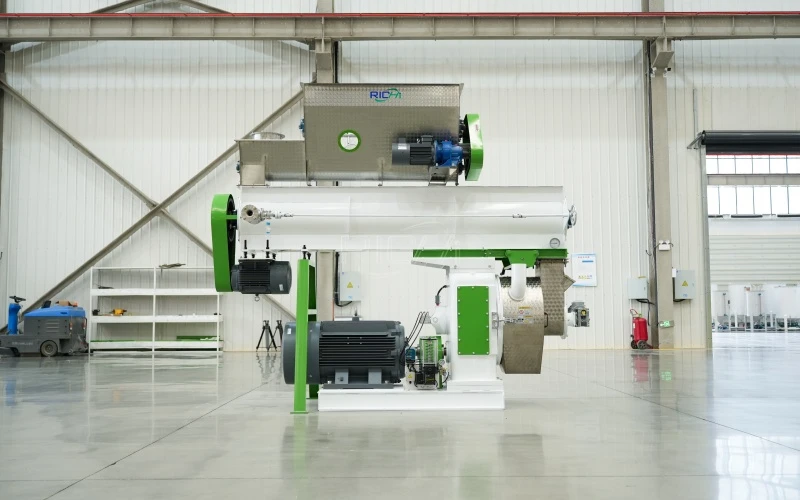
A forage processor in France's Grand Est region selected one RICHI CZLH520 Alfalfa Pellet Machine for Animal Feed in France to add a dedicated pelletizing stage to an existing alfalfa-processing operation. The customer already handled alfalfa collection, drying, grinding, cooling and finished-product storage, so the project did not require another complete forage feed plant. The new machine was installed to convert part of the customer's dried alfalfa meal into a standardized pellet product for regional dairy farms.
The CZLH520 alfalfa grass pellet machine uses a 132 kW main motor and provides approximately 2.8–3.0 T/H of pelletizing capacity under suitable forage conditions. Dried alfalfa is reduced to approximately 3–5 mm before entering the pelletizer, while material moisture is normally controlled within an approximately 10–15% operating window according to actual forming behavior. The customer produces approximately 6 mm alfalfa pellets as a concentrated forage ingredient for dairy cattle rations.
Name:
Ring die alfalfa pellet machine
Country:
France
Date:
2026
Capacity:
2.8–3.0 T/H
Model:
CZLH520
Main Motor Power:
132 kW
Raw Materials:
Alfalfa Bales
Pellet diameter:
6 mm
Eastern France has the country's strongest concentration of dehydrated alfalfa production, supported by specialized cooperatives that grow, collect, dehydrate and market alfalfa in several physical forms. This gives the project a realistic raw-material base and an established commercial market for dried forage products.
The customer purchases alfalfa through a regional grower network and processes it as a forage ingredient rather than treating the crop as a generic biomass material. Suitable alfalfa lots can remain in long-fiber or bale form, while selected dried material is directed to grinding and pelletizing according to dairy-feed demand.
This allows the processor to use one raw material in different commercial formats without forcing every tonne of harvested alfalfa through the alfalfa feed pellet mill.
| Project Parameter | Specification |
|---|---|
| Equipment | Ring die alfalfa pellet machine |
| Model | CZLH520 |
| Main Motor | 132 kW |
| Arch-Breaking Feeder | 3 kW |
| Forced Feeder | 1.5 kW |
| Ring Die Inner Diameter | 520 mm |
| Pelletizing Capacity | Approximately 2.8–3.0 T/H |
| Prepared Alfalfa Size | Approximately 3–5 mm |
| Project Moisture Window | Approximately 10–15% |
| Project Pellet Diameter | Approximately 6 mm |
| Annual Pellet Target | Approximately 5,000 T/Y |
| Main Application | Alfalfa forage pellets for dairy cattle |
The 2.8–3.0 T/H capacity range assumes appropriately dried and ground forage. Actual production varies with alfalfa maturity, stem-to-leaf ratio, moisture, particle-size distribution, die specification and feeding stability. A coarse, stem-rich alfalfa meal can place a different load on the machine from finely prepared leafy material even when both are described simply as alfalfa.
The CZLH520 is the densification stage of the process rather than a bale breaker or forage crusher. Large rectangular or round alfalfa bales must first be opened so twine and foreign material can be removed. Long stems are then chopped and ground before the material reaches the pelletizing section.
The customer prepares the dried forage to approximately 3–5 mm. This removes long fibers that could interfere with feeding and provides a more consistent material for the forced feeder and ring die chamber.
If alfalfa arrives in a meal or already-ground form from the customer's dehydration system, unnecessary coarse crushing can be bypassed. Equipment selection therefore follows the actual incoming material form rather than assuming that every tonne starts as a complete bale.
Alfalfa moisture strongly influences compression behavior. Material that is excessively wet can feed poorly and form unstable pellets, while overly dry forage may generate more dust and create higher friction during compression.
For this project, the normal operating window is approximately 10–15% before pelletizing, but the final working point is established during commissioning according to motor load, feeder behavior and finished pellet condition.
The CZLH520 does not use a conventional animal-feed steam conditioner in the same way as an SZLH compound-feed pellet mill. The project relies mainly on controlled forage drying, grinding and feeding before ring die compression.
The customer selected approximately 6 mm as the standard commercial pellet diameter for its dairy forage product. Standardizing around one main specification reduces unnecessary ring die changes and simplifies cooling, screening, storage and communication with livestock customers.
The machine can technically use other pellet diameters within the CZLH forage-pellet range, but the project does not manufacture separate dairy, beef and sheep products simply because several die sizes are available.
The 6 mm pellet is a physical forage format. It is not presented as automatically improving milk yield, digestibility or animal performance. Those outcomes depend on total ration formulation, forage quality, intake and farm management.
Dried alfalfa already contains the protein, fiber, minerals and other nutrients provided by the crop and its harvest condition. Grinding and pelletizing do not create additional nutrients. The main value of densification is physical: loose alfalfa meal becomes easier to handle, meter, transport and store.
This distinction is important for dairy customers. Alfalfa pellets are incorporated as one feed ingredient in a complete ration alongside silage, forage, concentrates, minerals and other components selected by the nutritionist.
The feed processor therefore controls both laboratory composition and physical pellet quality. A dense, visually uniform pellet cannot compensate for alfalfa harvested at an unsuitable maturity or material that does not meet the required nutrient specification.
The customer plans to pelletize approximately 5,000 tonnes of dried alfalfa annually. At 3.0 T/H, that volume requires approximately 1,667 effective pelletizing hours per year. At 2.8 T/H, the requirement is approximately 1,786 hours.
Across 250 production days, this equals approximately 6.7–7.1 effective pelletizing hours per day. The project can therefore operate near a normal production shift while retaining time for cleaning, maintenance, die inspection and seasonal changes in forage quality.
This operating pattern also explains why one CZLH520 is sufficient. Installing multiple pelletizers before the regional alfalfa supply and sales volume justify the additional capacity would create unnecessary capital and maintenance requirements.
Fresh alfalfa pellets leave the ring die warm and require cooling before long-term storage or packaging. The existing cooler receives the full approximately 2.8–3.0 T/H pellet flow and reduces product temperature toward a stable handling condition.
After cooling, screening removes loose fines generated during pellet formation and conveying. Qualified 6 mm pellets then move into finished-product storage before bulk or packaged dispatch.
The complete process for this project is alfalfa receiving → bale opening where required → drying or moisture control → grinding to approximately 3–5 mm → CZLH520 pelletizing → cooling → screening → finished alfalfa pellet storage.
This project does not use a permanent 60% alfalfa, 20% grass and 20% straw formula. The commercial product is an alfalfa forage pellet, so the quality of the alfalfa itself is the main raw-material consideration.
Harvest maturity, leaf retention, crude protein, fiber, moisture and foreign material are checked before material enters production. Different alfalfa lots can be segregated or blended according to the finished feed specification, but the customer does not dilute the project with unrelated straw and grass simply to demonstrate that the machine can pelletize them.
This approach also gives dairy-feed buyers clearer information about what they are purchasing.
France has a mature dehydrated-alfalfa industry rather than an emerging experimental market. Pellets are already one of the recognized commercial forms alongside long-fiber bales and destructured fiber. Dairy and other ruminant applications therefore provide an established downstream context for a specialized forage pelletizer.
For this customer, the investment is not based on predicting rapid national market growth. It is based on adding pellet capacity to an existing regional forage business with access to both growers and dairy-feed customers.
The CZLH520 Alfalfa Pellet Machine for Animal Feed in France is prepared for export from Qingdao, China, with Le Havre used as a practical French container gateway before inland delivery to the Grand Est facility.
Before shipment, RICHI reviews the customer's grinder output, material storage, feeder elevation, 132 kW electrical load, pellet discharge position, cooler capacity, screening system and maintenance clearance. The purpose is to integrate one new pelletizer into the existing forage-processing plant without replacing upstream and downstream equipment that remains correctly sized.
This Alfalfa Pellet Machine for Animal Feed in France project uses one RICHI CZLH520 with a 132 kW main motor to produce approximately 6 mm dairy forage pellets in Grand Est. Dried alfalfa is prepared to approximately 3–5 mm and around 10–15% moisture before entering the pelletizer, which provides approximately 2.8–3.0 T/H of reference capacity.
At an annual target of approximately 5,000 tonnes, the machine requires around 1,667–1,786 effective pelletizing hours per year. For another French forage processor evaluating a CZLH520, RICHI Machinery needs the annual dry-alfalfa volume, incoming form, moisture, particle size, pellet specification, operating schedule and capacities of the existing grinding, cooling and screening equipment before confirming the final configuration.
Having the right mix of reliable, high-quality pellet machine and pelletizing systems and expert support is essential to your success. Watch how our end-to-end feed pellet plant solutions have helped our customers optimize their performance.
Our customized and future-proofed turnkey pellet plant solutions is designed with you at the core. From vision to reality and beyond, our team stays connected with yours. Giving you peace-of-mind with an expert at your side.
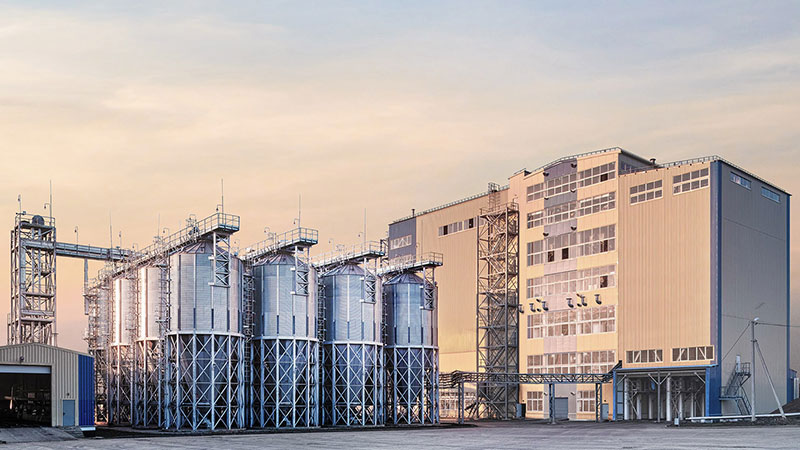
At RICHI, we go beyond project completion. With RICHI Servicee, we’re your dedicated partners in success. Count on us for expert guidance, minimal downtime, and optimized productivity. Choose RICHI for unmatched service and support.
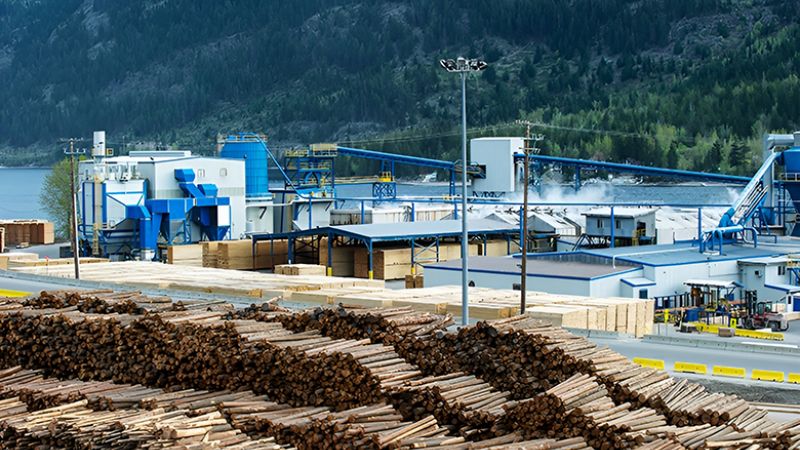


Meet global product demands and quality standards with industry-leading pellet plant design, engineering, equipment, and construction services for pellet processors.

Your Partner Beyond Project Completion
2000+ cases
RICHI is the leading designer, manufacturer and builder of pellet plants in the world, completing over 2000 projects in 140 countries across 6 continents.
Read More
Increase plant productivity, profitability, and safety by integrating high quality equipment into your pellet production line. Over the years, RICHI has become China's top pellet equipment manufacturer. At the same time, RICHI has established valuable partnerships with the world's leading component and raw material manufacturers to bring you the best there is in technology, automation, and efficiency in pelleting plant machinery.

For nearly 30 years, RICHI has been providing best-in-class pellet plant equipment and services to clients across a variety of industries, sizes, and needs. We pride ourselves on the knowledge and skill that each team member possesses – from our technical sales team to our process design engineers. You can count on RICHI Machinery to take your operation to the next level of innovation, quality, and success.
Need help with your pellet manufacturing plant project? Contact us today.
ANIMAL FEED
BIOMASS
WOOD
ORGANIC FERTILIZER
AQUA FEED
CAT LITTER
MUNICIPAL WASTE RECYCLING
SPECIAL PELLET PRODUCTION
RICHI Machinery continues to deliver world class pellet mill equipment, pellet plant engineering and project solutions that add value to our customers in the animal feed, wood waste, agriculture waste, organic fertilizer, cat litter and special pellet products industries. Throughout the years, we RICHI Machinery have built strong brand, becoming industry-leading pellet machine manufacturer. We value integrity, promise quality, and prioritize your success.
Learn MoreWith our expert team, we precisely implement your process engineering requirements in pellet mill and pelletizing plant systems. No matter which industry you’re in – we understand your needs and deliver solutions that meet the highest standards.
At RICHI, quality comes first. Our pellet making machine and related pellet line equipment undergo rigorous quality controls to ensure they meet the highest standards. Rely on products that are durable, safe, and efficient.
With decades of experience in pellet machine and pellet production line production, we have earned a reputation as a trusted partner in various industries. Our expertise allows us to cover a wide range of applications.
Not only do we offer premium pelleting equipment, but we are also experts at designing, building, installing, and maintaining facilities from the ground up. Our expertise is within pellt plant process design, discovering the most efficient, productive, and profitable way to handle your materials in an end-to-end cycle.
○ RICHI MACHINERY
Keeping in touch with us is an effective way to solve all your problems. If you have any needs or questions, please leave your contact information, then RICHI technical consultants will send design, quotation, videos to your mailbox. You can also contact us directly via WhatsApp: +86 13838389622
Copyright©2015-2026 by HENAN RICHI MACHINERY CO., LTD. All rights reserved.