
The large organic fertilizer granule and powder production line in Vietnam installed for the Can Tho cooperative represents a milestone in the Mekong Delta's agricultural waste processing capabilities. Designed to handle 20 tons per hour across five distinct product lines, this facility transforms locally abundant rice straw and mushroom residue into 140,000 tons of organic fertilizer annually.
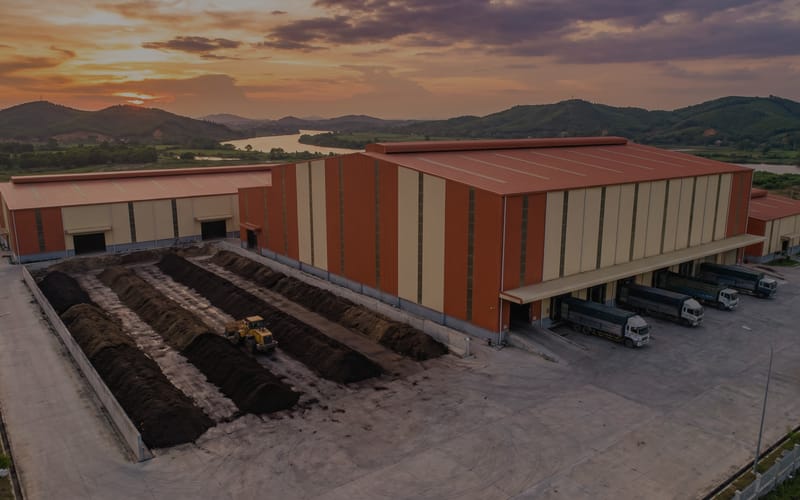
The large organic fertilizer granule and powder production line in Vietnam installed for the Can Tho cooperative represents a milestone in the Mekong Delta's agricultural waste processing capabilities.
Designed to handle 20 tons per hour across five distinct product lines, this facility transforms locally abundant rice straw and mushroom residue into 140,000 tons of organic fertilizer annually.
The cooperative's investment of $385,000 covers a complete processing system including crushing, mixing, granulating, drying, and packaging equipment, all configured to fit within their existing 2,100-square-meter building.
With natural gas available from the local industrial park and water supplied through municipal connections plus rainwater collection, the line operates two shifts per day, 300 days per year, producing both granular and powder formulations for rice farmers, fruit growers, and tea plantations across southern Vietnam.
Name:
Organic Fertilizer Granule and Powder Plant
Country:
Vietnam
Date:
2025
Capacity:
20T/H
Raw Material:
Rice Straw, Mushroom Residue
Control Mode:
Automatic
final product:
Granular / Powder
Guiding Price:
$385,000
What makes this large organic fertilizer granule and powder production line in Vietnam particularly effective is its integration with the cooperative's existing farmer network. Rather than purchasing raw materials on the open market, the cooperative collects rice straw from 2,000 member farmers across three districts, paying in fertilizer credits instead of cash.
The mushroom residue comes from small farms that previously disposed of spent substrate illegally, now diverted to become the primary organic matter for microbial fertilizer production. This closed-loop approach reduces raw material costs while solving two environmental problems simultaneously.
The equipment package, shipped from Qingdao to Cai Mep port, includes four crushers, four mixers, two granulator types, four dryers, and complete dust collection systems, all automated through PLC controls to ensure consistent product quality meeting Vietnamese organic fertilizer standards.
In early 2025, a Vietnamese agricultural cooperative from Can Tho reached out to us with a problem that sounded familiar: they had too much waste and not enough ways to use it. The cooperative, which represents over 2,000 rice farmers across three districts in the Mekong Delta, was sitting on thousands of tons of rice straw after each harvest.
Some of it went to mushroom cultivation. Most of it got burned in the fields, sending smoke across the countryside and drawing complaints from local residents.
But here's what made this inquiry different from the others. The cooperative's technical director had done his homework. He knew that Vietnam's agricultural strategy was pushing toward organic production. He understood that rice farmers needed alternatives to burning. And he'd calculated that with millions of tons of rice straw generated annually in the Delta, someone needed to turn that into fertilizer at industrial scale.
His question to us was simple: "Could a 20t/h large organic fertilizer granule and powder production line process our rice straw fast enough to keep up with harvests, and could it also handle mushroom residue from the farms we supply?"
We spent the next three months working through the answer. Site visits, material sampling, lab testing, layout planning, and finally equipment specification. The cooperative had a 2,100-square-meter building on the outskirts of Can Tho that had previously housed a rice milling operation.
The structure was sound, with 9-meter eaves and a concrete floor that could handle the weight. Power was available—they'd already upgraded the transformer for the mill. Water was available from the local supply. Natural gas was piped to the industrial park.
The only missing piece was the right equipment configured for their specific raw materials.
What they needed, we concluded, was a 20t/h large organic fertilizer granule and powder production line capable of handling wet, fibrous agricultural residues and producing multiple product types. The target: 140,000 tons per year, split across five product lines.
Here are the final production targets we designed for:
| Product Type | Annual Output (tons) | Moisture Target | Primary Market |
|---|---|---|---|
| Microbial Organic Fertilizer (Granular) | 60,000 | 30% | Fruit and vegetable growers |
| Microbial Organic Fertilizer (Powder) | 10,000 | 30% | Tea and coffee plantations |
| Organic Fertilizer (Granular) | 50,000 | 30% | Rice and grain farmers |
| Organic Fertilizer (Powder) | 10,000 | 30% | Soil amendment market |
| Water-Soluble Fertilizer | 10,000 | 3% | High-value crop fertigation |
The total annual throughput of 140,000 tons meant the organic fertilizer production line would run 300 days per year, two shifts per day, with each shift working 8 hours. That's 4,800 operating hours annually. At 20 tons per hour average, the math worked—as long as the line ran reliably and raw material supply was consistent.
The cooperative's board approved the project in June 2025. We had the equipment designed, fabricated, and loaded in Qingdao by September. The vessels arrived at Cai Mep port near Vung Tau in October, and we had the line mechanically complete by January 2026.
Commissioning took another six weeks—longer than usual because of Lunar New Year holidays—but by mid-March, the first bags of granular organic fertilizer were coming off the line.
Before we could design the equipment, we needed to understand what would go into it. The Mekong Delta has one of the most concentrated agricultural waste streams in Southeast Asia. Rice straw alone is measured in millions of tons. But waste is only useful if you can collect it consistently and cost-effectively.
The cooperative already had relationships with rice farmers across three districts. After each harvest—typically two per year in most of the Delta, three in some areas—farmers would either burn the straw or leave it to rot. The cooperative proposed a simple deal: deliver your straw to our collection points, and we'll either pay you a small fee or credit you for fertilizer when production starts. Most farmers chose the fertilizer credit.
Mushroom residue was a different story. The cooperative supplied mushroom spawn to small farms around Can Tho. Those farms generated spent substrate—the material left after mushrooms are harvested—which is rich in organic matter but also wet and fibrous.
Previously, this material was piled up behind farms or dumped illegally. The cooperative saw an opportunity to collect it, process it, and turn it back into product.
Here's the final raw material matrix we designed for the Can Tho operation:
| Raw Material | Local Source | Annual Consumption (tons) | Typical Moisture | Function in Production |
|---|---|---|---|---|
| Rice Straw | Contracted farmers across three districts | 36,000 | 30% after fermentation | Base carbon source for organic lines |
| Mushroom Residue | Spent substrate from local mushroom farms | 45,700 | 35% | Primary organic matter for microbial lines |
| Sugarcane Press Mud | Mills around Can Tho | 12,000 | 30% | Binder and energy source |
| Bentonite | Imported or domestic source | 12,000 | 10% | Granulation aid and anti-caking agent |
| Soybean Cake | Local oil pressing operations | 12,000 | 30% | Nitrogen booster |
| Probiotic Powder | Imported cultures | 300 | <5% | Microbial inoculation for premium lines |
| Urea | Imported industrial grade | 3,000 | <1% | Water-soluble line |
| Monoammonium Phosphate | Imported | 3,000 | <1% | Water-soluble line |
| Potassium Sulfate | Imported | 700 | <1% | Water-soluble line |
| Zinc Sulfate | Imported | 2,000 | <1% | Micronutrient blend |
| Magnesium Sulfate | Imported | 1,000 | <1% | Micronutrient blend |
The rice straw needed pre-processing before it could enter the main line. Farmers delivered it in bales, which we ran through a separate chopper to reduce length to under 10 centimeters. From there, it went into covered windrows for fermentation. The cooperative built simple concrete pads with roof structures—enough to keep rain off but open on the sides for airflow. Fermentation took 30 to 45 days depending on the season, with turning every week to ensure aerobic conditions.
The mushroom residue arrived already partially decomposed from the mushroom growing process. That actually helped—the fungi had already broken down some of the tougher fibers. We blended it directly with other materials without additional fermentation.
Water consumption was another factor. The granular lines need moisture for proper granulation—about 16,500 cubic meters per year total. The cooperative had access to municipal water, but we also designed rainwater collection from the roof of the processing building.
During the wet season, which runs from May to November in Can Tho, collected rainwater covered about 40% of their needs. The rest came from the municipal supply. About 20% of the added water evaporates during processing. The remainder stays in the product, contributing to the final 30% moisture specification.
With raw materials characterized and supply chains mapped, we moved to equipment selection. The 20t/h large organic fertilizer granule and powder production line needed to handle multiple product types without excessive changeover time. That meant dedicated lines for some products and shared equipment for others.
We arranged the 2,100-square-meter building into four zones:
This U-shaped flow kept material moving in one direction and minimized cross-traffic.
Here's the complete equipment package we installed:
| Equipment | Quantity | Power (kW) | Function |
|---|---|---|---|
| Wheel Loader Feeder | 2 | 15 each | Raw material intake |
| Vertical Crusher | 2 | 45 each | Primary size reduction |
| Chain Crusher | 2 | 30 each | Secondary fine grinding |
| Double Shaft Mixer | 2 | 22 each | Homogeneous blending with water addition |
| Ring Die Organic Fertilizer Pellet Machine | 1 | 37 each | Main granulation for high-volume lines |
| Ring Die Organic Fertilizer Pellet Machine | 1 | 30 each | Alternative for specialty batches |
| Rotary Dryer | 2 | 15 each (drive) | Direct-fired, natural gas |
| Cooler | 2 | 11 each | Ambient air, counter-flow |
| Screening Machine | 2 | 7.5 each | Two-deck for overs/fines separation |
| Coating Machine | 1 | 11 | Probiotic application for microbial lines |
| Belt Conveyors | 9 | 2.2–5.5 each | Enclosed type where dust is likely |
| Bucket Elevators | 3 | 4–7.5 each | Vertical transport |
| Fans and Cyclones | 3 | 18.5–37 | Air handling for dryer and cooler |
| Automatic Packing Scale | 2 | 5 each | 25kg to 50kg bags |
| Dynamic Feeder System | 2 systems | — | Automated batching |
| Control Panels | 1 system | — | PLC-based with HMI |
| Air Compressor | 1 | 15 | Pneumatic controls |
| Dust Collection System | 1 system | 30 | Baghouse with 15m stack |
The total installed power came to approximately 850 kW. The cooperative's existing transformer was rated for 1,000 kW, so no upgrade was needed.
One decision we debated was the conveyor layout. The building was long but not wide, so we had two options: run multiple short conveyors with transfer points, or run one long main conveyor with automated trippers to discharge at different equipment locations. We chose the long conveyor approach—about 109 meters total—because fewer transfer points meant less dust and fewer jams. The automated trippers added some cost upfront but reduced maintenance over the life of the line.
The drying system required careful sizing. Vietnam's humidity means incoming material can be wetter than in drier climates. The four rotary dryers, each 1.5 meters in diameter and 15 meters long, provided enough capacity to handle peak moisture loads.
We calculated total heat requirement at about 32 million MJ per year, which translated to roughly 900,000 cubic meters of natural gas annually. The Can Tho industrial park had pipeline gas available, so we used direct-fired furnaces rather than indirect heating.
For dust control—a major concern in any organic fertilizer operation—we installed collection hoods at every transfer point, crusher, mixer, and packer. All collected dust goes to a baghouse, with the recovered material returned to the process. The baghouse discharges through a 15-meter stack that meets Vietnamese industrial emission standards.
The production manager at the cooperative wanted to understand every step before the equipment arrived. We spent two days walking through the flow on paper, then another day adjusting based on his questions. Here's how material actually moves through a 20t/h large organic fertilizer granule and powder production line.
This is the most complex product path, with annual target of 60,000 tons. The process has nine distinct stages:
The process for the 50,000-ton organic granule line is similar but simpler. Rice straw (fermented), bentonite, and soybean cake go through the same crushing, mixing, granulating, drying, cooling, and screening steps. The coating stage is skipped entirely.
For the 20,000 tons of powder products (microbial and straight organic), the process is even simpler:
No granulation. No drying. No cooling. This line runs faster and uses less energy, though the product sells at a lower price point than granules.
The 10,000-ton water-soluble line is almost completely separate from the organic lines. It uses:
This line requires careful cleaning between product runs to prevent cross-contamination. The operator runs a rice hull flush between color changes or nutrient blends.
The Vietnamese market for organic fertilizers has specific expectations, even if the regulatory framework is still developing. Buyers in the Mekong Delta—whether rice farmers or fruit growers—know what they want and test products before buying in volume.
We designed the line to meet or exceed these common requirements:
| Parameter | Target Range | Testing Frequency |
|---|---|---|
| Organic matter (dry basis) | ≥30% | Daily composite |
| Moisture content | ≤30% | Every 2 hours |
| pH | 5.5–8.5 | Daily |
| Mechanical contaminants | None visible | Visual every batch |
| Odor | No foul smell | Sensory check |
| Viable count (microbial lines) | ≥0.2 billion CFU/g | Weekly |
| Water insolubles (WSF) | ≤1% | Per batch change |
The cooperative set up a small lab in one corner of the building. It's not fancy—just a balance, a drying oven, a pH meter, and some glassware—but it's enough to verify quality before product ships.
For the water-soluble line, we installed an extra fine screen to ensure complete dissolution. Vietnamese fruit growers use drip irrigation systems that clog easily if fertilizer doesn't fully dissolve.
The cooperative asked early on about lead times and shipping. They'd heard horror stories of equipment stuck in ports for months.
We explained our standard process. All fabrication happens at our workshops near Zhengzhou. Once equipment is tested and crated, it moves by truck to Qingdao port. Qingdao is our closest major international port with frequent sailings to Southeast Asia.
For this project, we shipped in three batches:
| Batch | Contents | Containers | Vessel Type |
|---|---|---|---|
| 1 | Dryer shells, granulator | 4 flat racks | Breakbulk carrier |
| 2 | Crushers, mixers, elevators | 12 open-top | Container ship |
| 3 | Motors, controls, small parts | 10 standard | Container ship |
The destination port was Cai Mep, the deepwater facility near Vung Tau that handles most containerized cargo for the Mekong Delta region. From Qingdao to Cai Mep, transit time averaged 8 days. Customs clearance took another 4 days—longer than usual because of some documentation issues, but within the range we'd estimated.
We provided detailed packing lists, lifting plans, and assembly drawings with each shipment. The cooperative hired a local crane contractor who had experience with industrial equipment. Unloading took two days. Positioning the equipment inside the building took another week.
The cooperative's board needed to see numbers before approving the project. We worked with them to develop realistic investment and operating cost estimates.
Total equipment cost: $385,000 (FOB Qingdao)
The cooperative's own calculations showed payback in 18 to 24 months, assuming they reached full production in the first year. With their existing farmer network and guaranteed offtake agreements, that seemed realistic.
Vietnam's agriculture is at an inflection point. Rice farmers can no longer burn straw without facing fines and community opposition. Mushroom growers can't pile spent substrate behind their farms indefinitely. Fruit and vegetable farmers need consistent, high-quality organic fertilizers to meet export requirements.
A 20t/h large organic fertilizer granule and powder production line addresses all of these pressures at once. It turns waste streams into revenue. It creates local jobs. It reduces environmental complaints. And it produces exactly the products that Vietnamese farmers are already buying—just at a lower cost than imported alternatives.
The Can Tho cooperative is now running three shifts during peak season, processing rice straw that used to go up in smoke. Their members get fertilizer credits instead of burning fines. Local mushroom farms have a place to send their spent substrate. And the provincial government has pointed to the project as a model for other districts.
If you're sitting on agricultural waste and wondering if it could become product, you're not alone. We've engineered lines for rice straw in Vietnam, sugarcane waste in Thailand, mushroom residue in China, and oil palm waste in Indonesia. The process fundamentals are the same even if the raw materials vary.
Here's what we need to start a conversation:
Send RICHI Machinery those details and we'll run preliminary numbers. We'll tell you what a 20t/h large organic fertilizer granule and powder production line would look like in your facility—what equipment, what layout, what investment, what payback.
All equipment ships from Qingdao to any port you name. We've done over 40 organic fertilizer production projects across Southeast Asia. The engineering we put into Can Tho can work for you too.
Having the right mix of reliable, high-quality pellet machine and pelletizing systems and expert support is essential to your success. Watch how our end-to-end feed pellet plant solutions have helped our customers optimize their performance.
Our customized and future-proofed turnkey pellet plant solutions is designed with you at the core. From vision to reality and beyond, our team stays connected with yours. Giving you peace-of-mind with an expert at your side.
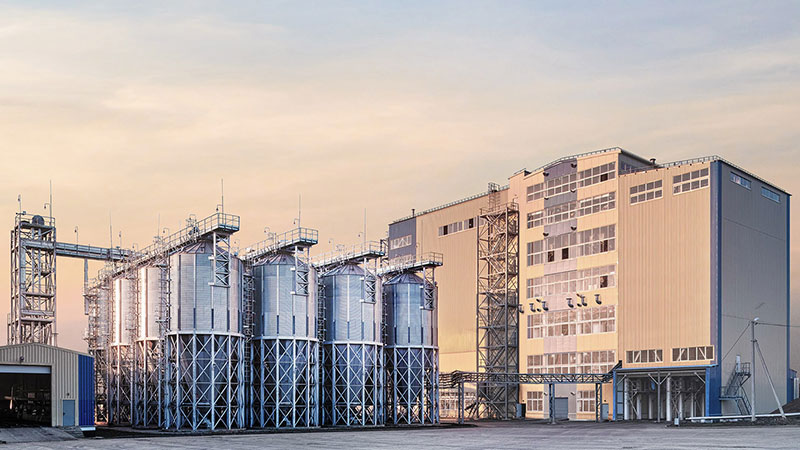
At RICHI, we go beyond project completion. With RICHI Servicee, we’re your dedicated partners in success. Count on us for expert guidance, minimal downtime, and optimized productivity. Choose RICHI for unmatched service and support.
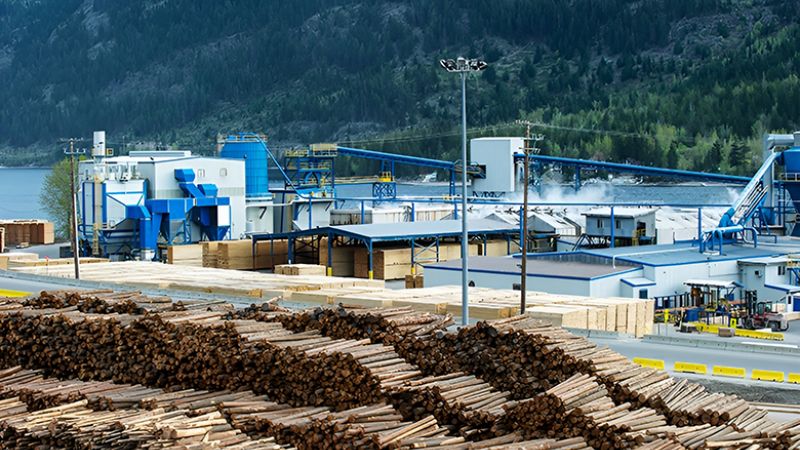

Meet global product demands and quality standards with industry-leading pellet plant design, engineering, equipment, and construction services for pellet processors.


Your Partner Beyond Project Completion
2000+ cases
RICHI is the leading designer, manufacturer and builder of pellet plants in the world, completing over 2000 projects in 140 countries across 6 continents.
Read More
Increase plant productivity, profitability, and safety by integrating high quality equipment into your pellet production line. Over the years, RICHI has become China's top pellet equipment manufacturer. At the same time, RICHI has established valuable partnerships with the world's leading component and raw material manufacturers to bring you the best there is in technology, automation, and efficiency in pelleting plant machinery.

For nearly 30 years, RICHI has been providing best-in-class pellet plant equipment and services to clients across a variety of industries, sizes, and needs. We pride ourselves on the knowledge and skill that each team member possesses – from our technical sales team to our process design engineers. You can count on RICHI Machinery to take your operation to the next level of innovation, quality, and success.
Need help with your pellet manufacturing plant project? Contact us today.
ANIMAL FEED
BIOMASS
WOOD
ORGANIC FERTILIZER
AQUA FEED
CAT LITTER
MUNICIPAL WASTE RECYCLING
SPECIAL PELLET PRODUCTION
RICHI Machinery continues to deliver world class pellet mill equipment, pellet plant engineering and project solutions that add value to our customers in the animal feed, wood waste, agriculture waste, organic fertilizer, cat litter and special pellet products industries. Throughout the years, we RICHI Machinery have built strong brand, becoming industry-leading pellet machine manufacturer. We value integrity, promise quality, and prioritize your success.
Learn MoreWith our expert team, we precisely implement your process engineering requirements in pellet mill and pelletizing plant systems. No matter which industry you’re in – we understand your needs and deliver solutions that meet the highest standards.
At RICHI, quality comes first. Our pellet making machine and related pellet line equipment undergo rigorous quality controls to ensure they meet the highest standards. Rely on products that are durable, safe, and efficient.
With decades of experience in pellet machine and pellet production line production, we have earned a reputation as a trusted partner in various industries. Our expertise allows us to cover a wide range of applications.
Not only do we offer premium pelleting equipment, but we are also experts at designing, building, installing, and maintaining facilities from the ground up. Our expertise is within pellt plant process design, discovering the most efficient, productive, and profitable way to handle your materials in an end-to-end cycle.
○ RICHI MACHINERY
Keeping in touch with us is an effective way to solve all your problems. If you have any needs or questions, please leave your contact information, then RICHI technical consultants will send design, quotation, videos to your mailbox. You can also contact us directly via WhatsApp: +86 13838389622
Copyright©2015-2026 by HENAN RICHI MACHINERY CO., LTD. All rights reserved.