

This is where you find all our press releases and news articles.
A complete 1-2 T/H wood pellet production line manufactured by RICHI Machinery has started its journey to a customer in Taiwan. The shipment includes the equipment required to build a complete biomass pellet processing system rather than only an individual wood pellet mill, allowing the customer to organize raw material preparation, pelletizing and finished pellet handling around one production route.
With a designed output of 1-2 tons per hour, this project represents a practical small-to-medium wood pellet plant configuration for businesses that have a stable supply of woody biomass but do not require the investment and raw material volume of a large industrial pellet factory. After manufacturing and shipment preparation were completed, the equipment left RICHI Machinery for the customer's project in Taiwan.
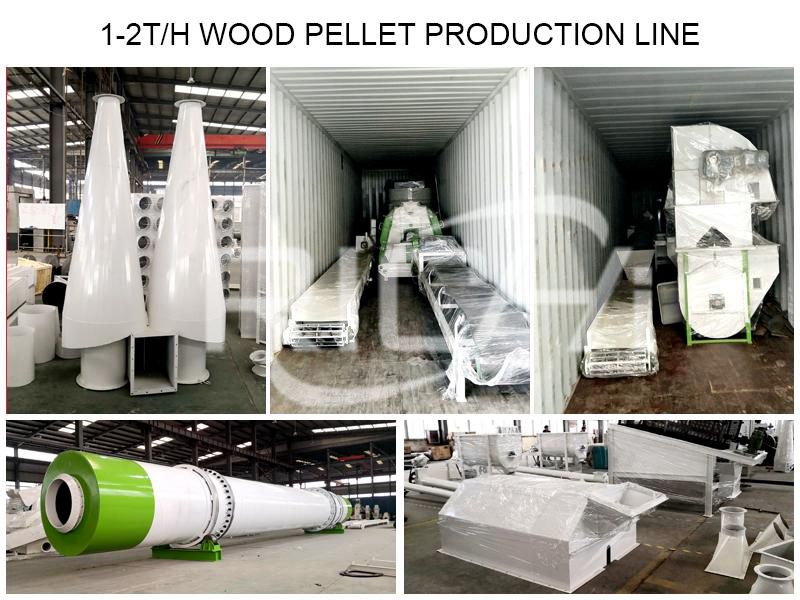
The confirmed capacity of this Taiwan project is 1-2 T/H. At this scale, the project is no longer simply a wood pellet machine installation. Crushing, moisture control, pelletizing, cooling, screening, conveying and packing need to be considered as connected parts of the same production system according to the condition of the customer's incoming wood material.
A 1-2 T/H wood pellet production line can theoretically produce approximately 8-16 tons of pellets during an eight-hour production shift when operating around the designed hourly output. At 20 operating hours per day, the corresponding theoretical daily production is approximately 20-40 tons. Actual output will vary with wood species, moisture, particle size, operating conditions and equipment utilization.
This capacity range can suit wood-processing businesses, timber and furniture operations, biomass fuel producers and other companies that can secure sufficient clean woody residues for continuous pellet production. It also provides a different investment route from a large 5 T/H, 10 T/H or higher-capacity industrial wood pellet plant.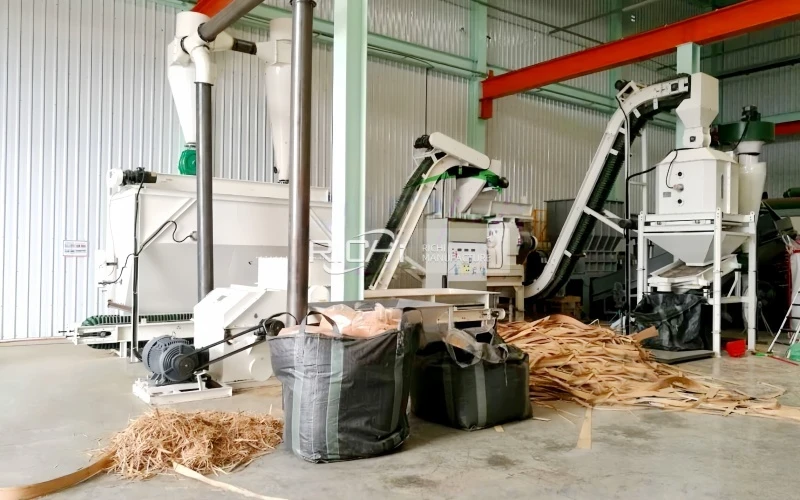
The original project record identifies this as a wood pellet production line but does not specify the exact wood species used by the Taiwanese customer. The line design for this type of project can be adapted to common clean woody biomass such as sawdust, wood shavings, wood chips and suitable wood-processing residues, provided the incoming material is prepared to meet pelletizing requirements.
The condition of the raw material is more important than simply calling it "wood waste." Dry sawdust from a woodworking operation requires a much shorter preprocessing route than wet wood chips or coarse timber residues. Mixed residues with oversized pieces require size reduction, while material with excessive moisture requires drying before stable pelletizing can be achieved.
For wood pellet production, prepared material normally needs to be reduced to a relatively uniform small particle size suitable for the ring die biomass pellet machine. Moisture also needs to be controlled within an appropriate pelletizing range. In many wood pellet projects, approximately 10-15% moisture before pelletizing is a practical working reference, although the final target should be adjusted according to wood species, particle condition and pellet quality requirements.
This is why a customer searching for a sawdust pellet production line may need a different equipment configuration from a customer searching for a wood chip pellet production line, even when both require the same nominal 1-2 T/H finished pellet capacity.
For a complete wood pellet plant, RICHI Machinery does not determine the equipment list from capacity alone. The condition in which the customer's raw material enters the factory directly affects the preprocessing system.
Relatively clean sawdust with suitable particle size and moisture can simplify the production route. Depending on its actual condition, the material may require screening or additional size adjustment before entering the pelletizing system, but heavy primary crushing and a large drying section may not be necessary.
Wood chips are too coarse to enter a biomass pellet mill directly. They normally require further size reduction with suitable wood crushing or hammer milling equipment. If the chips are wet, a drying section must also be considered before pelletizing.
Wood shavings and mixed clean wood residues can vary considerably in bulk density, particle length and moisture. A suitable crushing and conveying arrangement is required to create a stable feed for downstream pelletizing. Oversized wood pieces, metal and other unwanted contaminants should be removed before they reach the pellet mill.
These differences explain why the correct question is not simply "How much does a 1-2 T/H wood pellet line cost?" A useful quotation needs to start with what the customer has before processing and what pellet product the customer wants after processing.
For a project in this capacity range, the production process can be configured around the actual raw material route. Where complete preprocessing is required, a wood pellet line may include raw material receiving, size reduction, drying when necessary, fine crushing, pelletizing, cooling, screening, conveying and packing.
If the incoming material is already dry sawdust of suitable size, several upstream stages can be reduced or omitted. If the customer receives coarse and wet wood residues, additional crushing and drying equipment becomes essential.
The pelletizing section is the core of the line. RICHI uses its MZLH series biomass pellet mill platform for wood and other biomass pellet applications. For a 1-2 T/H project, wood pellet mill selection needs to consider the real material, required output and operating conditions rather than selecting a model solely from a nominal capacity figure.
After pelletizing, hot pellets need to be cooled before storage or packaging. Screening removes fines and loose material from the finished product, while the packing system can be configured according to whether the pellets will be handled in bags, bulk storage or another downstream logistics format.
The purpose of a wood pellet production line is not merely to reduce the volume of wood residues. Pelletizing converts loose woody biomass into a denser, more uniform solid fuel that is easier to handle, store and transport.
Depending on the target market and combustion equipment, wood fuel pellets are commonly produced in diameters such as 6 mm or 8 mm. Pellet diameter, bulk density, durability, fines content and moisture all affect handling and end use, so the required finished-pellet specification should be considered during line design rather than after equipment selection.
For customers planning to sell biomass pellets commercially, the intended buyer is especially important. A plant supplying packaged heating pellets may have different requirements for raw material cleanliness, pellet appearance, fines control and packing from a project producing industrial biomass fuel for larger combustion systems.
For a 1-2 T/H wood pellet plant in Taiwan, defining this downstream market before production begins can help determine whether the project should prioritize flexible raw material handling, tighter finished-pellet control, specific packaging arrangements or future capacity expansion.
A 1-2 T/H biomass pellet production line occupies an important position between a standalone small wood pellet machine and a larger industrial pellet factory.
At 1 ton per hour, approximately 8 tons of finished pellets can theoretically be produced in one eight-hour shift. At 2 tons per hour, the theoretical output rises to approximately 16 tons over the same operating period. This means the customer needs a meaningful and continuous supply of raw material rather than occasional small quantities of wood waste.
Raw material planning must also account for moisture removal and processing losses. A plant cannot assume that one ton of wet incoming wood will automatically produce one ton of finished pellets. If wet wood chips require significant drying, the incoming raw material requirement by weight will be higher than the final pellet output because water is removed during processing.
For this reason, RICHI normally recommends that customers evaluate their available wood residue volume on a daily and monthly basis, together with moisture content and operating hours, before finalizing line capacity.
One of the advantages of purchasing a complete wood pellet production line is that upstream and downstream equipment can be selected around the required pellet mill output.
If the crushing section cannot prepare enough material, the pellet mill will operate below its potential capacity. If a dryer is undersized for the incoming moisture load, wet material can restrict the entire line. If cooling and conveying equipment cannot handle the pellet output, downstream bottlenecks can appear even when the pellet mill itself is operating normally.
For a 1-2 T/H line, proper equipment matching is particularly relevant because customers often want to control the initial investment. Removing unnecessary equipment can reduce cost, but removing a process that the raw material actually requires can create production problems later.
RICHI therefore configures wood pellet equipment according to raw material size, moisture, required capacity, pellet diameter, working hours, workshop conditions and the customer's expected finished product.
For this project, the complete set of wood pellet production line equipment was manufactured and prepared for overseas shipment by RICHI Machinery. The shipment photo records the project as it moved from the equipment manufacturing stage toward implementation at the customer's site in Taiwan.
International delivery is an important transition for a biomass pellet plant. A complete line contains multiple machines and supporting components that will subsequently need to be installed according to the designed process and equipment layout.
Proper preparation before shipment helps the project move more smoothly into the installation stage after the equipment arrives at its destination.
The commercial logic of a biomass pellet project begins with raw material supply. Customers that already generate or control woody residues can approach a pellet project differently from investors that need to purchase all of their feedstock from external suppliers.
A sawmill may have sawdust, shavings, chips and other clean processing residues. A furniture or wood-products manufacturer may need a solution for suitable clean wood residues generated during production. A biomass fuel business may instead collect or purchase woody materials from multiple suppliers and therefore require a more flexible preprocessing system.
These customer types can all search for a wood pellet production line, but they should not receive identical equipment configurations.
Before designing a project, RICHI Machinery therefore needs to understand where the raw material comes from, how much is available, whether supply is seasonal or continuous, its typical size and moisture, the desired pellet specification and the planned market for the finished pellets.
The Taiwan shipment represents one capacity segment within RICHI Machinery's biomass pellet production solutions. Wood pellet projects can be developed for different production scales depending on feedstock availability, investment planning, operating schedule and market demand.
For customers considering a 1-2 T/H sawdust pellet plant, wood chip pellet line or complete biomass pellet production line, the equipment configuration should be determined after the incoming material has been clearly defined. Dry sawdust, wet wood chips and mixed wood-processing residues should not be treated as identical feedstocks.
The same principle applies when capacity increases. A larger wood pellet factory requires not only a larger pelletizing section but also sufficient raw material storage, crushing, drying, conveying, cooling and finished-product handling capacity to support continuous operation.
If you are planning a wood pellet production project, send RICHI Machinery your raw material type, current particle size, moisture content, available quantity per day, required pellet diameter, target output and working hours. These details allow our engineers to determine whether a 1-2 T/H line or another capacity configuration is more suitable for your project.
Having the right mix of reliable, high-quality pellet machine and pelletizing systems and expert support is essential to your success. Watch how our end-to-end feed pellet plant solutions have helped our customers optimize their performance.
Our customized and future-proofed turnkey pellet plant solutions is designed with you at the core. From vision to reality and beyond, our team stays connected with yours. Giving you peace-of-mind with an expert at your side.
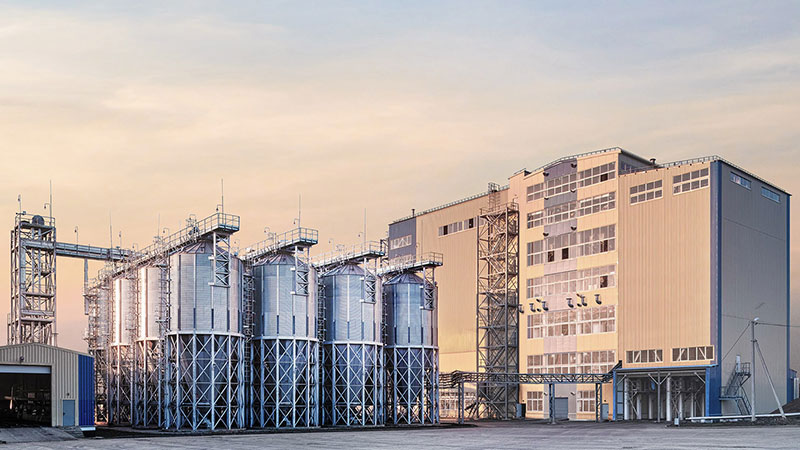
At RICHI, we go beyond project completion. With RICHI Servicee, we’re your dedicated partners in success. Count on us for expert guidance, minimal downtime, and optimized productivity. Choose RICHI for unmatched service and support.
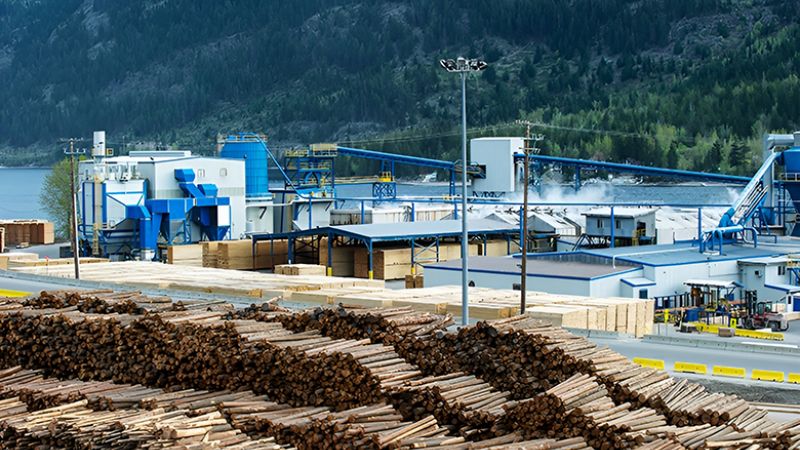


Meet global product demands and quality standards with industry-leading pellet plant design, engineering, equipment, and construction services for pellet processors.


Your Partner Beyond Project Completion
2000+ cases
RICHI is the leading designer, manufacturer and builder of pellet plants in the world, completing over 2000 projects in 140 countries across 6 continents.
Read More
Increase plant productivity, profitability, and safety by integrating high quality equipment into your pellet production line. Over the years, RICHI has become China's top pellet equipment manufacturer. At the same time, RICHI has established valuable partnerships with the world's leading component and raw material manufacturers to bring you the best there is in technology, automation, and efficiency in pelleting plant machinery.

For nearly 30 years, RICHI has been providing best-in-class pellet plant equipment and services to clients across a variety of industries, sizes, and needs. We pride ourselves on the knowledge and skill that each team member possesses – from our technical sales team to our process design engineers. You can count on RICHI Machinery to take your operation to the next level of innovation, quality, and success.
Need help with your pellet manufacturing plant project? Contact us today.
ANIMAL FEED
BIOMASS
WOOD
ORGANIC FERTILIZER
AQUA FEED
CAT LITTER
MUNICIPAL WASTE RECYCLING
SPECIAL PELLET PRODUCTION
RICHI Machinery continues to deliver world class pellet mill equipment, pellet plant engineering and project solutions that add value to our customers in the animal feed, wood waste, agriculture waste, organic fertilizer, cat litter and special pellet products industries. Throughout the years, we RICHI Machinery have built strong brand, becoming industry-leading pellet machine manufacturer. We value integrity, promise quality, and prioritize your success.
Learn MoreWith our expert team, we precisely implement your process engineering requirements in pellet mill and pelletizing plant systems. No matter which industry you’re in – we understand your needs and deliver solutions that meet the highest standards.
At RICHI, quality comes first. Our pellet making machine and related pellet line equipment undergo rigorous quality controls to ensure they meet the highest standards. Rely on products that are durable, safe, and efficient.
With decades of experience in pellet machine and pellet production line production, we have earned a reputation as a trusted partner in various industries. Our expertise allows us to cover a wide range of applications.
Not only do we offer premium pelleting equipment, but we are also experts at designing, building, installing, and maintaining facilities from the ground up. Our expertise is within pellt plant process design, discovering the most efficient, productive, and profitable way to handle your materials in an end-to-end cycle.
○ RICHI MACHINERY
Keeping in touch with us is an effective way to solve all your problems. If you have any needs or questions, please leave your contact information, then RICHI technical consultants will send design, quotation, videos to your mailbox. You can also contact us directly via WhatsApp: +86 13838389622
Copyright©2015-2026 by HENAN RICHI MACHINERY CO., LTD. All rights reserved.