
This biomass pellet production line in Chile was developed for a cooperative of approximately 40 sawmill operators in the Biobío region who pooled their resources to transform forestry residues into a commercial fuel product.
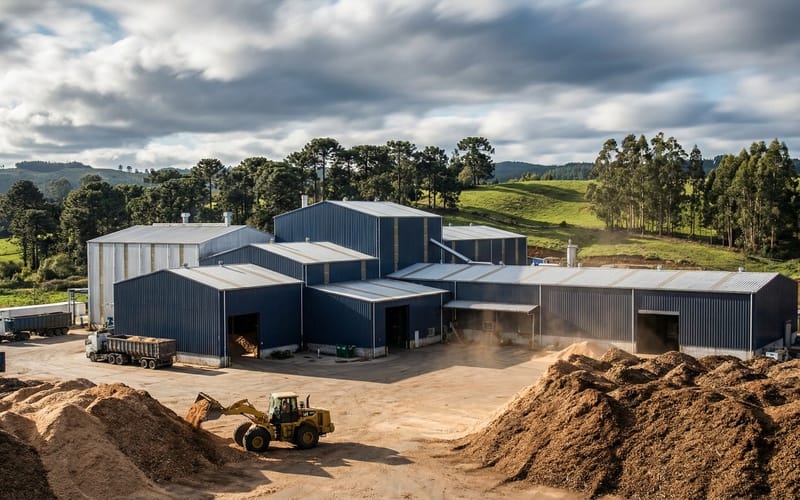
This biomass pellet production line in Chile was developed for a cooperative of approximately 40 sawmill operators in the Biobío region who pooled their resources to transform forestry residues into a commercial fuel product.
The facility, located just outside Los Ángeles, processes Pinus radiata sawdust, wood chips, and planer shavings from member operations into 6mm and 8mm premium wood pellets for residential and industrial heating applications. RICHI Machinery supplied a complete 7-8 tons per hour system including the biomass pellet mill, FSP80C hammer mill, counterflow cooler, and bagging equipment, with total installed power of approximately 590 kW.
The project addresses a critical environmental and economic challenge facing Chile's forestry sector: the management of sawmill residues under tightening emissions regulations. By consolidating waste streams from dozens of independent mills, the cooperative achieves economies of scale that individual operators could not access, producing 20,000 tons annually from a 1,260 m² enclosed facility.
The plant's location near the Ruta 5 highway provides efficient access to the central-south heating market, where pellet heating is increasingly competitive with electricity and propane as new emission standards drive adoption of automated pellet heaters.
Name:
biomass waste pellet plant
Country:
Chile
Date:
December 2024
Capacity:
7-8 tons/hour
Annual output:
20,000 tons/year
Raw Material:
Pinus radiata sawdust, wood chips, shavings
Control Mode:
Automatic
End Product:
6mm and 8mm
I got the call from our sales team in September 2024. A group of sawmill operators in the Biobío region about 40 of them, mostly family-owned had pooled resources to build a centralized pellet plant. For years, they'd been sitting on mountains of sawdust and wood chips, paying to have it hauled away or just burning it in tepee burners which are increasingly restricted under Chile's new decontamination plans. They wanted to turn that waste stream into a revenue stream.
The timing made sense. Chile's pellet market is in what the locals call a consolidation phase production hit about 220,000 tons in 2024, and new plants are coming online every year, mostly from the central zone down to the south. Biobío alone accounts for over 70% of the country's pellet production. The forestry industry here is massive, and where you find sawmills, you find residue.
But here's the thing: most of the existing plants are small 1-2 t/h lines cobbled together with second-hand equipment. The cooperative wanted something bigger. They wanted a 7-8 t/h biomass pellet production line in Chile that could actually compete on volume and quality with the imports from Canada and Europe. That's where we came in.
I flew into Santiago, then caught a connection to Carriel Sur airport in Concepción. From there, it's about an hour's drive southeast to Los Ángeles. The site was an old sawmill yard about 2,000 square meters total situated right off the Ruta 5 south highway. Good truck access, which matters when you're moving 20,000 tons of finished product per year.
The ground was packed clay, relatively flat. The client had already poured the slab for the production building a 1,260 m² steel structure, 10 meters at the eaves. Fully enclosed, which is critical here. You get rain, and wet sawdust is a nightmare. The office and dormitory building was going up next to it two stories, with a small kitchen on the ground floor and bunks upstairs for the night shift operators. The crew here runs 330 days a year, two shifts. Twelve people total ten operators and two supervisors.
What struck me was how organized the raw material yard was. They had three separate piles: fresh sawdust from the mills (50%+ moisture), kiln-dry shavings from a furniture manufacturer (12-15% moisture), and chipped logging residues. The plan was to blend these to control the feed moisture going into the dryer. Smart.
| Area | Dimensions/Size | Function |
|---|---|---|
| Production Building | 1,260 m² (enclosed, 10m eave height) | Main processing line |
| Raw Material Storage | 400 m² (within production building) | Green sawdust, chips, shavings |
| Semi-finished Storage | 60 m² (within production building) | Ground material buffer |
| Finished Product Storage | 320 m² (within production building) | Bagged pellets (30kg & 50kg sacks) |
| Office/Dormitory | 2 stories | Admin, meals, overnight crew |
| Hazardous Waste Storage | 5 m² | Oils, lubricants, contaminated rags |
| Weighbridge | 30 m² | Incoming/outbound weighing |
You can't design a biomass pellet production line in Chile without understanding the feedstock. Pinus radiata is the dominant species here fast-growing, relatively low density, but consistent. The client's raw material breakdown looked like this:
| Material | Annual Usage (tons) | Max On-Site Storage (tons) | Source |
|---|---|---|---|
| Sawdust (green) | ~12,000 | 1,200 | Member sawmills |
| Wood chips | ~5,000 | 500 | Logging residue |
| Planer shavings | ~3,000 | 300 | Furniture manufacturer |
| Total | 20,000 | 2,000 |
The green sawdust comes in at 50-55% moisture. The target for pelletizing is 12-15%. That means we have to remove about 40 percentage points of moisture. That's a lot of water, and it takes energy. The client had budgeted for a biomass dryer, but we had to size it carefully.
The client originally sent us a list of equipment they'd seen at a trade show some Chinese machines, some Brazilian. We sat down with them in Santiago and walked through the process step by step. In the end, they went with our full recommendation. Here's what we put in:
| Equipment | Model/Specs | Quantity | Power (kW) | Notes |
|---|---|---|---|---|
| Screw Feeder | Variable frequency | 1 | 5.5 | Metered infeed to crusher |
| Coarse Crusher | XPJ1400 | 1 | 75 | Reduces chips to <30mm |
| Coarse Crusher Outfeed Conveyor | 8m, head height 4m | 1 | 4 | Magnetic head pulley |
| Fine Crusher (Hammer Mill) | FSP80C | 1 | 160 | Screen size 6-8mm for final grind |
| Fine Crusher Outfeed Conveyor | 8m, head height 4m | 1 | 4 | Enclosed, with magnets |
| Biomass Pellet Machine | MZLH | 2 | 250 | 7-8 t/h rated, ring die 6/8mm |
| Pellet Mill Outfeed Conveyor | 8m, head height 4m | 2 | 4 | To cooler |
| Counterflow Cooler | Matched to 8 t/h | 1 | 7.5 | Reduces pellet temp to <5°C above ambient |
| Vibrating Screener | 3 kW | 1 | 3 | Removes fines before bagging |
| Bagging Machine | Semi-automatic | 1 | 5.5 | 30kg and 50kg bags |
| Air Compressor | Screw type | 1 | 22 | For pneumatics |
| Baghouse Dust Collector | 5,000 m³/h | 1 | 15 | With 15m stack |
| Fans | Various | Several | ~30 total | For pneumatic conveying |
| Total Installed Power | ~590 kW |
We also supplied the electrical control panel with a PLC, but the client sourced the transformers and cabling locally saved them on shipping.
The biomass pellet mill is the workhorse. 250 kW, ring die, capacity matched to the hammer mill. We spent a lot of time talking about die specs. For pine, we recommended a compression ratio of around 1:5 for the 6mm die. The client wanted the flexibility to run both 6mm (residential stoves) and 8mm (industrial boilers), so we supplied two dies.
Standing on the floor, watching the line run for the first time that's the moment. Here's how it works:
Front-end loader dumps raw material into the receiving pit. Screw feeder meters it onto the conveyor. The operator controls the speed from the panel, matching feed rate to the crusher load.
The XPJ1400 eats the big chips and chunks. It's a low-speed, high-torque machine handles the occasional nail or rock without catastrophic failure though we told them to be careful with metal. Outfeed conveyor has a magnetic pulley to pull out ferrous scrap.
The biomass hammer mill runs at 160 kW. This is where the magic happens. The hammers swing, the screens size the material. We started with 6mm screens for the first run, but they'll switch to 8mm for industrial pellets. The mill is loud we built an insulated enclosure around it per the environmental permit.
Ground material goes into the bin above the MZLH. The biomass pellet mill runs continuously. We conditioned the material with steam the client had a small electric boiler for startup, but they're planning to add a biomass boiler later to use their own fines as fuel. The rolls press the material through the die, knives cut the strands, and hot pellets (80-90°C) pour out like golden rain.
Pellets go up the drag conveyor to the counterflow cooler. Ambient air pulls upward through the moving pellet bed. In 15-20 minutes, they're down to within 5°C of ambient. Then they hit the vibrating screener. Fines drop out (recycled back to the mill), and on-spec pellets go to the bagging bin.
The bagging machine is semi-automatic operator hangs the bag, the scale fills to 30 or 50 kg, and it drops to a roller conveyor for stitching. Bagged pellets get forklifted to the finished product storage area (320 m²). They stack three pallets high.
Chile's environmental rules are tightening. The new Solid Biofuels Law is being drafted, and emission standards for heaters and boilers are coming. For the plant itself, the main concerns are dust and odor though pine doesn't smell bad.
Captured dust goes back into the process via a screw conveyor under the baghouse. It's not wasted. The exhaust goes up a 15m stack (DA001). During performance testing, we measured outlet particulates well below the Chilean standard which is similar to EPA levels.
| Utility | Annual Consumption | Unit Cost (Est.) | Annual Cost (USD) |
|---|---|---|---|
| Electricity | 1,100,000 kWh | $0.12/kWh | $132,000 |
| Water | 475 m³ | $1.50/m³ | $712 |
| Lubricants | 0.05 tons | $3,000/ton | $150 |
| Total Utilities | ~$133,000 |
| Category | Cost (USD) | Notes |
|---|---|---|
| Land lease | $15,000/year | 2,000 m² industrial land, 5-year renewable |
| Site preparation & foundations | $85,000 | Slab, drainage, electrical trenching |
| Building construction | $220,000 | 1,260 m² steel structure, office/dorm |
| RICHI process equipment (FOB Qingdao) | $450,000 | Crushers, mills, conveyors, pellet mill, cooler, screener, baghouse, controls |
| Shipping (Qingdao to San Antonio) | $65,000 | 40' containers and flat racks |
| Customs clearance & inland freight | $28,000 | San Antonio port to Los Ángeles site |
| Installation (local labor + RICHI supervision) | $95,000 | 8 weeks onsite for our team |
| Electrical installation | $62,000 | Transformers, cabling, panel connection |
| Project management & contingencies | $40,000 | |
| Total Project Cost | ~$1,060,000 |
Chile imports very few pellets the local industry supplies nearly all domestic demand. And demand is growing. Heating with pellets is cheaper than electricity or propane in most of the country, and with the new emission standards coming for wood stoves, people are switching to automated pellet heaters.
The Biobío region is the heart of the industry. Having a 7-8 t/h biomass pellet production line in Chile here means you're close to both the raw material and the customers.
The cooperative model makes sense, too. Instead of 40 sawmills each struggling with their own waste, they have one central plant turning that waste into a high-value product. The payback period on this line, based on current pellet prices ($250-300/ton wholesale), is around 3-4 years.
This was a good biomass pellet project. The client knew what they wanted, the site was well-prepared, and the local contractors were professional. The biomass pelletizer fired up on the first try and ran smoothly through the week-long performance test. We hit 7.5 tons/hour on 6mm pine pellets, with less than 2% fines.
If you're sitting on forestry or ag waste in Chile and thinking about a pellet line, get in touch. We'll help you figure out the numbers the real numbers, not the brochure numbers. And if you're anywhere near Los Ángeles, stop by this plant. They'll show you around. Just don't mention the dryer.
Having the right mix of reliable, high-quality pellet machine and pelletizing systems and expert support is essential to your success. Watch how our end-to-end feed pellet plant solutions have helped our customers optimize their performance.
Our customized and future-proofed turnkey pellet plant solutions is designed with you at the core. From vision to reality and beyond, our team stays connected with yours. Giving you peace-of-mind with an expert at your side.
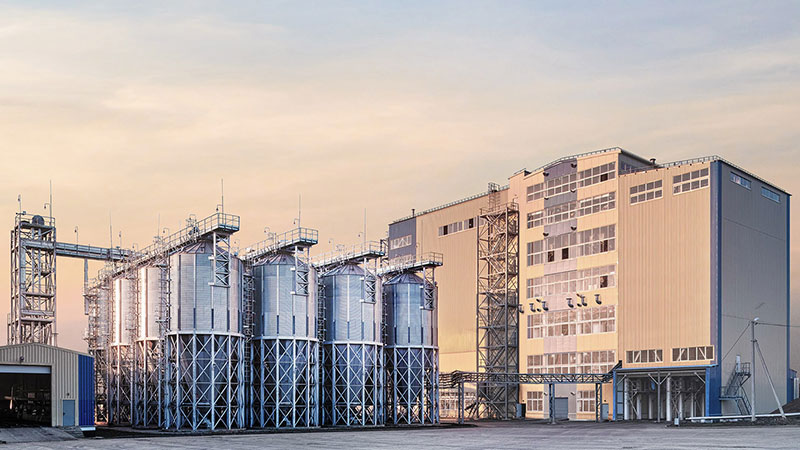
At RICHI, we go beyond project completion. With RICHI Servicee, we’re your dedicated partners in success. Count on us for expert guidance, minimal downtime, and optimized productivity. Choose RICHI for unmatched service and support.
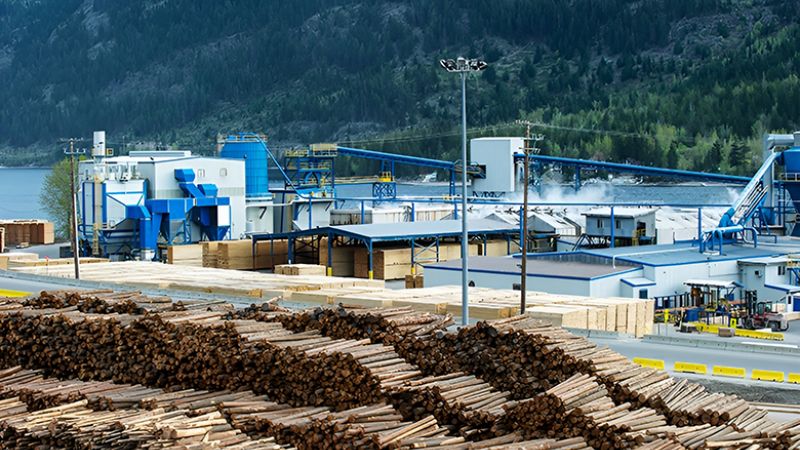


Meet global product demands and quality standards with industry-leading pellet plant design, engineering, equipment, and construction services for pellet processors.


Your Partner Beyond Project Completion
2000+ cases
RICHI is the leading designer, manufacturer and builder of pellet plants in the world, completing over 2000 projects in 140 countries across 6 continents.
Read More
Increase plant productivity, profitability, and safety by integrating high quality equipment into your pellet production line. Over the years, RICHI has become China's top pellet equipment manufacturer. At the same time, RICHI has established valuable partnerships with the world's leading component and raw material manufacturers to bring you the best there is in technology, automation, and efficiency in pelleting plant machinery.

For nearly 30 years, RICHI has been providing best-in-class pellet plant equipment and services to clients across a variety of industries, sizes, and needs. We pride ourselves on the knowledge and skill that each team member possesses – from our technical sales team to our process design engineers. You can count on RICHI Machinery to take your operation to the next level of innovation, quality, and success.
Need help with your pellet manufacturing plant project? Contact us today.
ANIMAL FEED
BIOMASS
WOOD
ORGANIC FERTILIZER
AQUA FEED
CAT LITTER
MUNICIPAL WASTE RECYCLING
SPECIAL PELLET PRODUCTION
RICHI Machinery continues to deliver world class pellet mill equipment, pellet plant engineering and project solutions that add value to our customers in the animal feed, wood waste, agriculture waste, organic fertilizer, cat litter and special pellet products industries. Throughout the years, we RICHI Machinery have built strong brand, becoming industry-leading pellet machine manufacturer. We value integrity, promise quality, and prioritize your success.
Learn MoreWith our expert team, we precisely implement your process engineering requirements in pellet mill and pelletizing plant systems. No matter which industry you’re in – we understand your needs and deliver solutions that meet the highest standards.
At RICHI, quality comes first. Our pellet making machine and related pellet line equipment undergo rigorous quality controls to ensure they meet the highest standards. Rely on products that are durable, safe, and efficient.
With decades of experience in pellet machine and pellet production line production, we have earned a reputation as a trusted partner in various industries. Our expertise allows us to cover a wide range of applications.
Not only do we offer premium pelleting equipment, but we are also experts at designing, building, installing, and maintaining facilities from the ground up. Our expertise is within pellt plant process design, discovering the most efficient, productive, and profitable way to handle your materials in an end-to-end cycle.
○ RICHI MACHINERY
Keeping in touch with us is an effective way to solve all your problems. If you have any needs or questions, please leave your contact information, then RICHI technical consultants will send design, quotation, videos to your mailbox. You can also contact us directly via WhatsApp: +86 13838389622
Copyright©2015-2026 by HENAN RICHI MACHINERY CO., LTD. All rights reserved.