
A Wheat Straw Hammer Mill in Austria was purchased by an agricultural cooperative in Lower Austria to process locally collected wheat straw into controlled particle sizes for bedding, agricultural use and other downstream applications.
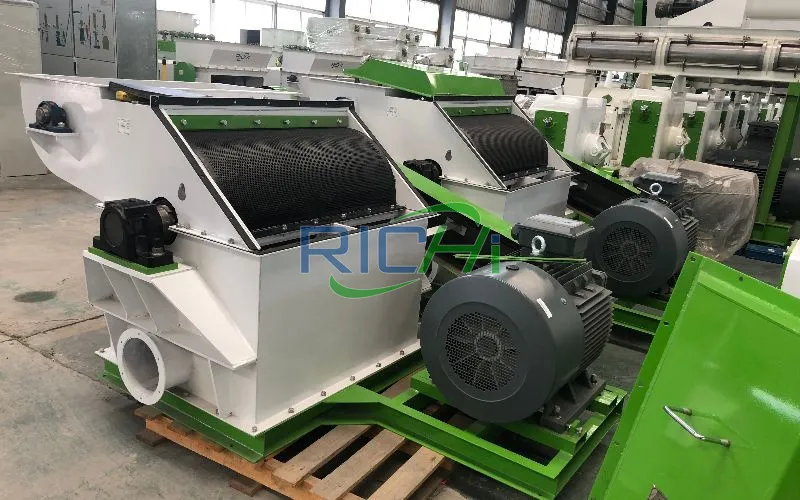
A Wheat Straw Hammer Mill in Austria was purchased by an agricultural cooperative in Lower Austria to process locally collected wheat straw into controlled particle sizes for bedding, agricultural use and other downstream applications. The cooperative already had straw baling, storage and preliminary bale-breaking equipment, so it did not need a complete straw processing line.
RICHI supplied one SFSP66*80 hammer mill with a 75 kW main motor and several interchangeable screens. By adding the grinder to its existing system, the cooperative can now change the size of processed wheat straw according to different orders instead of selling all of its straw in the same unprocessed form.
Name:
Wheat Straw Grinder
Country:
Austria
Date:
2025
Capacity:
5T/H
Model:
SFSP66*80
Main Motor Power:
75 kW
Raw Materials:
Wheat straw
Final product size:
0.5-20mm
Lower Austria is an important agricultural region, and cereal cultivation provides farms and cooperatives with considerable quantities of straw after harvest. For this customer, wheat straw was not a new raw material. The cooperative had been collecting and baling it for years.
The problem was that baled straw offered limited flexibility. Some customers could use long straw directly, while others required material that had already been reduced to a more uniform size. The cooperative's existing chopper could perform basic size reduction, but particle size varied considerably and changing the finished specification was inconvenient.
This became the reason for purchasing a Wheat Straw Hammer Mill in Austria. Instead of increasing straw collection, the cooperative wanted to get more value from material it already controlled.
The project was also a standalone machine purchase. Bale handling equipment, a storage shed and basic conveying facilities were already available. Replacing those systems with a completely new line would have added cost without solving the actual bottleneck.
Before equipment selection, the customer discussed straw condition, required output and finished particle sizes with RICHI. Wheat straw is lightweight and fibrous, so grinding performance depends not only on motor power but also on straw length before grinding, moisture, feeding stability and screen opening.
RICHI recommended the SFSP66*80 with a 75 kW main motor for the customer's medium-scale operation. The cooperative also ordered different screens so that one machine could serve several processing requirements.
| Project Item | Specification |
|---|---|
| Equipment | Wheat straw hammer mill |
| Model | SFSP66*80 |
| Main Motor Power | 75 kW |
| Raw Material | Baled wheat straw after preliminary breaking |
| Screen Options | 6 mm, 8 mm and 12 mm |
| Project Type | Standalone machine added to an existing straw handling system |
| Main Applications | Bedding and prepared straw for further utilization |
The use of several screens was more important to this customer than simply purchasing a larger hammer mill. Screen opening influences the particle-size distribution and also affects production capacity. A finer screen generally requires more grinding work and can reduce hourly throughput compared with a coarser screen under otherwise similar conditions.
The cooperative's main raw material is wheat straw collected from member farms after grain harvest. Straw is baled in the field and moved to covered storage before processing. The customer pays attention to keeping the material reasonably dry because excessively wet straw is more difficult to grind consistently and creates additional storage problems.
Whole bales do not enter the hammer mill directly. The cooperative already owns equipment for opening the bales and reducing long, tangled straw into a condition that can be fed more evenly.
After preliminary breaking, the loose straw passes through a controlled feeding arrangement before entering the grinding chamber. Inside the Wheat Straw Hammer Mill in Austria, rapidly moving hammers repeatedly impact the material. Straw that has reached a suitable size passes through the installed screen, while oversized material remains in the grinding chamber for further reduction.
This screen-controlled process provides much better particle-size consistency than the cooperative's previous basic chopping method.
The cooperative did not want to produce only one type of ground straw. Different customers had different handling requirements, so RICHI supplied 6 mm, 8 mm and 12 mm screens.
The customer can therefore change the screen according to production orders rather than keeping three separate grinding machines. Actual finished particle distribution is not identical to the nominal screen opening because straw shape, fiber structure, moisture and hammer mill operating conditions also influence the result.
This flexibility is one of the main reasons the SFSP66*80 suited the project.
Wheat straw behaves differently from dense granular materials. Its low bulk density means that a large physical volume may represent relatively little weight, while long fibers can bridge or feed unevenly if the upstream preparation is poor.
For that reason, RICHI considered the customer's bale breaker and feeding arrangement when configuring the Wheat Straw Hammer Mill in Austria. Simply installing a powerful motor would not solve inconsistent production if straw arrived at the grinding chamber in irregular clumps.
Stable feeding helps maintain motor load, grinding efficiency and particle-size consistency. It also reduces the likelihood of sudden overloading caused by large masses of straw entering the machine at once.
The cooperative retained its existing bale-breaking equipment because it was suitable for the required throughput. The new hammer mill therefore became the fine size-reduction stage rather than replacing every piece of upstream equipment.
Dry straw grinding inevitably produces airborne fine material. This needs to be considered when designing a commercial straw processing workshop.
The customer already understood this issue from its previous straw handling operations. The new grinding section was therefore arranged with material collection and dust-control equipment rather than allowing the hammer mill to discharge uncontrolled into the building.
RICHI discussed cyclone separation, aspiration and appropriate dust collection with the customer according to the workshop arrangement. Good dust management helps keep the processing area cleaner and reduces unnecessary accumulation around motors, bearings and other equipment.
Foreign-material control is equally important. Agricultural straw can occasionally contain wire, metal fragments, stones or other contaminants collected during baling and handling. Suitable upstream separation should therefore be considered before material reaches a high-speed hammer mill.
The cooperative's first market remains agricultural. Coarser processed straw can be supplied for bedding where customers want material that is easier to distribute than long baled straw. The ability to produce a more uniform specification also makes it easier for the cooperative to respond to buyers with specific handling requirements.
Finer straw creates additional possibilities. Depending on customer requirements and further processing, reduced wheat straw can be considered for substrate preparation, biomass processing, fiber-based products and other agricultural or industrial applications.
The customer does not assume that every screen size automatically creates a premium product. Instead, grinding specifications are selected according to actual orders.
This is a more sustainable business model for the cooperative. One raw material can be prepared in several ways, while the Wheat Straw Hammer Mill in Austria remains the same core machine.
For RICHI, this project was not an opportunity to sell the largest possible equipment package. The cooperative already had much of the infrastructure needed around the grinder.
The technical discussion therefore concentrated on whether the SFSP66*80 could integrate with the existing bale breaker, feeding equipment and workshop layout. Motor requirements, inlet arrangement, discharge connection, screen replacement and maintenance access were considered before manufacturing.
This is particularly important for a standalone wheat straw grinding machine. Unlike a complete production line designed by one supplier, the new equipment has to connect with machines that are already installed.
RICHI also discussed spare screens, hammers and other wear parts with the customer. Straw is less abrasive than some high-silica agricultural residues, but hammers and screens are still working components and require inspection during long-term operation.
Austria is landlocked, so the equipment could not be shipped directly to an Austrian seaport. The Wheat Straw Hammer Mill in Austria was arranged for ocean shipment from Qingdao Port in China to the Port of Koper in Slovenia, an important Adriatic gateway for Central European cargo.
Before shipment, RICHI prepared the hammer mill and associated components for sea transportation and supplied the customer with the necessary equipment drawings and technical information.
For a standalone project, this preparation is particularly useful because the customer can work on foundations, electrical connections and surrounding equipment while the machine is in transit.
After operating the machine through its first main straw-processing period, the cooperative reported that the biggest improvement was not simply higher output. The more useful change was being able to produce a repeatable straw specification.
The customer found that the coarse screen was suitable when production speed and a more fibrous product were priorities, while finer screens required a different balance between feed rate and particle size. Operators gradually established their own settings for the wheat straw available from member farms.
Screen replacement also gave the cooperative flexibility that the old chopper did not provide. When an order changes, the company can adjust the grinding specification instead of telling the buyer that only one type of processed straw is available.
The customer also appreciated that RICHI had not required it to replace usable existing equipment. The SFSP66*80 solved the specific grinding problem while allowing the rest of the straw handling system to remain in service.
This Wheat Straw Hammer Mill in Austria project shows how a single machine can change the way an agricultural business uses an existing residue. The cooperative was already collecting wheat straw and already had storage and bale handling equipment. Its problem was the lack of controlled size reduction.
Adding the SFSP66*80 filled that gap.
For other farms, cooperatives or biomass processors considering a wheat straw hammer mill, equipment selection should start with the raw material and required finished size. Straw moisture, bale preparation, hourly throughput, screen opening, dust control and downstream use all affect the appropriate configuration.
A customer preparing coarse bedding material will not necessarily need the same screen or operating conditions as one grinding wheat straw before pellet production. Likewise, a company that already owns bale breakers and conveyors may need only a standalone wheat straw grinder, while a greenfield project may require a complete system from bale breaking and metal removal through grinding, conveying and dust collection.
RICHI Machinery can evaluate these conditions before recommending a wheat straw hammer mill in Austria or similar straw grinding equipment for another market. When the machine is properly matched to the existing process, a common agricultural residue can be converted into a more consistent raw material for several downstream applications without forcing the customer to invest in equipment it does not need.
Having the right mix of reliable, high-quality pellet machine and pelletizing systems and expert support is essential to your success. Watch how our end-to-end feed pellet plant solutions have helped our customers optimize their performance.
Our customized and future-proofed turnkey pellet plant solutions is designed with you at the core. From vision to reality and beyond, our team stays connected with yours. Giving you peace-of-mind with an expert at your side.
At RICHI, we go beyond project completion. With RICHI Servicee, we’re your dedicated partners in success. Count on us for expert guidance, minimal downtime, and optimized productivity. Choose RICHI for unmatched service and support.


Meet global product demands and quality standards with industry-leading pellet plant design, engineering, equipment, and construction services for pellet processors.

Your Partner Beyond Project Completion
2000+ cases
RICHI is the leading designer, manufacturer and builder of pellet plants in the world, completing over 2000 projects in 140 countries across 6 continents.
Read More
Increase plant productivity, profitability, and safety by integrating high quality equipment into your pellet production line. Over the years, RICHI has become China's top pellet equipment manufacturer. At the same time, RICHI has established valuable partnerships with the world's leading component and raw material manufacturers to bring you the best there is in technology, automation, and efficiency in pelleting plant machinery.

For nearly 30 years, RICHI has been providing best-in-class pellet plant equipment and services to clients across a variety of industries, sizes, and needs. We pride ourselves on the knowledge and skill that each team member possesses – from our technical sales team to our process design engineers. You can count on RICHI Machinery to take your operation to the next level of innovation, quality, and success.
Need help with your pellet manufacturing plant project? Contact us today.
ANIMAL FEED
BIOMASS
WOOD
ORGANIC FERTILIZER
AQUA FEED
CAT LITTER
MUNICIPAL WASTE RECYCLING
SPECIAL PELLET PRODUCTION
RICHI Machinery continues to deliver world class pellet mill equipment, pellet plant engineering and project solutions that add value to our customers in the animal feed, wood waste, agriculture waste, organic fertilizer, cat litter and special pellet products industries. Throughout the years, we RICHI Machinery have built strong brand, becoming industry-leading pellet machine manufacturer. We value integrity, promise quality, and prioritize your success.
Learn MoreWith our expert team, we precisely implement your process engineering requirements in pellet mill and pelletizing plant systems. No matter which industry you’re in – we understand your needs and deliver solutions that meet the highest standards.
At RICHI, quality comes first. Our pellet making machine and related pellet line equipment undergo rigorous quality controls to ensure they meet the highest standards. Rely on products that are durable, safe, and efficient.
With decades of experience in pellet machine and pellet production line production, we have earned a reputation as a trusted partner in various industries. Our expertise allows us to cover a wide range of applications.
Not only do we offer premium pelleting equipment, but we are also experts at designing, building, installing, and maintaining facilities from the ground up. Our expertise is within pellt plant process design, discovering the most efficient, productive, and profitable way to handle your materials in an end-to-end cycle.
○ RICHI MACHINERY
Keeping in touch with us is an effective way to solve all your problems. If you have any needs or questions, please leave your contact information, then RICHI technical consultants will send design, quotation, videos to your mailbox. You can also contact us directly via WhatsApp: +86 13838389622
Copyright©2015-2026 by HENAN RICHI MACHINERY CO., LTD. All rights reserved.