
Twin screw extruder machine in Denmark for floating fish feed and premium pet food, featuring the SPHS120×2 with a 1.5–2 T/H reference capacity and flexible production integration.
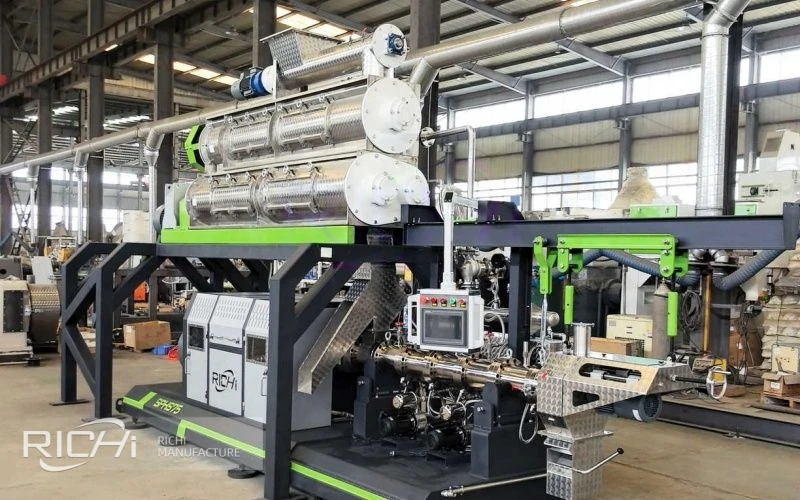
A feed producer in Jutland, Denmark, wanted to expand its product range without rebuilding its entire factory. The company supplied feed for aquaculture customers and was also developing a premium pet food business. Its existing single-screw extruder had served the plant for more than a decade, but processing more demanding formulations had become a challenge, particularly when the company needed greater control over cooking, expansion, pellet shape and texture.
Rather than replacing the complete production line, the manufacturer selected an SPHS120×2 twin screw extruder machine from RICHI Machinery as a targeted equipment upgrade. The project retained the existing grinding, mixing and drying equipment, subject to compatibility checks, while introducing a new extrusion unit for floating trout and salmon feed and selected dry dog and cat food products.
Name:
twin screw extruder machine
Country:
Denmark
Date:
2026
Capacity:
1.5–2 T/H
Model:
SPHS120×2
Main Motor Power:
90 kW
Primary applications:
Floating fish feed and extruded dog and cat food
Pellet diameter:
1.5-12mm
The investment focused on improving extrusion flexibility while keeping the scope of the project manageable. The new machine was selected around the manufacturer's intended product range and reference throughput rather than the maximum capacity available from a larger model.
| Project Item | Specification |
|---|---|
| Installation country | Denmark |
| Customer location | Jutland |
| Equipment model | SPHS120×2 twin screw extruder |
| Main motor power | 90 kW |
| Screw diameter | 120 mm |
| Reference throughput | 1.5–2 T/H, depending on formulation and operating conditions |
| Primary applications | Floating fish feed and extruded dog and cat food |
| Project scope | Single-machine upgrade to an existing feed processing facility |
| Existing equipment retained | Grinding, mixing and drying equipment, subject to capacity and compatibility verification |
For this Danish manufacturer, the main consideration was whether the new extruder could accommodate different product requirements without creating additional bottlenecks elsewhere in the factory. The available throughput therefore needed to be evaluated alongside recipe characteristics, conditioning requirements, die configuration and the capacity of the downstream dryer.
The selected model incorporates a twin-screw extrusion arrangement with a dedicated feeding and conditioning system. The feeder regulates the supply of prepared mash, while conditioning prepares the material for extrusion. The screw configuration, moisture level, temperature, screw speed and die arrangement all influence the final product.
| Technical Parameter | Specification |
|---|---|
| Model | SPHS120×2 |
| Main motor | 90 kW |
| Screw diameter | 120 mm |
| Feeder motor | 1.5 kW |
| Conditioner motor | 11 kW |
| Differential conditioner motor | 11 kW |
| Total listed motor ratings | 113.5 kW, excluding other auxiliary equipment |
| Reference capacity | 1.5–2 T/H |
The listed motor ratings provide an initial basis for electrical planning, but the final supply specification must also account for starting methods, auxiliary equipment, protective devices and the factory's electrical infrastructure. The rated throughput is a reference range rather than a guaranteed output for every fish feed or pet food formulation.
One reason for selecting a twin screw extruder was the manufacturer's intention to process both aquafeed and pet food. Although the products share some equipment requirements, their formulation and processing targets are not identical.
| Product Group | Typical Raw Material Groups | Key Extrusion Considerations | Product Targets |
|---|---|---|---|
| Floating trout and salmon feed | Grains, suitable protein meals, fishmeal, oils and vitamin-mineral premixes | Starch cooking, expansion, water stability, pellet durability and buoyancy | Uniform pellets sized for the target fish species and growth stage |
| Premium dry dog food | Cereal or alternative starch sources, poultry or other suitable protein meals, fats and nutritional premixes | Expansion, density, shape, texture and compatibility with subsequent fat coating | Consistent kibble geometry and the required hardness and texture |
| Dry cat food | Suitable animal protein ingredients, starch sources, fats and nutritional premixes | Recipe-specific cooking, die selection, density and texture control | Small, uniform kibble appropriate for the intended product specification |
As preliminary product targets, fish feed may use pellet diameters of approximately 1.5–4 mm, while dry dog and cat kibble may use approximately 5–12 mm. These are indicative ranges for product planning, not confirmed die sizes for this installation. Final dimensions depend on the intended product, feeding requirements, die design and cutter configuration.
The production team also needs separate formulation and process records for each product family. Moving between aquafeed and pet food requires an appropriate changeover and cleaning procedure, along with checks on the suitability of the shared equipment for the intended feed safety and traceability requirements.
The raw material strategy for this type of Danish operation can combine locally available agricultural ingredients with specialized protein and fat sources purchased from qualified suppliers. The formulation must be developed separately for each product rather than relying on one common recipe for fish and pet food.
Ingredient variability matters as much as the ingredient list itself. Moisture, starch content, protein level, fat content and particle size can affect extrusion stability. The operator should therefore monitor incoming material quality and adjust the processing parameters to the actual formulation.
The machine upgrade was intended to retain the factory's existing preparation and drying stages while improving the extrusion section. The practical process sequence is as follows.
Before connecting the new unit, the plant needs to confirm that its existing dryer can handle the intended product mix. Aquafeed and pet food can have different moisture-removal requirements, bulk densities and downstream finishing needs. Retaining existing equipment is practical only when its capacity and operating range match the new production plan.
A single-machine retrofit can reduce the scope of an investment, but it still requires a detailed review of the installation area, utilities and maintenance access. The following figures and requirements are preliminary planning guidance rather than verified as-built data for the Danish facility.
| Planning Item | Engineering Consideration |
|---|---|
| Electrical supply | Allow for the listed 113.5 kW of motor ratings, then calculate the complete connected load and starting requirements. |
| Steam and water | Determine the required supply conditions and consumption from the actual formulations, conditioning settings and throughput. |
| Installation footprint | Use the approved general arrangement drawing to establish the machine envelope and service clearances. Include access for cleaning, die and cutter maintenance, and screw servicing. |
| Preliminary floor-space allowance | Approximately 25–40 m² may be used as an early planning allowance for the extrusion module and immediate service access. Confirm the actual requirement against the equipment drawings and site layout. |
| Operating personnel | Two to three operators per shift may be a preliminary allowance for the extrusion station and associated material handling, depending on automation and whether dryer supervision is shared. |
| Downstream equipment | Verify dryer capacity, cooling, screening, conveying and any coating equipment against the intended production rate. |
These planning allowances should not replace a site-specific engineering review. The final layout must also provide safe access to inspection points, electrical panels and moving components, together with appropriate dust control, ventilation and maintenance isolation arrangements.
The operating team needs to establish separate process settings for each product family rather than using one temperature and moisture profile for every recipe. The initial commissioning work should focus on product quality, machine loading and downstream performance.
These checks are particularly important when an existing single-screw extruder is being replaced by a twin-screw system. Even when the nominal capacity appears suitable, the new machine may require different conditioning settings, material feeding arrangements and downstream adjustments to achieve the intended product specification.
Producing aquafeed and pet food in the same facility requires a documented approach to ingredient handling, cleaning, traceability and product changeovers. Machine construction and accessible cleaning points can support hygienic operation, but they do not by themselves establish compliance with Danish or EU requirements.
The manufacturer should verify the ordered machine's food-contact materials and cleaning provisions, maintain suitable ingredient and batch records, and ensure that the production process meets the applicable feed hygiene and product safety obligations.
For a plant handling different formulations, a practical changeover procedure should include:
The new extruder gives the manufacturer a basis for evaluating additional products without immediately replacing the complete production line. Potential development work includes alternative floating fish feed formulations, different kibble geometries and selected premium pet food recipes.
Each proposed product should first be assessed for formulation compatibility, processing requirements, die configuration, drying capacity and commercial demand. A twin screw extruder provides processing flexibility, but not every recipe or finished product can be introduced without additional trials or equipment adjustments.
This project illustrates how a twin screw extruder machine in Denmark can serve as the core of a single-machine upgrade when a feed producer wants to broaden its product range while retaining suitable existing equipment. The SPHS120×2 provides a reference throughput of 1.5–2 T/H, with its actual output depending on the recipe, process settings and complete line configuration.
For aquafeed and pet food manufacturers considering a similar investment, the key is to evaluate the extruder alongside raw material characteristics, product specifications, utilities, drying capacity and cleaning requirements. RICHI Machinery can assist with model selection, process configuration and integration planning so that the proposed equipment matches the factory's actual production objectives.
Having the right mix of reliable, high-quality pellet machine and pelletizing systems and expert support is essential to your success. Watch how our end-to-end feed pellet plant solutions have helped our customers optimize their performance.
Our customized and future-proofed turnkey pellet plant solutions is designed with you at the core. From vision to reality and beyond, our team stays connected with yours. Giving you peace-of-mind with an expert at your side.
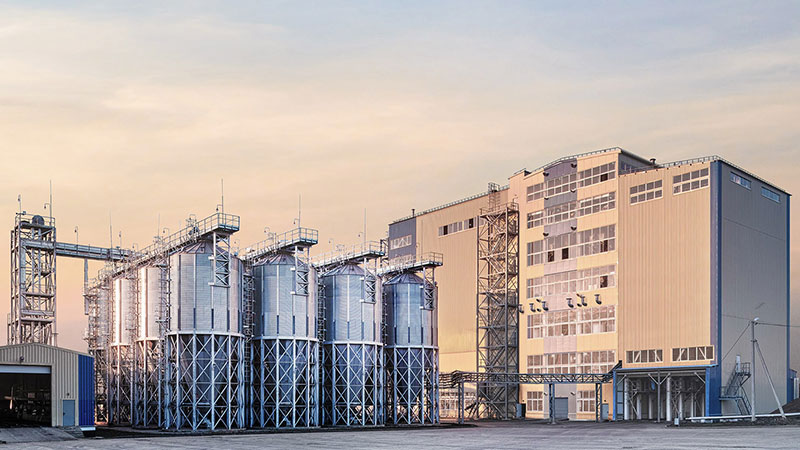
At RICHI, we go beyond project completion. With RICHI Servicee, we’re your dedicated partners in success. Count on us for expert guidance, minimal downtime, and optimized productivity. Choose RICHI for unmatched service and support.
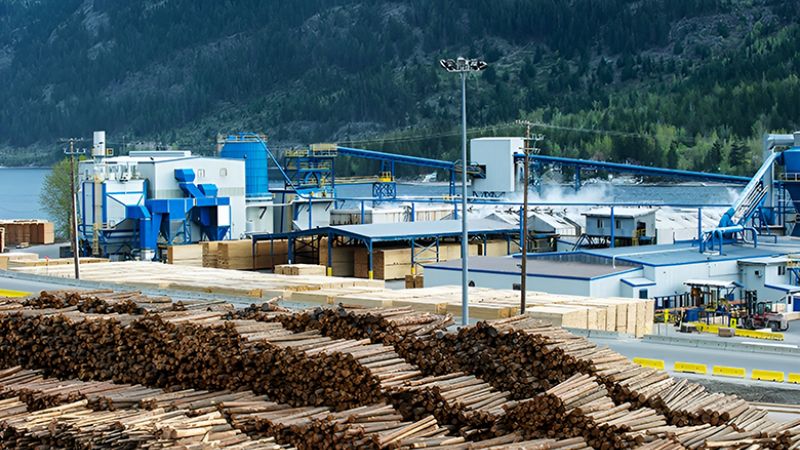


Meet global product demands and quality standards with industry-leading pellet plant design, engineering, equipment, and construction services for pellet processors.


Your Partner Beyond Project Completion
2000+ cases
RICHI is the leading designer, manufacturer and builder of pellet plants in the world, completing over 2000 projects in 140 countries across 6 continents.
Read More
Increase plant productivity, profitability, and safety by integrating high quality equipment into your pellet production line. Over the years, RICHI has become China's top pellet equipment manufacturer. At the same time, RICHI has established valuable partnerships with the world's leading component and raw material manufacturers to bring you the best there is in technology, automation, and efficiency in pelleting plant machinery.

For nearly 30 years, RICHI has been providing best-in-class pellet plant equipment and services to clients across a variety of industries, sizes, and needs. We pride ourselves on the knowledge and skill that each team member possesses – from our technical sales team to our process design engineers. You can count on RICHI Machinery to take your operation to the next level of innovation, quality, and success.
Need help with your pellet manufacturing plant project? Contact us today.
ANIMAL FEED
BIOMASS
WOOD
ORGANIC FERTILIZER
AQUA FEED
CAT LITTER
MUNICIPAL WASTE RECYCLING
SPECIAL PELLET PRODUCTION
RICHI Machinery continues to deliver world class pellet mill equipment, pellet plant engineering and project solutions that add value to our customers in the animal feed, wood waste, agriculture waste, organic fertilizer, cat litter and special pellet products industries. Throughout the years, we RICHI Machinery have built strong brand, becoming industry-leading pellet machine manufacturer. We value integrity, promise quality, and prioritize your success.
Learn MoreWith our expert team, we precisely implement your process engineering requirements in pellet mill and pelletizing plant systems. No matter which industry you’re in – we understand your needs and deliver solutions that meet the highest standards.
At RICHI, quality comes first. Our pellet making machine and related pellet line equipment undergo rigorous quality controls to ensure they meet the highest standards. Rely on products that are durable, safe, and efficient.
With decades of experience in pellet machine and pellet production line production, we have earned a reputation as a trusted partner in various industries. Our expertise allows us to cover a wide range of applications.
Not only do we offer premium pelleting equipment, but we are also experts at designing, building, installing, and maintaining facilities from the ground up. Our expertise is within pellt plant process design, discovering the most efficient, productive, and profitable way to handle your materials in an end-to-end cycle.
○ RICHI MACHINERY
Keeping in touch with us is an effective way to solve all your problems. If you have any needs or questions, please leave your contact information, then RICHI technical consultants will send design, quotation, videos to your mailbox. You can also contact us directly via WhatsApp: +86 13838389622
Copyright©2015-2026 by HENAN RICHI MACHINERY CO., LTD. All rights reserved.