
Explore a sunflower pellet granulator in Serbia for processing sunflower stalks and sunflower husks into biomass fuel pellets. Learn about the MZLH420 ring die pellet machine, raw material preparation, technical specifications and project requirements.
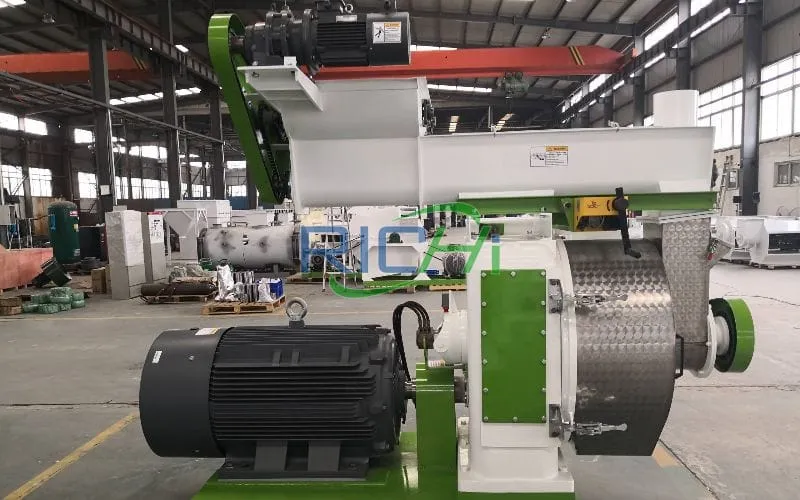
A sunflower pellet granulator in Serbia is being considered for a biomass fuel project that combines agricultural residue recovery with a practical pelletizing operation. In this representative project scenario, a Serbian agricultural biomass supplier plans to purchase one RICHI MZLH420 ring die pellet machine to process prepared sunflower stalks and sunflower seed husks into solid fuel pellets.
The buyer already has access to agricultural residues collected from sunflower-growing areas and husks supplied by nearby oilseed processors. Rather than investing immediately in a complete pellet production line, the business intends to add a single granulator to its existing material preparation operation. The purchase is intended to establish a dedicated pelletizing step and assess whether the prepared material can meet local industrial fuel requirements.
Name:
Sunflower Pellet Granulator
Country:
Serbia
Date:
2026
Capacity:
1.0–1.2 T/H
Model:
MZLH420
Main Motor Power:
90 kW
Raw Materials:
sunflower stalk, sunflower seed husks
Pellet diameter:
8 mm
Sunflower production generates more than one potentially useful biomass resource. After harvesting, the remaining stalks can be collected and processed as agricultural residue. At oilseed processing facilities, sunflower husks are separated from the kernels and can become another source of biomass material.
These two materials behave differently during pelletizing. Sunflower stalks contain fibrous plant tissue, while sunflower husks have a different particle structure and compression behavior. A suitable mixture may make use of both local resources, but the proportions must be established through material testing rather than assumed to work equally well with every batch.
For this project, the initial trial formula is set at 65% prepared sunflower stalk material and 35% sunflower seed husks by mass. This is a proposed starting point for testing, not a verified commercial formula. The buyer will need to assess pellet strength, fines, machine load and combustion characteristics before deciding whether to retain or adjust the blend.
The intended finished product is biomass fuel rather than animal feed. The granulator is expected to turn loose, prepared agricultural residues into more compact pellets that are easier to store, meter and transport. Whether those pellets can be used in a particular boiler depends on the combustion system, fuel specifications and ash behavior.
The proposed customer is an agricultural biomass supplier that collects crop residues and prepares them for further use. Its existing activities cover raw material sourcing, seasonal collection and preliminary size reduction. The missing stage is densification, which would allow the business to offer a more uniform fuel product instead of handling only loose residues.
A single-machine purchase makes sense at this stage because the buyer wants to evaluate a new product without committing to a complete automated plant. Existing chopping, grinding and drying equipment can be retained where it is suitable for the incoming material. The new MZLH420 biomass pellet mill would be installed downstream of those operations and dedicated to pellet formation.
This arrangement also gives the buyer an opportunity to learn which raw material combinations are most practical. If stalk-rich batches require different grinding conditions from husk-rich batches, the preparation process can be adjusted before material reaches the granulator. A larger line can be considered later if a stable supply and reliable demand are established.
The purchase is therefore not a replacement of an entire production system. It is an additional processing machine intended to connect the buyer's existing residue preparation activities with a new biomass pellet product.
The selected model is the MZLH420 ring die biomass pellet machine. Its reference capacity of 1.0–1.2 T/H is suitable for evaluating a moderate-volume pelletizing operation supplied by prepared agricultural residues. Actual production will depend on the sunflower stalk particle size, husk proportion, moisture content and the machine's operating conditions.
| Item | MZLH420 specification |
|---|---|
| Equipment type | Ring die biomass pellet machine |
| Purchase quantity | 1 unit |
| Main motor power | 90 kW |
| Anti-bridging feeder power | 3 kW |
| Forced feeder power | 1.5 kW |
| Ring die inner diameter | 420 mm |
| Reference capacity | 1.0–1.2 T/H |
| Available pellet diameter range | 4–12 mm |
| Initial target pellet diameter | 8 mm, subject to material trials |
| Conditioning system | No conditioner included |
The MZLH420 is equipped with an anti-bridging feeder and a forced feeder. These components are useful when handling prepared biomass that may not flow as consistently as uniform granular material. The anti-bridging feeder helps maintain material movement above the feeding outlet, while the forced feeder assists in delivering the prepared mixture into the pelletizing chamber.
The ring die compresses the prepared material through its die holes to form cylindrical pellets. The listed capacity is a reference value rather than a guaranteed output for every mixture. The proposed 8 mm pellet diameter must also be confirmed against the buyer's intended fuel-handling and combustion equipment.
Sunflower stalks are collected after harvesting and may arrive as long, dry stems or as chopped agricultural residues. Long stalks cannot be fed directly into the granulator in their original form. They need to be reduced in size and ground into a more uniform particle mixture suitable for compression.
For this project, the assumed preparation route uses an existing stalk chopper followed by a hammer mill. The initial target is a ground particle size of approximately 3 mm, with the final distribution confirmed during trials. This is a proposed preparation target, not a fixed requirement for every sunflower stalk formula.
Stalk material can be fibrous and relatively difficult to handle if it contains long strands. Oversized particles may interfere with stable feeding, while excessive fines can affect airflow, dust generation and the behavior of the mixture. Screening after grinding can help separate unsuitable particles where necessary.
Moisture control is equally important. The proposed working target is approximately 10–15% moisture at the granulator inlet, subject to tests with the actual material. If freshly collected stalks or stored residues exceed 20% moisture, a suitable dryer is required before pelletizing. Drying requirements depend on initial moisture, ambient conditions, throughput and the selected preparation process.
The second raw material is sunflower seed husk obtained from an oilseed processing facility. Unlike sunflower stalks, the husks are already separated from the harvested plant and may arrive as a loose, lightweight residue. Their particle size and cleanliness depend on the processing and collection arrangement.
Before blending, the husks should be checked for stones, metal fragments, excessive dust and unwanted foreign material. If the husks are already sufficiently fine and dry, they may not require the same grinding route as the stalks. The preparation system should therefore treat the two materials according to their actual condition instead of automatically sending everything through identical equipment.
The proposed 65:35 stalk-to-husk mixture is intended to use a local agricultural residue alongside a processing by-product. During commissioning, the operator should compare the initial blend with alternative proportions. A higher stalk content may change the mixture's fiber structure, while a higher husk content may alter its compression behavior and fuel characteristics.
The final ratio should be selected using measurable results, including pellet durability, fines after handling, throughput, motor load and fuel performance. If a stable blend cannot be obtained at the initial ratio, the formula and preparation conditions should be reviewed before increasing production.
The pellet machine is only one stage of the proposed operation. The complete material route begins with residue collection, inspection and separation of unsuitable material. Sunflower stalks are then chopped and ground, while the husks are checked and prepared according to their moisture and particle condition.
After the two streams are prepared, they are blended at the trial ratio and checked for consistency. The mixture then enters the granulator through its feeding system. The ring die compresses the material into pellets, which are discharged for cooling, screening and storage as required by the finished-product handling arrangement.
Because the selected machine has no conditioning system, the process relies on suitable material preparation and the mechanical compression provided by the ring die. If tests show that the material requires a different moisture level, particle distribution or additional preparation, the upstream process must be adjusted or supplementary equipment considered.
Freshly produced pellets should be allowed to cool before bulk storage or packaging. Screening can remove fines, while the collected fines may be assessed for controlled return to the process if the operating procedure permits it. The appropriate arrangement depends on product quality targets and the amount of material being processed.
For a single-machine installation, the buyer should plan enough space for feeding, discharge, inspection and maintenance. The granulator should not be treated as a stand-alone solution for every stage of biomass processing. The existing chopper, hammer mill and dryer must be checked to ensure that they can supply the selected machine at the required rate.
The primary target is biomass fuel for compatible industrial or commercial combustion equipment. Densifying sunflower stalks and husks can reduce the volume of loose residues and make the material easier to feed in systems designed for pellets. It can also simplify storage and handling compared with irregular, low-density biomass.
However, not every boiler designed for wood pellets can automatically accept sunflower-based fuel. The ash content, ash melting behavior, heating value, moisture and feeding requirements should be assessed before the product is offered to a customer. Sunflower residues may behave differently from clean wood fuel during combustion, and the receiving system must be able to manage those characteristics.
The buyer should therefore establish the target market before fixing the final pellet specification. An industrial boiler operator may require fuel analysis and combustion trials, while another customer may prioritize pellet diameter, durability and ease of handling. These requirements should guide the testing plan and the final production settings.
The same general ring die biomass pellet machine family can be configured for other suitable biomass materials, including certain types of straw, grass, sawdust and other plant residues. This does not mean all materials can be mixed indiscriminately or processed with identical settings. Each raw material has its own preparation and operating requirements.
For this biomass pellet project, the buyer needs more than a machine capacity figure. The main concern is whether the proposed equipment can handle a fibrous stalk-and-husk mixture and whether the pellet quality will be acceptable for the intended application. Model selection must therefore take into account raw material preparation, moisture control, feeding stability and the finished fuel requirements.
RICHI can review the customer's material description, particle size, moisture range, expected operating hours and required pellet diameter before confirming the equipment configuration. Where representative samples are available, material testing can help determine whether the proposed blend is suitable and whether the preparation route needs adjustment.
Technical discussions should also cover motor power, feeder arrangement, ring die selection, electrical supply, installation space and maintenance access. These details help the buyer prepare the site and understand which parts of the process are covered by the single-machine purchase and which remain part of the existing operation.
RICHI supplies biomass pellet machines for a range of agricultural and wood-based residues, as well as equipment for complete biomass pellet production lines. For a customer beginning with one granulator, the immediate priority is to select a suitable machine and establish reliable operating conditions. If production later expands, the existing preparation equipment can be reviewed as part of a broader capacity assessment.
The planned shipping arrangement is sea freight from Qingdao Port in China to the Port of Bar in Montenegro, a regional seaport used for cargo movements serving landlocked Serbia. The actual route, transit time, cargo handling requirements and final freight arrangement should be confirmed with the appointed freight forwarder before shipment.
Before dispatch, the buyer should confirm the packed dimensions and gross weight, unloading arrangements, available lifting equipment and the installation area's access conditions. Electrical requirements and foundation preparation should also be checked so the receiving team can prepare the site before the machine arrives.
In this representative project scenario, the buyer's assessment focuses on three practical questions. Can the existing preparation equipment provide a consistent mixture? Can the MZLH420 produce pellets with acceptable durability at the required rate? And can the finished pellets meet the receiving user's fuel specifications?
During initial operation, the buyer should record the moisture of the incoming mixture, the stalk-to-husk ratio, pellet diameter, fines after cooling, production rate and motor load. These records provide a sound basis for adjusting the formula and determining whether the reference capacity is achievable under the actual operating conditions.
No verified customer quotation or measured project result is available for this illustrative case. Once actual commissioning records and customer comments are available, they can be used to document feedback on material handling, pellet quality, operating stability and technical support without inventing a testimonial.
A sunflower pellet granulator in Serbia should be selected according to the raw materials available, their preparation requirements and the intended fuel application. In this project scenario, the MZLH420 is proposed as a single-machine addition with a reference capacity of 1.0–1.2 T/H and an initial target pellet diameter of 8 mm, subject to material trials.
RICHI can help assess the sunflower stalks and husks, review the proposed mixing ratio, confirm the machine configuration and identify any additional preparation or cooling equipment required. For a buyer who wants to start with one machine and expand only when the process is proven, a carefully evaluated single-machine installation offers a practical starting point. Contact RICHI to discuss a sunflower pellet granulator in Serbia or a similar biomass pelletizing application based on the actual material supply.
Having the right mix of reliable, high-quality pellet machine and pelletizing systems and expert support is essential to your success. Watch how our end-to-end feed pellet plant solutions have helped our customers optimize their performance.
Our customized and future-proofed turnkey pellet plant solutions is designed with you at the core. From vision to reality and beyond, our team stays connected with yours. Giving you peace-of-mind with an expert at your side.

At RICHI, we go beyond project completion. With RICHI Servicee, we’re your dedicated partners in success. Count on us for expert guidance, minimal downtime, and optimized productivity. Choose RICHI for unmatched service and support.



Meet global product demands and quality standards with industry-leading pellet plant design, engineering, equipment, and construction services for pellet processors.


Your Partner Beyond Project Completion
2000+ cases
RICHI is the leading designer, manufacturer and builder of pellet plants in the world, completing over 2000 projects in 140 countries across 6 continents.
Read More
Increase plant productivity, profitability, and safety by integrating high quality equipment into your pellet production line. Over the years, RICHI has become China's top pellet equipment manufacturer. At the same time, RICHI has established valuable partnerships with the world's leading component and raw material manufacturers to bring you the best there is in technology, automation, and efficiency in pelleting plant machinery.

For nearly 30 years, RICHI has been providing best-in-class pellet plant equipment and services to clients across a variety of industries, sizes, and needs. We pride ourselves on the knowledge and skill that each team member possesses – from our technical sales team to our process design engineers. You can count on RICHI Machinery to take your operation to the next level of innovation, quality, and success.
Need help with your pellet manufacturing plant project? Contact us today.
ANIMAL FEED
BIOMASS
WOOD
ORGANIC FERTILIZER
AQUA FEED
CAT LITTER
MUNICIPAL WASTE RECYCLING
SPECIAL PELLET PRODUCTION
RICHI Machinery continues to deliver world class pellet mill equipment, pellet plant engineering and project solutions that add value to our customers in the animal feed, wood waste, agriculture waste, organic fertilizer, cat litter and special pellet products industries. Throughout the years, we RICHI Machinery have built strong brand, becoming industry-leading pellet machine manufacturer. We value integrity, promise quality, and prioritize your success.
Learn MoreWith our expert team, we precisely implement your process engineering requirements in pellet mill and pelletizing plant systems. No matter which industry you’re in – we understand your needs and deliver solutions that meet the highest standards.
At RICHI, quality comes first. Our pellet making machine and related pellet line equipment undergo rigorous quality controls to ensure they meet the highest standards. Rely on products that are durable, safe, and efficient.
With decades of experience in pellet machine and pellet production line production, we have earned a reputation as a trusted partner in various industries. Our expertise allows us to cover a wide range of applications.
Not only do we offer premium pelleting equipment, but we are also experts at designing, building, installing, and maintaining facilities from the ground up. Our expertise is within pellt plant process design, discovering the most efficient, productive, and profitable way to handle your materials in an end-to-end cycle.
○ RICHI MACHINERY
Keeping in touch with us is an effective way to solve all your problems. If you have any needs or questions, please leave your contact information, then RICHI technical consultants will send design, quotation, videos to your mailbox. You can also contact us directly via WhatsApp: +86 13838389622
Copyright©2015-2026 by HENAN RICHI MACHINERY CO., LTD. All rights reserved.