
The Vietnamese buyer did not need another complete biomass plant. Its existing facility in the Mekong Delta already collected baled rice straw, opened the bales, reduced the fiber length, dried material when necessary, and stored prepared biomass under cover. The missing step was commercial densification: loose straw occupied too much space, fed inconsistently into industrial combustion systems, and was expensive to move compared with a compact pellet.
The Vietnamese buyer did not need another complete biomass plant. Its existing facility in the Mekong Delta already collected baled rice straw, opened the bales, reduced the fiber length, dried material when necessary, and stored prepared biomass under cover. The missing step was commercial densification: loose straw occupied too much space, fed inconsistently into industrial combustion systems, and was expensive to move compared with a compact pellet.
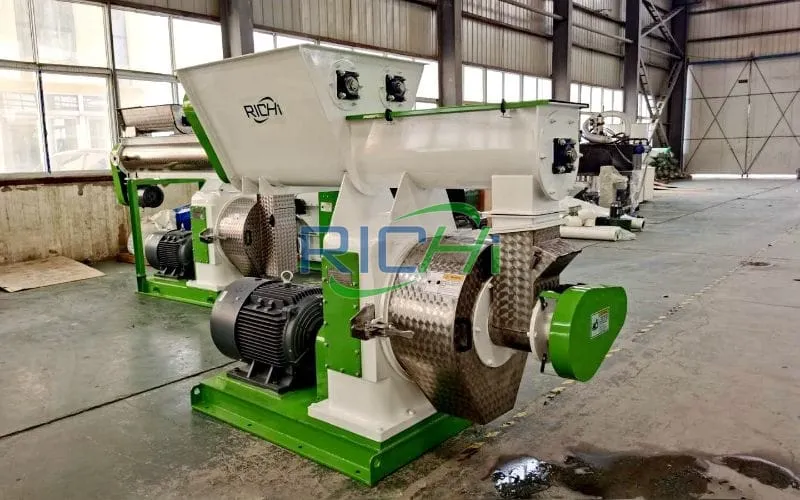
The company therefore added two MZLH420 straw pellets machines in Vietnam to its existing preparation system. Both units were configured around one product only: 8 mm rice-straw-based industrial fuel pellets. Rather than presenting the project as a small pilot, the customer sized the two machines for modular commercial production—one unit can cover routine orders, while the second can be brought online when enough prepared straw and confirmed fuel demand are available.
Name:
Straw Pelletizer Machine
Country:
Vietnam
Date:
2025
Capacity:
2.0–2.4 T/H
Model:
2* MZLH420
Main Motor Power:
90 kW
Raw Materials:
Rice Straw
Pellet diameter:
8 mm
The customer operates in the Mekong Delta, where rice harvesting generates a highly concentrated seasonal straw resource. That makes rice straw a strong basis for this project.
Its collection network works with farmers and straw-baling contractors after harvest. Baled material is moved to the processing site instead of being left as loose straw, which would create much higher storage and transport costs.
Feedstock procurement is planned by harvest season. The company does not assume that the pellet machines can be supplied continuously simply because rice is grown in the region. Straw collection still depends on weather, field accessibility, baling capacity, competing uses, moisture, and the willingness of growers to remove the residue.
Loose and chopped rice straw can already be burned in appropriately designed biomass systems, so pelletizing is not the only possible utilization route.
The customer chose pellets because its target industrial users needed a fuel that could be stored, transported, conveyed, and metered more predictably.
Densification reduces the physical handling problems associated with very low-bulk-density straw. It also gives the buyer a more standardized fuel size for automated feeding.
The value of the straw pellets machine in Vietnam therefore comes mainly from changing the physical form of the fuel. Pelletizing does not remove the mineral matter naturally present in rice straw and does not automatically make rice straw equivalent to premium wood pellets.
The customer was already aware that rice straw cannot be marketed to every boiler user.
Compared with clean woody biomass, rice straw normally contains more ash-forming minerals. Silica, potassium, chlorine, and other inorganic constituents can affect ash behavior, slagging, fouling, corrosion risk, and maintenance requirements depending on the combustion system.
For that reason, the final pellets are supplied to industrial customers whose boilers are suitable for agricultural-residue fuels or whose operators have verified the fuel through combustion trials.
The company does not sell the product under the assumption that any wood-pellet stove or small household boiler can consume it without adjustment.
Whole rice-straw bales do not enter the pellet machines.
The customer first opens the bales and removes obvious contaminants such as stones, plastic rope, metal, and excessive soil. The straw then passes through coarse chopping so that long tangled stems no longer dominate the material flow.
A secondary hammer-milling stage reduces the fiber further. For this project, the prepared material entering the pelletizing section is generally in the several-millimeter range, with long strands removed before the forced feeder.
This preparation is essential because long lightweight fibers can bridge above the straw biomass pellet mill, wrap around feeding components, and create unstable throughput even when the pelletizer itself has sufficient motor power.
Some straw reaches the collection point dry enough for further processing after favorable harvest weather. Other batches arrive too wet because of rain, high humidity, early baling, or storage conditions.
The customer therefore does not rely on a fixed rule such as “leave the straw in the field for seven days and it will be ready.”
Moisture is measured after collection.
Material above the workable pelletizing range is routed through the customer’s existing drying system before grinding and storage. Dry straw is protected from rainfall and ground moisture so that it does not absorb water again before production.
For routine pelletizing, the plant normally works around a low-teens moisture range, with the exact operating point adjusted according to die load, fiber condition, pellet strength, and final moisture after cooling.
| Project Parameter | Configuration |
|---|---|
| Equipment | Straw pellet machine |
| Model | MZLH420 |
| Quantity | 2 units |
| Main Motor Power | 90 kW per unit |
| Arch-Breaking Feeder | 3 kW per unit |
| Forced Feeder | 1.5 kW per unit |
| Ring Die Inner Diameter | 420 mm |
| Available Pellet Diameter | 4–12 mm |
| Project Pellet Diameter | 8 mm |
| Reference Capacity | Approximately 1.0–1.2 T/H per machine |
| Combined Reference Capacity | Approximately 2.0–2.4 T/H under suitable straw conditions |
The company preferred two machines because straw supply and fuel orders are not perfectly constant.
One MZLH420 can operate when daily demand is moderate. During larger fuel orders or periods when sufficient dried straw has accumulated, the second machine can run in parallel.
The arrangement also makes scheduled die and roller maintenance easier because one pelletizer does not necessarily stop the entire densification section.
Although the machine can be configured for different pellet diameters, the customer standardized its commercial rice straw fuel at approximately 8 mm.
This reduced unnecessary ring-die changes and simplified discussions with industrial fuel users.
A smaller die hole could produce a different pellet, but it would also change compression resistance, throughput, energy consumption, and durability. Larger pellets could be suitable for other combustion systems.
The selected diameter therefore reflects this project’s industrial fuel market rather than a universal specification for all straw pellets.
Ground rice straw has a much lower bulk density and different flow behavior from grain meal.
Even after fine grinding, the fibrous material can bridge inside hoppers instead of dropping steadily under gravity.
The MZLH420 configuration uses an arch-breaking feeder to keep the material moving and a forced feeder to deliver the light fiber into the pelletizing chamber more consistently.
This does not eliminate the need for proper upstream preparation. Poorly chopped straw containing long fiber bundles can still destabilize feeding.
The customer therefore treats stable particle size as part of the pelletizer’s capacity rather than something separate from it.
A ring die used successfully for sawdust should not automatically be installed for rice straw.
The two materials differ in fiber structure, bulk density, ash, natural binding behavior, and friction inside the die.
During commissioning, the customer evaluated pellet strength together with main-motor load and throughput.
If compression is excessive, power demand increases and production falls. If it is too low, pellets leave the machine with inadequate mechanical strength and create excessive fines during downstream handling.
The final die specification was therefore selected around the customer’s actual rice straw rather than copied from another biomass project.
The two machines were not immediately operated at their highest combined reference capacity.
Commissioning started with one MZLH420.
Operators established stable feeding, monitored motor current, evaluated pellet surface condition, and checked the amount of fines created after cooling. Only after a repeatable operating window had been established was feed rate increased.
The second machine was then commissioned using the same prepared material.
This approach gave the customer a meaningful production baseline before parallel operation began.
Hot straw pellets leaving the ring die are not ready for storage.
They first enter the customer’s existing cooling section so that temperature and residual process moisture can stabilize.
The cooled product is screened to remove loose fines and broken pieces.
Acceptable clean fines can be returned to the preparation section where appropriate. Finished 8 mm pellets continue to storage and dispatch.
This downstream treatment is especially important for an industrial fuel that will travel through conveyors, storage bins, trucks, and boiler feeding systems. High fines content can create dust and less predictable fuel handling.
The commercial installation is focused on industrial fuel.
This makes raw-material control, die selection, quality testing, storage, and sales much clearer.
Animal bedding has different expectations for absorbency, hygiene, dust, granule breakdown, and livestock safety. Biochar production is another downstream thermal process with its own feedstock requirements.
The customer may evaluate these markets separately in the future, but they are not part of the current MZLH420 production application.
The company provides representative pellet samples before committing large volumes to a new thermal user.
The buyer can evaluate calorific value, moisture, ash, bulk density, pellet durability, chlorine, and other parameters relevant to the boiler.
A combustion trial is particularly useful because ash behavior cannot be judged only from pellet appearance.
This testing also prevents unrealistic comparisons with wood pellets. Rice straw pellets can be an effective agricultural-residue fuel in the right system, but they are a different fuel class with different combustion characteristics.
A combined reference output around 2.0–2.4 T/H requires a meaningful straw supply.
At 2.2 T/H, six net pelletizing hours correspond to roughly 13 tonnes of finished pellets in a day. The customer therefore needs more than occasional truckloads of straw from one farm.
Its collection model relies on multiple farmers and baling contractors across a defined sourcing radius.
This is one reason the Mekong Delta is a credible location: straw generation is concentrated enough for mechanized collection and aggregation to become practical, while the project remains small enough that the customer does not need to control a huge regional straw market.
Rice straw becomes available in concentrated periods around harvest rather than in perfectly even daily quantities.
The company therefore separates collection capacity from pelletizing capacity.
During favorable harvest periods, the priority can shift toward baling, transporting, drying, and protecting straw. Pellet production can then continue from stored prepared material after the field collection peak has passed.
Covered storage is important because letting dried straw absorb monsoon moisture would add unnecessary drying cost later.
The two MZLH420 units were shipped from Qingdao Port in China to southern Vietnam.
For a Mekong Delta project, the customer selected a major southern container gateway and then arranged inland delivery to the biomass facility.
Before shipment, RICHI provided equipment dimensions, electrical requirements, foundation information, feeder connection data, discharge elevations, and recommended maintenance clearances.
This allowed the customer to modify its existing workshop while the machines were being manufactured and transported.
The customer’s older conveyors had been sized for chopped straw rather than continuous feeding of two pellet machines.
During integration, the technical team checked whether the upstream bin and conveying equipment could actually supply both MZLH420 units at the required rate.
The same review was carried out downstream.
A cooler or conveyor sized for one tonne per hour can become the bottleneck immediately if two biomass pellet machines are capable of producing more than two tonnes per hour together.
This prevented the common mistake of looking only at pellet-machine nameplate capacity while ignoring the equipment around it.
“The two pellet mills are quite predictable when the straw entering them is predictable. Our biggest variation comes from the field. One batch is dry and clean, another contains more soil or arrives after rain. Once we tightened our receiving rules and stored the straw properly, the pelletizing section became much easier to operate.”
The company subsequently introduced clearer acceptance standards for collected straw.
Loads with excessive soil, moisture, mould, or foreign material are separated rather than mixed into a good production batch simply to increase tonnage.
Production records now include throughput, main-motor load, electricity use, fines percentage, finished moisture, ash test results, die and roller condition, and rejected raw material.
This gives management a better picture of the economics than a single maximum T/H figure.
A high-output shift processing dirty straw may create more wear and poorer fuel than a slightly slower shift using clean, well-prepared material.
The customer therefore evaluates usable finished pellets per tonne of collected straw rather than only the amount passing through the machines.
This straw pellets machine in Vietnam project processes collected rice straw into 8 mm industrial biomass fuel for suitable thermal users.
Two MZLH420 pelletizers, each equipped with a 90 kW main motor, 3 kW arch-breaking feeder, and 1.5 kW forced feeder, provide approximately 1.0–1.2 T/H of reference capacity per unit. The project standard is an 8 mm industrial rice straw fuel pellet.
The most important engineering work happens around the pellet machines. Straw must be collected economically, protected from rain, opened from bales, cleaned, chopped, fine-ground, moisture-controlled, fed consistently, cooled after compression, and screened before storage.
The market also has to match the material. Because rice straw has different ash characteristics from clean wood, the final pellets are directed toward industrial thermal users capable of handling agricultural-residue fuels rather than being advertised as a universal substitute for wood pellets.
For another customer evaluating a straw pellets machine in Vietnam, RICHI Machinery would first calculate collectable straw volume, baling method, seasonal moisture, storage requirement, chopping and grinding capacity, required fuel specification, boiler type, operating hours, existing cooler and conveyors, electrical supply, and confirmed annual pellet demand before deciding whether one MZLH420, two units, or a larger configuration is appropriate.
That is what determines whether rice straw pelletization becomes a stable fuel business: not simply the amount of straw visible after harvest, but how much clean, dry material can actually be collected, processed, and sold into a combustion system designed to use it.
Having the right mix of reliable, high-quality pellet machine and pelletizing systems and expert support is essential to your success. Watch how our end-to-end feed pellet plant solutions have helped our customers optimize their performance.
Our customized and future-proofed turnkey pellet plant solutions is designed with you at the core. From vision to reality and beyond, our team stays connected with yours. Giving you peace-of-mind with an expert at your side.
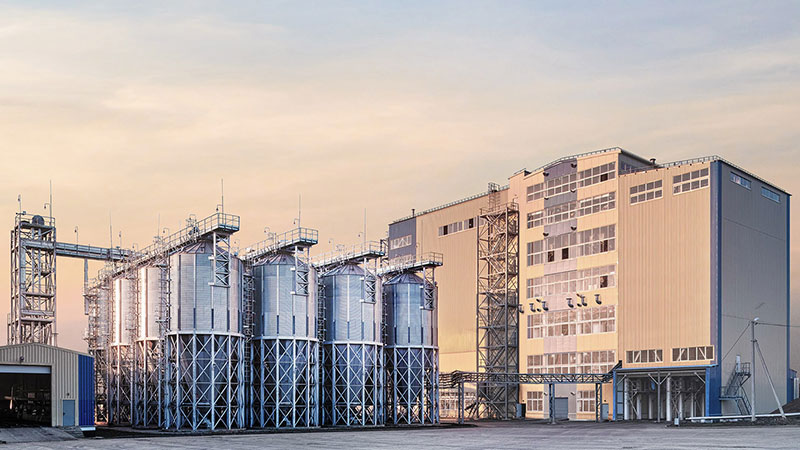
At RICHI, we go beyond project completion. With RICHI Servicee, we’re your dedicated partners in success. Count on us for expert guidance, minimal downtime, and optimized productivity. Choose RICHI for unmatched service and support.
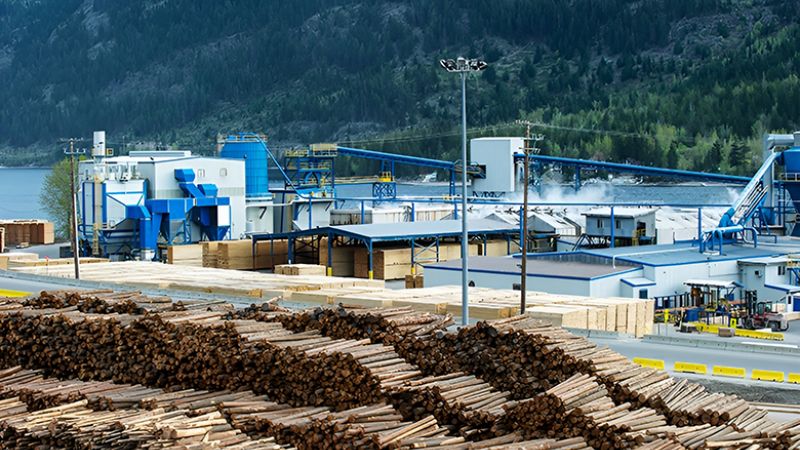


Meet global product demands and quality standards with industry-leading pellet plant design, engineering, equipment, and construction services for pellet processors.


Your Partner Beyond Project Completion
2000+ cases
RICHI is the leading designer, manufacturer and builder of pellet plants in the world, completing over 2000 projects in 140 countries across 6 continents.
Read More
Increase plant productivity, profitability, and safety by integrating high quality equipment into your pellet production line. Over the years, RICHI has become China's top pellet equipment manufacturer. At the same time, RICHI has established valuable partnerships with the world's leading component and raw material manufacturers to bring you the best there is in technology, automation, and efficiency in pelleting plant machinery.

For nearly 30 years, RICHI has been providing best-in-class pellet plant equipment and services to clients across a variety of industries, sizes, and needs. We pride ourselves on the knowledge and skill that each team member possesses – from our technical sales team to our process design engineers. You can count on RICHI Machinery to take your operation to the next level of innovation, quality, and success.
Need help with your pellet manufacturing plant project? Contact us today.
ANIMAL FEED
BIOMASS
WOOD
ORGANIC FERTILIZER
AQUA FEED
CAT LITTER
MUNICIPAL WASTE RECYCLING
SPECIAL PELLET PRODUCTION
RICHI Machinery continues to deliver world class pellet mill equipment, pellet plant engineering and project solutions that add value to our customers in the animal feed, wood waste, agriculture waste, organic fertilizer, cat litter and special pellet products industries. Throughout the years, we RICHI Machinery have built strong brand, becoming industry-leading pellet machine manufacturer. We value integrity, promise quality, and prioritize your success.
Learn MoreWith our expert team, we precisely implement your process engineering requirements in pellet mill and pelletizing plant systems. No matter which industry you’re in – we understand your needs and deliver solutions that meet the highest standards.
At RICHI, quality comes first. Our pellet making machine and related pellet line equipment undergo rigorous quality controls to ensure they meet the highest standards. Rely on products that are durable, safe, and efficient.
With decades of experience in pellet machine and pellet production line production, we have earned a reputation as a trusted partner in various industries. Our expertise allows us to cover a wide range of applications.
Not only do we offer premium pelleting equipment, but we are also experts at designing, building, installing, and maintaining facilities from the ground up. Our expertise is within pellt plant process design, discovering the most efficient, productive, and profitable way to handle your materials in an end-to-end cycle.
○ RICHI MACHINERY
Keeping in touch with us is an effective way to solve all your problems. If you have any needs or questions, please leave your contact information, then RICHI technical consultants will send design, quotation, videos to your mailbox. You can also contact us directly via WhatsApp: +86 13838389622
Copyright©2015-2026 by HENAN RICHI MACHINERY CO., LTD. All rights reserved.