
The Guayaquil customer did not have a problem making shrimp feed in general. The problem appeared much earlier in the process, before micro-pelleting or microencapsulation even began. Several protein-rich ingredients entering the hatchery-feed section were still too coarse and too uneven after conventional grinding, which made subsequent mixing, agglomeration, particle classification, and final feed-size control less predictable.
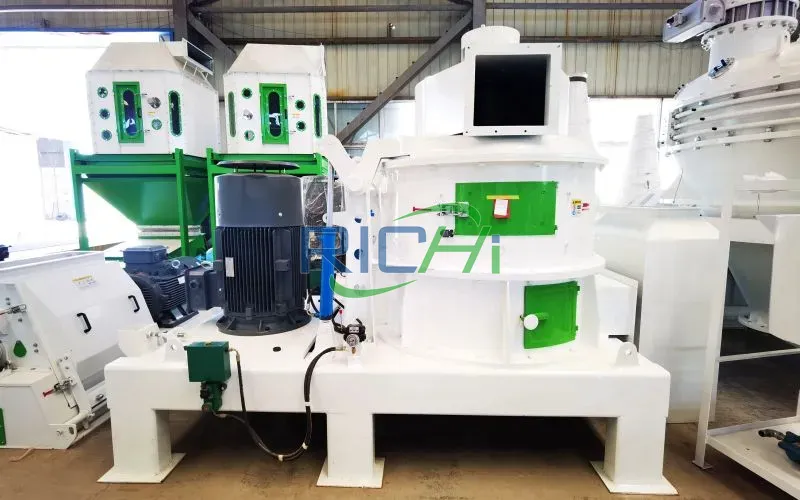
The Guayaquil customer did not have a problem making shrimp feed in general. The problem appeared much earlier in the process, before micro-pelleting or microencapsulation even began. Several protein-rich ingredients entering the hatchery-feed section were still too coarse and too uneven after conventional grinding, which made subsequent mixing, agglomeration, particle classification, and final feed-size control less predictable.
To solve that bottleneck, the company installed one SWFL90 shrimp feed micron grinding equipment in Ecuador as a dedicated fine-grinding stage for selected dry ingredients. The machine was not purchased to produce the final zoea, mysis, or post-larval feed particle directly. Its job is to prepare a much finer, more uniform powder—typically around the 100–150 μm class for selected formulas—before those ingredients enter the downstream hatchery-feed manufacturing process.
Name:
Shrimp Feed Grinder
Country:
Ecuador
Date:
2025
Capacity:
0.8–1.0 T/H
Model:
SWFL90
Main Motor Power:
90 kW
Application:
Ultrafine grinding of selected dry aquafeed ingredients
Working Target:
100–150 μm
The customer is a specialized aquafeed producer supplying shrimp hatcheries and nursery operators along Ecuador’s Pacific coast. Its product range includes fine crumble, micro-pellet, and specialty hatchery feeds for whiteleg shrimp, Litopenaeus vannamei.
Ecuador is an entirely credible location for this type of project. The country has one of the world’s most developed shrimp industries, and Guayaquil sits at the center of a large aquaculture supply chain serving farms, hatcheries, feed manufacturers, processors, laboratories, and exporters.
The plant already had conventional crushing, batching, mixing, micro-feed forming, drying, screening, and packing equipment. What it lacked was a stable ultrafine grinding step between normal feed grinding and the precision manufacturing stages used for hatchery products.
The existing system could reduce material sufficiently for ordinary juvenile shrimp feed, but not consistently enough for the finest product families.
This distinction became central to the final equipment selection.
A hatchery-feed manufacturer may need individual dry ingredients ground extremely fine so they can be mixed uniformly and subsequently formed into very small finished particles. That does not mean every shrimp larva should receive a final feed particle measuring exactly 100–120 μm.
Finished feed size changes with larval and post-larval development, feeding behavior, feed technology, and product design. Research and commercial practices use different particle classes as shrimp progress from protozoea through mysis and post-larval stages.
The SWFL90 therefore prepares the ingredient base. Downstream micro-pelleting, agglomeration, crumbling, screening, or microencapsulation determines the final feed particle supplied to the hatchery.
The micron grinder is therefore used for ingredient preparation rather than as the only machine responsible for producing ready-to-feed larval diets.
The customer had previously used a fine grinder combined with repeated screening and recirculation. The system could produce a relatively fine powder, but particle distribution remained broad.
Some material was already sufficiently fine while another fraction had to be returned several times. This reduced effective throughput and complicated production planning.
For hatchery feed, broad particle distribution can create additional problems downstream. Very coarse particles may not disperse uniformly in a small micro-pellet matrix, while excessive fines can affect bulk behavior and dust generation.
The production team therefore wanted better classification rather than simply more impact energy.
| Project Item | Configuration |
|---|---|
| Equipment | Shrimp feed micron grinding equipment |
| Model | SWFL90 |
| Main Motor | 90 kW |
| Application | Ultrafine grinding of selected dry aquafeed ingredients |
| Reference Fine-Grinding Range | Approximately 75–180 μm depending on material and classification setting |
| Project Working Target | Mainly around 100–150 μm for selected hatchery-feed ingredients |
| Reference Throughput at Fine Settings | Approximately 0.8–1.0 T/H, material dependent |
| Final Product after This Machine | Micronized dry ingredient powder, not finished shrimp feed |
The supplied SWFL90 micro crusher machine configuration is intended for the ultrafine range and combines high-speed grinding with classification rather than relying only on a fixed screen opening. The project reference data gives approximately 75–180 μm capability, with around 0.8–1.0 T/H considered a more realistic output when the customer operates in the finer 100–120 μm region.
The SWFL90 does not receive the complete shrimp-feed formula exactly as it will later be sold.
The finest grinding duty is focused on selected dry protein and carbohydrate ingredients that benefit from additional particle-size reduction before final mixing.
These can include high-quality fish meal, squid-derived dry ingredients, selected marine protein meals, finely prepared plant proteins, starch-bearing ingredients, and other dry components used in premium hatchery formulations.
Fish oil, lecithin, and other liquid lipids do not pass through the micron grinder. These are introduced later through the formulation and mixing process.
This matters because high surface fat can make ultrafine grinding much more difficult. Oily materials may smear, reduce classifier efficiency, and accumulate inside the grinding system.
Where a marine protein ingredient has unusually high fat content, the customer evaluates it separately rather than assuming the SWFL90 will process every fish-derived material at the same capacity.
The customer does not feed large flakes, whole pellets, or coarse raw ingredients directly into the ultrafine grinder.
Material first passes through conventional size reduction so the SWFL90 receives a reasonably uniform pre-ground feed.
For the finer product campaigns, the customer typically prepares material around the sub-millimeter to roughly 1 mm class before ultrafine grinding.
This reduces the amount of work the classifier-grinding circuit has to perform and helps maintain more stable feed rate.
Pre-grinding condition has a direct effect on SWFL90 capacity. If incoming material becomes substantially coarser, the same classifier setting will normally reduce throughput.
One reason the customer selected the SWFL design was the ability to control particle separation through an air-classification stage.
Material sufficiently fine to meet the selected cut point leaves the grinding circuit with the airflow, while oversized particles remain in circulation for further grinding.
This creates a narrower distribution than repeatedly passing an uncontrolled product through a conventional hammer mill.
The classifier speed can be changed according to the required fineness, but the plant does not use one permanent number such as 3,100 rpm for every formulation.
Classifier speed, airflow, feed rate, material density, moisture, fat content, and grinding condition work together. A setting that produces the desired result with fish meal may not create the same distribution with a different protein ingredient.
At micron scale, conventional visual inspection is not sufficient.
The quality-control team therefore verifies particle-size distribution using suitable laboratory methods rather than assuming that a particular classifier setting automatically equals a specific micron value.
This is especially important around the 100–150 μm range.
The customer is interested not only in the average particle size but also in how much coarse material remains and how wide the distribution is.
A batch with an average near 120 μm can still be unsuitable if it contains an excessive tail of much larger particles.
The equipment scale also needs to fit the local industry.
A small hatchery producing feed only for its own tanks would not normally justify a 90 kW industrial micron grinder. The SWFL90 makes much more sense for a specialist feed manufacturer supplying multiple hatcheries and nursery customers.
The customer is a specialist feed manufacturer supplying multiple hatcheries and nursery customers.
Ecuador’s commercial shrimp sector is large enough to support specialized upstream suppliers, and the Guayaquil area provides access to imported marine proteins, premixes, oils, packaging, laboratory services, and port logistics.
The customer can therefore run the micron grinder in concentrated production campaigns for several hatchery-feed SKUs rather than operating continuously on one product.
The customer markets feed quality carefully.
Appropriate feed size and ingredient fineness matter in hatchery nutrition, but larval survival cannot be attributed to a grinder alone.
Survival depends on broodstock quality, water chemistry, pathogen control, stocking density, live-feed management, feeding rate, nutrient balance, digestibility, feed stability, tank hygiene, and many other hatchery conditions.
The SWFL90 can improve control over one manufacturing variable: particle size of selected feed ingredients.
That can support more uniform downstream feed manufacture, but it would be technically inappropriate to claim that switching from one grinder to another automatically raises PL survival by 10% or 20%.
After ultrafine grinding, the micronized ingredients enter the controlled batching and mixing section.
Other nutritional ingredients are added according to the product formula. Liquids such as fish oil and lecithin are incorporated through suitable mixing or coating stages rather than being micron-ground.
The blended feed is then processed into the required physical form.
Depending on the product family, that may mean very small agglomerates, micro-pellets, crumble fractions, or encapsulated feed particles. Screening and classification afterward produce the size classes required for different hatchery stages.
This is where the actual feeding particle is defined.
Micron grinding increases the specific surface area of the powder and creates much more airborne fine material than ordinary feed grinding.
The Ecuadorian plant therefore treats airflow, cyclone separation, filtration, sealing, and housekeeping as part of the equipment package rather than optional accessories.
This has both product-recovery and worker-environment benefits.
Fine marine-protein powders are valuable ingredients. Losing them into the production room is a direct raw-material loss as well as a sanitation problem.
The system also needs to prevent condensation and buildup inside the air circuit, particularly when operating with ingredients that contain more residual fat.
Ultrafine grinding is demanding on wear components.
The customer keeps spare grinding parts and monitors condition according to actual operating hours and material processed.
However, the plant does not assume that hammers must be changed after exactly 400 or 500 hours.
Mineral contamination, ingredient hardness, classifier setting, feed rate, and target fineness all affect wear.
Gradual loss of grinding efficiency can often be seen through rising power consumption, falling throughput, or a change in particle-size distribution before a component reaches its mechanical wear limit.
The micron grinder is not required for every tonne of feed the factory produces.
Standard juvenile and grow-out shrimp feeds can use a coarser grinding specification, while the SWFL90 is reserved for finer hatchery and specialty products.
This means the customer schedules the machine by product family.
One campaign may process fine marine protein ingredients for post-larval microfeed; another may use a slightly coarser cutoff for a nursery formula.
This approach gives the plant much better utilization than sizing the SWFL90 against total annual aquafeed tonnage.
The SWFL90 was exported from Qingdao Port in China and delivered through Guayaquil.
For a customer located in Ecuador’s main shrimp-industry and commercial corridor, this route is practical. Guayaquil is the country’s principal maritime trade gateway, while Contecon’s terminal handles containerized cargo, general cargo, heavy machinery, and project cargo.
The equipment package included the grinding unit, classifier-related components, feeder, air-separation equipment, specified wear parts, electrical documentation, and Spanish-language operating information.
Final sailing time and customs duration were confirmed from the actual shipping schedule rather than treated as permanent fixed numbers.
The customer’s main gain was improved process control.
Instead of repeatedly regrinding batches and relying heavily on downstream screening to remove coarse material, the plant can now establish a repeatable ultrafine grinding condition for each principal ingredient family.
That makes mixing and microfeed forming more predictable and reduces the number of corrective passes through the grinding section.
“Before, we spent too much time trying to correct particle size after grinding. Now we work from a defined micron specification before the material reaches the microfeed section. That has made formulation runs easier to repeat, especially when we change between marine protein ingredients with different densities and fat levels.”
For this type of shrimp-feed project, asking only for “100 micron powder” is not enough.
RICHI needs to know what material is being ground, its initial particle size, moisture, fat content, required particle distribution, desired kilograms per hour, downstream feed process, and how the customer will verify final fineness.
A buyer should also clarify whether 100–120 μm refers to an ingredient specification or the final feed particle. Those are completely different engineering requirements.
If the desired final hatchery-feed particle is 300, 500, or 800 μm, the ingredients may still need to be ground much finer before the finished microfeed is formed.
This shrimp feed micron grinding equipment in Ecuador project uses the SWFL90 for precision raw-material preparation before downstream hatchery-feed forming.
The Guayaquil manufacturer uses one SWFL90 to reduce selected dry aquafeed ingredients into a controlled ultrafine range before micro-pelleting, agglomeration, or other hatchery-feed forming processes. The project working range is mainly around 100–150 μm for selected ingredients, while final feed size is subsequently produced and classified according to the target shrimp stage.
The SWFL90 reference configuration supports approximately 75–180 μm grinding under suitable conditions, with the finer 100–120 μm region requiring lower practical throughput than standard fine grinding.
For another Ecuadorian hatchery-feed project, RICHI Machinery would first evaluate ingredient type, incoming particle size, fat level, moisture, target micron distribution, hourly output, laboratory particle-size testing method, downstream microfeed process, dust-control requirements, available electrical supply, and factory layout before confirming the final grinder and classifier configuration.
The equipment is configured to prepare a repeatable fine ingredient base for specialized shrimp-feed production and to match the micron-grinding stage with the downstream hatchery-feed process.
Having the right mix of reliable, high-quality pellet machine and pelletizing systems and expert support is essential to your success. Watch how our end-to-end feed pellet plant solutions have helped our customers optimize their performance.
Our customized and future-proofed turnkey pellet plant solutions is designed with you at the core. From vision to reality and beyond, our team stays connected with yours. Giving you peace-of-mind with an expert at your side.
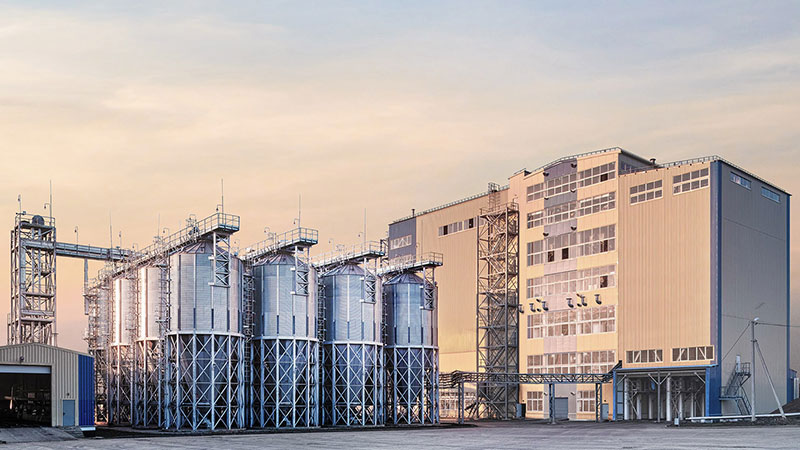
At RICHI, we go beyond project completion. With RICHI Servicee, we’re your dedicated partners in success. Count on us for expert guidance, minimal downtime, and optimized productivity. Choose RICHI for unmatched service and support.
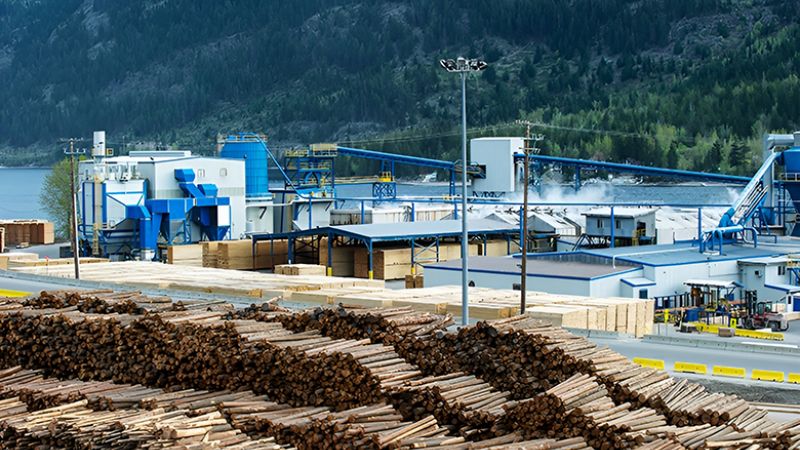


Meet global product demands and quality standards with industry-leading pellet plant design, engineering, equipment, and construction services for pellet processors.

Your Partner Beyond Project Completion
2000+ cases
RICHI is the leading designer, manufacturer and builder of pellet plants in the world, completing over 2000 projects in 140 countries across 6 continents.
Read More
Increase plant productivity, profitability, and safety by integrating high quality equipment into your pellet production line. Over the years, RICHI has become China's top pellet equipment manufacturer. At the same time, RICHI has established valuable partnerships with the world's leading component and raw material manufacturers to bring you the best there is in technology, automation, and efficiency in pelleting plant machinery.

For nearly 30 years, RICHI has been providing best-in-class pellet plant equipment and services to clients across a variety of industries, sizes, and needs. We pride ourselves on the knowledge and skill that each team member possesses – from our technical sales team to our process design engineers. You can count on RICHI Machinery to take your operation to the next level of innovation, quality, and success.
Need help with your pellet manufacturing plant project? Contact us today.
ANIMAL FEED
BIOMASS
WOOD
ORGANIC FERTILIZER
AQUA FEED
CAT LITTER
MUNICIPAL WASTE RECYCLING
SPECIAL PELLET PRODUCTION
RICHI Machinery continues to deliver world class pellet mill equipment, pellet plant engineering and project solutions that add value to our customers in the animal feed, wood waste, agriculture waste, organic fertilizer, cat litter and special pellet products industries. Throughout the years, we RICHI Machinery have built strong brand, becoming industry-leading pellet machine manufacturer. We value integrity, promise quality, and prioritize your success.
Learn MoreWith our expert team, we precisely implement your process engineering requirements in pellet mill and pelletizing plant systems. No matter which industry you’re in – we understand your needs and deliver solutions that meet the highest standards.
At RICHI, quality comes first. Our pellet making machine and related pellet line equipment undergo rigorous quality controls to ensure they meet the highest standards. Rely on products that are durable, safe, and efficient.
With decades of experience in pellet machine and pellet production line production, we have earned a reputation as a trusted partner in various industries. Our expertise allows us to cover a wide range of applications.
Not only do we offer premium pelleting equipment, but we are also experts at designing, building, installing, and maintaining facilities from the ground up. Our expertise is within pellt plant process design, discovering the most efficient, productive, and profitable way to handle your materials in an end-to-end cycle.
○ RICHI MACHINERY
Keeping in touch with us is an effective way to solve all your problems. If you have any needs or questions, please leave your contact information, then RICHI technical consultants will send design, quotation, videos to your mailbox. You can also contact us directly via WhatsApp: +86 13838389622
Copyright©2015-2026 by HENAN RICHI MACHINERY CO., LTD. All rights reserved.