
The Bavarian customer already had something many new pellet projects spend years trying to secure: a stable stream of clean sawmill residues. Spruce and fir sawdust, planer shavings, and a smaller quantity of clean softwood chips were generated every working day by the company’s own timber-processing operation and several nearby suppliers. The issue was not finding biomass. It was converting those residues into a standardized fuel product that could enter Germany’s mature wood-pellet market.
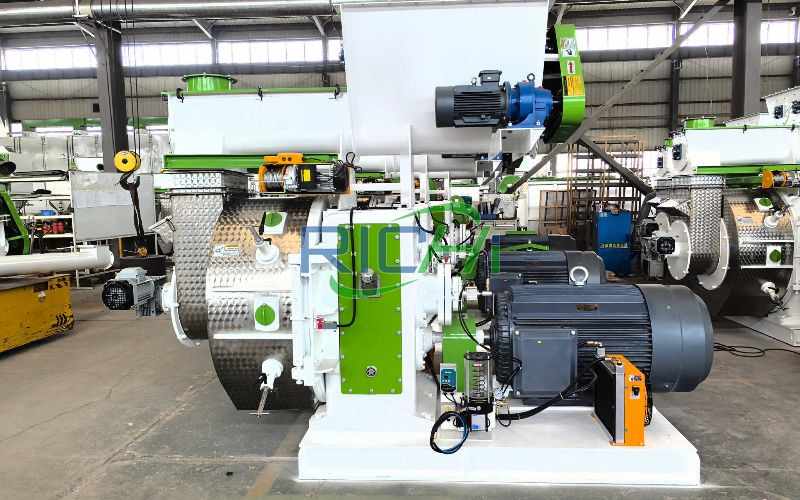
The Bavarian customer already had something many new pellet projects spend years trying to secure: a stable stream of clean sawmill residues. Spruce and fir sawdust, planer shavings, and a smaller quantity of clean softwood chips were generated every working day by the company’s own timber-processing operation and several nearby suppliers. The issue was not finding biomass. It was converting those residues into a standardized fuel product that could enter Germany’s mature wood-pellet market.
Instead of constructing another complete wood pellet line, the company installed one MZLH420 sawdust wood pellets machine in Germany inside an existing residue-processing section. Drying, secondary grinding, cooling, screening, storage, and bulk handling were already available. The new 90 kW wood pellet mill was purchased to add approximately 1.0–1.2 T/H of independent production capacity for 6 mm wood pellets while allowing the main plant to continue operating during smaller production campaigns and maintenance periods.
Name:
sawdust pelletizer
Country:
Germany
Date:
2025
Capacity:
1.0–1.2 T/H
Model:
MZLH420
Main Motor Power:
90 kW
Raw Materials:
sawmill residues
Pellet diameter:
6 mm
Calling the customer’s sawdust “waste” would not accurately describe the German wood-pellet business.
Clean sawmill residues already have established markets. The customer therefore evaluated pellet production against alternative uses for sawdust and shavings rather than assuming that every tonne of residue had no value until it entered a pellet mill.
The advantage of pelletizing was the ability to convert loose residues into a standardized, dense fuel product with established distribution channels in Germany.
That meant the MZLH420 had to support repeatable quality, not simply produce cylindrical material.
The Bavarian customer works mainly with chemically untreated softwood residues generated during sawing and planing.
The main materials include spruce sawdust, fir sawdust, planer shavings, and clean softwood chips that are reduced further before pelletizing.
A limited hardwood fraction can be processed when its origin and quality are suitable, but the plant does not deliberately increase hardwood content merely to market a “premium” pellet.
For this customer, raw-material cleanliness and consistency matter more than whether the wood species sounds more valuable.
The MZLH420 can be configured for pellet diameters between approximately 4 and 12 mm, but the German customer standardized this project at 6 mm.
That decision reduced unnecessary die changes and aligned the product with the most familiar dimension in Germany’s residential heating market.
Eight-millimeter wood pellets are also recognized in European pellet specifications, but producing both diameters would have added complexity without creating a clear commercial advantage for this project.
The single MZLH420 therefore operates primarily with one 6 mm ring-die specification.
| Project Parameter | Configuration |
|---|---|
| Equipment | Sawdust wood pellets machine |
| Model | MZLH420 |
| Quantity | 1 unit |
| Main Motor Power | 90 kW |
| Arch-Breaking Feeder | 3 kW |
| Forced Feeder | 1.5 kW |
| Ring Die Inner Diameter | 420 mm |
| Available Pellet Diameter | 4–12 mm |
| Project Pellet Diameter | 6 mm |
| Reference Capacity | Approximately 1.0–1.2 T/H under suitable sawdust conditions |
The reference capacity assumes adequately prepared material. Actual throughput changes with moisture, particle-size distribution, wood species, die compression, bulk density, and the proportion of shavings or chips in the blend.
The customer therefore does not treat 1.2 T/H as a permanent output regardless of raw-material condition.
Even clean sawmill residue needs preparation.
Fine sawdust can often move directly toward moisture conditioning and pelletizing after screening, but planer shavings and small chips require additional size reduction.
The customer uses its existing hammer mill to prepare a relatively uniform wood fraction, generally in the few-millimeter range.
Oversized splinters and chips are removed or returned for further grinding.
This improves feeding stability and reduces the chance that long shavings will bridge above the pellet mill.
The moisture entering the plant varies according to where the residue originates.
Sawdust generated from freshly sawn timber can contain substantial moisture and requires drying. Planer shavings from previously kiln-dried timber can be much drier.
The customer therefore does not send every material through the rotary dryer simply because a project specification says “sawdust moisture = 25–30%.”
Each material stream is evaluated.
Wet sawdust is dried. Material already close to the required operating range can bypass unnecessary thermal drying and be blended with wetter fractions where appropriate.
The prepared mixture entering the pelletizer is normally kept around a low-teens moisture range, with the final setting adjusted according to pellet formation and cooling results.
This distinction is important in a German market.
The material may enter the sawdust pellet mill at a moisture level that supports compression and natural lignin binding, but the finished pellet has to meet the final fuel specification after cooling.
For high-grade residential pellets, finished moisture is controlled much more tightly.
The customer therefore checks final product moisture after cooling rather than assuming the moisture measured before pelletizing represents the packaged pellet.
Clean softwood contains natural lignin that softens under pressure and temperature during pelletizing.
For the normal spruce-fir formulation, the customer does not need a starch binder simply to make the pellets hold together.
This simplifies the formulation and avoids adding another raw material unless testing shows a technical need.
If an additive were ever introduced, its identity and dosage would need to remain compatible with the quality class and certification system targeted by the producer.
A low-resistance die can increase throughput but may produce pellets with insufficient durability.
An excessively restrictive die can create the opposite problem: high motor load, reduced output, overheating, and accelerated wear.
The customer therefore selected the die compression around its actual softwood mixture and the physical quality required from the finished pellet.
Commissioning was based on motor current, pellet surface, fines generation, mechanical durability, and throughput together.
The highest instantaneous production rate was not automatically accepted as the best operating point.
The MZLH420 itself does not make an ENplus pellet.
Certification depends on the producer, approved raw materials, process control, testing, storage, traceability, and finished pellet characteristics across the production system.
The Bavarian customer therefore treats the pellet machine as one process stage inside a broader quality-management system.
Its standard raw material is clean, chemically untreated wood-processing residue.
Demolition timber, painted boards, impregnated wood, MDF scraps, coated furniture panels, and other chemically treated wood are kept outside the residential pellet feedstock stream.
A workshop that produces furniture can generate both clean virgin wood offcuts and processed panels containing adhesives or coatings.
Those materials cannot simply be mixed together and called sawdust.
The customer accepts suitable clean residues only when their origin is known.
Particleboard dust, MDF waste, painted timber, laminated panels, and demolition wood are segregated rather than pelletized into the household-heating product.
This raw-material discipline is much more important in Germany than demonstrating that the MZLH420 is mechanically capable of compressing a wide range of biomass.
Fresh 6 mm pellets leave the ring die warm and relatively soft.
They enter the customer’s existing counterflow cooling section before screening.
Cooling allows the pellets to stabilize and reduces temperature before storage.
If pellets are handled aggressively while still hot, additional breakage can occur even when the pellet mill is operating correctly.
After cooling, screening removes loose fines. Suitable clean fines are returned to production instead of being packed with the finished product.
The German customer is not satisfied with pellets that merely look smooth when they leave the die.
Pellets must survive conveyors, storage, bulk loading, delivery, and pneumatic handling without generating excessive fines.
The plant therefore monitors mechanical quality alongside production rate.
A change in pellet durability can indicate moisture variation, die wear, roller adjustment problems, particle-size changes, or a different raw-material blend.
This gives the production team an earlier warning than waiting until a customer reports excessive dust.
The customer already operates a larger pellet-production section.
The new MZLH420 was not installed merely as a “pilot machine” to determine whether wood pellets can be manufactured.
Germany has one of Europe’s most established pellet industries, and the customer already understood the process.
The standalone unit has a more practical purpose: small production campaigns, selected raw-material trials, maintenance coverage, and specialized orders that would otherwise interrupt the main production schedule.
This gives the business independent capacity without duplicating the entire upstream and downstream plant.
At approximately 1.1 T/H, seven net production hours correspond to nearly eight tonnes of pellets.
Over a normal production week, the single MZLH420 can therefore generate a meaningful commercial volume.
The customer does not describe it as a laboratory or demonstration machine.
Its smaller size only makes sense relative to the company’s larger primary production assets.
For this Bavarian customer, bulk domestic supply is more representative of the market.
The main product enters established German pellet distribution channels serving heating customers and commercial thermal users.
Bagged production can be supplied where required, but the project was not designed around luxury retail packaging.
The customer also does not depend on export markets to justify the MZLH420 investment.
One lesson from the first production campaigns was that keeping the feedstock narrow made operation easier.
In practice, the stable spruce-fir residue stream gave the plant a much more repeatable operating condition.
Die load, moisture adjustment, pellet color, bulk density, and fines percentage became easier to predict.
This is why the machine is dedicated mainly to wood pellets instead of being promoted internally as a universal biomass press.
Ring die and roller life cannot be stated accurately as one fixed number of hours or tonnes.
Clean softwood sawdust normally creates a different wear environment from bark-heavy material or wood contaminated with mineral particles.
The maintenance team watches motor current, throughput, die temperature, roller condition, pellet appearance, and fines generation.
A gradual reduction in output at the same motor load can indicate wear or changing raw-material conditions before a major mechanical problem develops.
The MZLH420 was manufactured in China and exported from Qingdao Port to Germany.
The actual European entry port was selected according to the confirmed vessel route, freight cost, and inland delivery arrangement rather than being fixed permanently as Hamburg simply because Hamburg is Germany’s best-known seaport.
Before shipment, RICHI supplied machine dimensions, foundation requirements, motor information, electrical documentation, feeder and discharge interface data, and recommended maintenance clearances.
The customer could therefore prepare the installation position while the equipment was in transit.
“The most useful part of the new machine is not that we can pelletize more types of biomass. It is that we can run one controlled wood specification without disturbing the larger line. Once we standardized the sawdust moisture and stopped mixing unnecessary raw materials, the machine became much easier to operate consistently.”
The customer now uses the smaller line primarily when production flexibility has more value than maximum plant throughput.
That includes short campaigns, qualification of a new clean sawmill-residue supplier, scheduled maintenance on the main line, and production orders that do not justify changing the setup of the larger pelletizing section.
This sawdust wood pellets machine in Germany project is a controlled 6 mm fuel-pellet production application within an established Bavarian pellet business.
The Bavarian producer uses one MZLH420 with a 90 kW main motor, 3 kW arch-breaking feeder, 1.5 kW forced feeder, and 420 mm ring die. Under suitable prepared sawdust conditions, the machine provides approximately 1.0–1.2 T/H of reference capacity and is configured primarily for 6 mm fuel pellets.
The more important part of the project is the raw-material discipline around the machine. Clean untreated spruce and fir sawmill residues dominate the formulation. Wetter sawdust is dried, dry planer shavings are blended appropriately, oversized material is ground, treated wood is excluded, pellets are cooled and screened, and finished quality is verified before sale.
For another company evaluating a sawdust wood pellets machine in Germany, RICHI Machinery would first examine sawdust origin, softwood-hardwood ratio, annual residue volume, incoming moisture, chip and shaving percentage, existing dryer and hammer mill, target pellet quality class, pellet diameter, operating schedule, cooler capacity, storage arrangement, and actual sales channel before selecting a model.
In Germany, the question is rarely only whether sawdust can be pelletized. The more important question is whether the complete process can repeatedly produce the quality that a mature and highly standardized pellet market expects.
Having the right mix of reliable, high-quality pellet machine and pelletizing systems and expert support is essential to your success. Watch how our end-to-end feed pellet plant solutions have helped our customers optimize their performance.
Our customized and future-proofed turnkey pellet plant solutions is designed with you at the core. From vision to reality and beyond, our team stays connected with yours. Giving you peace-of-mind with an expert at your side.
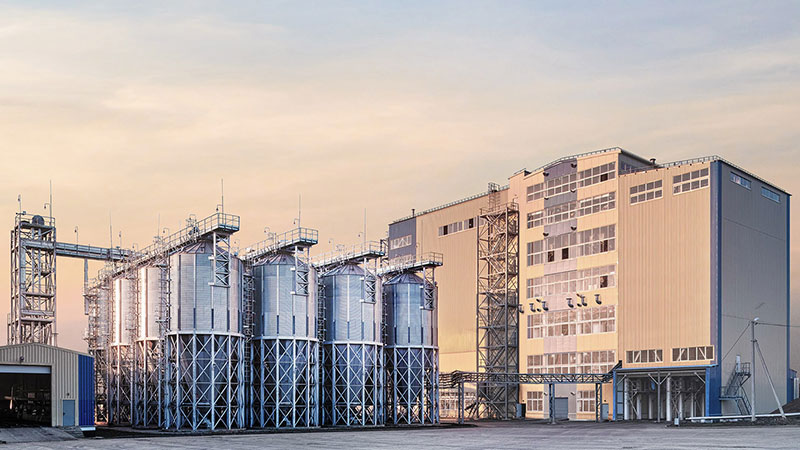
At RICHI, we go beyond project completion. With RICHI Servicee, we’re your dedicated partners in success. Count on us for expert guidance, minimal downtime, and optimized productivity. Choose RICHI for unmatched service and support.
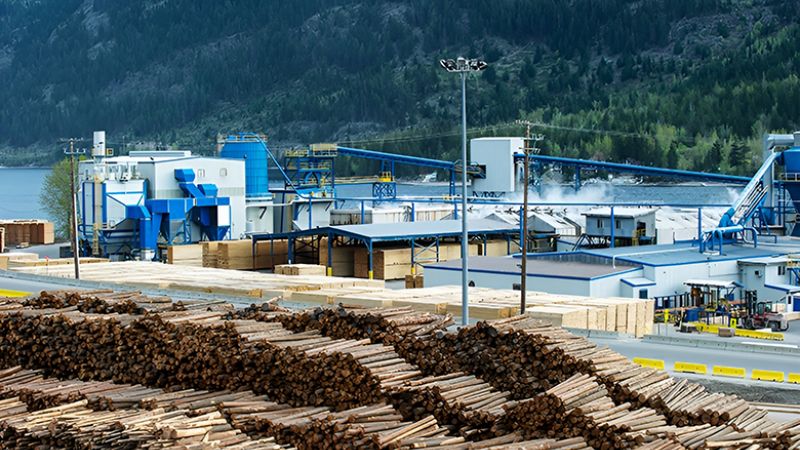


Meet global product demands and quality standards with industry-leading pellet plant design, engineering, equipment, and construction services for pellet processors.


Your Partner Beyond Project Completion
2000+ cases
RICHI is the leading designer, manufacturer and builder of pellet plants in the world, completing over 2000 projects in 140 countries across 6 continents.
Read More
Increase plant productivity, profitability, and safety by integrating high quality equipment into your pellet production line. Over the years, RICHI has become China's top pellet equipment manufacturer. At the same time, RICHI has established valuable partnerships with the world's leading component and raw material manufacturers to bring you the best there is in technology, automation, and efficiency in pelleting plant machinery.

For nearly 30 years, RICHI has been providing best-in-class pellet plant equipment and services to clients across a variety of industries, sizes, and needs. We pride ourselves on the knowledge and skill that each team member possesses – from our technical sales team to our process design engineers. You can count on RICHI Machinery to take your operation to the next level of innovation, quality, and success.
Need help with your pellet manufacturing plant project? Contact us today.
ANIMAL FEED
BIOMASS
WOOD
ORGANIC FERTILIZER
AQUA FEED
CAT LITTER
MUNICIPAL WASTE RECYCLING
SPECIAL PELLET PRODUCTION
RICHI Machinery continues to deliver world class pellet mill equipment, pellet plant engineering and project solutions that add value to our customers in the animal feed, wood waste, agriculture waste, organic fertilizer, cat litter and special pellet products industries. Throughout the years, we RICHI Machinery have built strong brand, becoming industry-leading pellet machine manufacturer. We value integrity, promise quality, and prioritize your success.
Learn MoreWith our expert team, we precisely implement your process engineering requirements in pellet mill and pelletizing plant systems. No matter which industry you’re in – we understand your needs and deliver solutions that meet the highest standards.
At RICHI, quality comes first. Our pellet making machine and related pellet line equipment undergo rigorous quality controls to ensure they meet the highest standards. Rely on products that are durable, safe, and efficient.
With decades of experience in pellet machine and pellet production line production, we have earned a reputation as a trusted partner in various industries. Our expertise allows us to cover a wide range of applications.
Not only do we offer premium pelleting equipment, but we are also experts at designing, building, installing, and maintaining facilities from the ground up. Our expertise is within pellt plant process design, discovering the most efficient, productive, and profitable way to handle your materials in an end-to-end cycle.
○ RICHI MACHINERY
Keeping in touch with us is an effective way to solve all your problems. If you have any needs or questions, please leave your contact information, then RICHI technical consultants will send design, quotation, videos to your mailbox. You can also contact us directly via WhatsApp: +86 13838389622
Copyright©2015-2026 by HENAN RICHI MACHINERY CO., LTD. All rights reserved.