
RICHI supplied a 6–8 T/H FZLH420 Ring Die Granulator Machine Organic Fertilizer in Vietnam to process 2–5 mm mature compost into 8 mm fertilizer granules.
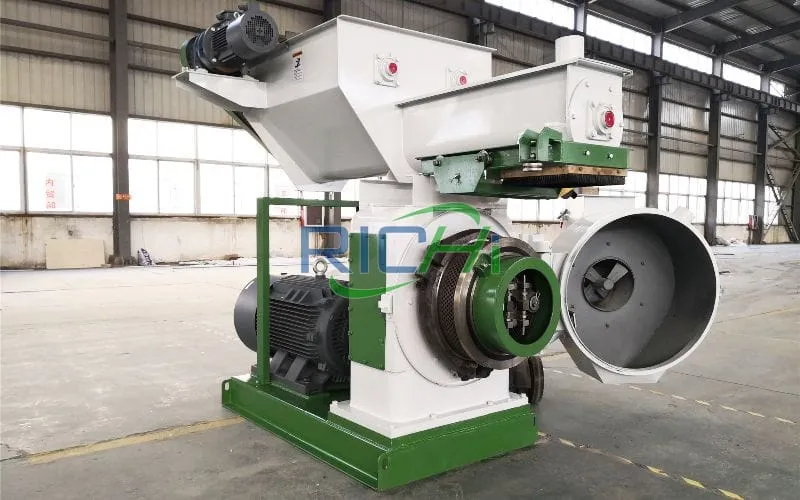
An organic fertilizer manufacturer in southern Vietnam selected one RICHI FZLH420 Ring Die Granulator Machine Organic Fertilizer in Vietnam to upgrade the granulation section of its existing plant. The customer already had manure receiving, aerobic composting, crushing, screening, mixing, cooling and packaging equipment, so purchasing another complete production line would have duplicated equipment that was still suitable for use. The new machine was installed specifically to increase the capacity of the pellet-forming stage.
The FZLH420 uses a 90 kW main motor and provides a clear organic fertilizer granulation capacity of approximately 6–8 T/H. Mature compost is crushed and screened to approximately 2–5 mm before granulation, with feed moisture controlled around 15–20% for this organic fertilizer production project and adjusted during commissioning according to actual material behavior. The customer produces approximately 8 mm cylindrical organic fertilizer pellets for commercial distribution to rice-growing customers in the Mekong Delta.
Name:
Granulator Machine for Organic Fertilizer
Country:
Vietnam
Date:
2025
Capacity:
6–8 T/H
Model:
FZLH420
Main Motor Power:
90 kW
Raw Materials:
cow and poultry manure, agricultural residues
Pellet diameter:
8 mm
The customer's existing plant could already handle most of the fertilizer production process. Fresh manure could be received and composted, mature material could be crushed and mixed, and downstream cooling and packaging capacity were available. The limiting section was granulation. Smaller existing equipment required longer production schedules and provided insufficient reserve capacity during periods of higher fertilizer demand.
Installing one FZLH420 fertilizer granulator machine allowed the company to retain the useful parts of the existing plant while raising the granulation section to approximately 6–8 T/H. At one effective eight-hour shift and 300 production days per year, this corresponds to approximately 14,400–19,200 tonnes of theoretical annual granulation capacity before maintenance, changeovers and production interruptions are considered.
| Project Parameter | Specification |
|---|---|
| Equipment | Ring die organic fertilizer granulator |
| Model | FZLH420 |
| Main Motor Power | 90 kW |
| Granulation Capacity | 6–8 T/H |
| Prepared Material Size | Approximately 2–5 mm |
| Project Feed Moisture | Approximately 15–20% |
| Available Pellet Diameter | Approximately 4–12 mm |
| Project Pellet Diameter | 8 mm |
| 8-Hour Theoretical Output | 48–64 tonnes/day |
| 300-Day Theoretical Capacity | 14,400–19,200 T/Y |
| Main Product | Granular organic fertilizer for rice production |
The 6–8 T/H range refers to properly composted, crushed and conditioned organic fertilizer material entering the FZLH420. Fresh manure tonnage cannot be treated as pellet-machine capacity because composting changes moisture and mass before the material reaches granulation. The same FZLH420 organic fertilizer pellet machine can also operate at different points within the range as bulk density, fiber content, moisture and die resistance change.
The factory uses livestock manure available from regional farming operations, primarily cow and poultry manure, together with agricultural residues used where appropriate during compost preparation. Rice straw is particularly relevant in southern Vietnam because it is widely available after rice harvesting. Chopped straw can provide carbon and physical structure during composting, while bagasse can be introduced when its supply and material analysis suit the formulation.
Fresh cow or chicken manure is not dried directly to 18% moisture and fed into the ring die machine. The correct sequence starts with controlled aerobic composting. Manure and suitable carbon-rich residues are blended, turned and aerated until the material reaches the required maturity and stability. Only after composting does the plant adjust moisture, crush the mature material and prepare it for pelletizing.
The raw-material ratio is therefore not fixed at 40% cow manure, 25% chicken manure, 25% rice straw and 10% bagasse. Actual proportions depend on manure moisture, carbon-to-nitrogen balance, composting behavior, nutrient analysis and the registered finished-fertilizer specification.
Particle preparation is essential before the FZLH420. Long rice straw, fibrous compost clumps and oversized material should not enter the ring die chamber directly. After compost maturation, the material passes through crushing and screening so the granulator receives an approximately 2–5 mm feed.
This size range gives the mixer and feeder a more consistent material and reduces the risk of long fibers disturbing the flow into the ring die. It also helps different compost components distribute more uniformly before compression.
Moisture is then checked and adjusted to approximately 15–20% for the project operating window. This is not treated as a universal organic fertilizer moisture specification. Material behavior during trial production determines the final working point because mature poultry-manure compost, cow-manure compost and straw-rich formulations do not respond identically under compression.
Prepared compost is transferred from the mixer to the FZLH420 feeding system. The arch-breaking and forced-feeding arrangement helps move the relatively low-density, fibrous fertilizer material into the pelletizing chamber continuously. Inside the ring die section, mechanical compression forms the mixture into cylindrical granules through the selected die openings.
The customer uses an 8 mm die for its current commercial fertilizer product. The FZLH series can support other diameters within approximately 4–12 mm, but changing diameter can also change resistance and practical output. An 8 mm product is therefore the confirmed specification for this project rather than a claim that 8 mm is the best fertilizer size for every Vietnamese crop.
After granulation, the pellets move through cooling and screening. Fines are separated before packaging, while finished-product moisture and physical condition are checked against the manufacturer's product specification. The granulator creates the required physical form; it does not create additional nutrients or automatically increase fertilizer effectiveness.
The Mekong Delta provides a strong agricultural context for this project because rice cultivation generates substantial quantities of straw after harvest. Using part of that material in controlled composting gives fertilizer producers another route for agricultural-residue management while combining it with livestock manure.
The value of rice straw in this process comes from its role as an organic and structural material rather than from simply grinding straw and pressing it into fertilizer pellets. Composting converts the mixed organic materials into a more stable fertilizer feedstock before the ring die granulation stage.
This is also why the customer keeps the composting and granulation sections separate. FZLH420 capacity is calculated from tonnes of mature prepared compost per hour, not tonnes of fresh manure or raw straw collected from farms.
A uniform 8 mm granule can improve physical handling, bagging, storage and mechanical application, but commercial fertilizer quality still depends on composition and compliance. The customer needs to control nutrient values, organic matter, moisture and relevant limiting substances according to the fertilizer category being produced and marketed in Vietnam.
The plant therefore combines production control with laboratory testing rather than judging fertilizer only by pellet hardness or appearance. Granulation should be understood as the final physical-forming stage of an already controlled fertilizer formulation.
This separation is particularly important if biological or microbial components are used in another product formulation. Heat-sensitive components may require different addition points and process control rather than being assumed to tolerate every granulation condition.
The FZLH420 is prepared for export from Qingdao, China, with Tan Cang–Cat Lai in Ho Chi Minh City serving as a practical container entry point for a southern Vietnam project. From the terminal, equipment can move inland toward industrial and agricultural areas in Long An and the wider Mekong Delta region.
Before shipment, RICHI checks the existing plant interfaces, including feeder elevation, foundation, motor power supply, mixer discharge, cooler capacity, screen throughput and maintenance space. This is especially important because the customer is adding one machine to an existing fertilizer plant rather than installing a completely new RICHI line.
This Ring Die Granulator Machine Organic Fertilizer in Vietnam project uses one RICHI FZLH420 with a 90 kW main motor to upgrade an existing fertilizer factory in southern Vietnam. The granulator handles approximately 6–8 T/H of mature, prepared organic fertilizer material. Compost is crushed and screened to approximately 2–5 mm, adjusted to around 15–20% moisture for the project operating condition and formed into approximately 8 mm finished granules.
At eight effective production hours per day, the machine provides approximately 48–64 tonnes of theoretical daily granulation capacity. For another fertilizer producer evaluating an FZLH420, RICHI Machinery needs the mature-compost T/H, manure source, composting process, material moisture, crushed particle size, fiber content, target pellet diameter, operating hours and capacities of the existing upstream and downstream equipment. These parameters allow the ring die granulator to be matched to the actual fertilizer plant rather than selected only from fresh-manure volume.
Having the right mix of reliable, high-quality pellet machine and pelletizing systems and expert support is essential to your success. Watch how our end-to-end feed pellet plant solutions have helped our customers optimize their performance.
Our customized and future-proofed turnkey pellet plant solutions is designed with you at the core. From vision to reality and beyond, our team stays connected with yours. Giving you peace-of-mind with an expert at your side.
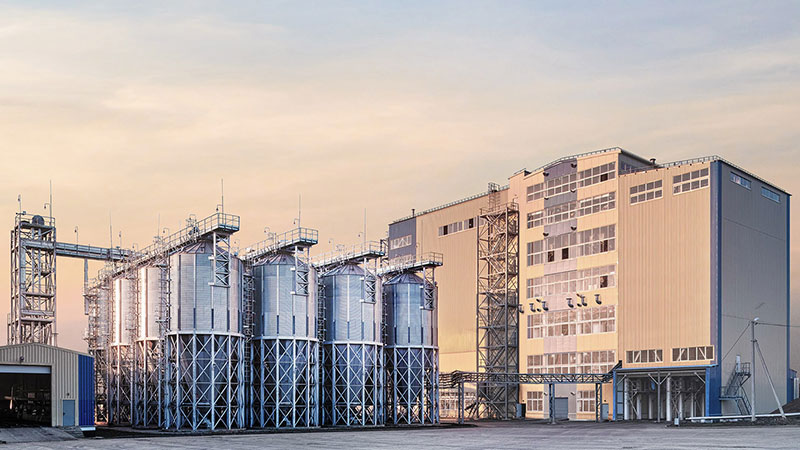
At RICHI, we go beyond project completion. With RICHI Servicee, we’re your dedicated partners in success. Count on us for expert guidance, minimal downtime, and optimized productivity. Choose RICHI for unmatched service and support.
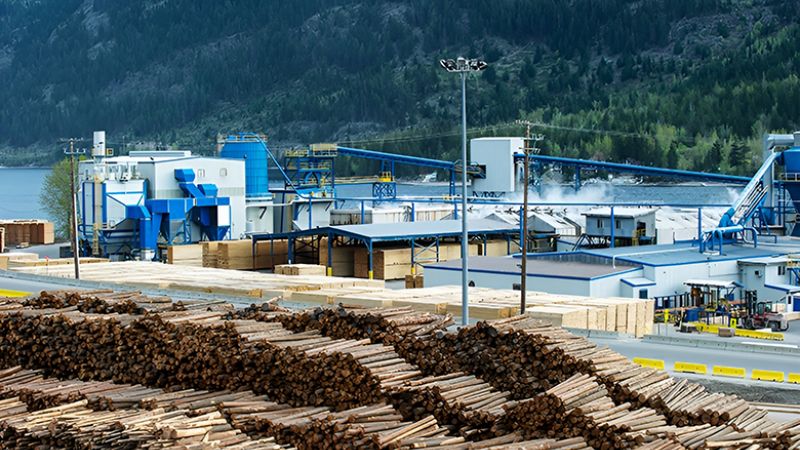


Meet global product demands and quality standards with industry-leading pellet plant design, engineering, equipment, and construction services for pellet processors.


Your Partner Beyond Project Completion
2000+ cases
RICHI is the leading designer, manufacturer and builder of pellet plants in the world, completing over 2000 projects in 140 countries across 6 continents.
Read More
Increase plant productivity, profitability, and safety by integrating high quality equipment into your pellet production line. Over the years, RICHI has become China's top pellet equipment manufacturer. At the same time, RICHI has established valuable partnerships with the world's leading component and raw material manufacturers to bring you the best there is in technology, automation, and efficiency in pelleting plant machinery.

For nearly 30 years, RICHI has been providing best-in-class pellet plant equipment and services to clients across a variety of industries, sizes, and needs. We pride ourselves on the knowledge and skill that each team member possesses – from our technical sales team to our process design engineers. You can count on RICHI Machinery to take your operation to the next level of innovation, quality, and success.
Need help with your pellet manufacturing plant project? Contact us today.
ANIMAL FEED
BIOMASS
WOOD
ORGANIC FERTILIZER
AQUA FEED
CAT LITTER
MUNICIPAL WASTE RECYCLING
SPECIAL PELLET PRODUCTION
RICHI Machinery continues to deliver world class pellet mill equipment, pellet plant engineering and project solutions that add value to our customers in the animal feed, wood waste, agriculture waste, organic fertilizer, cat litter and special pellet products industries. Throughout the years, we RICHI Machinery have built strong brand, becoming industry-leading pellet machine manufacturer. We value integrity, promise quality, and prioritize your success.
Learn MoreWith our expert team, we precisely implement your process engineering requirements in pellet mill and pelletizing plant systems. No matter which industry you’re in – we understand your needs and deliver solutions that meet the highest standards.
At RICHI, quality comes first. Our pellet making machine and related pellet line equipment undergo rigorous quality controls to ensure they meet the highest standards. Rely on products that are durable, safe, and efficient.
With decades of experience in pellet machine and pellet production line production, we have earned a reputation as a trusted partner in various industries. Our expertise allows us to cover a wide range of applications.
Not only do we offer premium pelleting equipment, but we are also experts at designing, building, installing, and maintaining facilities from the ground up. Our expertise is within pellt plant process design, discovering the most efficient, productive, and profitable way to handle your materials in an end-to-end cycle.
○ RICHI MACHINERY
Keeping in touch with us is an effective way to solve all your problems. If you have any needs or questions, please leave your contact information, then RICHI technical consultants will send design, quotation, videos to your mailbox. You can also contact us directly via WhatsApp: +86 13838389622
Copyright©2015-2026 by HENAN RICHI MACHINERY CO., LTD. All rights reserved.