
Discover a rice husk bedding pellet machine in Bangladesh for converting rice milling residues into animal bedding pellets. Explore the RICHI MZLH420 specifications, raw material preparation, production capacity and alternative pellet applications.
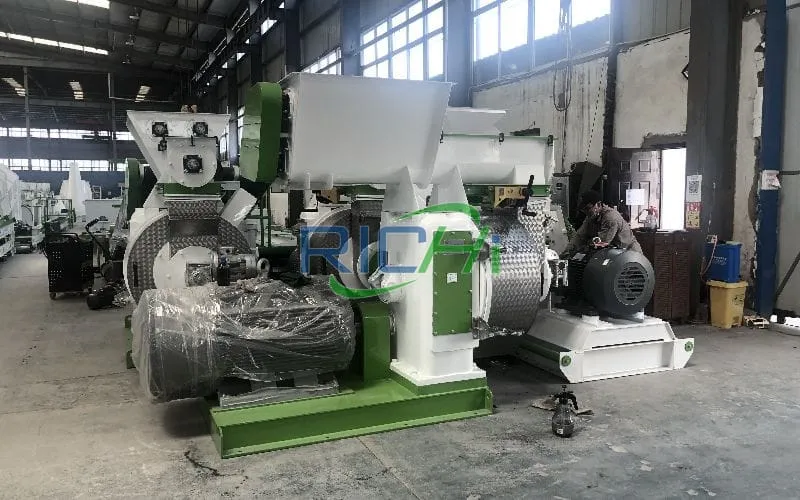
Rice Husk Bedding Pellet Machine in Bangladesh was selected for a rice milling and agricultural by-product processing business looking to turn loose rice husks into compact animal bedding pellets. The customer operates in a rice-producing area where husks are generated during the milling of paddy rice and can be collected from nearby mills.
Rather than establishing a large pellet production plant immediately, the business decided to purchase one RICHI MZLH420 ring die pellet machine and integrate it into an existing material preparation workshop. The initial target is to produce 6–8 mm rice husk bedding pellets for livestock and poultry housing applications.
The project is based on the customer's access to a relatively consistent supply of rice husks, its existing size-reduction equipment and the need to make a bulky agricultural residue easier to handle and distribute.
The selected machine has a listed capacity of 1.0–1.2 T/H and does not include a conditioner. The main objective is to develop a practical bedding product rather than feed production. Once the initial product has been evaluated, suitable rice husks may also be assessed for biomass fuel pellets or other non-feed applications, provided each finished product meets its own technical requirements.
Name:
Rice Husk Bedding Pellet Machine
Country:
Bangladesh
Date:
2026
Capacity:
1.0–1.2 T/H
Model:
MZLH420
Main Motor Power:
90 kW
Raw Materials:
rice husks
Pellet diameter:
6–8mm
Rice milling is a major part of Bangladesh's agricultural supply chain. Paddy rice is processed by mills of different sizes, leaving rice husks that must be stored, transported or directed toward suitable uses. For a business with regular access to these residues, the challenge is often not finding the material but deciding how to handle it efficiently and whether it can be converted into a product with a clear specification.
The customer for this project is a regional rice mill operator working with nearby paddy processors. Its existing operation includes rice husk collection, temporary storage and basic material handling. The company wants to add a new processing activity without immediately committing to a complete automated pellet production line.
Loose rice husks are lightweight and occupy considerable storage volume relative to their weight. Their shape can also make consistent feeding and bulk handling difficult. Compressing properly prepared husks into pellets can create a more uniform product that is easier to measure, screen, package and transport. For animal bedding suppliers, product consistency and manageable dust levels are important considerations alongside the physical dimensions of the pellets.
The planned purchase is an additional processing investment, not a replacement for an existing rice husk pellet machine. The MZLH420 will serve as the main pelletizing unit, while suitable equipment already available at the site may be retained for preliminary size reduction and conveying. Cooling, screening and packaging will be assessed as downstream requirements so that the business does not confuse purchasing a pelletizer with completing an entire production line.
This staged investment also gives the customer an opportunity to establish the product specification before expanding. The first priority is to confirm whether the locally available rice husks can be processed consistently and whether the resulting pellets perform adequately in the intended bedding application.
The principal raw material is rice husk separated from paddy during milling. The project is designed around a single main feedstock rather than a mixture of unrelated agricultural residues. This keeps the initial trial easier to evaluate and helps the customer identify how the properties of the rice husks influence pellet formation.
The material would be collected from rice milling operations serving the local agricultural market. Before acceptance, the customer should check for excessive soil, stones, metal fragments, plastic and other foreign matter. Rice husks from different mills may vary in moisture, cleanliness and particle distribution, so incoming material should be inspected rather than treated as a uniform commodity.
Rice husks typically have a fibrous, relatively rigid structure and contain substantial silica in their outer layers. These characteristics influence both compression behavior and equipment wear. The customer's existing hammer mill can be used to reduce oversized or irregular material where necessary, with a preliminary particle-size target of approximately 2–3 mm for evaluation. This is a process target to be confirmed through trials, not a universal requirement for every rice husk pellet formulation.
Moisture is another important control point. The customer plans to source reasonably dry husks, initially targeting approximately 8–12% moisture for prepared material. Actual moisture must be measured at the site. If incoming material is consistently below 20% moisture, a separate dryer may not be necessary for the proposed trial, subject to pelletizing results. If the moisture content rises above 20%, the customer would need to use a suitable dryer or arrange for pre-drying before the material enters the pelletizer.
Because the selected machine has no conditioner, the process does not rely on a conditioning chamber for steam treatment or moisture addition. This does not mean that moisture control or preparation can be skipped. Feedstock consistency remains essential, and the operating team should determine the acceptable moisture range through sample testing.
The initial project uses 100% rice husk as the proposed raw material. Other agricultural residues should not be added automatically: mixing rice husks with straw, sawdust or grass changes the physical properties of the feedstock and may affect pellet quality, feeding behavior and machine wear. Any mixed-material formulation should be evaluated separately before it is used commercially.
After considering the proposed scale of the operation, the customer selected one RICHI MZLH420 ring die pelletizer. Its listed capacity is 1.0–1.2 T/H, making it a candidate for a regional by-product processing operation that wants to begin with a defined production target rather than a high-capacity industrial installation.
The machine compresses prepared rice husks through a ring die to form cylindrical pellets. The anti-bridging feeder helps manage the movement of bulky material, while the forced feeder supports controlled delivery into the pelletizing chamber. These features are particularly relevant when handling fibrous agricultural residues, although stable feeding still depends on proper material preparation.
| Technical specification | RICHI MZLH420 |
|---|---|
| Machine type | Ring die |
| Purchase quantity | 1 unit |
| Main motor power | 90 kW |
| Anti-bridging feeder motor power | 3 kW |
| Forced feeder motor power | 1.5 kW |
| Ring die inner diameter | 420 mm |
| Reference capacity | 1.0–1.2 T/H |
| Available pellet diameter range | 4–12 mm |
| Proposed bedding pellet diameter | 6–8 mm |
The proposed 6–8 mm pellet diameter falls within the machine's listed range. The final specification should also address pellet length, durability, dust generation, moisture and how the product behaves when spread across animal housing floors. Diameter alone cannot establish bedding performance.
The listed capacity is a reference figure rather than a guarantee of output for every rice husk source. Actual production depends on moisture, particle size, husk characteristics, die configuration, operating conditions and the required pellet quality. The customer should therefore confirm achievable throughput using representative samples before setting a commercial production schedule.
The MZLH420 is being purchased as a single machine for a specific stage of processing. The existing rice husk collection and handling operation will remain in place, and suitable preparation equipment may be reused after its capacity and condition have been checked.
The proposed process begins with receiving and inspecting the rice husks. Oversized material can then be reduced through the existing hammer mill, followed by screening where required. Moisture is measured before the prepared material is fed into the pelletizer. After pelletizing, the material needs to be cooled and screened before packaging.
Cooling matters because freshly produced pellets may be warm and more vulnerable to damage during handling. Screening helps separate loose fines from the product, while the recovered fines can be evaluated for controlled reuse if they meet the process requirements. The final packaging method should protect the pellets against moisture pickup and excessive breakage during storage.
Before installation, the customer should confirm the foundation, lifting access, electrical supply, maintenance clearance and dust extraction arrangements. Rice husk handling and grinding can create airborne particles, so suitable dust management and housekeeping procedures should be included in the workshop plan.
The purpose of retaining the existing equipment is to avoid unnecessary duplication, not to assume that every existing machine will be compatible. If the hammer mill or screening equipment cannot supply a consistent feed at the required rate, the preparation section may need to be adjusted. A balanced process is more useful than installing a pelletizer whose nominal capacity exceeds the actual material preparation capability.
The main finished product in this project is rice husk bedding pellets. Their intended application is non-feed use in livestock or poultry housing, where the material may be spread over a suitable floor or bedding area according to the needs of the animals and the management system.
Loose rice husks are already used in some agricultural settings, but pelletizing changes the material's physical form. A compact pellet can be handled in measured quantities, packed more consistently and distributed as a standardized product. The practical benefit depends on how the pellets behave when used; compacting a material does not automatically make it more absorbent or suitable for every animal.
Before the product is sold, the customer should evaluate how easily the pellets break down or spread under the intended use conditions. Absorption, moisture retention, dust, surface texture and the presence of sharp or coarse particles all need to be considered. These characteristics can differ with the rice variety, milling process, particle preparation and pelletizing conditions.
For poultry bedding, the buyer should assess whether the material can be distributed evenly and maintained at an appropriate condition during use. For other livestock applications, the bedding requirements may differ, so the product should not be promoted as universally suitable without evaluation.
The customer should also determine how the finished material will be stored and transported. Rice husk pellets can absorb moisture from the surrounding environment, and damaged pellets may generate additional fines. Appropriate storage and packaging help preserve the condition of the product between production and use.
These checks will help the customer establish a product specification based on actual performance rather than relying solely on the fact that rice husks are an agricultural residue. A successful bedding product must be suitable for its intended use, not simply capable of passing through a pellet mill.
The MZLH420 is designed for biomass pelletizing, and suitable rice husks may be evaluated for other non-feed products in separate production runs. This offers the customer flexibility if different local buyers require different products, but each application must be assessed independently.
Fuel production requires particular care because rice husks contain relatively high levels of silica and can produce ash characteristics that differ from those of many wood fuels. The customer should not assume that a bedding pellet can automatically be sold as a fuel pellet without testing its properties and checking the intended boiler or combustion system.
Similarly, products intended for use as absorbents or agricultural materials need to meet the expectations of their particular application. The pelletizer can provide a common compression stage, but the finished product specifications, testing procedures and market requirements are not interchangeable.
The selected process is not intended for animal feed production. The machine configuration does not include a conditioner, and the project has been designed around non-feed applications. Any future change in application would require a separate technical assessment rather than an assumption that the existing configuration is suitable.
The decision to purchase one MZLH420 reflects the customer's intention to introduce pellet production in stages. The business already handles rice husks, but it needs to establish a repeatable bedding product before investing in a complete automated line.
A single pelletizer allows the customer to focus on three practical questions: whether the available husks can be prepared consistently, whether the pellets meet the intended bedding requirements, and whether the existing material handling equipment can support the planned production rate.
RICHI's equipment selection should be based on the customer's material samples, required pellet dimensions, available utilities and operating expectations. The 1.0–1.2 T/H reference capacity provides a starting point for planning, but it should not replace a feedstock trial or a review of the full material flow.
Technical support can also help the customer identify which parts of the existing operation can be retained and which may need modification. That includes evaluating grinding requirements, moisture control, feeding stability, cooling, screening and packaging. The aim is to avoid purchasing unnecessary equipment while ensuring that essential process stages are not overlooked.
RICHI supplies both individual pelletizing machines and complete pellet production line equipment. For this project, the immediate requirement is one ring die pelletizer. If the business later needs an integrated system, the process can be designed around its raw materials, production targets, available workshop space and intended products.
The production process can also be customized to the customer's material conditions. A complete line may include material receiving, grinding, drying where necessary, conveying, pelletizing, cooling, screening and packaging. The actual configuration depends on the incoming moisture, particle size, target output and finished-product requirements rather than a fixed equipment list.
No verified post-installation testimonial or operating record has been supplied for this project. Accordingly, the following is a summary of the buyer's proposed priorities, not a direct customer quotation or a claim that the machine has already achieved a particular result.
The buyer's main concern is whether the pelletizer can work with the rice husks already available through its milling network without requiring an unnecessarily complex new plant. The business wants to understand the preparation requirements, the practical production rate and the condition of the pellets after cooling and screening.
Another important consideration is maintenance. Rice husks contain abrasive mineral matter, so the customer needs clear guidance on inspecting the ring die and rollers, monitoring wear and following the equipment's maintenance schedule. Access to replacement wear parts and appropriate operating instructions is also relevant to long-term planning.
The customer also needs the proposed production process to fit the existing workshop. Before installation, the foundation, electrical connections, dust management, material flow and operator access should be reviewed. These details affect day-to-day operation as much as the nominal capacity printed on the machine specification.
For the buyer, the next meaningful milestone is a repeatable trial process. Recording the moisture, particle size, machine settings and finished-pellet condition for each batch will make it easier to identify the source of variations and determine whether the proposed bedding specification is achievable.
The planned shipping arrangement is from Qingdao Port in China to Chattogram Port in Bangladesh, subject to confirmation of the final shipping service, cargo arrangements and import requirements.
Before dispatch, the customer should confirm the installation area, foundation, electrical supply and lifting arrangements. The condition of the existing hammer mill and material handling equipment should also be checked so that the pelletizer receives properly prepared feedstock when commissioning begins.
After installation, the initial operating period should focus on stable feeding and consistent pellet formation. The operating team should record the material moisture, particle size, production rate and condition of the pellets after cooling and screening. These observations provide a useful basis for adjusting the process without making unsupported assumptions about performance.
Routine maintenance should follow the equipment documentation, including lubrication, inspection of the ring die and rollers, and replacement of worn components when required. Dust management and suitable storage practices are also important when handling dry rice husks and finished biomass pellets.
The Rice Husk Bedding Pellet Machine in Bangladesh project gives a rice milling business a way to evaluate a new product using a residue stream already present in its supply chain. The proposed RICHI MZLH420 has a 90 kW main motor, a 420 mm ring die and a listed reference capacity of 1.0–1.2 T/H. Its configuration without a conditioner is intended for properly prepared biomass materials and non-feed applications.
The initial product target is a 6–8 mm rice husk bedding pellet made from a single principal raw material. The process depends on consistent preparation, measured moisture, appropriate particle size and a downstream arrangement that includes cooling and screening. The suitability of the finished pellets must be demonstrated through trials under the intended bedding conditions.
The same general machine may also be considered for suitable biomass fuel or other non-feed pellet applications, but each product requires separate evaluation. Rice husk fuel performance, in particular, must be assessed against the requirements of the intended combustion system.
RICHI Machinery can supply the individual pelletizer or discuss a complete pellet production line with a customized process configuration. For a business entering pellet production for the first time, the sensible starting point is to confirm the raw material, establish the finished-product specification and select the equipment around the actual operating requirements.
Having the right mix of reliable, high-quality pellet machine and pelletizing systems and expert support is essential to your success. Watch how our end-to-end feed pellet plant solutions have helped our customers optimize their performance.
Our customized and future-proofed turnkey pellet plant solutions is designed with you at the core. From vision to reality and beyond, our team stays connected with yours. Giving you peace-of-mind with an expert at your side.

At RICHI, we go beyond project completion. With RICHI Servicee, we’re your dedicated partners in success. Count on us for expert guidance, minimal downtime, and optimized productivity. Choose RICHI for unmatched service and support.



Meet global product demands and quality standards with industry-leading pellet plant design, engineering, equipment, and construction services for pellet processors.


Your Partner Beyond Project Completion
2000+ cases
RICHI is the leading designer, manufacturer and builder of pellet plants in the world, completing over 2000 projects in 140 countries across 6 continents.
Read More
Increase plant productivity, profitability, and safety by integrating high quality equipment into your pellet production line. Over the years, RICHI has become China's top pellet equipment manufacturer. At the same time, RICHI has established valuable partnerships with the world's leading component and raw material manufacturers to bring you the best there is in technology, automation, and efficiency in pelleting plant machinery.

For nearly 30 years, RICHI has been providing best-in-class pellet plant equipment and services to clients across a variety of industries, sizes, and needs. We pride ourselves on the knowledge and skill that each team member possesses – from our technical sales team to our process design engineers. You can count on RICHI Machinery to take your operation to the next level of innovation, quality, and success.
Need help with your pellet manufacturing plant project? Contact us today.
ANIMAL FEED
BIOMASS
WOOD
ORGANIC FERTILIZER
AQUA FEED
CAT LITTER
MUNICIPAL WASTE RECYCLING
SPECIAL PELLET PRODUCTION
RICHI Machinery continues to deliver world class pellet mill equipment, pellet plant engineering and project solutions that add value to our customers in the animal feed, wood waste, agriculture waste, organic fertilizer, cat litter and special pellet products industries. Throughout the years, we RICHI Machinery have built strong brand, becoming industry-leading pellet machine manufacturer. We value integrity, promise quality, and prioritize your success.
Learn MoreWith our expert team, we precisely implement your process engineering requirements in pellet mill and pelletizing plant systems. No matter which industry you’re in – we understand your needs and deliver solutions that meet the highest standards.
At RICHI, quality comes first. Our pellet making machine and related pellet line equipment undergo rigorous quality controls to ensure they meet the highest standards. Rely on products that are durable, safe, and efficient.
With decades of experience in pellet machine and pellet production line production, we have earned a reputation as a trusted partner in various industries. Our expertise allows us to cover a wide range of applications.
Not only do we offer premium pelleting equipment, but we are also experts at designing, building, installing, and maintaining facilities from the ground up. Our expertise is within pellt plant process design, discovering the most efficient, productive, and profitable way to handle your materials in an end-to-end cycle.
○ RICHI MACHINERY
Keeping in touch with us is an effective way to solve all your problems. If you have any needs or questions, please leave your contact information, then RICHI technical consultants will send design, quotation, videos to your mailbox. You can also contact us directly via WhatsApp: +86 13838389622
Copyright©2015-2026 by HENAN RICHI MACHINERY CO., LTD. All rights reserved.