
The Upper River Region processor did not invest in a new hammer mill because groundnut haulms were difficult to find. The real problem was turning a highly variable, dusty forage residue into a consistent product that sheep and goat farmers could actually use. Groundnut hay already has an established role in small-ruminant feeding in The Gambia, so the opportunity was not to invent a new market, but to improve the way an existing forage resource was prepared and sold.
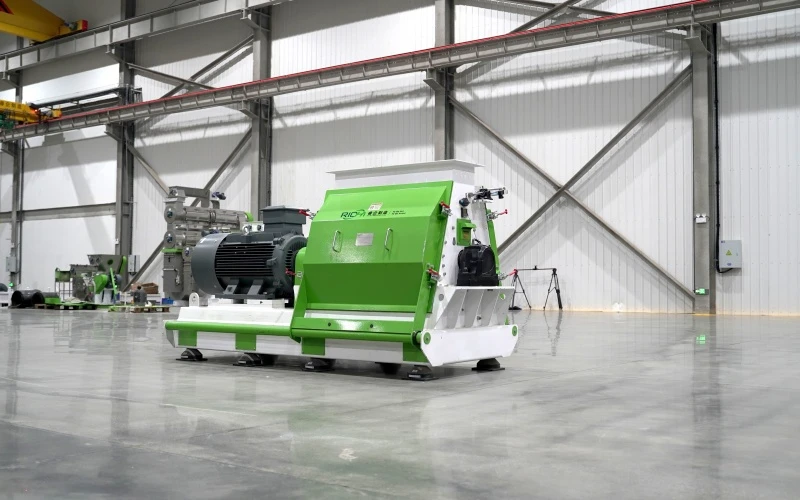
The Upper River Region processor did not invest in a new hammer mill because groundnut haulms were difficult to find. The real problem was turning a highly variable, dusty forage residue into a consistent product that sheep and goat farmers could actually use. Groundnut hay already has an established role in small-ruminant feeding in The Gambia, so the opportunity was not to invent a new market, but to improve the way an existing forage resource was prepared and sold.
The customer therefore installed one SFSP66×60 peanut straw hammer mill in The Gambia near Basse Santa Su. The 55 kW machine replaced an undersized older grinder and was integrated with the processor’s existing bale handling and bagging setup. Its main job is to reduce dried groundnut haulms into a more uniform meal for sheep and goat feeding, while allowing the operator to manage dust, screen wear, and the sand contamination that often comes with field-collected material.
Name:
Peanut Straw Crusher
Country:
Gambia
Date:
2025
Capacity:
1.0-1.5T/H
Model:
SFSP66×60
Main Motor Power:
55 kW
Raw Materials:
Ground forage
Final product size:
4 mm and 6 mm
The customer is a regional feed processor serving small-ruminant farmers rather than a large industrial feed mill.
Groundnut production has long been part of Gambian agriculture, and the haulms left after pod harvest are not simply waste. In livestock systems, especially for sheep and goats, groundnut hay is already valued as a forage resource and is traded commercially. Gambian livestock-sector documents specifically identify groundnut hay, groundnut cake, rice bran, minerals, and vitamins as important feed inputs for small ruminants, and note that the groundnut-hay trade supports many rural and peri-urban livelihoods.
The processor buys dried haulms from surrounding farmers after groundnut harvest. Some suppliers bring loosely bundled material, while others bale it for transport. The processor does not assume all incoming haulms are immediately suitable for grinding. Material containing excessive soil, stones, wire, or visible spoilage is separated before it reaches the hammer mill.
The previous machine was built for relatively light farm use. It could process small amounts of dry forage, but capacity dropped quickly when stem content increased or when sandy material entered the grinding chamber.
Groundnut haulms from sandy fields can be abrasive because soil particles remain attached to stems and roots during harvest and handling. That contamination is often more important for hammer wear than the plant fiber itself.
As feed sales increased, the processor needed a machine that could run for longer production periods, accept a controlled conveyor feed, and allow different screen sizes to be used according to the customer's requested particle size.
The SFSP66×60 was selected as a standalone replacement rather than as part of a full feed line because grinding was the main bottleneck. The customer already had floor space for bale opening, a feeding conveyor, a cyclone arrangement, and bagging space.
| Project Parameter | Configuration |
|---|---|
| Equipment | Peanut straw hammer mill |
| Model | SFSP66×60 |
| Quantity | 1 unit |
| Main Motor Power | 55 kW |
| Main Raw Material | Dried groundnut haulms |
| Project Screen Options | 4 mm and 6 mm |
| Main Product | Ground forage for sheep and goats |
| Installation Type | Standalone grinder integrated into an existing feed-processing room |
The customer also specified wear-resistant hammer options because of the abrasive contamination risk associated with field-collected haulms.
Rather than assuming carbide-tipped hammers always last a fixed multiple of standard hammers, the processor monitors actual wear against tonnes processed and contamination level. Clean, well-shaken haulms and sandy haulms can give very different wear results even when the same machine and screen are used.
Groundnut haulms arrive as stems and leaves rather than as a uniform powder. Before milling, bales or bundles are opened and visually inspected.
The customer removes wire, stones, and obviously contaminated material wherever practical. A magnetic protection point is used ahead of the high-speed grinder to reduce the risk of ferrous objects entering the chamber.
Moisture also affects performance. Properly dried haulms grind more easily and move through the screen more consistently than damp, compacted forage.
For this project, the processor aims to keep the material in a normal dry-forage storage condition, generally around the low teens in moisture. The exact operating limit is judged from storage stability and milling behavior rather than an absolute requirement that every load must be below exactly 12%.
The processor wanted one machine capable of making two different forage textures.
The 6 mm screen provides a coarser product with higher throughput and lower grinding energy. This material is suitable when customers want chopped or coarsely ground forage to mix with other ingredients on-farm.
The 4 mm screen creates a finer and more uniform product that is easier to blend into concentrate or supplementary feed, but the finer specification places more load on the hammer mill and normally reduces throughput.
The processor therefore does not treat 4 mm as universally “better” for goats and sheep.
Animal response depends on the complete ration, forage quality, fiber length, feeding method, and whether the haulm meal is offered alone or mixed with another ingredient. The screen is selected according to the customer's feeding system rather than a claim that one particle size eliminates all waste.
The processor sells the ground material primarily as a forage ingredient.
Groundnut haulms can provide useful protein and fiber, but their nutritional composition varies with variety, harvest stage, leaf retention, soil contamination, and storage. They should not automatically be described as a complete ration simply because livestock will eat them.
Some farmers use the ground haulms alongside millet, maize, bran, groundnut cake, or other available feed ingredients. Others use them as a roughage supplement during periods when pasture quality is low.
This is consistent with livestock feeding practices in The Gambia, where groundnut hay and groundnut cake are already recognized feed resources for small ruminants.
Dried groundnut haulms generate a significant quantity of lightweight dust and leaf fines during grinding, especially when material has been stored for a long period or contains a high proportion of brittle leaves.
The customer therefore uses a cyclone and downstream filtration rather than discharging mill air directly into the work area.
Dust collection serves several purposes: it improves working conditions, reduces product loss, prevents excessive buildup around the motor and bearings, and keeps the packing area cleaner.
The filtration system is sized around actual airflow and dust loading. The project does not use a fixed “99% capture” claim because collection efficiency depends on filter design, maintenance, media condition, and particle distribution.
The Gambia's groundnut-growing areas include sandy soils, and haulms can carry soil into the processing system if they are pulled, stacked, or baled without adequate shaking and cleaning.
For the hammer mill, this contamination creates two separate problems.
First, abrasive particles accelerate hammer and screen wear. Second, soil reduces the nutritional quality of the finished forage because it increases the ash fraction without adding feed value.
The processor therefore encourages suppliers to keep the haulms as clean as possible during collection and pays closer attention to visually dusty or soil-heavy loads.
This raw-material management can be more valuable than relying only on expensive wear-resistant hammers.
The finished groundnut-haulm meal is packed and sold mainly to sheep and goat keepers in the Upper River Region and surrounding markets.
The customer does not maintain one fixed recipe such as 70% haulms and 30% millet for every buyer. Some customers purchase the ground forage as a single ingredient and mix it themselves. Others request a blended feed according to their livestock-management needs.
This gives the processor flexibility without turning a small forage-grinding business into a full compound-feed mill.
It also avoids overstating the value of the hammer mill. The machine improves physical preparation and consistency; it does not replace ration formulation or nutritional testing.
Throughput on groundnut haulms varies with screen size, stem-to-leaf ratio, moisture, incoming chop length, and contamination.
For a coarser screen and well-prepared dry material, output can be noticeably higher than when the processor uses a 4 mm screen on stem-heavy haulms.
The customer therefore plans production from actual test runs rather than one fixed tonnage.
This is especially important in a small Gambian processing business where raw material is not perfectly standardized from supplier to supplier.
“What improved most is consistency. Before, every load of haulms behaved differently and the old grinder slowed down badly when the stems were tougher or the material was dusty. With the SFSP66×60, we can control the feed rate and choose the screen according to what our customers want. We still have to manage sand and dust carefully, but the grinding section is no longer the weak point in the business.”
The customer also found that inspection of hammer condition and screen wear is more useful than replacing components according to a fixed number of operating hours.
Loads containing more soil can increase wear quickly, while cleaner forage allows longer service intervals.
The SFSP66×60 crusher machine was shipped from Qingdao Port in China to the Port of Banjul.
The Port of Banjul is The Gambia's principal maritime gateway and handles both containerized and non-containerized cargo for imported feed-processing machinery.
Before shipment, RICHI supplied machine dimensions, electrical information, foundation requirements, and installation guidance so the customer could prepare the equipment area before delivery.
Final inland transport to the Upper River Region was arranged after customs clearance according to the customer's local logistics plan.
The customer is not a large industrial compound-feed producer. Its business depends on purchasing and processing a seasonal forage resource and selling it to livestock farmers.
A 55 kW SFSP66×60 gives the processor more capacity and durability than a small farm grinder without forcing the company into a much larger machine that would be difficult to keep fully supplied outside the main groundnut-haulm collection season.
The standalone arrangement also keeps investment concentrated on the process that adds the most value: turning bulky, irregular haulms into a consistent, baggable forage ingredient.
This peanut straw hammer mill in The Gambia project uses the SFSP66×60 to convert locally sourced dried groundnut haulms into a more consistent ground forage product for sheep and goat producers.
For another project, RICHI Machinery would first evaluate annual haulm supply, bale or bundle form, moisture, sand contamination, required particle size, daily operating hours, and whether the product will be sold as ground forage or blended with other feed ingredients.
Wear expectations should also be based on actual material cleanliness. If a customer's haulms contain large amounts of field soil, stronger hammers may help, but better raw-material cleaning should be addressed at the same time.
With these conditions understood, the SFSP66×60 provides a practical grinding solution for regional forage processors that need more capacity and more stable particle-size control than a small agricultural mill can provide.
Having the right mix of reliable, high-quality pellet machine and pelletizing systems and expert support is essential to your success. Watch how our end-to-end feed pellet plant solutions have helped our customers optimize their performance.
Our customized and future-proofed turnkey pellet plant solutions is designed with you at the core. From vision to reality and beyond, our team stays connected with yours. Giving you peace-of-mind with an expert at your side.
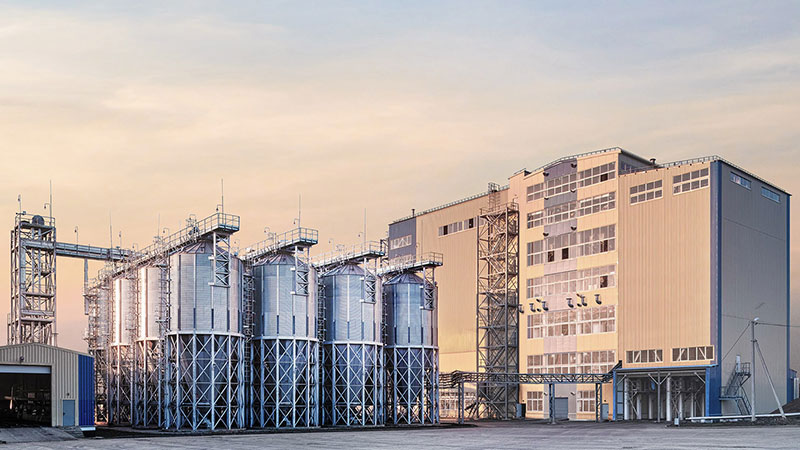
At RICHI, we go beyond project completion. With RICHI Servicee, we’re your dedicated partners in success. Count on us for expert guidance, minimal downtime, and optimized productivity. Choose RICHI for unmatched service and support.
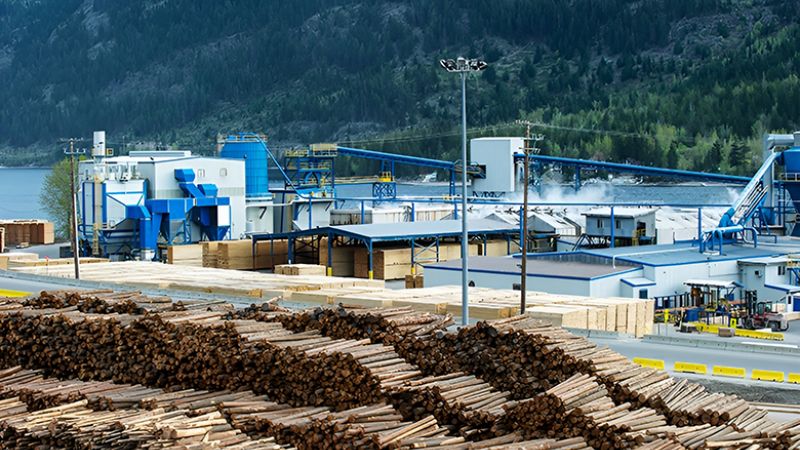


Meet global product demands and quality standards with industry-leading pellet plant design, engineering, equipment, and construction services for pellet processors.


Your Partner Beyond Project Completion
2000+ cases
RICHI is the leading designer, manufacturer and builder of pellet plants in the world, completing over 2000 projects in 140 countries across 6 continents.
Read More
Increase plant productivity, profitability, and safety by integrating high quality equipment into your pellet production line. Over the years, RICHI has become China's top pellet equipment manufacturer. At the same time, RICHI has established valuable partnerships with the world's leading component and raw material manufacturers to bring you the best there is in technology, automation, and efficiency in pelleting plant machinery.

For nearly 30 years, RICHI has been providing best-in-class pellet plant equipment and services to clients across a variety of industries, sizes, and needs. We pride ourselves on the knowledge and skill that each team member possesses – from our technical sales team to our process design engineers. You can count on RICHI Machinery to take your operation to the next level of innovation, quality, and success.
Need help with your pellet manufacturing plant project? Contact us today.
ANIMAL FEED
BIOMASS
WOOD
ORGANIC FERTILIZER
AQUA FEED
CAT LITTER
MUNICIPAL WASTE RECYCLING
SPECIAL PELLET PRODUCTION
RICHI Machinery continues to deliver world class pellet mill equipment, pellet plant engineering and project solutions that add value to our customers in the animal feed, wood waste, agriculture waste, organic fertilizer, cat litter and special pellet products industries. Throughout the years, we RICHI Machinery have built strong brand, becoming industry-leading pellet machine manufacturer. We value integrity, promise quality, and prioritize your success.
Learn MoreWith our expert team, we precisely implement your process engineering requirements in pellet mill and pelletizing plant systems. No matter which industry you’re in – we understand your needs and deliver solutions that meet the highest standards.
At RICHI, quality comes first. Our pellet making machine and related pellet line equipment undergo rigorous quality controls to ensure they meet the highest standards. Rely on products that are durable, safe, and efficient.
With decades of experience in pellet machine and pellet production line production, we have earned a reputation as a trusted partner in various industries. Our expertise allows us to cover a wide range of applications.
Not only do we offer premium pelleting equipment, but we are also experts at designing, building, installing, and maintaining facilities from the ground up. Our expertise is within pellt plant process design, discovering the most efficient, productive, and profitable way to handle your materials in an end-to-end cycle.
○ RICHI MACHINERY
Keeping in touch with us is an effective way to solve all your problems. If you have any needs or questions, please leave your contact information, then RICHI technical consultants will send design, quotation, videos to your mailbox. You can also contact us directly via WhatsApp: +86 13838389622
Copyright©2015-2026 by HENAN RICHI MACHINERY CO., LTD. All rights reserved.