
RICHI supplied a 0.3–0.5 T/H MZLH350 Paper Pellet Mill in Colombia to process prepared 3–8 mm recycled paper fiber into 6 mm pet litter and bedding pellets.
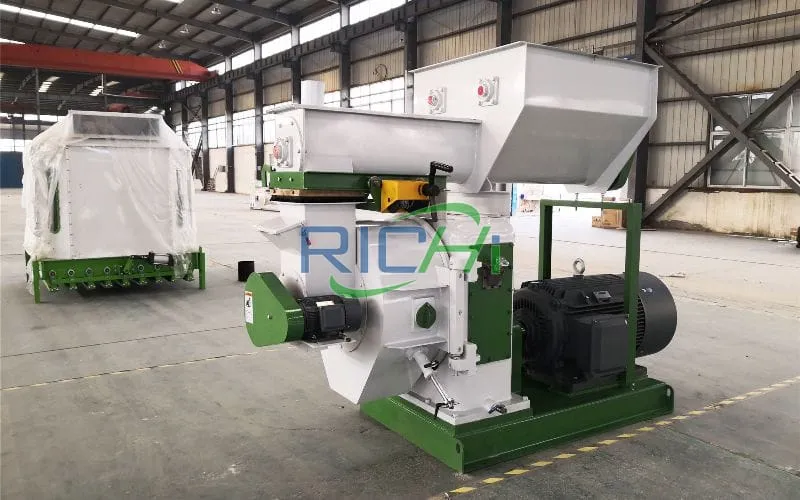
A recycling company in Colombia selected one RICHI MZLH350 Paper Pellet Mill in Colombia to convert selected low-grade recovered paper into 6 mm absorbent pellets for the pet litter and bedding market. The customer already operated a material recovery facility handling cardboard, office paper and commercial packaging waste, with sorting, shredding, conveying and bagging equipment already available. What the workshop lacked was a reliable densification stage capable of converting clean prepared paper fiber into a consistent finished pellet.
The MZLH350 was therefore supplied as a standalone pelletizing machine rather than as part of a completely new recycling line. With a 37 kW main motor and a rated paper-pellet capacity of approximately 0.3–0.5 T/H, the machine matches the customer's present supply of usable recovered fiber and the early commercial scale of the litter business. Prepared paper entering the pelletizer is reduced to a relatively uniform fibrous condition, generally within several millimeters rather than long strips or intact cardboard pieces, while the finished product is approximately 6 mm in diameter.
Name:
Paper Pellet Machine
Country:
Colombia
Date:
2026
Capacity:
300-500KG/H
Model:
MZLH350
Main Motor Power:
37 kW
Application:
Recycled paper litter and bedding pellets
Pellet diameter:
6 mm
The company receives recovered material from supermarkets, warehouses, offices, printing businesses and other commercial sources. Higher-grade corrugated cardboard and clean paper with an established recycling value can still be separated for conventional fiber recovery. The paper-pellet project focuses on clean fractions that remain technically usable but are less attractive to sell as loose or baled recovered paper.
Turning part of that material into a finished pellet gives the recycler another outlet without changing its entire business model. Loose shredded paper occupies considerable volume and is difficult to present as a standardized retail product. Densification reduces volume, creates a controlled physical form and allows the customer to sell the material as a defined 6 mm absorbent pellet instead of an irregular loose fiber.
The project therefore has one clear commercial application: recycled paper pellets for pet litter and bedding. The machine is not being used in this case to produce fuel pellets, horticultural pellets or industrial absorbents. Keeping the application narrow makes it easier to control raw-material cleanliness, pellet specification and packaging requirements.
The raw material is selected according to cleanliness rather than simply according to whether it is made of paper. The customer accepts suitable corrugated cardboard, uncoated commercial paper, clean office paper, printing offcuts and similar fiber-rich material after sorting. Heavily coated or laminated packaging, waxed paper, food-contaminated paper, wet decomposed fiber and material containing unknown chemical residues are kept out of the pet-product stream.
Foreign-material removal is especially important before size reduction. Plastic tape, stretch film, metal clips, staples, binding wire and other contaminants can damage downstream equipment or remain in the finished pellet. A paper pellet mill cannot correct poor sorting upstream. The quality of the litter pellet therefore begins at receiving and separation.
Intact cartons and large sheets are not fed directly into the ring die pellet mill. The customer first opens, sorts and shreds the recovered paper, then reduces oversized fiber further where necessary. For this project, the target condition entering the pelletizer is a loose, reasonably uniform paper fiber generally around 3–8 mm in effective particle size, without long strips that can bridge in the feeding system.
This range is used as a practical operating target rather than an absolute specification for every piece of paper. Corrugated board breaks differently from office paper, and fiber length can vary even when the same shredder screen is used. The key requirement is that the prepared fiber feeds continuously through the arch-breaking and forced-feeding system without wrapping, bridging or arriving in large compacted clumps.
If incoming material is still in 20–40 mm shredded pieces after primary size reduction, an additional fine-reduction stage is required before pelletizing. This distinction is important: coarse shredding prepares bulky paper for handling, while final preparation creates the smaller and more uniform fiber condition needed by the ring die pelletizer.
| Project Parameter | Specification | Project Basis |
|---|---|---|
| Equipment | Ring die paper pellet mill | Standalone densification machine |
| Model | MZLH350 | Selected for the customer's current recycled-paper supply |
| Main Motor | 37 kW | Standard selected project configuration |
| Arch-Breaking Feeder | 2.2 kW | Helps control low-density fibrous material |
| Forced Feeder | 0.75 kW | Supports stable entry into the pelletizing chamber |
| Ring Die Inner Diameter | 350 mm | MZLH350 configuration |
| Prepared Paper Fiber Size | Approximately 3–8 mm | After sorting and fine size reduction |
| Project Pellet Diameter | 6 mm | Pet litter and bedding application |
| Rated Capacity | 0.3–0.5 T/H | Depends on fiber type, moisture, density and die load |
| Main Product | Recycled paper litter and bedding pellets | Single use scenario for this project |
The 0.3–0.5 T/H capacity range is written explicitly because production scale is a core part of this project. The lower and upper ends are not random numbers: actual output changes when bulk density, fiber length, moisture, cardboard-to-paper ratio and feeding stability change. A batch dominated by dense kraft cardboard fiber can behave differently from one containing a higher proportion of light office-paper fiber.
The customer therefore treats 0.3–0.5 T/H as the working capacity range for properly prepared recycled paper rather than expecting exactly 0.5 T/H from every mixture. If feed preparation deteriorates or long fiber begins bridging above the forced feeder, real throughput can fall even though the pellet mill itself has not changed.
The customer selected approximately 6 mm pellets for the pet litter and bedding product. This diameter provides a compact physical form that is still large enough for convenient handling and bagging. It also avoids producing a very fine product that would increase the proportion of loose dust in the package.
The 6 mm size should not be interpreted as a universal standard for every paper-litter project. Pellet diameter depends on customer preference, animal type, packaging, required bulk density and product positioning. For this Colombian project, however, 6 mm is the confirmed finished-product specification and is therefore used consistently throughout the case.
Pellet length is controlled through the cutting arrangement and operation of the pellet mill. The customer is primarily concerned with a reasonably uniform retail product rather than maximizing pellet hardness. Litter pellets still need sufficient integrity for bagging and transport, but excessive compaction is not automatically desirable for an absorbent fiber product.
Paper fiber also requires controlled moisture before it reaches the ring die. Material that is excessively dry can be difficult to bind and may create more fines, while material that is too wet can deform, soften after packaging or feed inconsistently through the machine. The correct operating range depends on the actual paper mixture and should therefore be established during material trials rather than fixed from one generic paper specification.
The recycling facility stores selected fiber under dry conditions and checks material before pelletizing. If recovered cardboard has been exposed to rain or high humidity during collection, it is not simply mixed into the normal batch. Moisture adjustment or drying must take place before stable production resumes.
This is one of the reasons RICHI evaluates raw paper condition together with capacity. Two customers may both request 0.5 T/H, but a plant receiving dry factory offcuts has a much simpler preparation task than a recycler handling outdoor-stored cardboard with highly variable moisture.
Low-density shredded paper does not flow through a hopper in the same way as grain or dense pellets. Fibers can interlock and form a bridge above the feeding point, especially when longer strips remain after shredding. The MZLH350 configuration therefore uses an arch-breaking feeder and forced feeder to help move prepared paper toward the ring die more consistently.
These components improve feeding but do not eliminate the need for correct particle preparation. If intact cardboard pieces or long ribbon-like strips are dropped into the hopper, even a forced feeder can become unstable. Stable output begins with proper shredding and uniform feeding, followed by the mechanical feeding system on the pellet mill.
The customer therefore monitors hopper behavior together with motor load. If the main motor is underloaded while the hopper remains full, the operator checks bridging or poor feeder flow before changing pellet-mill settings.
The MZLH350 in this project is configured for recycled paper densification rather than compound animal feed production. A conventional feed conditioner is therefore not part of the selected process. The prepared paper fiber moves through the dedicated feeding arrangement into the ring die pelletizing chamber, where mechanical compression forms the material into cylindrical pellets.
This distinction prevents the project from being confused with an SZLH livestock-feed pellet line. Paper fiber does not require the same steam-conditioning logic used to gelatinize starch in poultry or pig feed. The important operating variables here are fiber preparation, moisture, feeding stability, die condition and compression behavior.
Pellets leaving the ring die are warm and should not be packed immediately. The customer therefore uses downstream cooling before finished-product storage and bagging. Cooling helps stabilize the pellets and prevents unnecessary heat from being trapped in the package.
Screening removes loose fines generated during pellet formation and handling. Suitable clean paper fines can be collected and returned to the process according to the customer's operating procedure. This helps keep the retail package more consistent while reducing avoidable fiber loss.
The downstream equipment must be matched to the 0.3–0.5 T/H pelletizing capacity. A cooler or screen with insufficient throughput would simply become a new production bottleneck after the MZLH350 is installed.
The final application makes material control more demanding. Because the pellets are marketed for pet litter and bedding, the customer cannot treat mixed recovered paper as an unrestricted raw material. Fiber coming from unknown industrial contamination, food waste, chemical packaging or heavily coated material is not accepted into this product stream.
Ink, adhesive and coating content also need consideration. Conventional printed paper is different from heavily laminated, waxed or specialty-coated packaging. The customer therefore maintains a defined acceptance standard instead of assuming that every paper material collected at the recycling yard is suitable for pet use.
The pellet mill contributes to product consistency, but it cannot make an unsuitable raw material safe. Sorting, supplier control and finished-product quality checks remain separate responsibilities within the recycling operation.
The main advantage of this project is that the customer did not duplicate equipment already available in the workshop. Existing sorting, primary shredding, conveying and packaging resources remain in service. The new MZLH350 fills the missing densification stage between prepared fiber and finished paper pellets.
The retrofit therefore concentrates on interfaces. Prepared fiber must arrive at the pellet mill continuously, the electrical supply must support the 37 kW main drive plus feeders, the discharge must connect properly to cooling, and the finished-product handling section must accept up to approximately 0.5 T/H when the machine is running near the upper end of its capacity range.
This integration approach is often more economical for established recyclers than buying a turnkey line. A complete paper pellet line is justified when the customer lacks sorting, shredding, conveying, cooling or packing capability. In this Colombian facility, those functions were already substantially available.
The MZLH350 Paper Pellet Mill in Colombia was prepared for export from Qingdao, China, with Buenaventura used as the destination seaport. From the port, inland transportation moved the machine toward the customer's recycling facility according to the final logistics arrangement.
Before shipment, RICHI confirmed machine dimensions, electrical requirements, feeding height, discharge interface and workshop arrangement so the standalone pelletizer could connect with equipment already installed at the site. This preparation is particularly important in retrofit projects because the upstream and downstream machines were not manufactured as one new integrated production line.
The MZLH350 paper pellet machine gives the customer a defined 0.3–0.5 T/H production range. At eight effective pelletizing hours per day, this corresponds theoretically to approximately 2.4–4 tonnes of pellets before allowing for cleaning, stops and product adjustments. Longer operating schedules can increase daily production without immediately requiring a larger pellet mill.
This scale fits the customer's current position better than installing a several-ton-per-hour machine. The recycler first needs enough clean paper to supply the machine continuously and enough litter customers to absorb the finished product. If those two conditions develop, capacity can be expanded later.
Future engineering would then examine the true bottleneck. The next investment might be a larger pelletizer, but it could just as easily be faster shredding, better dust extraction, a larger cooler or automatic packaging. Expansion should follow measured plant performance rather than assuming that the pellet mill is always the limiting machine.
This Paper Pellet Mill in Colombia project uses one RICHI MZLH350 to convert selected recovered paper into 6 mm recycled paper pellets for pet litter and bedding. The machine is equipped with a 37 kW main motor, 2.2 kW arch-breaking feeder and 0.75 kW forced feeder and operates within a rated capacity range of approximately 0.3–0.5 T/H under properly prepared paper-fiber conditions.
The project also makes the preprocessing requirement clear. Intact cardboard is sorted and shredded first, with the final fiber entering the MZLH350 controlled to an approximately 3–8 mm effective size rather than long strips or intact packaging. After pelletizing, the 6 mm pellets are cooled and screened before final packaging.
For another recycler evaluating a paper pellet mill, RICHI Machinery needs the actual paper mix, percentage of cardboard versus paper, contamination level, moisture, primary shred size, final prepared fiber size, required pellet diameter, desired capacity, operating hours and existing equipment list. With those parameters, the pellet mill and surrounding process can be matched to the real recovered-paper stream instead of being selected only from an advertised tonnes-per-hour number.
Having the right mix of reliable, high-quality pellet machine and pelletizing systems and expert support is essential to your success. Watch how our end-to-end feed pellet plant solutions have helped our customers optimize their performance.
Our customized and future-proofed turnkey pellet plant solutions is designed with you at the core. From vision to reality and beyond, our team stays connected with yours. Giving you peace-of-mind with an expert at your side.
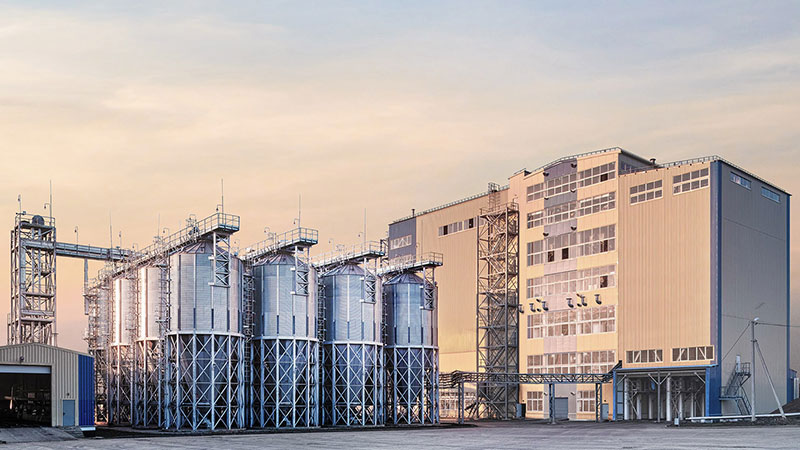
At RICHI, we go beyond project completion. With RICHI Servicee, we’re your dedicated partners in success. Count on us for expert guidance, minimal downtime, and optimized productivity. Choose RICHI for unmatched service and support.
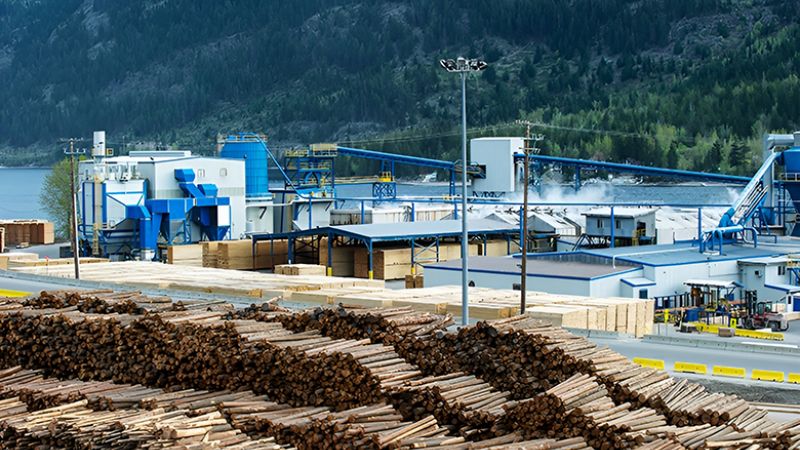


Meet global product demands and quality standards with industry-leading pellet plant design, engineering, equipment, and construction services for pellet processors.

Your Partner Beyond Project Completion
2000+ cases
RICHI is the leading designer, manufacturer and builder of pellet plants in the world, completing over 2000 projects in 140 countries across 6 continents.
Read More
Increase plant productivity, profitability, and safety by integrating high quality equipment into your pellet production line. Over the years, RICHI has become China's top pellet equipment manufacturer. At the same time, RICHI has established valuable partnerships with the world's leading component and raw material manufacturers to bring you the best there is in technology, automation, and efficiency in pelleting plant machinery.

For nearly 30 years, RICHI has been providing best-in-class pellet plant equipment and services to clients across a variety of industries, sizes, and needs. We pride ourselves on the knowledge and skill that each team member possesses – from our technical sales team to our process design engineers. You can count on RICHI Machinery to take your operation to the next level of innovation, quality, and success.
Need help with your pellet manufacturing plant project? Contact us today.
ANIMAL FEED
BIOMASS
WOOD
ORGANIC FERTILIZER
AQUA FEED
CAT LITTER
MUNICIPAL WASTE RECYCLING
SPECIAL PELLET PRODUCTION
RICHI Machinery continues to deliver world class pellet mill equipment, pellet plant engineering and project solutions that add value to our customers in the animal feed, wood waste, agriculture waste, organic fertilizer, cat litter and special pellet products industries. Throughout the years, we RICHI Machinery have built strong brand, becoming industry-leading pellet machine manufacturer. We value integrity, promise quality, and prioritize your success.
Learn MoreWith our expert team, we precisely implement your process engineering requirements in pellet mill and pelletizing plant systems. No matter which industry you’re in – we understand your needs and deliver solutions that meet the highest standards.
At RICHI, quality comes first. Our pellet making machine and related pellet line equipment undergo rigorous quality controls to ensure they meet the highest standards. Rely on products that are durable, safe, and efficient.
With decades of experience in pellet machine and pellet production line production, we have earned a reputation as a trusted partner in various industries. Our expertise allows us to cover a wide range of applications.
Not only do we offer premium pelleting equipment, but we are also experts at designing, building, installing, and maintaining facilities from the ground up. Our expertise is within pellt plant process design, discovering the most efficient, productive, and profitable way to handle your materials in an end-to-end cycle.
○ RICHI MACHINERY
Keeping in touch with us is an effective way to solve all your problems. If you have any needs or questions, please leave your contact information, then RICHI technical consultants will send design, quotation, videos to your mailbox. You can also contact us directly via WhatsApp: +86 13838389622
Copyright©2015-2026 by HENAN RICHI MACHINERY CO., LTD. All rights reserved.