
Paper Granulator for Biomass in Finland: two MZLH350 presses for a small paper-derived fuel stream, with winter storage and boiler acceptance checks.
The fuel arrives in bales; the boiler needs a measured stream. Between those two points, paper can bridge in bins, absorb moisture and produce fines during handling. Granulation becomes useful when it makes that route more predictable.
This illustrative application concerns an industrial CHP operator in eastern Finland considering a small paper-rich recovered-fuel stream alongside forest biomass. The design assumes a plant authorised for the relevant waste co-incineration duty, with the specific material subject to fuel acceptance. Its brief for a paper granulator for biomass in Finland centres on two MZLH350 units integrated with existing size-reduction equipment.
Name:
Paper Granulator
Country:
Finland
Date:
2026
Capacity:
600–1,000 kg/h
Model:
MZLH350
Main Motor Power:
37 kW
Pellet Diameter:
8 mm
Pellet length:
10–25 mm
The proposed supply is a dry, source-sorted paper-rich reject fraction from a commercial materials-recovery operator. Material suitable for paper recycling should remain in that recovery route. Fuel preparation starts with a defined non-recyclable fraction and documented acceptance criteria.
The fuel file needs moisture, ash, net calorific value, chlorine and relevant metals. Fillers, coatings, inks and residual plastics can change the combustion and ash characteristics. Granulation changes physical form; it does not establish the material's fuel classification or remove contaminants.
The retained paper-qualified shredder and secondary mill prepare the accepted material. Metal and other foreign-material separation takes place before fine size reduction. Initial trials use paper fragments with a largest dimension below approximately 5 mm and a moisture target of 10–12% on a wet basis.
Those targets require testing with the actual fibre mix. Long strips can bridge above the press, while moisture variation changes compaction behaviour. Die profile, feed preparation and any binder requirement should be evaluated together.
The material test should record feed condition, motor load, granule temperature and the amount returned from screening. Retain samples of both feed and granules so the agreed output can be tied to a defined paper grade.
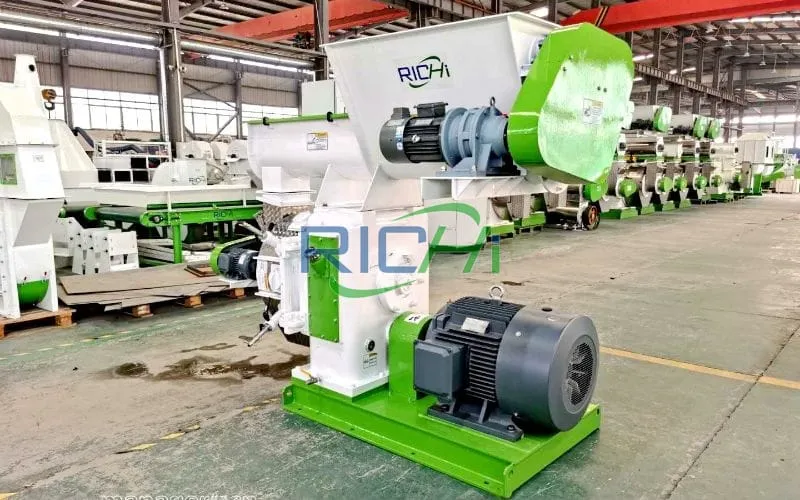
The proposed arrangement places two MZLH350 paper pellet machines in parallel. Each has an arch-breaking feeder and a forced feeder to deliver the light paper fragments into the pressing section. Separate feed control permits staged operation and individual material trials.
| Item | Reference specification or application target |
|---|---|
| Model and quantity | Two MZLH350 ring die granulators |
| Main motor rating | 37 kW per unit |
| Arch-breaking feeder rating | 2.2 kW per unit |
| Forced feeder rating | 0.75 kW per unit |
| Combined listed drive ratings | 79.9 kW for both machines |
| Ring die inner diameter | 350 mm |
| Manufacturer's biomass reference capacity | 300–500 kg/h per unit |
| Combined reference capacity | 600–1,000 kg/h |
| Paper application planning point | 400 kg/h per unit; 800 kg/h combined, subject to trials |
| Provisional finished granule dimensions | 8 mm diameter; 10–25 mm length |
The paper target is defined as accepted, cooled and screened granules. The published reference range does not guarantee that output on every paper fraction. Changing diameter requires a different ring die; the cutter controls length.
At 800 kg/h across eight scheduled hours and 200 production days, the planning quantity is 1,280 tonnes annually, before availability and rejection allowances. That modest stream supports controlled fuel diversification. Further expansion needs a matching supply of accepted paper and additional boiler demand.
The receiving boiler in this design is a bubbling fluidized bed unit. The combustion review needs to address bed behaviour, particle carryover and ash removal for the accepted paper fraction.
Paper granules and forest chips have different sizes, bulk densities and handling characteristics. A separate buffer bin and controlled dosing point allow the operator to measure the paper stream near the boiler feed system. Storage and discharge trials should check bridging, fines and segregation.
Fuel substitution is calculated from energy input. Using an illustrative as-received net calorific value of 14 MJ/kg, firing 800 kg/h supplies approximately 3 MW. Against a boiler operating at 60 MW fuel input, that represents around 5% at that operating point. Laboratory fuel results replace the assumed calorific value before a combustion trial.
The production schedule and buffer inventory determine how many hours the boiler can sustain that firing rate. Annual substitution must follow actual fuel deliveries and boiler operating records.
The boiler operator and its combustion specialist establish the permitted trial conditions. Monitoring should cover feed stability, combustion performance, emissions and ash behaviour. A granule diameter alone cannot establish an acceptable co-firing percentage.
Covered reception and an indoor conditioning buffer protect the prepared paper supply. Wet or frozen bales need assessment before processing; where thawing is necessary, moisture must be checked through the bale rather than only at its surface. A fixed thawing time would be unreliable across different loads.
Finished granules need a defined cooling and screening stage before enclosed storage. Warm product, cold surfaces and moisture ingress can undermine storage quality. The layout should manage condensation, remove fines and provide access for cleaning without relying on the press to solve storage problems.
Acceptance sampling should follow the granules through the intended conveyor route. Measure dimensions, bulk density, durability, fines and moisture after handling. The useful product is the fuel delivered to the dosing system, so that point belongs in the acceptance plan.
The main machinery order consists of the two presses and their feeders. The quotation should separately identify shared cooling, screening, extraction, conveyors, storage interfaces and controls. The listed 79.9 kW covers only the press and feeder drives.
Finland's nominal supply frequency is 50 Hz. The electrical package needs confirmation of actual site voltage, starting method, protection and integration requirements. Paper-dust containment, ignition control and the required conformity documentation also belong in the engineering review.
Foundation loads, lifting points, service clearances and building headroom must follow the supplier's arrangement drawings. The proposed operating plan assigns a process operator to the granulation station, with shared forklift and maintenance support. The existing boiler team retains fuel-admission and combustion control.
Shipping can be planned from Qingdao to Vuosaari Harbour in Helsinki, followed by inland transport. Final packing, route and installation support are agreed against the completed equipment list. Freight, taxes, site work and auxiliaries require their own quotation scope.
For a paper granulator for biomass in Finland, the most useful enquiry starts with an accepted paper sample, its fuel analysis and the boiler's fuel specification. Add the required hourly stream and winter storage arrangement. RICHI Machinery can then define the granulation trial and equipment interfaces around the fuel the plant can actually use.
Having the right mix of reliable, high-quality pellet machine and pelletizing systems and expert support is essential to your success. Watch how our end-to-end feed pellet plant solutions have helped our customers optimize their performance.
Our customized and future-proofed turnkey pellet plant solutions is designed with you at the core. From vision to reality and beyond, our team stays connected with yours. Giving you peace-of-mind with an expert at your side.

At RICHI, we go beyond project completion. With RICHI Servicee, we’re your dedicated partners in success. Count on us for expert guidance, minimal downtime, and optimized productivity. Choose RICHI for unmatched service and support.



Meet global product demands and quality standards with industry-leading pellet plant design, engineering, equipment, and construction services for pellet processors.


Your Partner Beyond Project Completion
2000+ cases
RICHI is the leading designer, manufacturer and builder of pellet plants in the world, completing over 2000 projects in 140 countries across 6 continents.
Read More
Increase plant productivity, profitability, and safety by integrating high quality equipment into your pellet production line. Over the years, RICHI has become China's top pellet equipment manufacturer. At the same time, RICHI has established valuable partnerships with the world's leading component and raw material manufacturers to bring you the best there is in technology, automation, and efficiency in pelleting plant machinery.

For nearly 30 years, RICHI has been providing best-in-class pellet plant equipment and services to clients across a variety of industries, sizes, and needs. We pride ourselves on the knowledge and skill that each team member possesses – from our technical sales team to our process design engineers. You can count on RICHI Machinery to take your operation to the next level of innovation, quality, and success.
Need help with your pellet manufacturing plant project? Contact us today.
ANIMAL FEED
BIOMASS
WOOD
ORGANIC FERTILIZER
AQUA FEED
CAT LITTER
MUNICIPAL WASTE RECYCLING
SPECIAL PELLET PRODUCTION
RICHI Machinery continues to deliver world class pellet mill equipment, pellet plant engineering and project solutions that add value to our customers in the animal feed, wood waste, agriculture waste, organic fertilizer, cat litter and special pellet products industries. Throughout the years, we RICHI Machinery have built strong brand, becoming industry-leading pellet machine manufacturer. We value integrity, promise quality, and prioritize your success.
Learn MoreWith our expert team, we precisely implement your process engineering requirements in pellet mill and pelletizing plant systems. No matter which industry you’re in – we understand your needs and deliver solutions that meet the highest standards.
At RICHI, quality comes first. Our pellet making machine and related pellet line equipment undergo rigorous quality controls to ensure they meet the highest standards. Rely on products that are durable, safe, and efficient.
With decades of experience in pellet machine and pellet production line production, we have earned a reputation as a trusted partner in various industries. Our expertise allows us to cover a wide range of applications.
Not only do we offer premium pelleting equipment, but we are also experts at designing, building, installing, and maintaining facilities from the ground up. Our expertise is within pellt plant process design, discovering the most efficient, productive, and profitable way to handle your materials in an end-to-end cycle.
○ RICHI MACHINERY
Keeping in touch with us is an effective way to solve all your problems. If you have any needs or questions, please leave your contact information, then RICHI technical consultants will send design, quotation, videos to your mailbox. You can also contact us directly via WhatsApp: +86 13838389622
Copyright©2015-2026 by HENAN RICHI MACHINERY CO., LTD. All rights reserved.