
A palm kernel shell pellet machine in Malaysia was purchased by a biomass fuel processor in Johor to add a new pelletized-fuel product to an existing PKS business. The company already sourced palm kernel shells from palm oil processing facilities in southern Malaysia and had experience storing, preparing and supplying PKS as an industrial biomass fuel.
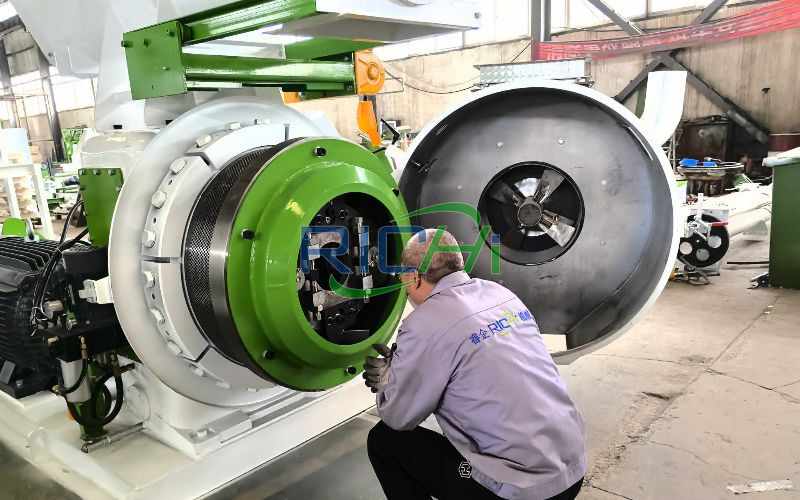
A palm kernel shell pellet machine in Malaysia was purchased by a biomass fuel processor in Johor to add a new pelletized-fuel product to an existing PKS business. The company already sourced palm kernel shells from palm oil processing facilities in southern Malaysia and had experience storing, preparing and supplying PKS as an industrial biomass fuel.
Instead of building another complete biomass pellet plant, the customer selected one MZLH678 ring die pellet machine and connected it with existing raw material handling and size-reduction equipment. The project was designed around one clear commercial objective: convert part of the company's loose PKS inventory into standardized 8 mm biomass fuel pellets while retaining the option to continue selling loose shells when that market was more attractive.
Name:
PKS pellet making machine
Country:
Malaysia
Date:
2024
Capacity:
2.5–3.0 T/H
Model:
MZLH678
Main Motor Power:
185 kW
Control Mode:
Automatic
Finished Pellet Diameter:
8 mm
The customer is not a new investor who entered the biomass industry simply because palm kernel shells are widely available in Malaysia. It is an established biomass fuel processor in Johor that had already been purchasing and handling PKS before the pelletizing project was considered.
That distinction influenced the equipment decision.
The company receives palm kernel shells from several palm oil processing facilities in southern Malaysia. After receiving the material, it stores and prepares different batches according to customer requirements.
For years, most of this material had been sold as loose biomass fuel. That business remains commercially useful because many industrial boilers in Malaysia and the wider Southeast Asian biomass market can use PKS directly.
The customer therefore had no reason to stop its existing business.
Instead, management noticed that another group of industrial energy users preferred a fuel with more uniform dimensions and more predictable feeding characteristics. Irregular shells can work well in combustion systems designed around loose PKS, but they are not necessarily the preferred form for every automated fuel-feeding system.
This created the commercial reason to install a palm kernel shell pellet machine in Malaysia.
Pelletizing would not replace the company's loose-shell business. It would give the same raw material a second product form and allow the customer to serve buyers with different fuel-handling requirements.
The customer already had a working biomass operation, so a complete new PKS biomass pellet production line was unnecessary.
Receiving and storage areas were available. The facility also had basic crushing and material conveying equipment that could be incorporated into the new process after technical checking.
The missing stage was densification.
For that reason, the investment focused on one MZLH678 palm kernel shell pellet mill rather than duplicating the customer's existing equipment.
This also gave management a practical way to enter pellet production at commercial scale without immediately committing capital to a much larger system.
The customer could establish actual electricity consumption, wear-part consumption, pellet durability, operating hours and buyer acceptance using one machine. If pellet orders later justify more capacity, another pelletizer can be added around real operating data.
For an existing biomass processor, this approach can be more sensible than purchasing the largest pellet plant available from the beginning.
Palm kernel shell is one of the major solid residues associated with Malaysia's palm oil processing industry, making Johor a logical location for this type of biomass project.
However, simply saying that the customer uses “PKS” does not describe the material well enough for pellet machine selection.
Incoming batches differ.
Some shells contain more fines. Others have larger pieces that require additional size reduction. Moisture also changes according to storage method, rainfall exposure and the conditions under which the shells were handled before arriving at the customer's facility.
The original project concept therefore did not assume that every batch would arrive at a fixed 8–12% moisture and could immediately be sent into the pelletizer.
The customer checks the physical condition of incoming material before production. Foreign matter that could damage the ring die or rollers must be removed, and oversized shells need to be reduced to a suitable particle size.
If a batch has been exposed to rain or stored under conditions that increase moisture, it must be dealt with before pelletizing. Conversely, material that is already within an appropriate working range does not need to be dried merely because a dryer is commonly shown on a biomass pellet line flow diagram.
A palm kernel shell pelletizer performs the densification stage. It should not be treated as a crusher for whole, uncontrolled PKS.
PKS is relatively hard compared with loose straw, grass and many other agricultural residues. Consistent size reduction therefore helps the material enter the feeding system more evenly and reduces unnecessary variation during pellet formation.
At this Johor facility, existing crushing equipment is used before the MZLH678.
The prepared PKS is inspected after crushing. Appropriate fines can remain in the pelletizing material, while unsuitable contaminants must be removed. Moisture is checked and adjusted according to the condition required for stable pellet formation.
These upstream controls have a direct influence on the performance of the palm kernel shell pellet mill.
If particle size varies excessively, feeding and compression become less predictable. If moisture is unsuitable, capacity and pellet durability can change even though the pellet machine itself has not changed.
This is why RICHI evaluates raw material condition rather than recommending a PKS pellet machine based only on the requested tons per hour.
The MZLH678 was selected because the customer's available PKS volume and target commercial output justified a larger standalone biomass pelletizer.
| Project Item | Specification |
|---|---|
| Machine | Palm kernel shell pellet machine |
| Model | MZLH678 |
| Quantity | 1 unit |
| Main Motor Power | 185 kW |
| Arch-Breaking Feeder Power | 3 kW |
| Forced Feeder Power | 1.5 kW |
| Ring Die Inner Diameter | 673 mm |
| Finished Pellet Diameter Range | 6–12 mm |
| Project Pellet Diameter | 8 mm |
| Rated Capacity | 2.5–3.0 T/H |
| Finished Product | PKS biomass fuel pellets |
The 2.5–3.0 T/H figure is the applicable rated capacity under suitable raw material and operating conditions. It should not be interpreted as a guarantee that every batch of palm kernel shell will continuously produce exactly 3 tons of pellets per hour.
Particle size, moisture, bulk density, die configuration, compression characteristics and operating adjustment can all affect actual output.
For this reason, RICHI's equipment selection focused not only on motor power but also on how the customer's prepared material would reach the MZLH678.
The customer chose 8 mm pellets because this project is aimed at industrial biomass fuel users.
The intention is not to turn PKS into household heating pellets simply because wood pellets are commonly sold in similar diameters. The finished specification is determined by the fuel-handling requirements of the customer's target market.
For this project, 8 mm provided a practical commercial specification for storage, conveying and controlled feeding.
Pelletizing gives irregular crushed PKS a much more consistent physical form. That can be useful for customers whose automated feeding equipment handles cylindrical pellets more predictably than shell pieces with varying shapes.
The MZLH678 can be configured for other pellet diameters within its applicable range, but the customer deliberately avoided producing several sizes during the initial stage.
One standardized product is easier to control while the company establishes pellet quality requirements, production costs and buyer feedback.
The palm kernel shell pellet machine in Malaysia is the core densification machine, not the entire production system.
PKS first enters the customer's existing receiving and storage section. Material is inspected, and oversized shells are reduced before pelletizing. Moisture condition is checked at this stage rather than after unsuitable material has already reached the pellet mill.
Prepared PKS is then conveyed to the MZLH678.
The arch-breaking feeder and forced feeder are particularly relevant to stable operation. Their role is to help maintain controlled material delivery into the pelletizing chamber rather than allowing irregular feeding to repeatedly change machine load.
Inside the pellet mill, rollers force prepared material through the openings of the ring die. Compression converts the loose crushed PKS into dense cylindrical pellets.
The newly formed pellets leave the machine hot and should not simply be sent directly into long-term storage. Cooling is required to stabilize the finished product, and screening can remove excessive fines before storage or delivery.
The customer could therefore retain useful upstream equipment while adding the new pelletizing stage where it created the greatest commercial value.
One reason this project could not simply use any general-purpose pellet press was the physical character of palm kernel shell.
PKS behaves differently from sawdust, rice husk, straw or soft forage. Its hardness, density and friction characteristics affect compression and equipment load.
Ring die selection therefore matters.
A die configuration that performs well on another biomass material is not automatically the best configuration for palm kernel shell. Compression ratio needs to be matched with actual material condition and required pellet quality.
The feeding system is equally important.
Unstable material supply can cause fluctuations in machine load and finished pellet quality. The combination of arch-breaking feeding and forced feeding helps maintain more controlled delivery to the pelletizing chamber.
Before finalizing the MZLH678 configuration, RICHI discussed raw material condition, pellet diameter and operating requirements with the customer so that the machine could be configured around PKS rather than supplied as a generic biomass pellet press.
Although the current project is dedicated to palm kernel shell pellets, the MZLH ring die biomass pellet machine is not restricted to one raw material.
Depending on preparation and machine configuration, this type of equipment can be applied to wood residues, sawdust, rice husk, straw and various agricultural processing residues.
That versatility has value for a Malaysian biomass processor because PKS does not have to remain the only possible feedstock throughout the life of the equipment.
However, “multi-material capability” does not mean different biomass materials can be switched without adjustment.
Particle size, moisture, feeding behavior and die compression requirements still need to be considered for each material. If the customer later wants to pelletize another palm residue or blend PKS with another biomass feedstock, RICHI would first review its physical properties and the intended fuel specification.
The finished pellets are intended for industrial thermal energy applications.
This is an important point because pelletizing PKS does not automatically make it more valuable than loose shells in every situation.
Malaysia already has an established market for palm biomass fuels. Some industrial users can handle loose PKS efficiently and may have no commercial reason to pay for additional densification.
Other buyers place more value on uniform dimensions, controlled feeding and denser storage.
The Johor customer's strategy is therefore to keep both options available.
Loose PKS can continue to be supplied to buyers whose combustion systems are designed around shells. A selected portion of prepared material can pass through the MZLH678 and become 8 mm PKS pellets for customers who prefer pelletized biomass fuel.
This is what makes the investment commercially different from a project that relies entirely on selling one finished product.
Having access to large quantities of PKS does not automatically justify installing the largest palm kernel shell pellet machine available.
The customer also had to consider how many tons of pelletized fuel could realistically be sold.
One MZLH678 palm waste pellet machine provides 2.5–3.0 T/H of rated pelletizing capacity. At eight operating hours per day, that represents substantial daily production before maintenance time, material changes and actual operating efficiency are considered.
The company preferred to begin at this level rather than immediately install two or three large machines and then depend on future sales to keep them utilized.
This also gives management useful production data.
Electricity consumption per ton, ring die and roller wear, labor requirements, crushing cost, cooling requirements, fines generation and customer response can all be evaluated under actual Malaysian operating conditions.
Those numbers will provide a much stronger basis for a second-stage investment than an expansion decision made before commercial production begins.
The MZLH678 palm kernel shell pellet machine was shipped by sea from Qingdao Port, China, to the Port of Tanjung Pelepas in Johor, Malaysia.
Because the customer was installing a standalone machine into an existing facility, RICHI's work did not end with packing the pelletizer for shipment.
Interface information had to be checked in advance.
The customer needed to know the required feed height, discharge position, electrical load, foundation requirements and maintenance clearance so that existing conveyors and surrounding equipment could be adapted before installation.
RICHI also supplied installation information and discussed routine spare parts for the pelletizing section. Ring dies and rollers are wear components, so planning for replacements is part of operating a commercial biomass pellet mill rather than something that should only be considered after wear occurs.
The first production runs reinforced one point that had been discussed before the machine was ordered: raw material preparation matters almost as much as the pelletizer itself.
Batches with controlled particle size and suitable moisture fed more consistently. When incoming PKS contained more oversized pieces or had been exposed to excessive moisture, upstream preparation had to be corrected before stable pelletizing could resume.
This gave the customer a clearer raw material acceptance procedure.
Instead of treating every truckload of PKS as identical, operators began paying closer attention to moisture, shell condition and preparation before material reached the pelletizing section.
The customer also achieved the commercial flexibility expected from the project.
It did not have to abandon loose PKS sales. Pellet production became an additional route for material already moving through the company's biomass business.
For management, that was more important than simply reporting a higher machine output: one locally available raw material could now be supplied in two different physical forms according to buyer requirements.
The purchase decision was based partly on equipment, but also on whether the supplier understood that this was an integration project rather than a new turnkey plant.
The customer did not need to be persuaded to replace usable storage and crushing equipment simply to make the project larger.
RICHI instead focused on the missing pelletizing section and checked how the MZLH678 would connect with the customer's existing process.
Raw material condition, required pellet diameter, feeding behavior, die selection, downstream cooling and interface dimensions were discussed before shipment.
This approach reduced unnecessary equipment investment and made the new palm kernel shell pelletizer easier to incorporate into the customer's existing biomass operation.
It also leaves the facility open to future expansion. If pellet orders eventually exceed the practical output of one MZLH678 biomass pellet machine, the next capacity increase can be planned around proven sales volume and actual production data.
The answer depends heavily on what equipment is already available.
A palm oil mill or biomass company that already has suitable crushing, conveying, storage and moisture-control equipment may only need to add pelletizing, cooling and related handling equipment.
A business starting with wet, contaminated or oversized palm kernel shells is in a different position.
Buying only a palm kernel shell pellet machine will not eliminate the need for proper raw material preparation. Crushing, drying or moisture adjustment, separation of foreign matter, cooling, screening and storage may still be required depending on the starting material and finished product.
Capacity also needs to be calculated from more than annual PKS availability.
The buyer should know the approximate daily supply, operating hours, expected percentage of PKS that will actually be pelletized and the amount of finished pellet fuel already supported by customer demand.
This Johor project shows why standalone pelletizing equipment can be a good investment for an established biomass processor when the surrounding infrastructure already exists.
The customer did not buy an unnecessary new plant. One MZLH678 was added to solve a specific processing requirement: convert prepared PKS into standardized 8 mm biomass fuel pellets at a rated 2.5–3.0 T/H while retaining the existing loose-shell business.
For another customer, the correct configuration may be completely different.
Before selecting a palm kernel shell pellet machine in Malaysia, RICHI Machinery normally needs to understand the available PKS volume, current moisture range, shell size, contamination level, required hourly output, target pellet diameter, daily working hours and final fuel market.
Existing equipment is equally important. If crushing, drying, conveying, cooling or screening equipment is already installed, its specifications can be reviewed before recommending additional machinery rather than automatically replacing it.
Companies evaluating a PKS biomass pellet mill can provide RICHI with raw material photos or samples, approximate tons per day, moisture data, required pellet specifications, available power and an existing equipment list. From those details, RICHI can determine whether the MZLH678 used in this Malaysian project is appropriate, whether a smaller palm kernel shell pelletizer would provide better utilization, or whether the expected market genuinely supports a larger pellet production system.
Having the right mix of reliable, high-quality pellet machine and pelletizing systems and expert support is essential to your success. Watch how our end-to-end feed pellet plant solutions have helped our customers optimize their performance.
Our customized and future-proofed turnkey pellet plant solutions is designed with you at the core. From vision to reality and beyond, our team stays connected with yours. Giving you peace-of-mind with an expert at your side.
At RICHI, we go beyond project completion. With RICHI Servicee, we’re your dedicated partners in success. Count on us for expert guidance, minimal downtime, and optimized productivity. Choose RICHI for unmatched service and support.


Meet global product demands and quality standards with industry-leading pellet plant design, engineering, equipment, and construction services for pellet processors.


Your Partner Beyond Project Completion
2000+ cases
RICHI is the leading designer, manufacturer and builder of pellet plants in the world, completing over 2000 projects in 140 countries across 6 continents.
Read More
Increase plant productivity, profitability, and safety by integrating high quality equipment into your pellet production line. Over the years, RICHI has become China's top pellet equipment manufacturer. At the same time, RICHI has established valuable partnerships with the world's leading component and raw material manufacturers to bring you the best there is in technology, automation, and efficiency in pelleting plant machinery.

For nearly 30 years, RICHI has been providing best-in-class pellet plant equipment and services to clients across a variety of industries, sizes, and needs. We pride ourselves on the knowledge and skill that each team member possesses – from our technical sales team to our process design engineers. You can count on RICHI Machinery to take your operation to the next level of innovation, quality, and success.
Need help with your pellet manufacturing plant project? Contact us today.
ANIMAL FEED
BIOMASS
WOOD
ORGANIC FERTILIZER
AQUA FEED
CAT LITTER
MUNICIPAL WASTE RECYCLING
SPECIAL PELLET PRODUCTION
RICHI Machinery continues to deliver world class pellet mill equipment, pellet plant engineering and project solutions that add value to our customers in the animal feed, wood waste, agriculture waste, organic fertilizer, cat litter and special pellet products industries. Throughout the years, we RICHI Machinery have built strong brand, becoming industry-leading pellet machine manufacturer. We value integrity, promise quality, and prioritize your success.
Learn MoreWith our expert team, we precisely implement your process engineering requirements in pellet mill and pelletizing plant systems. No matter which industry you’re in – we understand your needs and deliver solutions that meet the highest standards.
At RICHI, quality comes first. Our pellet making machine and related pellet line equipment undergo rigorous quality controls to ensure they meet the highest standards. Rely on products that are durable, safe, and efficient.
With decades of experience in pellet machine and pellet production line production, we have earned a reputation as a trusted partner in various industries. Our expertise allows us to cover a wide range of applications.
Not only do we offer premium pelleting equipment, but we are also experts at designing, building, installing, and maintaining facilities from the ground up. Our expertise is within pellt plant process design, discovering the most efficient, productive, and profitable way to handle your materials in an end-to-end cycle.
○ RICHI MACHINERY
Keeping in touch with us is an effective way to solve all your problems. If you have any needs or questions, please leave your contact information, then RICHI technical consultants will send design, quotation, videos to your mailbox. You can also contact us directly via WhatsApp: +86 13838389622
Copyright©2015-2026 by HENAN RICHI MACHINERY CO., LTD. All rights reserved.