
A western Georgia fertilizer processor uses one FZLH678 ring-die machine to pellet stabilized poultry litter, cattle manure and prepared agricultural organic materials.
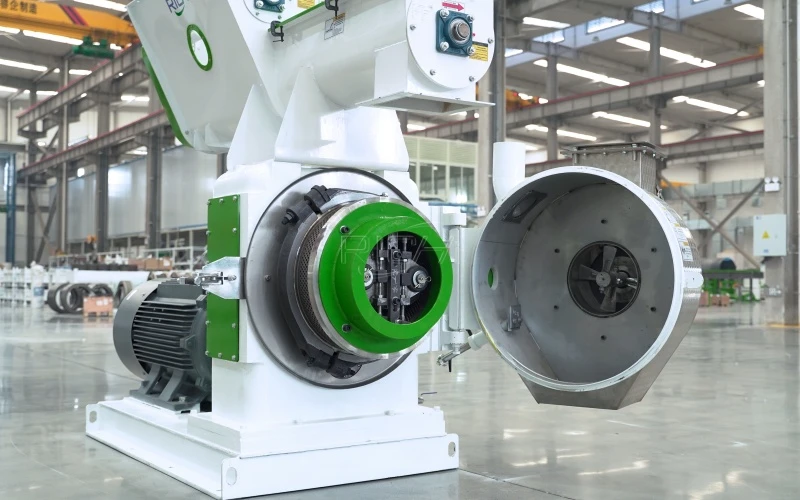
A regional organic fertilizer processor in western Georgia selected one FZLH678 Organic Fertilizer Pellet Machine in Georgia to expand the mechanical forming stage of its manure-recycling business. The plant aggregates stabilized livestock and poultry materials from several suppliers, combines them with qualified agricultural organic matter, and supplies pelletized fertilizer to orchards, horticultural farms and crop distributors.
The customer already operated composting, crushing, mixing, moisture-control, conveying and finished-product handling equipment, so the project remained a standalone granulation investment. The FZLH678 provides about 18–22 T/H of reference pelletizing capacity on suitable prepared fertilizer, allowing mature material to be processed in concentrated campaigns instead of requiring the whole factory to run continuously at that hourly rate.
Name:
Organic fertilizer ring-die pellet machine
Country:
Georgia
Date:
2026
Capacity:
18–22 T/H
Model:
FZLH678
Main Motor Power:
200 kW
Raw Materials:
poultry litter, cattle-manure
Pellet diameter:
10 mm
| Project Parameter | Configuration |
|---|---|
| Equipment | Organic fertilizer ring-die pellet machine |
| Model | FZLH678 |
| Quantity | 1 unit |
| Main Motor Power | 200 kW |
| Anti-Bridging Feeder Power | 3 kW |
| Forced Feeder Power | 1.5 kW |
| Ring Die Inner Diameter | 673 mm |
| Available Pellet Diameter | 4–12 mm |
| Main Project Pellet Diameter | 10 mm |
| Reference Capacity | Approximately 18–22 T/H under suitable prepared-material conditions |
| Main Feedstock | Stabilized poultry litter and collectable cattle-manure fertilizer materials |
| Additional Organic Materials | Prepared corn residues, hazelnut by-products and qualified woody carbon materials |
| Installation Type | Standalone pelletizing upgrade in a regional commercial fertilizer plant |
The 18–22 T/H figure applies to the ring-die forming stage and does not describe fresh-manure intake or guaranteed plant-wide output. Composting, drying, formulation, cooling and bagging operate under different time scales, so the customer sizes buffers and operating campaigns around the amount of mature fertilizer actually available for pelletizing.
An FZLH678 organic fertilizer pellet machine is too large for a small farm processing manure only from its own livestock. The Georgian customer therefore works as a centralized processor that purchases or receives organic materials from several agricultural businesses. Mature compost can accumulate before granulation, allowing the 200 kW machine to run efficiently for shorter production campaigns rather than remaining lightly loaded through an entire shift.
Western Georgia combines livestock activity with poultry farming, maize production, hazelnut processing and intensive horticulture. That gives a fertilizer processor access to several organic streams, but availability is not assumed from regional statistics alone. The plant contracts material that can be collected economically, transported without excessive water, and documented well enough to enter a controlled fertilizer formulation.
Samegrelo and Guria are major hazelnut areas, so husks and processing residues can become useful carbon-rich compost components when their condition is suitable. They are chopped or crushed as needed and biologically treated with manure rather than fed as coarse shells directly into the ring die. Their inclusion depends on moisture, decomposition, fibre and fertilizer analysis, not on a permanent percentage.
Georgia has substantial cattle and sheep populations, but manure deposited across grazing land is dispersed and expensive to collect. The plant therefore focuses on manure from dairy yards, housed animals, poultry operations and other concentrated collection points. This distinction prevents the project from overstating raw-material supply simply because a region contains many livestock animals.
Poultry litter is generated in a more concentrated setting than pasture manure, making collection and transport more practical for a commercial fertilizer business. Even so, litter is not transferred directly from a poultry house into the FZLH678. Bedding, ammonia, moisture, biological activity and salt concentration must be managed through stabilization and formulation before the material reaches mechanical pelletizing.
Fresh cattle manure may contain excessive water and remains biologically active, so drying it to one target moisture does not substitute for composting. The customer first combines manure with suitable carbonaceous materials and manages aerobic stabilization. Mature material can then be screened, crushed, blended and conditioned to the moisture required by the pelletizing section.
Sheep manure can contribute useful organic matter and nutrients, but flock management strongly affects collectability. Material accumulated in sheds, winter feeding areas or other concentrated locations can enter the plant after inspection and stabilization. The factory does not build its FZLH678 utilization around manure scattered over extensive grazing land, where collection cost would undermine the project economics.
Organic feedstocks vary too much for one permanent recipe to remain technically credible. Poultry litter, cattle manure, hazelnut residues, corn stalks and woody carbon materials can differ in moisture, ash, nutrient content and maturity. Commercial batches are therefore formulated from actual analysis and product targets rather than from fixed percentages copied across seasons or suppliers.
Clean untreated sawdust can support moisture balance and carbon supply during composting, but adding five percent does not automatically make fertilizer pellets harder or less dusty. Too much woody material can dilute nutrient concentration and increase the amount of slowly decomposing carbon in the product. The plant therefore uses sawdust only when compost balance and fertilizer analysis justify it.
The pellet machine operates near the end of the manufacturing route. It does not perform manure stabilization, nutrient formulation or primary crop-residue size reduction. Keeping those functions separate protects the ring-die section from wet, biologically active or oversized material and makes the final product easier to control from batch to batch.
Long corn stalk fibres, hazelnut shell pieces and compacted compost blocks can create unstable feeding if they reach the FZLH678 in coarse form. For many mature organic fertilizer mixtures, reducing the main fraction to a few millimeters provides a practical basis for ring-die processing. The exact requirement depends on fibre type, moisture and pellet diameter rather than one universal screen size.
The organic fertilizer production project does not use 18–20% as a permanent rule for every batch. Poultry-litter compost can behave differently from a cattle-manure blend containing more crop fibre, so the working moisture is established from feeder stability, motor load, pellet formation and cooling behavior. Material that is too wet can produce soft pellets, while excessively dry fertilizer can create dust and higher compression resistance.
The customer's thermal equipment is used only when mature fertilizer still contains more water than the pelletizing section can handle efficiently. Composting and covered maturation can already remove substantial moisture, so some batches need less thermal treatment than others. This approach avoids unnecessary fuel use and prevents the plant from confusing drying with the biological treatment required for fresh manure.
The customer uses a 10 mm ring die for its principal commercial pellet, which remains within the FZLH678 range of 4–12 mm. The diameter is selected for handling, storage and spreading requirements rather than for a claimed nutrient advantage. If distributors later request a smaller product, another compatible ring die can be evaluated after checking its effect on throughput and compression behavior.
A larger organic pellet may break down differently from a smaller one, but diameter alone does not create a controlled-release fertilizer. Nutrient availability depends on organic composition, mineral forms, pellet density, soil moisture, microbial activity and field conditions. Any specific release claim therefore requires product testing rather than being inferred from the 10 mm ring die.
Mature compost can compact in a hopper, while residual plant fibre can form arches above the outlet. The FZLH678 uses a 3 kW anti-bridging feeder and a 1.5 kW forced feeder to keep prepared fertilizer moving toward the ring-die chamber. These devices improve feeding stability, but they do not make wet manure, long stalks or large shell fragments acceptable machine feed.
A high-capacity pelletizer should not spend most of its operating time starved of prepared fertilizer. The mixer and intermediate buffer therefore need enough capacity to keep the feeder supplied during a granulation campaign. Operators monitor motor current, feed rate and pellet condition together, because a rising load can indicate excessive moisture, coarse fibre, die resistance or an aggressive feeder setting.
The mixer works in batches while the FZLH678 performs best with a steadier material stream. An intermediate bin separates these operating patterns and allows prepared fertilizer to accumulate before entering the feeder. Buffer capacity is selected from mixer batch weight, cycle time and pelletizer demand, while product separation is maintained when the factory manufactures more than one fertilizer formula.
The average annual output of the factory can be far below the pelletizer's hourly capacity, but the cooler still has to receive the real discharge rate while the FZLH678 is operating. If cooling can handle only half of the pellet flow, hot product will accumulate immediately. The retrofit therefore checks downstream capacity before the machine is operated near the upper end of its reference range.
Fresh pellets leave ring-die compression warm and need cooling before stable storage, but a cooler is not a substitute for upstream moisture control. If material enters the FZLH678 too wet, the finished pellets can remain soft or retain too much moisture even after cooling. The plant therefore solves large moisture loads through compost management or drying before granulation.
After cooling, screening separates qualified product from fines and broken pellets. A rising fines fraction can indicate unsuitable moisture, poor particle preparation, high residual fibre, die wear or rough conveying. The factory uses this information to investigate the process rather than assuming every weak pellet requires more compression. Recycle is controlled so product formulation remains consistent.
A dense uniform pellet can still have the wrong nutrient profile for a crop or soil. The processor therefore evaluates organic matter, nitrogen, phosphorus, potassium, moisture, ash and other relevant quality parameters before making commercial claims. Pelletizing improves physical handling and bulk characteristics, but it does not create nutrients or compensate for a weak formulation.
Hazelnut orchards, vegetables, maize, tea, citrus and other permanent crops create several potential markets for organic fertilizer in western Georgia. These crops do not all need the same formulation or application rate, so the manufacturer supplies defined products rather than one universal manure pellet. Soil analysis, crop demand and local agronomic practice still determine how the fertilizer is used.
The FZLH678 can be shipped from Qingdao to Poti and then moved inland to the western Georgia facility. This route is practical because Poti is the country's largest seaport and has direct road and rail connections into the region. Foundation work, electrical preparation and material interfaces can be completed from confirmed drawings while logistics are arranged, without relying on one fixed transit period.
The FZLH678 fertilizer granulator machine main motor is 200 kW, with additional power required for the anti-bridging feeder, forced feeder, conveyors, crusher, mixer, cooler, screen and dust-control equipment. The factory therefore checks transformer capacity, motor starting, protection, cable sizing and simultaneous load before installation. A machine of this scale should not be selected without confirming the complete utility demand.
The first expansion question is whether enough stabilized and formulated material regularly accumulates ahead of the FZLH678. If composting, drying, mixing or cooling is already restricting the plant, another pelletizer would add installed power without increasing saleable fertilizer. Longer operating hours on the installed machine may provide substantial reserve before parallel granulation becomes necessary.
An Organic Fertilizer Pellet Machine in Georgia should be selected from the tonnes of mature fertilizer available after stabilization rather than from livestock numbers or fresh-manure weight. RICHI Machinery would review collection method, composting capacity, mature-material moisture, crop-residue condition, formulation, target pellet size, mixer output, cooling capacity, electrical supply and annual sales plan.
Those figures determine whether the FZLH678 can be used efficiently or whether an FZLH420 or FZLH520 would better match the business. A regional processor with several contracted manure streams can justify high instantaneous granulation capacity, while a farm-scale operation normally needs a smaller machine with lower installed power and a longer daily operating window.
Having the right mix of reliable, high-quality pellet machine and pelletizing systems and expert support is essential to your success. Watch how our end-to-end feed pellet plant solutions have helped our customers optimize their performance.
Our customized and future-proofed turnkey pellet plant solutions is designed with you at the core. From vision to reality and beyond, our team stays connected with yours. Giving you peace-of-mind with an expert at your side.
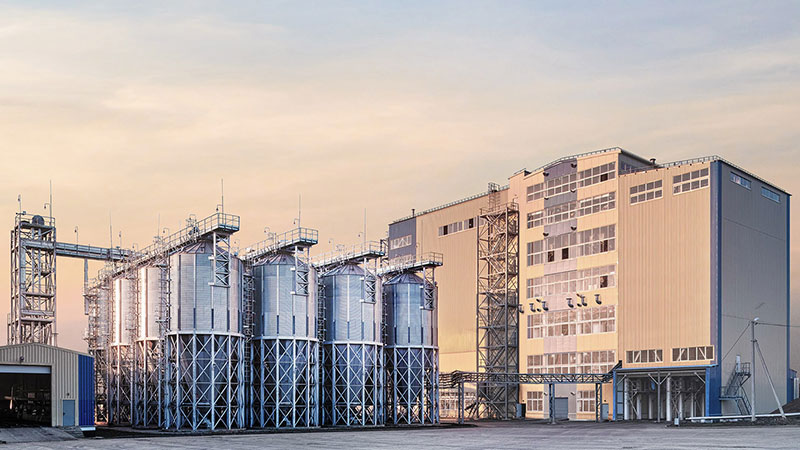
At RICHI, we go beyond project completion. With RICHI Servicee, we’re your dedicated partners in success. Count on us for expert guidance, minimal downtime, and optimized productivity. Choose RICHI for unmatched service and support.
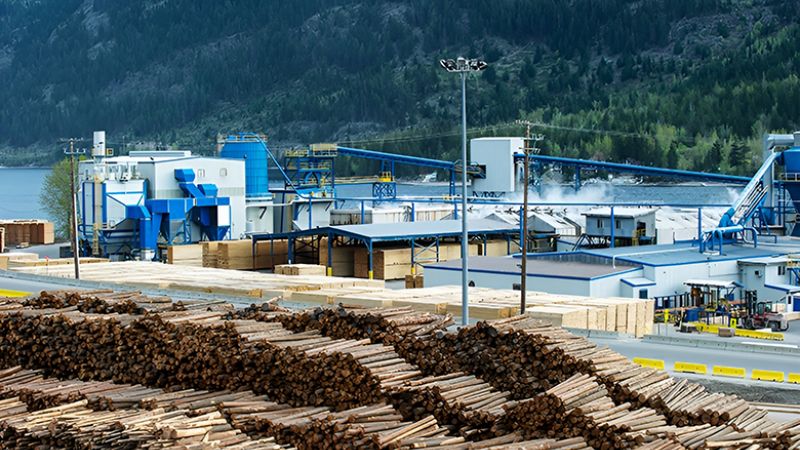


Meet global product demands and quality standards with industry-leading pellet plant design, engineering, equipment, and construction services for pellet processors.


Your Partner Beyond Project Completion
2000+ cases
RICHI is the leading designer, manufacturer and builder of pellet plants in the world, completing over 2000 projects in 140 countries across 6 continents.
Read More
Increase plant productivity, profitability, and safety by integrating high quality equipment into your pellet production line. Over the years, RICHI has become China's top pellet equipment manufacturer. At the same time, RICHI has established valuable partnerships with the world's leading component and raw material manufacturers to bring you the best there is in technology, automation, and efficiency in pelleting plant machinery.

For nearly 30 years, RICHI has been providing best-in-class pellet plant equipment and services to clients across a variety of industries, sizes, and needs. We pride ourselves on the knowledge and skill that each team member possesses – from our technical sales team to our process design engineers. You can count on RICHI Machinery to take your operation to the next level of innovation, quality, and success.
Need help with your pellet manufacturing plant project? Contact us today.
ANIMAL FEED
BIOMASS
WOOD
ORGANIC FERTILIZER
AQUA FEED
CAT LITTER
MUNICIPAL WASTE RECYCLING
SPECIAL PELLET PRODUCTION
RICHI Machinery continues to deliver world class pellet mill equipment, pellet plant engineering and project solutions that add value to our customers in the animal feed, wood waste, agriculture waste, organic fertilizer, cat litter and special pellet products industries. Throughout the years, we RICHI Machinery have built strong brand, becoming industry-leading pellet machine manufacturer. We value integrity, promise quality, and prioritize your success.
Learn MoreWith our expert team, we precisely implement your process engineering requirements in pellet mill and pelletizing plant systems. No matter which industry you’re in – we understand your needs and deliver solutions that meet the highest standards.
At RICHI, quality comes first. Our pellet making machine and related pellet line equipment undergo rigorous quality controls to ensure they meet the highest standards. Rely on products that are durable, safe, and efficient.
With decades of experience in pellet machine and pellet production line production, we have earned a reputation as a trusted partner in various industries. Our expertise allows us to cover a wide range of applications.
Not only do we offer premium pelleting equipment, but we are also experts at designing, building, installing, and maintaining facilities from the ground up. Our expertise is within pellt plant process design, discovering the most efficient, productive, and profitable way to handle your materials in an end-to-end cycle.
○ RICHI MACHINERY
Keeping in touch with us is an effective way to solve all your problems. If you have any needs or questions, please leave your contact information, then RICHI technical consultants will send design, quotation, videos to your mailbox. You can also contact us directly via WhatsApp: +86 13838389622
Copyright©2015-2026 by HENAN RICHI MACHINERY CO., LTD. All rights reserved.