
An organic fertilizer processor in Guayas uses one FZLH350 ring-die granulator to produce 6 mm fertilizer pellets from stabilized manure and prepared coastal agricultural residues.
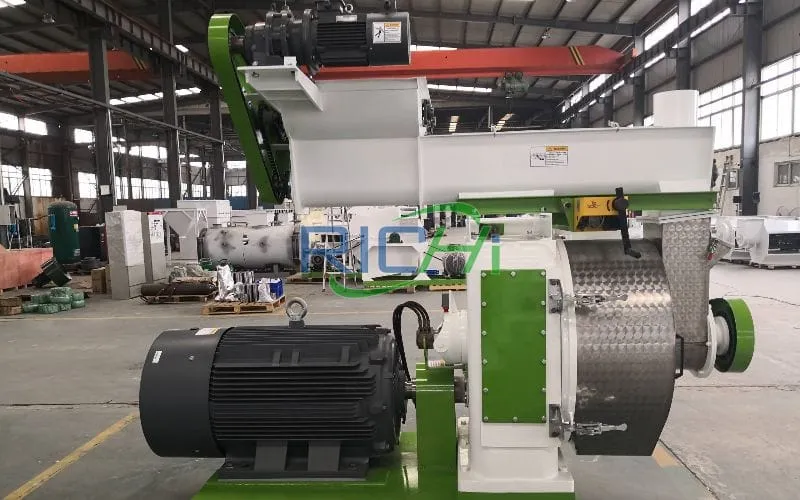
An organic fertilizer processor in Guayas selected one FZLH350 New Type Organic Fertilizer Granulator in Ecuador to add a higher-capacity cylindrical pellet product to its existing compost-based fertilizer operation. The plant works with livestock manure and agricultural residues generated in Ecuador's coastal farming region and supplies fertilizer to banana, cocoa, sugarcane, vegetable and other commercial crop operations.
The customer already had manure receiving, composting, crushing, mixing and moisture-control equipment, so the investment remained focused on granulation. One FZLH350 with approximately 3–5 T/H reference pelletizing capacity gives the factory enough output for commercial production campaigns without forcing it to replace serviceable upstream equipment or immediately expand into a larger complete fertilizer plant.
Name:
Ring-die organic fertilizer granulator
Country:
Ecuador
Date:
2026
Capacity:
3–5 T/H
Model:
FZLH350
Power:
37 kW
Raw materials:
manure-based organic fertilizer mixtures
Pellet Diameter:
6 mm
The plant had experience with disc granulation, but the customer wanted to add a denser cylindrical fertilizer pellet that could be bagged, transported and mechanically handled with less loose powder.
This is not simply a matter of installing a larger machine behind the same wet-granulation process.
A disc granulator builds rounded particles through rolling, agglomeration and moisture addition. The FZLH350 fertilizer granulator machine uses mechanical compression to force prepared organic fertilizer through ring-die holes and produces cylindrical pellets.
The two technologies therefore require different material conditions and create visibly different products.
The customer selected the ring-die route because its targeted distributors wanted a compact pellet product rather than another rounded wet-granulated fertilizer.
| Project Parameter | Configuration |
|---|---|
| Equipment | Ring-die organic fertilizer granulator |
| Model | FZLH350 |
| Quantity | 1 unit |
| Main Motor Power | 37 kW |
| Anti-Bridging Feeder Power | 2.2 kW |
| Forced Feeder Power | 0.75 kW |
| Ring Die Inner Diameter | 350 mm |
| Available Pellet Diameter | 4–12 mm |
| Main Project Pellet | 6 mm |
| Reference Capacity | Approximately 3–5 T/H under suitable prepared-material conditions |
| Main Feedstock | Stabilized manure-based organic fertilizer mixtures |
| Secondary Materials | Prepared sugarcane bagasse, cocoa residues and other suitable agricultural organic matter |
| Installation Type | Standalone granulation upgrade in an operating fertilizer factory |
The 3–5 T/H figure applies to material that has already completed biological treatment and mechanical preparation. It does not represent the tonnes of fresh manure or freshly generated crop residue entering the fertilizer factory.
The FZLH350 occupies a useful position between small farm-scale pelletizers and larger commercial fertilizer granulators.
For this customer, 3–5 T/H of pelletizing capacity is sufficient because fertilizer production is organized in campaigns around the inventory of mature compost.
The factory may spend days preparing, stabilizing and storing organic material before running the granulation section for a concentrated production period.
The granulator therefore does not need to operate continuously throughout every hour of the composting cycle.
This operating pattern also allows the plant to produce different fertilizer batches without installing excess pelletizing capacity that the existing mixer, cooler or packing system cannot use.
Guayas and Ecuador's wider coastal agricultural region generate several organic materials that can be used in commercial fertilizer production after suitable preparation.
The customer works mainly with:
The actual combination changes according to season, supplier and fertilizer specification.
Ecuador's agricultural information system continues to track sugarcane, cocoa, banana, poultry, cattle and other major agricultural activities nationally and provincially, making this type of mixed agricultural-residue supply chain realistic for a coastal fertilizer processor.
Fresh poultry manure can contain high moisture, unstable organic matter, soluble salts and a substantial microbial load.
Reducing its moisture alone does not make it a finished fertilizer feedstock.
The customer first manages poultry manure through a controlled biological stabilization or composting stage. Carbon-rich structural materials can be introduced where required to regulate aeration, moisture and composting conditions.
The material is considered ready for further processing when it has reached an appropriate degree of maturity rather than after one fixed number of days.
Only mature material proceeds toward crushing, screening, formulation and ring-die pelletizing.
Cattle manure can form another important organic base, but its characteristics depend heavily on housing, bedding, collection system and storage.
Manure containing substantial straw or fibrous bedding requires more size reduction than fine composted material.
Material collected together with excessive soil or sand also requires attention because mineral contamination contributes little fertilizer value while increasing die and roller wear.
The customer therefore evaluates cattle-manure compost as a separate raw material rather than assuming it behaves identically to poultry manure.
Sugarcane processing is established in Ecuador's coastal region, including the Guayas area, so bagasse is a credible local organic resource for this organic fertilizer production project.
Fresh bagasse, however, is fibrous and can contain substantial residual moisture.
Long fibres would bridge in bins and interfere with feeding if they were sent directly into the FZLH350.
Where bagasse is incorporated into the fertilizer route, it is first reduced in size and normally participates in composting or stabilization with the manure fraction.
After decomposition, the remaining fibrous material is further crushed as required so that the fertilizer mixture entering the granulator has a reasonably controlled particle distribution.
Cocoa production gives Ecuador another locally relevant agricultural residue.
Cocoa pod husks contain organic matter and mineral nutrients, but raw pod material should not simply be ground and assigned a fixed percentage in every fertilizer recipe.
The husks can be composted or processed through another validated organic-treatment route before inclusion.
This matters because the behavior of raw cocoa pod residue differs from mature compost. Undecomposed material can continue biological activity after application and can temporarily affect nutrient availability.
The customer therefore treats cocoa pod material as a fertilizer component whose maturity and analysis must be confirmed before formulation.
Banana production is one of the major agricultural activities along Ecuador's coast, but this does not mean every banana residue belongs in the FZLH350 recipe.
Fresh pseudostems and similar field residues contain very high moisture and large fibrous structures.
Transporting, drying and finely preparing them only for ring-die pelletizing may not be economically attractive.
If banana residue is used, the customer first evaluates whether it is already part of a viable composting system and whether the mature material can be prepared efficiently for granulation.
The plant does not add a material merely because it is abundant locally.
Commercial organic fertilizer cannot be formulated responsibly from one fixed percentage recipe independent of the incoming materials.
Chicken manure from two poultry farms can differ in nutrient concentration, bedding content, moisture and ash. The same variation applies to cattle manure, bagasse and cocoa residues.
The customer therefore establishes each commercial formula from:
The ring-die machine forms the product after these decisions have been made. It does not formulate the fertilizer.
The New Type Organic Fertilizer Granulator in Ecuador sits close to the end of the production process rather than directly behind raw-manure receiving.
A representative production route is:
This route keeps biological treatment, fertilizer formulation and mechanical pelletizing as separate production functions.
A ring-die granulator performs best when the feed material is sufficiently fine and reasonably uniform.
Large bagasse strands, intact cocoa husk fragments and hardened compost lumps do not belong in the pelletizing chamber.
For many manure-based fertilizer mixtures, preparing the majority of material to a few millimeters gives a practical basis for ring-die feeding.
Approximately 2–5 mm can be used as a useful engineering reference for many prepared organic fertilizer materials, while the allowable longest fibre depends on material type and die configuration.
Grinding far finer than necessary wastes electricity and can increase dust, so the plant aims for controllable feed rather than powder for its own sake.
The customer does not automatically dry every batch to exactly 18% moisture.
Different manure and fibre combinations can form stable pellets at different moisture levels.
If the prepared mixture is too wet, the material may smear, feed poorly and produce soft pellets. If it is too dry, compression resistance and dust can increase.
The working condition is therefore established by observing feeder stability, motor load, die behavior, pellet surface and the condition of the material after cooling.
The existing dryer is used when mature fertilizer contains more moisture than the pelletizing section can handle efficiently.
Thermal drying consumes significant energy, so the plant does not run material through the dryer simply because a dryer is available.
Some compost batches may already reach an appropriate moisture condition through controlled composting and covered storage.
Other batches, particularly those containing wetter manure or high-moisture agricultural residues, can require additional moisture removal.
The customer checks actual material condition first and applies drying only to the extent required for stable pellet production and finished-product storage.
The project uses approximately 6 mm pellets as its main product rather than an unusually precise 6.8 mm diameter.
A 6 mm ring die provides a widely manageable cylindrical fertilizer size within the FZLH350's available 4–12 mm range.
The product can be bagged and distributed to commercial growers while remaining convenient for manual or suitable mechanical field application.
If another buyer requires 4 mm, 8 mm or another compatible size, the pellet diameter can be altered by changing the ring-die specification.
Pellet diameter does not determine fertilizer nutrient content.
It would be misleading to claim that changing from 7 mm to 6 mm guarantees a defined improvement in nutrient release.
Breakdown in soil depends on many factors, including fertilizer composition, organic-matter stability, pellet density, moisture, rainfall, soil biology and application conditions.
Pellet size is selected mainly for handling, spreading, mechanical production and buyer preference.
Agronomic performance should be evaluated from the complete fertilizer product rather than one millimeter of diameter difference.
This project changes more than machine capacity.
Material compressed through a ring die emerges as a cylindrical strand and is cut to the required length.
A disc granulator creates rounded particles through agglomeration.
The customer therefore cannot assume that buyers purchasing spherical fertilizer will automatically accept a ring-die product simply because both are described as granules.
Product shape, packaging and field-application expectations are confirmed with the intended market before large-scale production.
Mature fertilizer mixtures do not always flow freely by gravity.
Fine compost can compact inside a hopper, while residual fibre from bagasse or other plant matter can form bridges above the machine inlet.
The FZLH350 uses a 2.2 kW anti-bridging feeder to keep the prepared material moving.
A 0.75 kW forced feeder then delivers material toward the pelletizing chamber more consistently.
These components improve feeding stability but cannot compensate for long unprocessed fibre or excessively wet compost.
The FZLH350's approximately 3–5 T/H reference capacity describes the mass of prepared fertilizer passing through the ring-die section.
It does not mean the plant converts 5 tonnes of fresh manure directly into 5 tonnes of finished pellets every hour.
During composting and drying, substantial water is lost and organic material also changes in mass.
Screening removes unwanted fractions, while formulation may introduce other ingredients.
The customer's fresh-manure requirement must therefore be calculated backward from required finished fertilizer production rather than copied from the granulator nameplate.
A fine, dense manure-compost blend may pass through the FZLH350 differently from a lightweight formula containing more fibrous agricultural material.
Practical throughput depends on:
The customer therefore does not treat 5 T/H as an unconditional operating result for every Ecuadorian agricultural residue mixture.
Fresh pellets leave the ring die warm and need time to stabilize.
The cooling section reduces product temperature and helps the pellet reach a more stable mechanical condition before screening and packaging.
Cooling is not a substitute for removing a large amount of excess process moisture.
If the material entering the granulator was too wet, the correct response is to improve upstream moisture control rather than expecting the cooler to perform the work of a dryer.
The screen after cooling separates qualified pellets from loose fines and broken material.
An increase in fines can indicate several different problems: unsuitable moisture, excessive fibre, incorrect grinding, die wear, insufficient compaction or rough downstream handling.
The operator therefore uses screening results as production feedback rather than simply recycling all fines without investigating their cause.
Where practical, recovered fines can return to the process through a controlled recycling arrangement.
Organic fertilizer formulas vary too widely to claim one fixed pellet durability or crushing-strength value for every product.
A manure-rich formula and a bagasse-rich formula can form pellets with very different mechanical properties even on the same machine.
The customer establishes commercial acceptance from its actual packaging, transport and application requirements.
Material testing is therefore more useful than publishing a single durability percentage that has not been measured on the customer's fertilizer.
Ecuador's coastal environment can create humid storage conditions, particularly during wetter periods.
Organic fertilizer pellets can absorb moisture if bags are stored against wet floors, under leaking roofs or in poorly protected warehouses.
The customer therefore cools the product before storage and keeps packaged fertilizer on a dry, protected surface.
Bag selection should also follow actual storage duration and distribution conditions rather than relying on the granulator alone to maintain product quality.
Manure and agricultural residues collected from the ground can carry sand and soil into the fertilizer factory.
These contaminants do not improve the fertilizer product and can increase wear on the ring die and rollers.
Cocoa pod residues and bagasse should also be inspected for stones, metal and other foreign material introduced during collection and transport.
The plant therefore uses screening and appropriate separation before fine processing.
Contamination control can often extend practical component life more effectively than simply selecting a harder wear material.
The FZLH350 uses a 37 kW main motor together with the 2.2 kW anti-bridging feeder and 0.75 kW forced feeder.
The complete fertilizer section also includes electrical demand from conveyors, crushers, mixers, cooler, screener and any dryer or dust-control equipment in operation.
Site preparation therefore checks the actual simultaneous load rather than sizing electrical infrastructure from the 37 kW value alone.
Voltage, frequency, motor protection, cable sizing and starting conditions are confirmed for the Ecuadorian facility before installation.
A 3–5 T/H pelletizer provides little benefit if the mixing section can prepare only one tonne of qualified fertilizer per hour.
The customer therefore checks mixer batch size and cycle time together with the FZLH350 feed rate.
A buffer between mixing and pelletizing can help separate batch preparation from continuous feeding.
This also allows operators to complete quality checks on the formulated mixture before it enters the ring die.
Installing the FZLH350 does not necessarily mean the customer has to discard every piece of disc-granulation equipment.
If the factory still has buyers for rounded agglomerated fertilizer, the two forming methods can be scheduled for different product families where the surrounding process supports them.
The ring-die machine can concentrate on dense cylindrical organic fertilizer pellets while the disc section remains available for products designed around wet agglomeration.
This gives the processor product flexibility without pretending the two machines are mechanically interchangeable.
The FZLH350 organic fertilizer pellet machine is prepared for sea transport from Qingdao to the Guayaquil port area before inland delivery to the customer's Guayas facility.
For a project in coastal Ecuador, this keeps the inland equipment route relatively direct.
Before dispatch, the customer can prepare the machine location using confirmed foundation data, inlet and discharge elevations, electrical requirements and required maintenance clearances.
Ocean schedules, customs handling and inland transport depend on the confirmed shipment rather than one fixed delivery duration.
If market demand expands, adding another FZLH350 is one possible route, but only after the factory confirms that the existing machine is actually the limiting stage.
Two FZLH350 units would provide approximately 6–10 T/H of combined reference pelletizing capacity under suitable prepared-material conditions.
The factory would first need to confirm that composting, crushing, screening, mixing, moisture control, cooling, electrical infrastructure and packing can support that volume.
If mature compost is available at only 4 T/H, installing 10 T/H of nominal pelletizing capacity would not double saleable fertilizer production.
Operating data may show that the customer needs faster crushing, more covered compost storage or better moisture control before it needs another ring-die machine.
A larger cooler or screen may also become the restriction once pellet output increases.
This is why the first FZLH350 is useful as a modular commercial upgrade.
It gives the processor enough capacity to identify the real bottleneck before committing capital to the next expansion stage.
A New Type Organic Fertilizer Granulator in Ecuador should be selected from the amount and condition of mature fertilizer material available after composting rather than from the fresh weight of manure collected from farms. Raw material type, residual fibre, moisture, particle size, nutrient specification and required pellet diameter all influence usable capacity.
For another Ecuadorian fertilizer project, RICHI Machinery would first review manure type and annual volume, crop-residue sources, composting method, mature compost output, moisture after stabilization, particle size, required pellet diameter, mixer capacity, drying requirement, cooling and screening capacity, operating hours, electrical supply and finished-product market.
Those details determine whether an FZLH350 provides the appropriate scale or whether another FZLH model should be selected for the customer's actual fertilizer operation.
Having the right mix of reliable, high-quality pellet machine and pelletizing systems and expert support is essential to your success. Watch how our end-to-end feed pellet plant solutions have helped our customers optimize their performance.
Our customized and future-proofed turnkey pellet plant solutions is designed with you at the core. From vision to reality and beyond, our team stays connected with yours. Giving you peace-of-mind with an expert at your side.
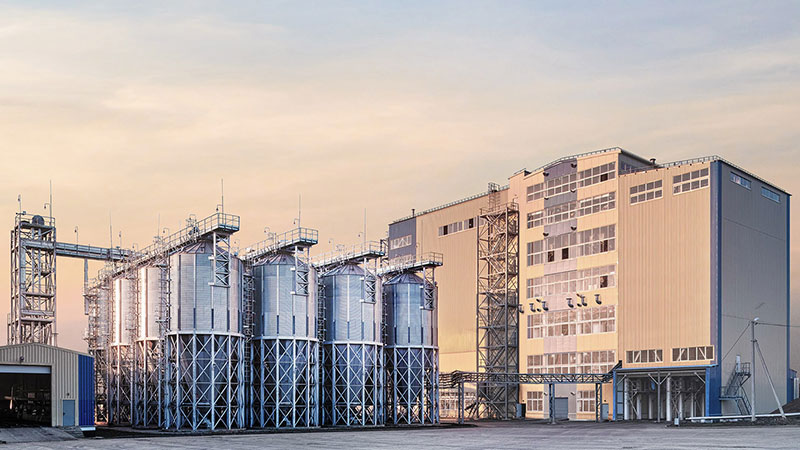
At RICHI, we go beyond project completion. With RICHI Servicee, we’re your dedicated partners in success. Count on us for expert guidance, minimal downtime, and optimized productivity. Choose RICHI for unmatched service and support.
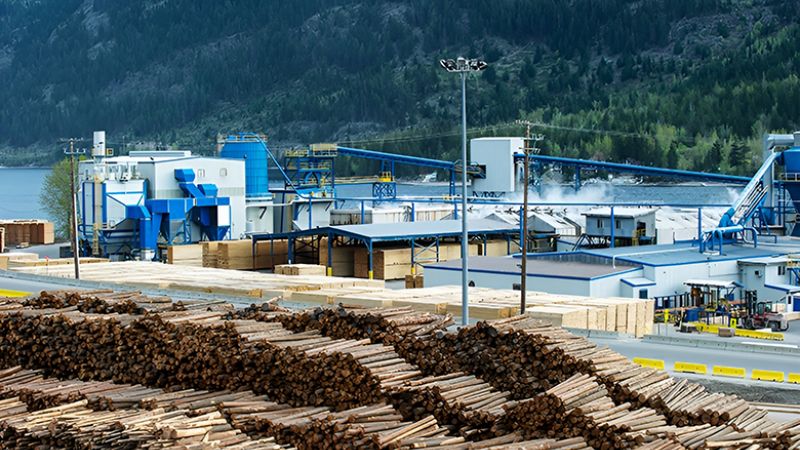


Meet global product demands and quality standards with industry-leading pellet plant design, engineering, equipment, and construction services for pellet processors.


Your Partner Beyond Project Completion
2000+ cases
RICHI is the leading designer, manufacturer and builder of pellet plants in the world, completing over 2000 projects in 140 countries across 6 continents.
Read More
Increase plant productivity, profitability, and safety by integrating high quality equipment into your pellet production line. Over the years, RICHI has become China's top pellet equipment manufacturer. At the same time, RICHI has established valuable partnerships with the world's leading component and raw material manufacturers to bring you the best there is in technology, automation, and efficiency in pelleting plant machinery.

For nearly 30 years, RICHI has been providing best-in-class pellet plant equipment and services to clients across a variety of industries, sizes, and needs. We pride ourselves on the knowledge and skill that each team member possesses – from our technical sales team to our process design engineers. You can count on RICHI Machinery to take your operation to the next level of innovation, quality, and success.
Need help with your pellet manufacturing plant project? Contact us today.
ANIMAL FEED
BIOMASS
WOOD
ORGANIC FERTILIZER
AQUA FEED
CAT LITTER
MUNICIPAL WASTE RECYCLING
SPECIAL PELLET PRODUCTION
RICHI Machinery continues to deliver world class pellet mill equipment, pellet plant engineering and project solutions that add value to our customers in the animal feed, wood waste, agriculture waste, organic fertilizer, cat litter and special pellet products industries. Throughout the years, we RICHI Machinery have built strong brand, becoming industry-leading pellet machine manufacturer. We value integrity, promise quality, and prioritize your success.
Learn MoreWith our expert team, we precisely implement your process engineering requirements in pellet mill and pelletizing plant systems. No matter which industry you’re in – we understand your needs and deliver solutions that meet the highest standards.
At RICHI, quality comes first. Our pellet making machine and related pellet line equipment undergo rigorous quality controls to ensure they meet the highest standards. Rely on products that are durable, safe, and efficient.
With decades of experience in pellet machine and pellet production line production, we have earned a reputation as a trusted partner in various industries. Our expertise allows us to cover a wide range of applications.
Not only do we offer premium pelleting equipment, but we are also experts at designing, building, installing, and maintaining facilities from the ground up. Our expertise is within pellt plant process design, discovering the most efficient, productive, and profitable way to handle your materials in an end-to-end cycle.
○ RICHI MACHINERY
Keeping in touch with us is an effective way to solve all your problems. If you have any needs or questions, please leave your contact information, then RICHI technical consultants will send design, quotation, videos to your mailbox. You can also contact us directly via WhatsApp: +86 13838389622
Copyright©2015-2026 by HENAN RICHI MACHINERY CO., LTD. All rights reserved.