
A biomass processing company in Kaduna State selected one RICHI MZLH420 millet straw pellet mill in Nigeria to develop a small commercial fuel-pellet business using locally available agricultural residues. Millet straw is the primary raw material, while corn stalks and selected clean wood residues can be introduced when the customer needs to adjust feedstock availability or pellet behavior.
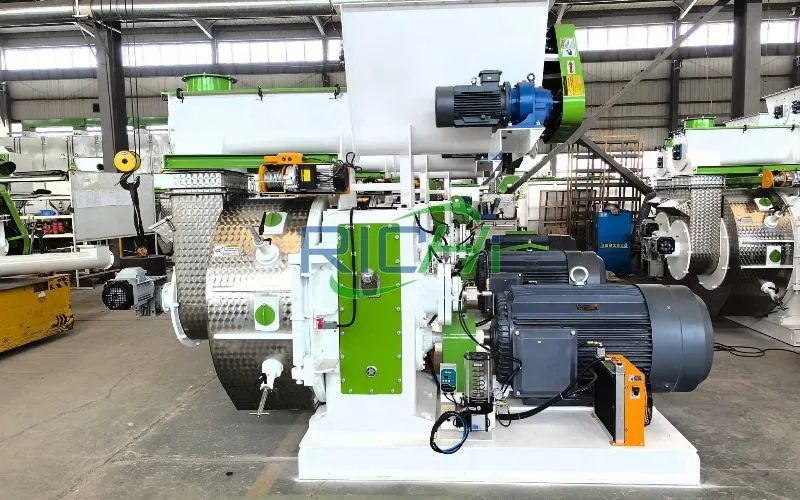
A biomass processing company in Kaduna State selected one RICHI MZLH420 millet straw pellet mill in Nigeria to develop a small commercial fuel-pellet business using locally available agricultural residues. Millet straw is the primary raw material, while corn stalks and selected clean wood residues can be introduced when the customer needs to adjust feedstock availability or pellet behavior.
The company did not begin with a complete biomass pellet production line. It already had access to basic residue collection, shredding and material-handling equipment and wanted to verify raw-material supply, pellet formation and local fuel demand before committing to a larger line. The standalone MZLH420 therefore became the core machine for a controlled first-stage project with a reference output of approximately 1.0–1.2 T/H.
Name:
Millet Straw Pelletizer
Country:
Nigeria
Date:
2026
Capacity:
1.0–1.2 T/H
Model:
MZLH420
Main Motor Power:
90 kW
Raw Materials:
Millet straw, corn stalks
Pellet diameter:
6–10 mm
Northern Nigeria has a strong millet-growing base, and Kaduna is one of the states where millet production forms part of the regional agricultural economy.
For a biomass company, the useful resource is not the total millet crop itself but the portion of post-harvest straw that can realistically be collected without interfering with livestock feeding, soil management or other local uses.
This distinction matters when evaluating a pellet project.
Crop residues are often described as “waste,” but in practice some straw may already be used as animal roughage, bedding, household fuel or field cover. A pellet producer therefore needs to calculate recoverable surplus rather than assuming that every tonne of millet straw in the surrounding farming area is commercially available.
The Kaduna customer builds its raw-material plan around contracted collection from surrounding farms and seasonal storage after harvest.
Millet straw is the main material because it is locally available and fibrous enough to be densified after proper size reduction. Corn stalks can supplement supply during periods when millet straw volume is lower.
Clean, untreated solid-wood residues may also be considered in selected fuel-pellet batches, provided the source is traceable.
Painted wood, laminated boards, MDF, particleboard, preservative-treated timber and chemically contaminated wood are kept out of the fuel-pellet feedstock stream.
| Project Parameter | Configuration |
|---|---|
| Equipment | Millet straw pellet making machine |
| Model | MZLH420 |
| Main Motor | 90 kW |
| Reference Capacity | Approximately 1.0–1.2 T/H |
| Main Raw Material | Millet straw |
| Supplementary Raw Materials | Corn stalks and selected clean untreated wood residues |
| Pellet Application | Biomass fuel |
| Typical Pellet Diameter | Approximately 6–10 mm depending on customer fuel specification |
| Project Type | Standalone pelletizing-section investment |
| Location | Kaduna State, Nigeria |
The MZLH420 uses a 90 kW main motor and is positioned above small pilot pellet mills while remaining suitable for a producer entering commercial biomass pellet production at roughly one tonne per hour.
Its approximately 1.0–1.2 T/H reference capacity is based on suitable prepared biomass. Actual output changes with raw-material density, fibre structure, particle size, moisture, die specification and feeding stability.
This makes the MZLH420 a more realistic machine for the Kaduna project than a 1.8–2.0 T/H rating.
At 1.0 T/H and eight actual pelleting hours per day, theoretical output is approximately eight tonnes per day. At 1.2 T/H, the same operating window gives approximately 9.6 tonnes per day before allowing for maintenance, stops and raw-material changeovers.
If the plant operates 300 days per year, the theoretical range is roughly 2,400–2,880 tonnes annually.
These figures give the customer a useful basis for comparing annual raw-material collection with expected pellet sales.
Millet straw should not move directly from field bales into the ring die pellet mill.
Long fibrous stems are difficult to feed consistently, and coarse material can bridge in hoppers or create unstable loading at the pellet mill.
The customer therefore separates coarse preparation from final grinding.
For straw projects, an intermediate coarse size around 15–60 mm after bale breaking or primary shredding can be practical before hammer milling.
The final hammer-milled material needs to be substantially finer before it reaches the pellet mill.
This two-stage approach is more reliable than expecting one shredder to convert intact straw bales directly into pellet-mill-ready material.
Moisture is one of the most important operating variables in millet straw pellet production.
However, a fixed 12–15% figure should not be treated as a universal specification for every batch.
A low-teens moisture range can provide a useful starting region for biomass pellet trials, but the correct value depends on millet straw condition, corn-stalk proportion, any wood fraction, particle size, ambient conditions and die behavior.
Material that is too wet can feed poorly, generate soft pellets or increase the risk of blockage and unstable compression.
Material that is too dry may require more compression force and can produce brittle pellets or excessive fines.
The Kaduna customer therefore checks the actual stored straw rather than assuming harvest moisture remains unchanged.
Northern Nigerian residues can experience large seasonal differences between dry-season collection and material exposed to rainfall or poor storage.
Covered storage is therefore part of raw-material management.
If the straw arrives too wet for direct pelletizing, drying capacity may become necessary before fine grinding or pelletizing. If the material is already sufficiently dry, adding a full industrial dryer would unnecessarily increase project cost.
This is one advantage of starting with a standalone pellet mill: the customer can characterize local straw first and determine whether additional drying equipment is genuinely required before expanding the system.
Millet straw can be densified into fuel pellets, but pellet shape alone does not determine fuel quality.
Agricultural residues usually behave differently from clean wood because their ash-forming mineral content can be higher.
Soil contamination can increase ash further.
This means collection practice matters. Straw picked up together with excessive soil, stones or dust can create unnecessary wear in the grinding and pelletizing equipment and can also reduce the quality of the finished fuel.
The customer therefore controls field contamination before pellet production rather than relying on the pellet mill to correct poor raw material.
Corn stalks can be used as a supplementary agricultural residue where supply is available.
Selected clean wood residues can also be evaluated in fuel-pellet blends, but they are not automatically added simply to “increase calorific value.”
Before a mixed feedstock is adopted, the producer needs to consider availability, ash, bulk density, pellet formation and the fuel specification required by the final boiler user.
The receiving boiler is equally important.
A pellet that forms well mechanically is not automatically suitable for every industrial combustion system.
Boiler grate design, fuel-feeding system, allowable ash, slagging tendency and operating temperature all influence whether a particular straw pellet is a good commercial fuel.
For that reason, RICHI recommends that biomass producers qualify both the raw material and the downstream fuel customer before expanding production.
The MZLH420 in this project is configured as a biomass pellet mill for fuel production.
Millet straw may have separate livestock-feed uses in agricultural systems, but those uses should not be mixed into a biomass pellet case simply because the same crop residue is involved.
Commercial animal-feed production requires nutritional formulation, ingredient quality control, feed-safety management and equipment suited to feed conditioning and production requirements.
Fuel pellet production has a different objective.
The Kaduna customer is trying to increase bulk density, improve storage and transport, and convert loose agricultural residues into a standardized solid biomass fuel.
The relevant product properties therefore include pellet dimensions, mechanical strength, fines, moisture, ash and combustion compatibility.
This also makes the project easier to operate commercially.
Instead of trying to develop fuel pellets, goat feed, cattle feed and poultry feed from one small production section, the customer can concentrate raw-material testing and market development on one clear product family.
For the MZLH420, 6–10 mm fuel pellets can be evaluated depending on the target boiler and customer handling system.
Pellet diameter is selected through ring die configuration, but die selection also affects compression resistance and throughput.
Purchasing one MZLH420 does not mean that untreated straw can be placed into the machine at one end and packaged pellets collected at the other.
The standalone-machine strategy means that the customer invests in the pelletizing core while retaining or locally arranging the required preprocessing and downstream handling.
For this Kaduna project, the important interfaces are straw opening, primary size reduction, fine grinding, foreign-material removal, feeding, cooling and screening.
Stable feeding deserves particular attention because dry straw is lightweight.
A pellet mill designed for fibrous biomass benefits from equipment that prevents bridging and feeds the ring die at a controlled rate.
If the customer later increases annual output, the MZLH420 can become part of a more integrated production line.
Potential expansion can include automated bale receiving, larger shredding capacity, dedicated drying, buffer silos, additional pellet mills, counterflow cooling, screening, dust collection and automatic bagging.
The expansion decision should follow actual raw-material availability and pellet sales rather than being assumed during the first investment.
The MZLH420 biomass pellet mill was prepared for export from Qingdao and routed through a Nigerian seaport before inland delivery toward Kaduna State.
Lagos is a practical maritime gateway for imported industrial machinery entering Nigeria, although final port selection depends on vessel service, forwarding arrangement and the customer’s import plan.
The inland section is significant because Kaduna is far from the southern coast.
For this reason, the customer needs to include inland trucking, lifting, unloading and site access in the logistics plan rather than evaluating only ocean freight.
Before dispatch, RICHI checks the machine configuration against the confirmed order and provides the technical information required for installation.
At site, foundation, electrical supply, feeding interface, discharge arrangement and safe maintenance space need to be checked before production starts.
The project does not depend on a fixed seven-day installation period or a guaranteed customs-clearance schedule. These steps vary according to site readiness, local logistics and the actual installation scope.
This millet straw pellet mill in Nigeria project is designed around a simple commercial question: can a biomass processor collect enough recoverable millet straw in northern Nigeria, prepare it consistently and sell the resulting pellets to fuel users at a scale that supports expansion?
The customer selected the RICHI MZLH420 straw biomass pellet machine because its approximately 1.0–1.2 T/H reference capacity provides a practical entry point between very small pellet machines and a complete multi-tonne-per-hour industrial plant.
The project uses millet straw as the main biomass feedstock, with corn stalks and selected clean wood residues available as supplementary materials where technically and commercially justified.
Raw material moves through bale opening, coarse size reduction, foreign-material control, fine grinding and moisture adjustment before entering the pellet mill.
This preparation is essential. Long millet straw cannot simply be shredded once to 3–5 mm and sent directly from the bale into the ring die. Coarse preparation and fine grinding perform different jobs.
The finished product is biomass fuel pellet, not animal feed pellet.
This keeps machine selection, process control and customer qualification consistent with the MZLH biomass series.
For another buyer searching for a Millet Straw Pellet Mill in Nigeria, millet straw pellet machine, straw biomass pellet mill, agricultural waste pellet machine Nigeria, crop residue pellet mill or 1 T/H biomass pellet machine, RICHI first evaluates the raw-material supply rather than beginning with machine price alone.
Useful project data include annual recoverable dry millet straw, collection season, bale type, stored moisture, soil and foreign-material contamination, supplementary biomass sources, required operating hours, target pellet diameter and the combustion system that will use the finished fuel.
Existing equipment is equally important.
A company that already owns a bale breaker, straw shredder, hammer mill, cooler and bagging equipment may only need a pellet mill and feeding interface. A company starting with field bales may require a much larger preprocessing system before an MZLH420 can operate reliably.
Electrical conditions also need to be confirmed because the main pellet mill uses a 90 kW motor and the complete working section includes additional motors for feeding, grinding, conveying, cooling and dust control.
RICHI Machinery can use this information to determine whether the customer needs only an MZLH420 millet straw pellet mill or whether the planned production volume has already reached the point where an integrated pellet line would be more economical and easier to operate.
For a Kaduna biomass project, send RICHI the millet straw quantity available per year, current moisture, bale dimensions, preprocessing equipment already installed, target tonnes per hour, fuel-pellet diameter and intended boiler application. These inputs are enough to start a technically meaningful equipment recommendation instead of selecting a pellet mill from nominal capacity alone.
Having the right mix of reliable, high-quality pellet machine and pelletizing systems and expert support is essential to your success. Watch how our end-to-end feed pellet plant solutions have helped our customers optimize their performance.
Our customized and future-proofed turnkey pellet plant solutions is designed with you at the core. From vision to reality and beyond, our team stays connected with yours. Giving you peace-of-mind with an expert at your side.
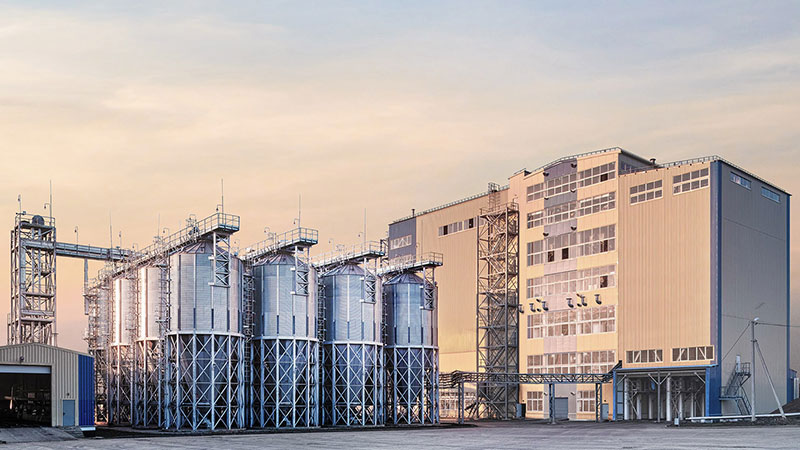
At RICHI, we go beyond project completion. With RICHI Servicee, we’re your dedicated partners in success. Count on us for expert guidance, minimal downtime, and optimized productivity. Choose RICHI for unmatched service and support.
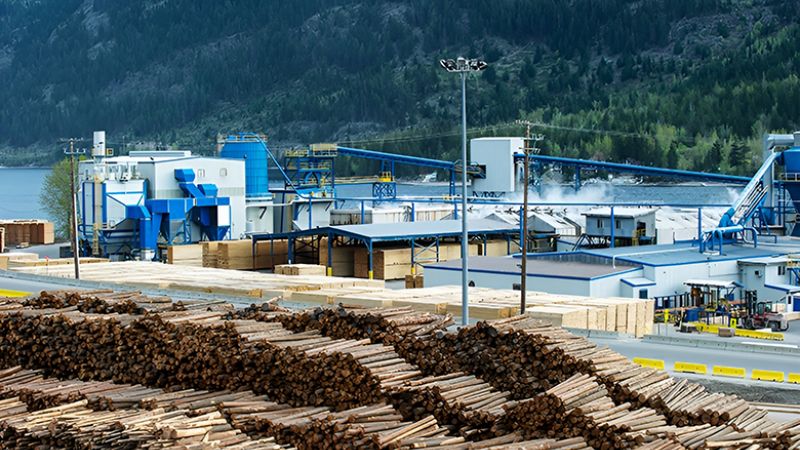


Meet global product demands and quality standards with industry-leading pellet plant design, engineering, equipment, and construction services for pellet processors.


Your Partner Beyond Project Completion
2000+ cases
RICHI is the leading designer, manufacturer and builder of pellet plants in the world, completing over 2000 projects in 140 countries across 6 continents.
Read More
Increase plant productivity, profitability, and safety by integrating high quality equipment into your pellet production line. Over the years, RICHI has become China's top pellet equipment manufacturer. At the same time, RICHI has established valuable partnerships with the world's leading component and raw material manufacturers to bring you the best there is in technology, automation, and efficiency in pelleting plant machinery.

For nearly 30 years, RICHI has been providing best-in-class pellet plant equipment and services to clients across a variety of industries, sizes, and needs. We pride ourselves on the knowledge and skill that each team member possesses – from our technical sales team to our process design engineers. You can count on RICHI Machinery to take your operation to the next level of innovation, quality, and success.
Need help with your pellet manufacturing plant project? Contact us today.
ANIMAL FEED
BIOMASS
WOOD
ORGANIC FERTILIZER
AQUA FEED
CAT LITTER
MUNICIPAL WASTE RECYCLING
SPECIAL PELLET PRODUCTION
RICHI Machinery continues to deliver world class pellet mill equipment, pellet plant engineering and project solutions that add value to our customers in the animal feed, wood waste, agriculture waste, organic fertilizer, cat litter and special pellet products industries. Throughout the years, we RICHI Machinery have built strong brand, becoming industry-leading pellet machine manufacturer. We value integrity, promise quality, and prioritize your success.
Learn MoreWith our expert team, we precisely implement your process engineering requirements in pellet mill and pelletizing plant systems. No matter which industry you’re in – we understand your needs and deliver solutions that meet the highest standards.
At RICHI, quality comes first. Our pellet making machine and related pellet line equipment undergo rigorous quality controls to ensure they meet the highest standards. Rely on products that are durable, safe, and efficient.
With decades of experience in pellet machine and pellet production line production, we have earned a reputation as a trusted partner in various industries. Our expertise allows us to cover a wide range of applications.
Not only do we offer premium pelleting equipment, but we are also experts at designing, building, installing, and maintaining facilities from the ground up. Our expertise is within pellt plant process design, discovering the most efficient, productive, and profitable way to handle your materials in an end-to-end cycle.
○ RICHI MACHINERY
Keeping in touch with us is an effective way to solve all your problems. If you have any needs or questions, please leave your contact information, then RICHI technical consultants will send design, quotation, videos to your mailbox. You can also contact us directly via WhatsApp: +86 13838389622
Copyright©2015-2026 by HENAN RICHI MACHINERY CO., LTD. All rights reserved.