
A maize stover hammer mill in North Macedonia was purchased by a mixed crop and livestock farm near Sveti Nikole to make better use of corn residues left after grain harvest. The farm already handled its own forage and mixed part of its cattle feed on site, but long maize stalks, leaves, husks and cob fractions were too irregular to use efficiently without additional size reduction.
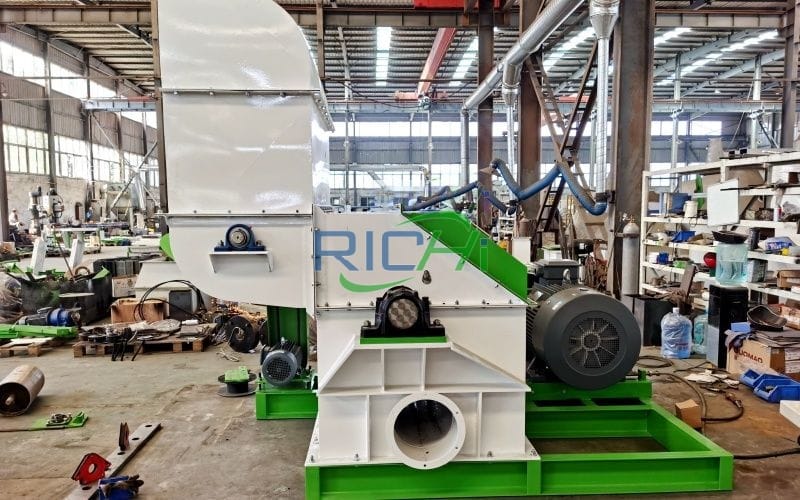
A maize stover hammer mill in North Macedonia was purchased by a mixed crop and livestock farm near Sveti Nikole to make better use of corn residues left after grain harvest. The farm already handled its own forage and mixed part of its cattle feed on site, but long maize stalks, leaves, husks and cob fractions were too irregular to use efficiently without additional size reduction.
The customer selected one SFSP66×60 hammer mill with a 55 kW main motor and ordered 6 mm, 8 mm and 10 mm screens for different processing requirements. Instead of investing in a complete livestock feed production line, the farm added only the grinding stage it was missing, using the prepared maize stover mainly as a fibrous cattle-feed ingredient and livestock bedding material.
Name:
Maize Stover Crusher
Country:
North Macedonia
Date:
2025
Capacity:
0.7-1.1 T/H
Model:
SFSP66×60
Main Motor Power:
55 kW
Raw Materials:
maize stalks, leaves, husks
Final product size:
6 -10 mm
The customer operates a mixed farm in the central-eastern agricultural area of North Macedonia, combining maize production with dairy cattle and sheep.
After grain harvest, the farm has access to a substantial volume of maize stover consisting mainly of stalks, leaves, husks and some cob fractions. Previously, the material had relatively limited use because its long and irregular form made handling difficult.
The customer already purchased straw and other roughage materials for livestock use. This created an obvious question: could part of the maize residue already available on the farm be processed into a more usable form instead?
The answer depended on preparation.
Long maize stalks are bulky and difficult to meter consistently into a mixer. Animals may also sort coarse fibrous material when particle length is excessive, particularly when the ration contains more palatable components.
The farm therefore needed a maize stover hammer mill in North Macedonia to reduce the physical size of the residue and make it easier to store, mix and distribute.
This was not a new feed factory project.
The farm already had forage storage, grain handling and a small mixing system. It did not need another complete cattle feed line, pellet mill or packaging system.
The missing process was controlled size reduction.
RICHI therefore recommended one SFSP66×60 hammer mill rather than adding equipment that would not immediately solve the customer's problem.
This also allowed the farm to introduce maize stover gradually into its existing feeding and bedding practices and judge how much material it could realistically use each year.
If the customer later decides to produce pellets or expand into commercial feed manufacturing, additional equipment can be considered separately instead of being purchased before there is a clear requirement.
The material is the above-ground crop residue remaining after maize grain is harvested.
For this farm, the collected fraction includes stalks, leaves, husks and suitable cob pieces. The exact proportions vary from batch to batch depending on harvest method and field collection.
This variation matters because the different fractions do not grind identically.
Leaves and husks are relatively light, while stalk nodes and cob pieces can be much more resistant to impact. A batch containing more coarse stem material therefore places a different load on the hammer mill than one dominated by leafy residues.
Research on corn stover size reduction also shows that feedstock fraction and moisture influence hammer-mill throughput and energy demand, which supports treating maize stover as a variable biomass material rather than assigning one fixed output to every batch.
The farm uses part of the processed stover as a fibrous component in cattle feeding.
However, the hammer mill does not improve the protein or energy value of the material by itself.
Maize stover is a relatively low-quality roughage compared with high-quality alfalfa or well-managed silage. Its practical inclusion therefore depends on the animal group, the rest of the ration and the farm's nutrition program.
The customer does not use one fixed percentage of stover in every dairy ration.
Ground material may be incorporated into an appropriately formulated TMR where additional structural fiber is required, but the amount must be balanced against energy, protein and physically effective fiber requirements.
This is why the original fixed 25% maize stover TMR formula was removed.
Livestock bedding is the second application.
Corn stalk residues are used as livestock bedding in agricultural systems, and research has found cornstalk material can have useful absorbency characteristics.
For bedding, the customer does not need the finest possible grind.
A coarser material retains more fibrous structure and can be easier to distribute through livestock pens. This makes the 8 mm and 10 mm screens useful for bedding-oriented batches.
The key advantage is therefore flexibility rather than one screen being universally “best.”
This is one of the most important corrections to the original project description.
The SFSP66×60 is not a bale breaker.
Even relatively loose maize stover bales should first be opened, loosened or subjected to preliminary chopping before the material reaches the hammer mill inlet.
Long stalk bundles can bridge in the feeding area and create unstable loading. Feeding them manually in large armfuls is also not a good basis for continuous commercial operation.
At this farm, the material is therefore loosened and reduced to a manageable form before entering the grinding section.
A magnetic separation point is also used ahead of the mill to help protect the high-speed grinding system from ferrous contaminants that may enter the collected crop residue.
RICHI matched the model to the customer's moderate processing requirement, available power and mixed feed/bedding application.
| Project Item | Specification |
|---|---|
| Equipment | Maize stover hammer mill |
| Model | SFSP66×60 |
| Quantity | 1 unit |
| Main Motor Power | 55 kW |
| Project Screen Options | 6 mm, 8 mm and 10 mm |
| Main Raw Material | Dry maize stalks, leaves, husks and suitable cob fractions |
| Main Applications | Cattle roughage preparation and livestock bedding |
| Actual Output | Varies with screen opening, moisture, feed preparation and stover composition |
The 55 kW configuration provides enough grinding power for this farm-scale commercial application without moving into an unnecessarily large machine class.
RICHI did not define the project solely by motor power, however. The condition of the stover entering the machine and the required particle size were equally important.
The customer ordered 6 mm, 8 mm and 10 mm screen configurations because the crusher machine serves two different end uses.
A smaller screen opening generally requires more grinding work. Material remains inside the chamber longer before it becomes small enough to pass through the screen, so capacity normally decreases as finer grinding is required.
A larger opening allows material to leave more quickly and retains a coarser structure.
For this farm, the 8 mm screen became the most practical general-purpose option during routine operation because it provides a middle ground between finer feed preparation and coarser bedding production.
However, RICHI does not describe 8 mm as a universal optimum for all cattle or all bedding systems.
Forage particle size affects ration structure and animal sorting behavior, so final feed size should be evaluated as part of the complete feeding program.
The earlier version provided a precise capacity for each screen size.
That would only be appropriate if those numbers came from recorded tests using the customer's actual maize stover under defined moisture and feed conditions.
Hammer mill capacity changes with stalk-to-leaf ratio, cob content, moisture, initial chop length, screen size and feeding stability.
A batch collected after a dry harvest period may behave differently from material that has retained more moisture.
For this reason, the revised project does not present three exact T/H figures as guaranteed results.
RICHI can carry out material testing when a customer requires more precise capacity estimates for a particular stover condition.
Dry maize stover is much easier to grind and store than wet field residue.
Higher moisture can reduce grinding performance and increase the energy required for size reduction. Research on hammer milling also shows that moisture condition can significantly influence energy use and throughput.
The farm therefore checks material condition before grinding rather than relying on a universal “below 15%” rule for every batch.
If residue is visibly wet or unsuitable for stable storage, it should first be allowed to dry or be handled through an appropriate moisture-management process.
Dry maize stover generates dust during grinding.
The project therefore uses cyclone separation and filtration around the discharge.
The original statement that one fabric bag “captures about 90%” of the dust has been removed because actual collection efficiency depends on air volume, filter area, dust particle distribution and system design.
The correct dust-control system should be sized around the airflow requirement of the grinder rather than described by an unsupported fixed percentage.
This is particularly important when the mill operates for longer hours or when very dry leafy material produces more fines.
Hammers and screens are wear parts.
The earlier project description claimed that the original hammers lasted about 500 hours. That should not be treated as a general service-life figure unless supported by an actual maintenance record.
Wear depends on ash and soil contamination, cob content, operating hours, screen size and whether foreign material enters the grinding chamber.
Field residues can carry soil and mineral contamination, which can increase abrasive wear.
The customer therefore inspects the hammers and screens periodically and rotates or replaces them according to actual condition rather than a predetermined hour count.
Prepared maize stover first enters the controlled feeding section.
The material then passes through the SFSP66×60 grinding chamber, where high-speed hammer impact reduces it until suitable particles can pass through the installed screen.
After grinding, the material follows one of two routes.
Material intended for feed preparation can move toward the farm's existing mixing equipment and become part of a formulated ration.
Coarser batches intended for bedding can instead be stored separately and distributed to livestock pens.
This simple arrangement is why the customer needed only one maize stover hammer mill in North Macedonia rather than another complete processing line.
The farm's current objective is to use maize stover internally, not manufacture a commercial pellet product.
Adding a straw pellet machine would introduce another set of requirements, including more precise moisture control, pelletizing capacity, cooling and additional electrical load.
The customer therefore chose to solve the immediate size-reduction problem first.
This staged approach also allows the farm to determine how much maize stover is genuinely useful in its annual feeding and bedding program before investing in further processing.
North Macedonia is a landlocked country, so the machine was shipped by sea from Qingdao Port in China to Thessaloniki Port in Greece.
Thessaloniki is a practical regional gateway for cargo moving toward North Macedonia, and the port has established intermodal connections with Skopje.
RICHI supplied installation dimensions, motor information and technical documentation before shipment so that the farm could prepare the grinding area in advance.
As required for this type of project, the case focuses only on the sea-port route and does not treat inland transport as part of the equipment specification.
The biggest improvement was not a dramatic fixed percentage reduction in feed cost.
The farm gained a controlled way to process crop residue that had previously been inconvenient to use.
Operators could select a different screen according to whether the immediate requirement was feed preparation or bedding. They also learned that uniformly prepared, drier material produced more stable grinding than long or highly variable stover.
The machine therefore gave the customer more flexibility in how maize residues were used after harvest.
This is a more defensible project outcome than claiming an exact 40% reduction in waste or 50% reduction in bedding cost without supporting farm records.
No.
The economics depend on how much residue is actually collected, what the farm currently pays for roughage or bedding, and whether there are enough livestock or another downstream use to consume the processed material.
A very small maize farm may not generate enough stover to justify a 55 kW hammer mill.
A larger livestock farm, agricultural cooperative or residue processor can make much better use of this machine class when it has a steady seasonal feedstock supply.
The starting form also matters.
Customers processing dense bales may require more upstream preparation than those already handling chopped or loose residue.
The SFSP66×60 was selected for this project because the customer had its own maize residue, existing livestock operations and a clear need for both roughage preparation and bedding.
Another project may require a smaller or larger grinder.
Before recommending equipment, RICHI Machinery needs to know the annual or daily quantity of maize stover, whether it is loose, chopped or baled, approximate moisture, typical stalk and cob size, target particle size and required T/H.
The final use should also be explained.
Cattle feed preparation, bedding and downstream biomass pelletizing can require different screens and different capacity expectations even when the starting material is the same.
Existing equipment is equally important. Customers can provide information about bale breakers, choppers, conveyors, mixers and dust collection equipment already installed.
With these details, RICHI Machinery can determine whether the SFSP66×60 used in this maize stover hammer mill in North Macedonia project is appropriate, what screen arrangement should be supplied and whether preliminary size reduction is needed before grinding.
The objective is not simply to turn corn stalks into smaller pieces. It is to configure the hammer mill so that an agricultural residue the customer already owns can be integrated practically into the livestock operation without purchasing unnecessary equipment.
Having the right mix of reliable, high-quality pellet machine and pelletizing systems and expert support is essential to your success. Watch how our end-to-end feed pellet plant solutions have helped our customers optimize their performance.
Our customized and future-proofed turnkey pellet plant solutions is designed with you at the core. From vision to reality and beyond, our team stays connected with yours. Giving you peace-of-mind with an expert at your side.

At RICHI, we go beyond project completion. With RICHI Servicee, we’re your dedicated partners in success. Count on us for expert guidance, minimal downtime, and optimized productivity. Choose RICHI for unmatched service and support.


Meet global product demands and quality standards with industry-leading pellet plant design, engineering, equipment, and construction services for pellet processors.


Your Partner Beyond Project Completion
2000+ cases
RICHI is the leading designer, manufacturer and builder of pellet plants in the world, completing over 2000 projects in 140 countries across 6 continents.
Read More
Increase plant productivity, profitability, and safety by integrating high quality equipment into your pellet production line. Over the years, RICHI has become China's top pellet equipment manufacturer. At the same time, RICHI has established valuable partnerships with the world's leading component and raw material manufacturers to bring you the best there is in technology, automation, and efficiency in pelleting plant machinery.

For nearly 30 years, RICHI has been providing best-in-class pellet plant equipment and services to clients across a variety of industries, sizes, and needs. We pride ourselves on the knowledge and skill that each team member possesses – from our technical sales team to our process design engineers. You can count on RICHI Machinery to take your operation to the next level of innovation, quality, and success.
Need help with your pellet manufacturing plant project? Contact us today.
ANIMAL FEED
BIOMASS
WOOD
ORGANIC FERTILIZER
AQUA FEED
CAT LITTER
MUNICIPAL WASTE RECYCLING
SPECIAL PELLET PRODUCTION
RICHI Machinery continues to deliver world class pellet mill equipment, pellet plant engineering and project solutions that add value to our customers in the animal feed, wood waste, agriculture waste, organic fertilizer, cat litter and special pellet products industries. Throughout the years, we RICHI Machinery have built strong brand, becoming industry-leading pellet machine manufacturer. We value integrity, promise quality, and prioritize your success.
Learn MoreWith our expert team, we precisely implement your process engineering requirements in pellet mill and pelletizing plant systems. No matter which industry you’re in – we understand your needs and deliver solutions that meet the highest standards.
At RICHI, quality comes first. Our pellet making machine and related pellet line equipment undergo rigorous quality controls to ensure they meet the highest standards. Rely on products that are durable, safe, and efficient.
With decades of experience in pellet machine and pellet production line production, we have earned a reputation as a trusted partner in various industries. Our expertise allows us to cover a wide range of applications.
Not only do we offer premium pelleting equipment, but we are also experts at designing, building, installing, and maintaining facilities from the ground up. Our expertise is within pellt plant process design, discovering the most efficient, productive, and profitable way to handle your materials in an end-to-end cycle.
○ RICHI MACHINERY
Keeping in touch with us is an effective way to solve all your problems. If you have any needs or questions, please leave your contact information, then RICHI technical consultants will send design, quotation, videos to your mailbox. You can also contact us directly via WhatsApp: +86 13838389622
Copyright©2015-2026 by HENAN RICHI MACHINERY CO., LTD. All rights reserved.