
Explore an industrial leaf pellet machine in Argentina for processing corn leaves, wheat straw and sunflower residues into biomass fuel pellets. Discover the RICHI MZLH678, equipment specifications, material preparation and customized pelletizing solutions.
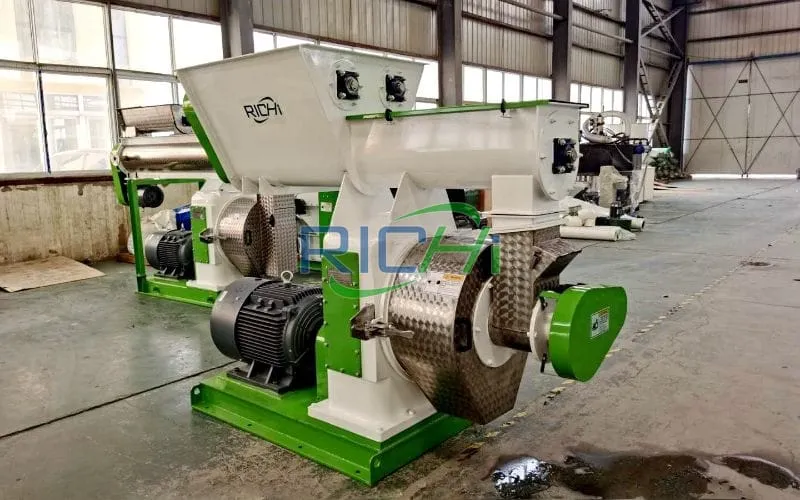
An industrial leaf pellet machine in Argentina was selected for an agricultural residue processing project serving grain-producing areas in the central part of the country. The customer is a commercial biomass processor that collects crop residues from nearby agricultural operations and prepares them for value-added utilization.
Instead of purchasing a complete new production line, the business ordered one RICHI MZLH678 ring die biomass pellet machine to work with its existing grinding, drying and conveying equipment. With a rated capacity of 2.5–3.0 T/H, the machine is intended to support regular production of biomass fuel pellets from prepared corn leaves, wheat straw and suitable sunflower crop residues.
Name:
Leaf Pellet Machine
Country:
Argentina
Date:
2026
Capacity:
2.5–3.0 T/H
Model:
MZLH678
Main Motor Power:
185 kW
Raw Materials:
corn leaves, wheat straw and suitable sunflower crop residues
Pellet diameter:
8 mm
The investment addresses a practical problem faced by agricultural residue handlers: loose leaves, stalk fragments and straw occupy substantial storage space and are not always convenient to transport or feed into downstream equipment.
The customer's objective is to turn suitable, locally available residues into a more uniform solid product that can be stored, handled and supplied to compatible biomass fuel users. The new pellet machine will serve as the main compression unit in an existing material preparation operation, allowing the business to expand its processing capability without replacing equipment that remains suitable for its current duties.
Argentina has an extensive agricultural sector, with corn, wheat and sunflower among the crops grown in different production regions. Harvesting and field management generate plant residues that must be handled according to local farming practices, soil-management requirements and the intended use of the land. Some residues remain in the field, while suitable surplus material may be collected where collection is practical and environmentally appropriate.
The customer in this project is an independent agricultural by-product processor working with grain growers and local agricultural service providers. Its existing business includes collecting selected crop residues, arranging preliminary size reduction and preparing biomass for further processing. The company is not a feed manufacturer. It is developing a separate biomass fuel product from suitable plant material that would otherwise have limited value in its current commercial operation.
The decision to buy a single industrial leaf pellet machine followed an assessment of the equipment already available at the facility. The customer had access to grinding and drying machinery and did not want to duplicate these investments. What the operation lacked was a ring die pelletizer capable of converting prepared, low-density agricultural material into compact cylindrical pellets at a commercially useful rate.
For this type of business, the investment is not simply about installing a larger motor or increasing nominal output. It is about connecting the pelletizing stage to the existing raw material supply, storage arrangements and downstream handling system. A machine that can operate within the facility's intended production range offers a practical starting point for developing a repeatable process.
The proposed feedstock consists of corn leaves and leaf-rich crop residues, wheat straw, and suitable sunflower stalk fragments collected after harvesting. The blend is designed around the availability of agricultural by-products rather than a single uniform material. Corn leaves provide the leaf-rich component, wheat straw contributes fibrous material, and finely prepared sunflower residues can supplement the mixture when their condition is suitable for pelletizing.
The preliminary blend is 40% corn leaves and associated leaf-rich residues, 35% wheat straw, and 25% finely prepared sunflower stalk residues by mass. This is a proposed starting formulation for process evaluation, not a universal recipe for Argentine crop residues. Actual proportions should be adjusted after assessing the material's moisture, fiber structure, ash content, particle size and pellet-forming behavior.
Material collection also needs to respect the agricultural purpose of crop residues. Not every leaf or stalk should be removed from a field. Residue retention can be important for protecting soil, maintaining organic matter and reducing erosion. The customer's raw material supply therefore focuses on suitable surplus material available through cooperating agricultural operations, rather than assuming that all field residues can be collected.
Before pelletizing, the material is sorted to remove stones, soil clumps, metal, plastic and other foreign matter. Oversized stalk pieces are cut and ground. The initial grinding target is approximately 3 mm or smaller, with the final particle size determined by material trials and the feeding performance of the selected machine. Long fibers that cause bridging or irregular feeding may require further size reduction.
Moisture management is equally important. The proposed operating target for prepared material is approximately 10–15% moisture, subject to testing. If incoming residues have a moisture content above 20%, the customer's existing dryer will be used before pelletizing. Material that already falls within the agreed processing range can bypass unnecessary drying, helping avoid additional energy consumption.
The RICHI MZLH678 was selected because its rated capacity fits the intended scale of the customer's agricultural residue operation. The customer needs a machine suited to regular commercial production rather than a small pilot unit, but the investment remains focused on one key piece of equipment. Existing grinders, dryers and conveying systems will be retained where their specifications and actual condition are suitable for the new process.
The MZLH678 has a ring die with an inner diameter of 673 mm and a 185 kW main motor. Its listed production capacity is 2.5–3.0 T/H. Actual output will depend on the crop residue blend, moisture content, particle size, die configuration and operating conditions. This distinction is particularly important when processing leaf-rich material, whose bulk density and fiber characteristics can differ substantially from those of conventional wood sawdust.
The MZLH678 is a biomass pellet machine rather than a conventional animal feed pellet machine. It does not have the conditioning system required for standard conditioned feed pellet production. Its role in this project is to compress properly prepared agricultural residues into biomass fuel pellets, with finished-product suitability determined by testing and the requirements of the intended end user.
The machine's capacity also needs to match the upstream equipment. A pelletizer cannot sustain its rated output if the grinder supplies material too slowly, the dryer cannot handle the incoming moisture load, or the conveying system delivers an inconsistent mixture. RICHI's equipment selection process therefore considers the complete material flow even when the customer purchases only one machine.
The production process begins with the collection and inspection of suitable agricultural residues. Incoming material is checked for foreign matter and separated according to its physical condition. Coarse stalks and other oversized pieces are reduced in size before the different materials are blended. This preparation helps create a more consistent mixture for the pelletizing stage.
Grinding is especially important when the blend contains wheat straw and sunflower stalk fragments. Long fibers can interfere with smooth feeding, while oversized pieces can make the mixture less uniform. An initial particle-size target of approximately 3 mm or smaller provides a practical starting point for trials, although the final specification should reflect the actual crop residues and the machine's operating requirements.
The prepared material is then checked for moisture. Where moisture exceeds the target range, the existing dryer reduces it before the material reaches the pellet machine. This is not a minor detail: excessive moisture can affect pellet formation and stability, while overly dry material may increase fines or make durable pellet formation more difficult. The target should be confirmed using representative samples rather than applied indiscriminately to every incoming batch.
Once prepared, the mixture is conveyed to the MZLH678. Its arch-breaking feeder helps reduce material bridging above the feeding outlet, while the forced feeder supports a more controlled supply into the pelletizing chamber. These functions are useful when handling lightweight agricultural residues that may not flow as consistently as uniform granular material.
Inside the machine, the ring die and rollers compress the prepared biomass into cylindrical pellets. The proposed product diameter is 8 mm, within the MZLH series' stated 4–12 mm range. Pellet length can be adjusted through the cutting arrangement. Durability, fines content and production stability should be evaluated with the actual blend before the customer finalizes its product specification.
After pelletizing, the product should be cooled before extended storage or packaging. Screening can separate excessive fines, which may be returned to the process where appropriate. Because the customer is purchasing a single pellet machine, these downstream stages can use existing equipment where suitable or be added as separate units after the required throughput and layout have been confirmed.
The main objective is to produce biomass fuel pellets for potential sale to users with compatible solid-fuel equipment. Compact pellets are easier to weigh, package, stack and handle than loose crop residues. They can also simplify inventory management by providing a more standardized product form.
However, pelletizing alone does not establish whether a product is suitable for a particular boiler or heating system. Agricultural residues can differ in ash content, mineral composition, calorific value and combustion behavior. Before the customer commits to a specific market, representative pellets should be tested for moisture, ash, durability, fines and other properties required by the intended buyer.
For the customer, the potential commercial benefit lies in adding a value-creating processing step to an existing residue handling operation. Instead of selling or storing all suitable material in loose form, the business can evaluate whether a standardized pellet product attracts buyers who prefer compact, easier-to-handle biomass fuel. The actual return will depend on collection costs, preparation energy, electricity consumption, maintenance, storage losses and the final selling price.
The process may also help the business organize seasonal material availability. Crop residues can be collected during suitable periods, prepared and stored under appropriate conditions, and pelletized according to production schedules and customer demand. This can improve operational planning, provided the storage arrangements protect the prepared biomass from excess moisture and contamination.
Ring die biomass pellet machines are used for a range of prepared agricultural and forestry residues, including sawdust, wood shavings, straw, grass, selected crop residues and other fibrous materials. The correct machine configuration depends on the raw material and finished product. A leaf-rich crop residue blend requires particular attention to grinding, moisture and feeding consistency because its physical characteristics differ from those of conventional wood-based material.
The MZLH678 combines a ring die pelletizing system with arch-breaking and forced feeding components. These feeding arrangements help the operator manage material flow into the pelletizing chamber. Consistent feeding is important for maintaining stable operation and limiting interruptions caused by bridging or irregular supply.
As with other biomass pellet presses, the die and rollers are wear components. Abrasive contamination and unsuitable foreign materials can accelerate wear, making effective raw material cleaning and regular maintenance important parts of the operating plan. Monitoring the condition of the die and rollers also helps the operator identify when maintenance is needed before wear significantly affects production performance.
The value of the equipment depends on the whole process, not only the compression stage. Correctly prepared material, controlled feeding, suitable operating settings and adequate cooling all contribute to the final pellet quality. These factors should be considered when evaluating output and operating cost per tonne.
Before selecting a biomass pellet machine, a customer needs to understand how the proposed equipment will work with the actual raw material and the machinery already installed. RICHI can review the intended feedstock, moisture range, particle-size target, finished pellet diameter and required hourly output when recommending an appropriate model.
For this project, the key planning points are the proportion of corn leaves, wheat straw and sunflower residues; the capacity of the existing grinder and dryer; the feeding arrangement; and the space available for the pelletizer and downstream equipment. Reviewing these factors helps the customer avoid treating the nominal machine capacity as a guaranteed production rate for every possible blend.
RICHI supplies individual biomass pellet mill machines as well as complete biomass pellet production lines. Customers who already own suitable grinding, drying, conveying or cooling equipment can purchase a single machine to complement their existing assets. For a new facility, RICHI can also develop a customized process design covering material preparation, drying, grinding, pelletizing, cooling, screening and packaging.
For agricultural leaf and straw mixtures, representative raw material testing is especially valuable. It can help determine the appropriate particle size and moisture range, assess pellet formation and identify whether the initial blend needs adjustment. These results provide a more useful basis for equipment selection and production planning than relying on a generic capacity figure alone.
The equipment is planned for sea shipment from Qingdao Port in China to the Port of Buenos Aires, Argentina. Buenos Aires is a major commercial port serving international cargo movements into the country.
Before shipment, the equipment configuration, electrical specifications, packing arrangements and shipping documentation should be checked against the purchase specifications. Advance planning also allows the customer to prepare the machine foundation, electrical supply, raw material feeding arrangement and discharge area before the equipment arrives.
The customer's main consideration was how to increase the value of collected crop residues without duplicating investments in machinery that remained suitable for the existing operation. The MZLH678 provided a defined capacity range around which the business could plan its material preparation and downstream handling arrangements.
The biomass pellet project also highlighted the importance of evaluating the actual residue blend before setting production targets. Corn leaves, wheat straw and sunflower stalk fragments do not behave identically during feeding and compression. By treating the proposed formulation as a starting point for trials, the customer can assess pellet quality, fines and throughput before establishing a routine production specification.
For a commercial agricultural residue processor, the most useful outcome is a process that can be measured and repeated. Equipment selection, raw material preparation and operating conditions must work together. The customer can then use production records and product test results to evaluate operating costs and determine whether additional cooling, screening or packaging capacity is justified.
The industrial leaf pellet machine in Argentina project illustrates how one ring die biomass pellet machine can become the core of a staged agricultural residue utilization plan. The MZLH678 is intended to process prepared corn leaves, wheat straw and suitable sunflower residues into biomass fuel pellets while making use of existing material preparation equipment wherever practical.
The proposed 8 mm pellets are intended for compatible biomass fuel applications, subject to product testing and buyer requirements. Grinding, moisture management, controlled feeding and cooling are essential to achieving consistent results. These requirements matter particularly when handling mixtures of leaves and fibrous crop residues, which cannot be assumed to behave like every other biomass material.
RICHI Machinery provides both individual biomass pellet machines and complete biomass processing solutions. Customers evaluating agricultural residues, straw, grass, sawdust or other suitable plant materials can request equipment recommendations based on the actual raw material, intended pellet size, required output and machinery already available at the site.
Businesses planning a similar project can contact RICHI with details of their raw materials, moisture content, target pellet diameter and expected hourly output. This information provides a practical starting point for selecting a suitable industrial leaf pellet machine and developing a process aligned with the project's actual requirements.
Having the right mix of reliable, high-quality pellet machine and pelletizing systems and expert support is essential to your success. Watch how our end-to-end feed pellet plant solutions have helped our customers optimize their performance.
Our customized and future-proofed turnkey pellet plant solutions is designed with you at the core. From vision to reality and beyond, our team stays connected with yours. Giving you peace-of-mind with an expert at your side.

At RICHI, we go beyond project completion. With RICHI Servicee, we’re your dedicated partners in success. Count on us for expert guidance, minimal downtime, and optimized productivity. Choose RICHI for unmatched service and support.



Meet global product demands and quality standards with industry-leading pellet plant design, engineering, equipment, and construction services for pellet processors.


Your Partner Beyond Project Completion
2000+ cases
RICHI is the leading designer, manufacturer and builder of pellet plants in the world, completing over 2000 projects in 140 countries across 6 continents.
Read More
Increase plant productivity, profitability, and safety by integrating high quality equipment into your pellet production line. Over the years, RICHI has become China's top pellet equipment manufacturer. At the same time, RICHI has established valuable partnerships with the world's leading component and raw material manufacturers to bring you the best there is in technology, automation, and efficiency in pelleting plant machinery.

For nearly 30 years, RICHI has been providing best-in-class pellet plant equipment and services to clients across a variety of industries, sizes, and needs. We pride ourselves on the knowledge and skill that each team member possesses – from our technical sales team to our process design engineers. You can count on RICHI Machinery to take your operation to the next level of innovation, quality, and success.
Need help with your pellet manufacturing plant project? Contact us today.
ANIMAL FEED
BIOMASS
WOOD
ORGANIC FERTILIZER
AQUA FEED
CAT LITTER
MUNICIPAL WASTE RECYCLING
SPECIAL PELLET PRODUCTION
RICHI Machinery continues to deliver world class pellet mill equipment, pellet plant engineering and project solutions that add value to our customers in the animal feed, wood waste, agriculture waste, organic fertilizer, cat litter and special pellet products industries. Throughout the years, we RICHI Machinery have built strong brand, becoming industry-leading pellet machine manufacturer. We value integrity, promise quality, and prioritize your success.
Learn MoreWith our expert team, we precisely implement your process engineering requirements in pellet mill and pelletizing plant systems. No matter which industry you’re in – we understand your needs and deliver solutions that meet the highest standards.
At RICHI, quality comes first. Our pellet making machine and related pellet line equipment undergo rigorous quality controls to ensure they meet the highest standards. Rely on products that are durable, safe, and efficient.
With decades of experience in pellet machine and pellet production line production, we have earned a reputation as a trusted partner in various industries. Our expertise allows us to cover a wide range of applications.
Not only do we offer premium pelleting equipment, but we are also experts at designing, building, installing, and maintaining facilities from the ground up. Our expertise is within pellt plant process design, discovering the most efficient, productive, and profitable way to handle your materials in an end-to-end cycle.
○ RICHI MACHINERY
Keeping in touch with us is an effective way to solve all your problems. If you have any needs or questions, please leave your contact information, then RICHI technical consultants will send design, quotation, videos to your mailbox. You can also contact us directly via WhatsApp: +86 13838389622
Copyright©2015-2026 by HENAN RICHI MACHINERY CO., LTD. All rights reserved.