
A grass carp feed extruder machine in Indonesia makes 1.5, 3.0 and 5.0 mm floating pellets at 1.3–2 t/h for an established feed mill in West Java.
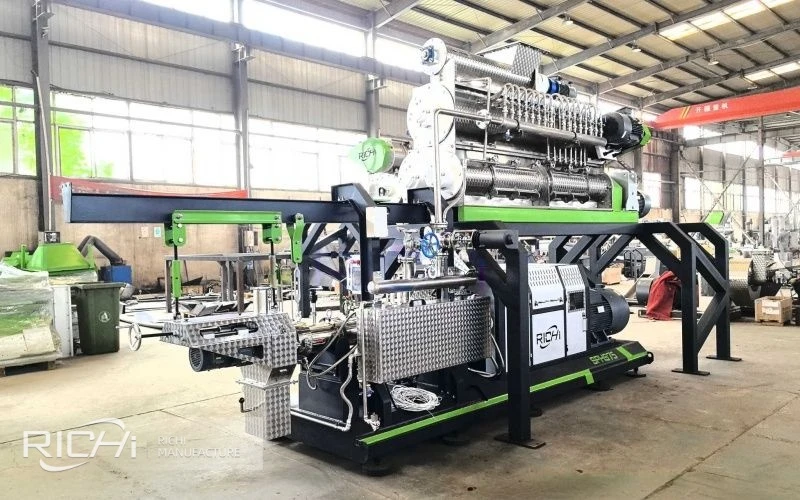
A feed mill in West Java commissioned one RICHI grass carp feed extruder machine in Indonesia to produce floating pellets from rice-bran-based formulations. The customer supplied local fish farms and already operated hammer mills, mixers, a dryer and a bagging section. The purchase covered the extrusion station, allowing the mill to continue using its established preparation and finishing equipment.
The installed machine is an SPHS120×2 twin-screw extruder with a 90 kW main motor and two 120 mm screws. Its product schedule covers 1.5 mm juvenile feed, 3.0 mm fingerling feed and 5.0 mm grow-out feed. Specified throughput runs from 1.3 to 2.0 t/h across these three grades, with the highest duty assigned to the 5.0 mm product.
Name:
Extruder for floating grass carp feed
Country:
Indonesia
Date:
2026
Capacity:
1.3–2 t/h
Model:
SPHS120×2
Power:
90 kW
Screw diameter:
120mm
Pellet diameter:
1.5, 3.0, 5.0mm
The customer's single-screw extruder had struggled to maintain uniform expansion when processing recipes with substantial rice bran inclusion. Increasing wheat flour helped processing but raised the cost of the ingredient mix. The upgrade addressed this constraint at the extrusion stage.
The twin-screw fish feed extruder machine provided conveying, mixing and cooking within one extrusion assembly. Its connection to the existing mixer discharge and dryer inlet was central to the purchase: the mill needed a compatible processing station that fitted the equipment already serving its customers.
| Equipment item | Installed specification |
|---|---|
| Extruder model and quantity | One SPHS120×2 |
| Main motor power | 90 kW |
| Screw diameter | 120 mm per screw |
| Largest scheduled pellet diameter | 5.0 mm |
| Upper specified product duty | 2.0 t/h for the 5.0 mm grade |
The 90 kW figure describes the extruder main drive. Electrical planning also covers feeding, cutting, drying, cooling, conveying and packing loads, together with motor starting requirements.
The customer buys rice bran from rice processors in West Java and fishmeal from a processor in Surabaya. Wheat flour, soybean meal and vegetable oil are the other principal ingredients identified for the grow-out product. Rice bran accounts for 40% of that formulation.
The smaller-fish formulation uses 25% rice bran and 20% fishmeal. This gives the mill a separate ingredient basis for its juvenile feed. Each product therefore has its own formulation and extrusion settings as well as a defined finished diameter.
For twin screw production of herbivorous fish feed, bran quality deserves close attention. Fibre, residual oil, moisture and storage condition influence the material entering the extruder. Ingredient inclusion percentages alone do not establish the finished feed's crude fibre or protein content; those values require the complete formulation and ingredient analyses.
The West Java project has three specified floating-feed grades. The throughput figures below identify each product duty. The engineering schedules in this case apply these rates on a dried-product basis, with grading losses accounted for separately.
| Feed grade | Finished pellet diameter | Specified throughput |
|---|---|---|
| Juvenile grass carp feed | 1.5 mm | 1.3–1.5 t/h |
| Fingerling grass carp feed | 3.0 mm | 1.5–1.8 t/h |
| Grow-out grass carp feed | 5.0 mm | 1.8–2.0 t/h |
These diameters identify the finished products after drying and cooling. Die geometry, expansion and cutting settings work together to deliver those sizes. The 1.5 mm grade requires its own production allowance rather than the hourly output assigned to 5.0 mm feed.
Finished-feed checks cover diameter, length consistency, fines and behaviour in water. A useful flotation record identifies the sample count, water temperature, observation period and number of pellets remaining afloat. Water-stability checks need a stated test method and sampling interval so that results can be compared between batches.
Fine grinding and screening prepare the rice bran and other dry ingredients for cooking. As an engineering preparation reference for the 1.5 mm product, a 0.3 mm check screen separates oversize material for further grinding. Material passing the screen continues into the preparation process.
This screening direction preserves suitable fine mash and limits oversized particles entering the extrusion system. Magnets and intake cleaning address metal and foreign matter before they reach the screws and die.
The extrusion settings then coordinate mash feed, process water or steam, screw operation and cutting. With a bran-rich recipe, stable expansion requires the formulation and cooking conditions to work together. Twin-screw mixing supports that control, while the finished pellets provide the acceptance check.
For this grass carp feed extruder machine in Indonesia, the connection to the existing dryer is an important capacity boundary. Hot, moist extrudate imposes a higher material flow on the dryer than the corresponding weight of dried feed.
An engineering calculation illustrates the difference. At 2,000 kg/h of dried pellets with 9% moisture, the dry-solids flow is 1,820 kg/h. Assuming the hot extrudate enters the dryer at 22% moisture and dry solids are conserved, dryer inlet flow is approximately 2,333 kg/h. The required evaporation is approximately 333 kg of water per hour.
The 22% inlet and 9% outlet moisture values are calculation assumptions for checking dryer duty. Actual load assessment also accounts for the product grade, measured moisture, residence time, airflow and fines handling. The dryer's evaporation capacity and wet-material handling capacity both need to support the extrusion schedule.
A reference calendar of 25 production days with eight net extrusion hours per day gives 200 productive hours per month. Multiplying those hours by each specified product duty gives the following scheduling figures.
| Finished pellet diameter | Hourly product duty | Calculated monthly output |
|---|---|---|
| 1.5 mm | 1.3–1.5 t/h | 260–300 tonnes |
| 3.0 mm | 1.5–1.8 t/h | 300–360 tonnes |
| 5.0 mm | 1.8–2.0 t/h | 360–400 tonnes |
These are engineering scheduling calculations. A 1,000-tonne monthly schedule consisting entirely of 5.0 mm feed requires approximately 500–556 net operating hours. Across 25 production days, that means 20.0–22.2 net hours per day. Product changes, start-up, cleaning and maintenance require additional calendar time.
For mixed orders, the required hours are calculated separately for each grade and then added. Saleable production is reconciled against the weight of dried, graded feed, including the effect of fines and rejected material.
The extruder travelled by sea from Qingdao to Jakarta, followed by inland delivery to the feed mill in West Java. The installation connected the machine to the customer's existing preparation, drying and packing sections.
The interfaces requiring attention included feed transfer from the mixer, process liquid connections, electrical protection, access for die and cutter servicing, and movement of wet extrudate into the dryer. Keeping those interfaces accessible supports daily cleaning and product changes.
Acceptance checks for the connected process cover ingredient preparation, extrusion, drying and finished-feed quality. A product record linking each feed code to its formulation, operating settings and quality results provides a practical basis for repeat production.
The West Java project centres on one 90 kW twin-screw extruder and three defined floating-feed sizes. Its equipment scope matches a customer that already had grinding, mixing, drying and packing capacity. The product-specific output figures also give the mill a clear basis for scheduling juvenile, fingerling and grow-out feed.
To specify a grass carp feed extruder machine in Indonesia for an established mill, send RICHI Machinery the complete formulations, ingredient analyses, required pellet sizes, hourly output and existing dryer data. These details connect machine selection to the feed products and production hours the business needs.
Having the right mix of reliable, high-quality pellet machine and pelletizing systems and expert support is essential to your success. Watch how our end-to-end feed pellet plant solutions have helped our customers optimize their performance.
Our customized and future-proofed turnkey pellet plant solutions is designed with you at the core. From vision to reality and beyond, our team stays connected with yours. Giving you peace-of-mind with an expert at your side.

At RICHI, we go beyond project completion. With RICHI Servicee, we’re your dedicated partners in success. Count on us for expert guidance, minimal downtime, and optimized productivity. Choose RICHI for unmatched service and support.



Meet global product demands and quality standards with industry-leading pellet plant design, engineering, equipment, and construction services for pellet processors.


Your Partner Beyond Project Completion
2000+ cases
RICHI is the leading designer, manufacturer and builder of pellet plants in the world, completing over 2000 projects in 140 countries across 6 continents.
Read More
Increase plant productivity, profitability, and safety by integrating high quality equipment into your pellet production line. Over the years, RICHI has become China's top pellet equipment manufacturer. At the same time, RICHI has established valuable partnerships with the world's leading component and raw material manufacturers to bring you the best there is in technology, automation, and efficiency in pelleting plant machinery.

For nearly 30 years, RICHI has been providing best-in-class pellet plant equipment and services to clients across a variety of industries, sizes, and needs. We pride ourselves on the knowledge and skill that each team member possesses – from our technical sales team to our process design engineers. You can count on RICHI Machinery to take your operation to the next level of innovation, quality, and success.
Need help with your pellet manufacturing plant project? Contact us today.
ANIMAL FEED
BIOMASS
WOOD
ORGANIC FERTILIZER
AQUA FEED
CAT LITTER
MUNICIPAL WASTE RECYCLING
SPECIAL PELLET PRODUCTION
RICHI Machinery continues to deliver world class pellet mill equipment, pellet plant engineering and project solutions that add value to our customers in the animal feed, wood waste, agriculture waste, organic fertilizer, cat litter and special pellet products industries. Throughout the years, we RICHI Machinery have built strong brand, becoming industry-leading pellet machine manufacturer. We value integrity, promise quality, and prioritize your success.
Learn MoreWith our expert team, we precisely implement your process engineering requirements in pellet mill and pelletizing plant systems. No matter which industry you’re in – we understand your needs and deliver solutions that meet the highest standards.
At RICHI, quality comes first. Our pellet making machine and related pellet line equipment undergo rigorous quality controls to ensure they meet the highest standards. Rely on products that are durable, safe, and efficient.
With decades of experience in pellet machine and pellet production line production, we have earned a reputation as a trusted partner in various industries. Our expertise allows us to cover a wide range of applications.
Not only do we offer premium pelleting equipment, but we are also experts at designing, building, installing, and maintaining facilities from the ground up. Our expertise is within pellt plant process design, discovering the most efficient, productive, and profitable way to handle your materials in an end-to-end cycle.
○ RICHI MACHINERY
Keeping in touch with us is an effective way to solve all your problems. If you have any needs or questions, please leave your contact information, then RICHI technical consultants will send design, quotation, videos to your mailbox. You can also contact us directly via WhatsApp: +86 13838389622
Copyright©2015-2026 by HENAN RICHI MACHINERY CO., LTD. All rights reserved.