
A feed mixer machine for multi-ingredient blending process in Bangladesh was selected by an aquafeed producer in the Mymensingh region to replace an older mixer that had become the weak point in its existing fish feed production system. The plant already had grinding, fine-grinding, conveying and extrusion equipment, so the customer did not need another complete feed line.
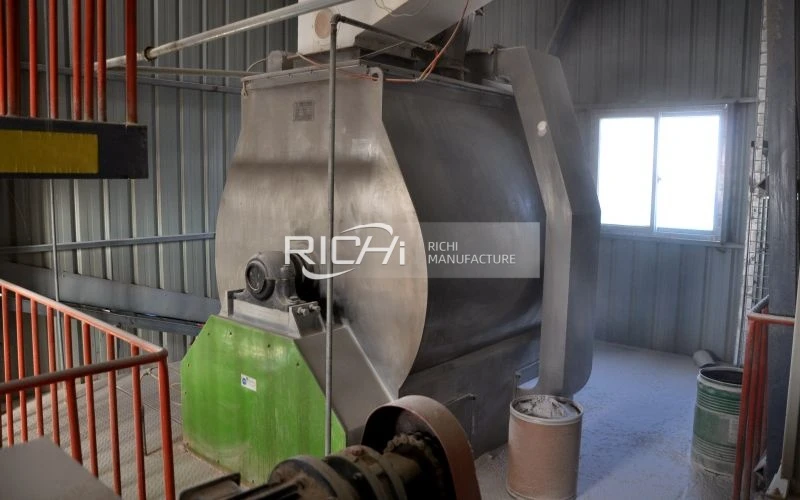
A feed mixer machine for multi-ingredient blending process in Bangladesh was selected by an aquafeed producer in the Mymensingh region to replace an older mixer that had become the weak point in its existing fish feed production line. The plant already had grinding, fine-grinding, conveying and fish feed extruder equipment, so the customer did not need another complete feed line.
The customer purchased one SLHJ1B paddle mixer with a 500 kg batch capacity and an 11 kW motor. Its main role is to blend ground cereals, rice bran, oilseed meals, protein ingredients, premixes and controlled liquid additions into a sufficiently uniform feed mash before the material enters the downstream extrusion process.
Name:
Feed Mixer
Country:
Bangladesh
Date:
2025
Capacity:
500 kg per batch
Model:
SLHJ1B
Main Motor Power:
11 kW
Raw Materials:
Ground cereals, rice bran, oilseed meals
material:
Stainless steel
The customer produces commercial fish feed for farms in northern Bangladesh. Mymensingh is a logical location for this type of project because aquaculture is well established in Bangladesh, and locally relevant feed ingredients include rice bran, mustard oilcake and fishmeal. :contentReference[oaicite:0]{index=0}
The plant's previous vertical mixer could still move bulk material, but the customer was handling increasingly complex formulations with ingredients that differed significantly in particle size, bulk density and inclusion rate.
Ground rice and maize behave differently from light rice bran. Mustard oilcake meal and fishmeal have their own flow characteristics, while vitamin and mineral premixes represent only a very small part of the total batch.
Liquid addition made the process even more demanding.
The customer needed vegetable oil to be distributed through moving feed material rather than accumulating in isolated wet zones. The older mixer was not providing the degree of process control required as formulations became more complex.
This is why the customer focused specifically on a feed mixer machine for multi-ingredient blending process in Bangladesh instead of purchasing another grinder, extruder or complete aquafeed plant.
This was a replacement-machine project.
The existing hammer mill could still prepare cereal ingredients. Fine grinding equipment was available for materials that required smaller particles, and the extruder downstream still matched the customer's current production plan.
The weak stage was mixing.
RICHI therefore recommended replacing only that section instead of asking the customer to discard machinery that remained useful.
One SLHJ1B was matched to the customer's batching rhythm and downstream process. This kept the project focused and limited modifications to the existing workshop.
For a running feed factory, this type of targeted investment can be more useful than purchasing an entirely new line simply because one process stage has become inadequate.
The customer's feed formulas use a combination of locally relevant and commercially sourced ingredients.
Rice bran is especially relevant in Bangladesh because of the country's large rice-processing sector. Mustard oilcake is also widely recognized as a locally available aquafeed ingredient, while fishmeal and other protein materials may be included according to nutritional requirements. FAO sources describing feed use in Bangladesh specifically identify rice bran, oilcakes and fishmeal among commonly used aquaculture feed materials. :contentReference[oaicite:1]{index=1}
The customer's ingredient basket can include ground rice, maize, rice bran, mustard oilcake meal, fishmeal, other appropriate protein meals, vegetable oil, vitamin premix and mineral premix.
RICHI did not design the SLHJ1B around one fixed tilapia or pangasius formula.
Commercial fish feed recipes change according to species, growth stage, protein target, raw material quality and ingredient price. The physical mixing problem, however, remains similar: large-volume dry ingredients, fine powders, micro-ingredients and liquids all need to be distributed throughout the batch as consistently as the product specification requires.
The earlier project description used detailed percentage formulas for tilapia and pangasius feed.
Those ratios should not be presented as universal commercial formulas without confirmed formulation records from the customer.
Two mills can both manufacture tilapia feed while using very different combinations of rice bran, cereals, oilcake, soybean meal, fishmeal and other ingredients.
Ingredient nutrient analysis also changes from supplier to supplier.
For this feed mixer machine for multi-ingredient blending process in Bangladesh project, RICHI therefore focuses on mixer-relevant data such as ingredient number, minimum inclusion rate, bulk density, particle size, liquid percentage and batch size rather than prescribing one permanent nutritional formula.
The SLHJ1B paddle mixer was selected because its batch size matched the customer's medium-scale production rhythm and because the machine could be configured for both dry ingredient blending and controlled liquid addition.
| Project Item | Specification |
|---|---|
| Equipment | Feed paddle mixer |
| Model | SLHJ1B |
| Quantity | 1 unit |
| Motor Power | 11 kW |
| Batch Capacity | Approximately 500 kg per batch |
| Project Configuration | Stainless steel contact surfaces |
| Liquid Addition | Configured for controlled oil spraying |
| Main Materials | Ground cereals, rice bran, oilseed meals, protein ingredients and premixes |
| Application | Multi-ingredient aquafeed blending before extrusion |
The 500 kg batch capacity was selected in relation to the surrounding process rather than because a larger mixer was unavailable.
If the mixer is too small, the extruder repeatedly waits for another batch. If it is too large, mixed material may sit unnecessarily while downstream equipment processes the previous batch.
Matching the production rhythm is therefore part of mixer selection.
The customer needed a machine capable of redistributing ingredients with different physical characteristics throughout the mixing chamber.
A paddle mixer creates active material movement rather than relying only on slow vertical circulation.
This is useful when a formulation contains relatively heavy ground cereals, lighter bran, fine protein ingredients and small quantities of premix.
The objective is not simply to operate the mixer for as many minutes as possible.
Mixing time should be established through the actual formula, filling level, liquid addition and uniformity target. Once sufficient uniformity is achieved, extending the cycle unnecessarily can reduce productivity without providing additional value.
The customer's old mixer had difficulty incorporating liquid ingredients consistently.
Oil should not simply be poured into one location inside the mixer.
The liquid addition system needs to distribute oil over moving material so that one part of the batch does not become excessively wet while another remains comparatively dry.
Spray pattern, flow rate, oil viscosity and the amount being added all affect this process.
The SLHJ1B was therefore considered together with a controlled liquid spraying arrangement rather than treating oil addition as an unrelated accessory.
This is especially important for aquafeed plants because liquid inclusion can vary significantly between products.
The original project stated that some formulas contained 10–12% vegetable oil and suggested that this level defined the mixer requirement.
That may be possible in a particular feed formulation, but it should not be treated as a normal value for every fish feed produced in Bangladesh.
High liquid inclusion can also affect more than mixing.
It can influence extrusion behavior, drying, coating strategy and final pellet characteristics.
RICHI therefore asks customers to provide the actual liquid inclusion range for their products instead of assuming one fixed percentage.
The mixer and spraying system can then be configured around the real requirement.
The original project described exact CV values for the old and new mixers.
Those numbers should only be published when they come from a documented sampling and laboratory test using a defined tracer and sampling protocol.
Simply looking at the feed is not enough to establish coefficient of variation.
For commercial feed production, mixing uniformity can be evaluated through representative samples collected from a batch and tested using a suitable marker.
RICHI can use these results during commissioning to determine whether mixing time or loading sequence needs adjustment.
For this reason, the revised case does not claim a guaranteed CV below 6% without supporting batch-test records.
The previous version gave one precise loading sequence: dry ingredients first, oil at a specific midpoint and premix during the final 30 seconds.
A commercial mixer should not be operated by one universal recipe for every formulation.
The correct sequence depends on ingredient quantity, dosing accuracy, premix carrier, liquid properties and the design of the upstream batching system.
Micro-ingredients need enough mixing time to distribute properly, while liquid spraying needs to occur when sufficient moving dry material is available for effective dispersion.
The production sequence is therefore established during commissioning around the customer's actual ingredients.
The earlier project linked prolonged mixing directly to vitamin destruction through frictional heating and used 40°C as a fixed control point.
That is too specific without supporting test data.
Vitamin stability depends on the vitamin form, exposure time, moisture, temperature and later processes such as conditioning and extrusion.
A normal feed mixer is not typically the main thermal treatment stage in an aquafeed plant.
For this project, the practical concern is accurate dosing and even distribution of the premix before downstream processing.
The customer selected stainless steel contact surfaces to support cleaning and hygiene management in an aquafeed plant handling protein meals, fine powders and liquid ingredients.
The original claim that fishmeal and vegetable oil would automatically corrode carbon steel was too broad.
Material selection depends on sanitation requirements, cleaning procedures, operating environment and customer preference.
For this project, stainless steel provided a practical surface for routine cleaning and handling of formulations containing liquid addition.
The feed mixer machine for multi-ingredient blending process in Bangladesh sits between raw material preparation and extrusion.
Major ingredients are first ground according to the feed specification.
Ingredients requiring finer particles can receive additional size reduction before they enter the batching system.
The required components are then weighed and transferred into the SLHJ1B.
After mixing, the uniform feed mash moves toward the customer's existing extrusion system.
The mixer does not determine whether the final feed floats or sinks.
Those characteristics depend mainly on formulation and extrusion conditions, including starch properties, moisture, temperature, pressure and die design.
The mixer provides the extruder with a consistent feed mixture so that unnecessary batch-to-batch variation is reduced before extrusion begins.
A feed extruder cannot correct poor ingredient distribution created upstream.
If oil, premix or protein ingredients are unevenly distributed before extrusion, different portions of the batch can enter the extruder with different composition.
This can make downstream operation less predictable.
The value of the mixer is therefore not limited to the mixing stage itself.
Consistent batch preparation helps create a more stable material supply for extrusion, drying and subsequent processing.
However, the revised case does not claim that the mixer alone improves fish growth, water stability or feed conversion. Those outcomes depend on the complete formula and production process.
The customer also considered product changeover when selecting the new mixer.
A commercial feed mill may produce several formulas using different ingredient combinations.
Material retained inside the mixer after discharge can carry over into the next batch.
For that reason, discharge design, cleanability and production sequencing need to be considered alongside mixing capacity.
This is more useful than claiming that a second or third mixer is automatically required whenever another feed product is introduced.
If the customer's future product range requires stricter separation, RICHI can evaluate whether dedicated equipment or revised cleaning procedures are appropriate.
Oil spraying equipment requires routine attention.
Nozzles can become less effective if liquid residue is allowed to accumulate during long shutdown periods.
Cleaning frequency depends on oil type, viscosity, production schedule and nozzle configuration.
The customer therefore includes nozzle and liquid-line inspection in its routine maintenance procedure.
The revised project does not prescribe one fixed hot-water flushing routine because the correct cleaning method should follow the actual liquid system and equipment design.
A larger mixer would not automatically increase the capacity of the aquafeed plant.
The existing batching system and extruder need to accept the mixed feed at a compatible rate.
If the customer's extruder operates at a lower hourly capacity than the mixer can supply, installing a much larger batch mixer may create unnecessary waiting time between batches.
The SLHJ1B mixer machine was therefore selected around the current production rhythm rather than future capacity that had not yet been confirmed.
If the plant expands later, RICHI can reassess mixer size based on the new line capacity.
The SLHJ1B was shipped by sea from Qingdao Port in China to Chattogram Port in Bangladesh.
Chattogram is Bangladesh's principal seaport and handles the majority of the country's seaborne trade, making it a logical arrival port for industrial equipment. :contentReference[oaicite:2]{index=2}
Before shipment, RICHI supplied equipment dimensions, electrical information and installation requirements so that the customer could prepare the existing mixer position.
Because this was a retrofit project, inlet height, discharge arrangement, surrounding conveyors and maintenance clearance all needed to be checked before delivery.
The first production period focused on finding suitable operating conditions for the customer's main feed formulations.
Operators evaluated batch loading, mixing time, liquid addition and discharge rather than immediately fixing one setting for every product.
Formulas with more bran or oil behaved differently from those dominated by ground cereals.
The plant also paid attention to whether material accumulated around the liquid spray system or internal contact surfaces.
This allowed the production team to establish a more repeatable mixing procedure around the new machine.
The earlier version stated that the customer had already purchased a second mixer and was planning a third machine for shrimp feed.
Unless those purchases are supported by verified project records, they should not be presented as completed facts.
The same applies to claims of 800 operating hours, almost no paddle wear and specific growth in customer demand.
The revised case keeps the focus on the equipment actually involved in the confirmed project: one SLHJ1B replacing the old mixer.
This project is most relevant to aquafeed mills and other feed producers that already have grinding and pelletizing or extrusion equipment but are experiencing problems with ingredient uniformity or liquid incorporation.
The first question should be whether the mixer is actually the bottleneck.
If grinding particle size is inconsistent or the batching system cannot dose micro-ingredients accurately, replacing the mixer alone may not solve the complete problem.
Likewise, a mixer with excellent theoretical capacity provides little benefit if the downstream extruder cannot process the batches quickly enough.
The SLHJ1B was selected for this Mymensingh project because the customer already had a functioning aquafeed process and needed a more suitable batch mixer for multiple dry ingredients and controlled liquid addition.
Another feed mill may require a different mixer size or configuration.
Before recommending equipment, RICHI Machinery needs to know the feed type, ingredient list, number of ingredients per batch, minimum and maximum inclusion rates, ground particle size, bulk density, liquid type and maximum liquid percentage.
The required batch weight, batches per hour and downstream extruder or pellet mill capacity are also important.
For replacement projects, customers can provide the existing mixer dimensions, inlet and discharge heights, electrical supply and photos of the surrounding workshop.
If mixing uniformity is the main problem, representative batch-test information can also help determine whether mixer design, mixing time, dosing or another part of the process needs attention.
With these details, RICHI Machinery can determine whether the SLHJ1B used in this feed mixer machine for multi-ingredient blending process in Bangladesh project is appropriate, whether a larger or smaller paddle mixer is justified, or whether improvements elsewhere in the batching and processing system should be made first.
The objective is not simply to move eight or ten ingredients around inside a vessel. It is to create a repeatable blending stage that matches the customer's formulas, liquid additions and downstream capacity while preserving the useful equipment already operating in the feed mill.
Having the right mix of reliable, high-quality pellet machine and pelletizing systems and expert support is essential to your success. Watch how our end-to-end feed pellet plant solutions have helped our customers optimize their performance.
Our customized and future-proofed turnkey pellet plant solutions is designed with you at the core. From vision to reality and beyond, our team stays connected with yours. Giving you peace-of-mind with an expert at your side.
At RICHI, we go beyond project completion. With RICHI Servicee, we’re your dedicated partners in success. Count on us for expert guidance, minimal downtime, and optimized productivity. Choose RICHI for unmatched service and support.


Meet global product demands and quality standards with industry-leading pellet plant design, engineering, equipment, and construction services for pellet processors.


Your Partner Beyond Project Completion
2000+ cases
RICHI is the leading designer, manufacturer and builder of pellet plants in the world, completing over 2000 projects in 140 countries across 6 continents.
Read More
Increase plant productivity, profitability, and safety by integrating high quality equipment into your pellet production line. Over the years, RICHI has become China's top pellet equipment manufacturer. At the same time, RICHI has established valuable partnerships with the world's leading component and raw material manufacturers to bring you the best there is in technology, automation, and efficiency in pelleting plant machinery.

For nearly 30 years, RICHI has been providing best-in-class pellet plant equipment and services to clients across a variety of industries, sizes, and needs. We pride ourselves on the knowledge and skill that each team member possesses – from our technical sales team to our process design engineers. You can count on RICHI Machinery to take your operation to the next level of innovation, quality, and success.
Need help with your pellet manufacturing plant project? Contact us today.
ANIMAL FEED
BIOMASS
WOOD
ORGANIC FERTILIZER
AQUA FEED
CAT LITTER
MUNICIPAL WASTE RECYCLING
SPECIAL PELLET PRODUCTION
RICHI Machinery continues to deliver world class pellet mill equipment, pellet plant engineering and project solutions that add value to our customers in the animal feed, wood waste, agriculture waste, organic fertilizer, cat litter and special pellet products industries. Throughout the years, we RICHI Machinery have built strong brand, becoming industry-leading pellet machine manufacturer. We value integrity, promise quality, and prioritize your success.
Learn MoreWith our expert team, we precisely implement your process engineering requirements in pellet mill and pelletizing plant systems. No matter which industry you’re in – we understand your needs and deliver solutions that meet the highest standards.
At RICHI, quality comes first. Our pellet making machine and related pellet line equipment undergo rigorous quality controls to ensure they meet the highest standards. Rely on products that are durable, safe, and efficient.
With decades of experience in pellet machine and pellet production line production, we have earned a reputation as a trusted partner in various industries. Our expertise allows us to cover a wide range of applications.
Not only do we offer premium pelleting equipment, but we are also experts at designing, building, installing, and maintaining facilities from the ground up. Our expertise is within pellt plant process design, discovering the most efficient, productive, and profitable way to handle your materials in an end-to-end cycle.
○ RICHI MACHINERY
Keeping in touch with us is an effective way to solve all your problems. If you have any needs or questions, please leave your contact information, then RICHI technical consultants will send design, quotation, videos to your mailbox. You can also contact us directly via WhatsApp: +86 13838389622
Copyright©2015-2026 by HENAN RICHI MACHINERY CO., LTD. All rights reserved.